This comprehensive analysis examines whether LightLink (LL), an Ethereum Layer 2 blockchain solution, represents a viable investment opportunity. The article covers LL's historical price performance, showing a 98.6% decline from its $0.3 launch price in April 2024 to $0.004132 as of February 2026, reflecting significant volatility in this early-stage project. Core investment factors include tokenomics, enterprise adoption in the APAC region, and Layer 2 ecosystem maturity. Price forecasts range from conservative estimates of $0.0034279-$0.004628 (2026) to optimistic long-term projections reaching $0.013239955982787 by 2031. The analysis details investment strategies for different risk profiles, emphasizing position sizing (1-20% allocation), risk management through diversification, and secure storage practices on Gate exchange and hardware wallets. Critical risks include high volatility, limited liquidity with only 2 exchange listings, regulatory uncertainty, and intense Layer 2 competition, making LL suitabl
Introduction: LightLink (LL) Investment Position and Market Outlook
LightLink (LL) is an Ethereum Layer 2 blockchain asset that has been developing blockchain solutions for major enterprises in the APAC region since 2017. As of February 2, 2026, LL maintains a market capitalization of approximately $1.73 million, with a circulating supply of around 417.88 million tokens, and a current price of approximately $0.004132. The token is deployed on the Ethereum blockchain as an ERC20 token. With its focus on providing instant, gasless transactions for dApps and enterprise users, LL has positioned itself in the Layer 2 scaling solutions sector. This article provides a comprehensive analysis of LL's investment characteristics, historical price movements, future price outlook, and associated investment risks for reference purposes.
I. LightLink (LL) Historical Price Review and Current Investment Value
LightLink (LL) was launched in April 2024 with a publish price of $0.3. Since its introduction to the market, the token has experienced considerable volatility. Following its initial listing, LL reached a peak of $0.3 on April 24, 2024, representing its highest valuation during the observation period.
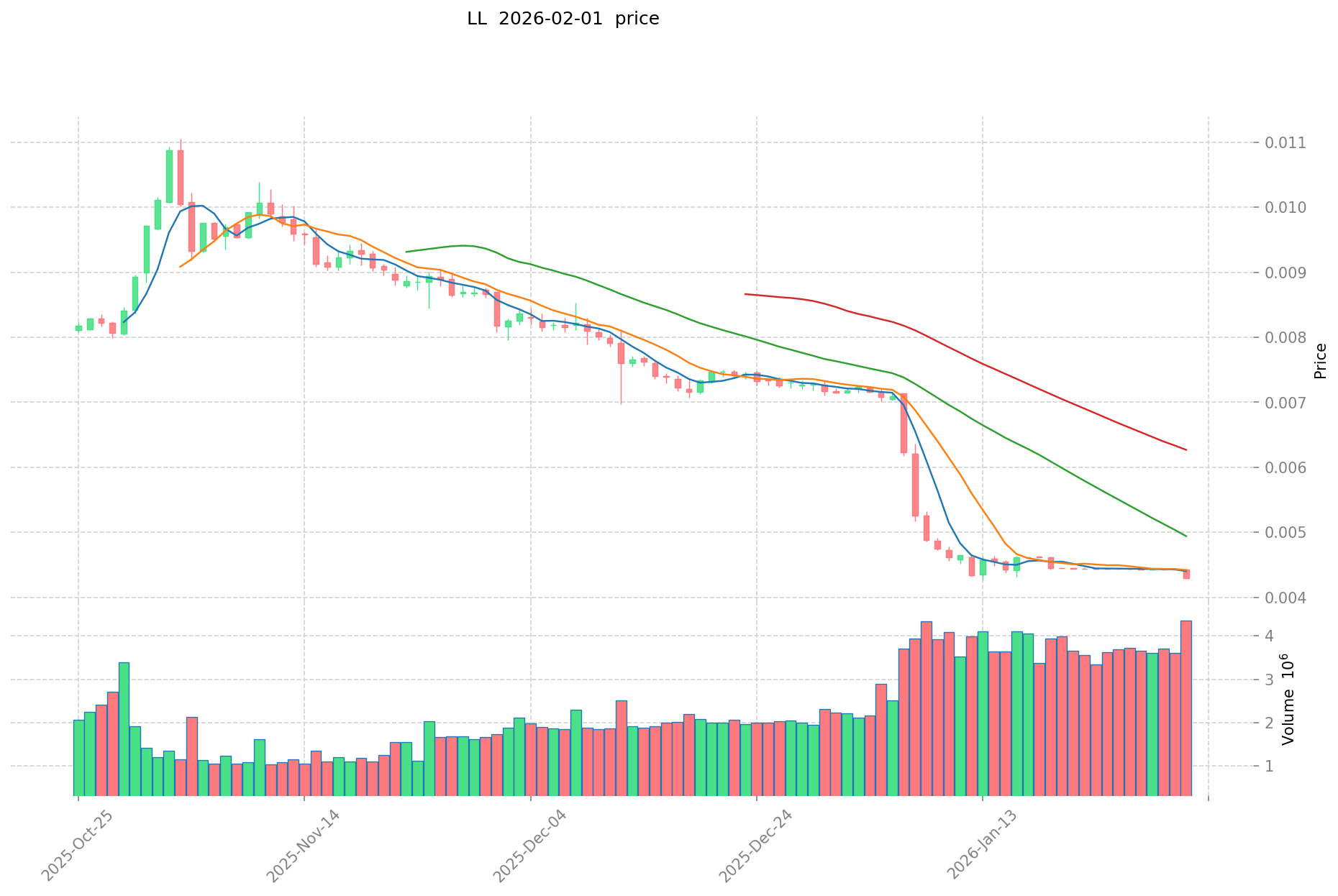
Throughout 2024 and into early 2026, LL underwent substantial price corrections. As of February 2, 2026, the token is trading at $0.004132, reflecting a decline of approximately 98.6% from its initial listing price. The most recent low point was recorded at $0.004131 on February 1, 2026.
The token's performance over different timeframes demonstrates ongoing downward pressure. Over the past year, LL has declined by approximately 85.18%, while the 30-day performance shows a decrease of around 42.86%. Short-term movements indicate a 6.92% decline over seven days and a 6.51% decrease in the most recent 24-hour period.
Current LL Investment Market Status (February 2026)
- Current LL Price: $0.004132
- Market Sentiment: The market emotion indicator stands at 1, suggesting subdued sentiment toward the asset
- 24-Hour Trading Volume: $21,408.19
- Market Capitalization: Circulating market cap stands at approximately $1.73 million, while the fully diluted market capitalization is estimated at $4.13 million
- Circulating Supply: 417,882,774.68 LL tokens (representing 41.79% of the total supply)
- Price Range (24h): The token has traded between $0.004131 and $0.004421
- Holder Count: 4,937 addresses currently hold LL tokens
- Exchange Availability: LL is listed on 2 exchanges
Click to view real-time LL market price
II. Core Factors Influencing Whether LL is a Good Investment
Supply Mechanism and Scarcity (LL Investment Scarcity)
- Total Supply and Circulation: LightLink has a maximum supply of 1,000,000,000 LL tokens, with a current circulating supply of approximately 417,882,775 LL, representing 41.79% of the total supply. The relatively limited circulating supply may contribute to scarcity dynamics that could influence price movements.
- Supply Structure Impact: The fixed maximum supply creates a predictable supply ceiling, which may affect long-term investment considerations. The circulating supply ratio indicates that a significant portion of tokens remains unvested or held, potentially impacting future market dynamics.
- Investment Consideration: The token's supply characteristics form part of the fundamental framework for evaluating its scarcity profile, though supply alone does not determine investment outcomes.
Institutional Investment and Mainstream Adoption (Institutional Investment in LL)
- Market Position: As of February 2, 2026, LightLink holds a market ranking of 2136 with a market capitalization of approximately $1.73 million and a market dominance of 0.00015%, indicating a relatively smaller market presence compared to major cryptocurrencies.
- Enterprise Focus: LightLink has been developing blockchain solutions for enterprises in the APAC region since 2017, focusing on bridging dApps with enterprise partners to foster an interconnected economy.
- Holder Base: The token currently has 4,937 holders, reflecting a limited but established user base.
Macroeconomic Environment's Impact on LL Investment
- Market Volatility Context: The broader cryptocurrency market environment, including monetary policy shifts and macroeconomic conditions, may influence investor sentiment toward smaller-cap tokens like LL.
- Risk Assessment: Market indicators and technical analyses suggest varied forecasts for 2026, with some projections indicating bearish trends and price predictions ranging from $0.004381 to $0.1178, reflecting significant uncertainty in the investment outlook.
Technology and Ecosystem Development (Technology & Ecosystem for LL Investment)
- Layer 2 Solution: LightLink operates as an Ethereum Layer 2 blockchain designed to offer instant, gasless transactions for dApp users and enterprises, addressing scalability and cost challenges on the Ethereum network.
- Technical Infrastructure: Built on a proprietary stack, the platform aims to enhance interoperability and connect dApps with enterprise user bases, potentially supporting ecosystem expansion.
- Ecosystem Applications: The focus on enterprise solutions and gasless transactions positions LightLink within the broader Layer 2 and enterprise blockchain adoption trends, though the extent of current adoption and application integration requires further market observation.
III. LL Future Investment Forecast and Price Outlook (Is LightLink(LL) worth investing in 2026-2030)
Short-term Investment Forecast (2026, short-term LL investment outlook)
- Conservative forecast: $0.0034279 - $0.004628
- Neutral forecast: $0.00413 - $0.004628
- Optimistic forecast: $0.0058646 - $0.0089
Mid-term Investment Outlook (2027-2028, mid-term LightLink(LL) investment forecast)
- Market stage expectation: The mid-term period may witness gradual stabilization as the Layer 2 ecosystem matures and broader interoperability adoption increases.
- Investment return forecast:
- 2027: $0.003398164 - $0.006646409
- 2028: $0.005414324685 - $0.007277318125
- Key catalysts: Enterprise partnership expansion, increased dApp integration, and overall Layer 2 adoption trends.
Long-term Investment Outlook (Is LightLink a good long-term investment?)
- Base scenario: $0.005174173186875 - $0.008055991164375 (assuming steady application growth and moderate market recovery)
- Optimistic scenario: $0.008945916204585 - $0.013239955982787 (assuming accelerated enterprise adoption and favorable market conditions)
- Risk scenario: Below $0.004131 (under adverse market conditions or prolonged bear market)
Click to view LL long-term investment and price forecast: Price Prediction
2026-02-02 - 2031 Long-term Outlook
- Base scenario: $0.005174173186875 - $0.008055991164375 (corresponding to steady progress and gradual mainstream application enhancement)
- Optimistic scenario: $0.008945916204585 - $0.013239955982787 (corresponding to large-scale adoption and favorable market environment)
- Transformative scenario: Above $0.013239955982787 (if the ecosystem achieves breakthrough development and mainstream popularization)
- 2031-12-31 projected high: $0.013239955982787 (based on optimistic development assumptions)
Disclaimer: The above forecasts are for informational purposes only and do not constitute investment advice. Cryptocurrency markets are highly volatile and subject to various risks. Investors should conduct thorough research and consider their own risk tolerance before making any investment decisions.
| Year |
Predicted High Price |
Predicted Average Price |
Predicted Low Price |
Price Change |
| 2026 |
0.0058646 |
0.00413 |
0.0034279 |
0 |
| 2027 |
0.006646409 |
0.0049973 |
0.003398164 |
20 |
| 2028 |
0.007277318125 |
0.0058218545 |
0.005414324685 |
40 |
| 2029 |
0.008055991164375 |
0.0065495863125 |
0.005174173186875 |
58 |
| 2030 |
0.010589043670734 |
0.007302788738437 |
0.005915258878134 |
76 |
| 2031 |
0.013239955982787 |
0.008945916204585 |
0.00581484553298 |
116 |
IV. LightLink (LL) Investment Strategy and Risk Management (How to invest in Layer 2 blockchain tokens)
Investment Methodology (LightLink investment strategy)
Long-term Holding (HODL LL)
Long-term holding may appeal to conservative investors who believe in the fundamental value proposition of Ethereum Layer 2 scaling solutions. This approach focuses on the potential growth of LightLink's ecosystem and its enterprise adoption strategy. Investors adopting this strategy typically:
- Monitor project development milestones and enterprise partnership announcements
- Evaluate the expansion of the dApp ecosystem built on LightLink
- Assess the adoption rate of gasless transaction features among users
- Track the growth in holder numbers and network activity over extended periods
Active Trading
Active trading strategies rely on technical analysis and market timing. Given LL's price volatility, traders may:
- Utilize technical indicators to identify entry and exit points
- Monitor 24-hour trading volumes and price movements across different timeframes
- Apply swing trading techniques during periods of heightened volatility
- Set stop-loss orders to manage downside risk in volatile market conditions
Risk Management (Risk management for LL investment)
Asset Allocation Ratios
Conservative Investors: May consider allocating 1-3% of their crypto portfolio to Layer 2 tokens like LL, focusing primarily on established assets with lower volatility profiles.
Moderate Investors: Could allocate 5-10% to emerging Layer 2 solutions, balancing potential growth opportunities with established digital assets.
Aggressive Investors: Might allocate 15-20% or more to higher-risk, higher-potential tokens in the Layer 2 space, accepting greater volatility for potential returns.
Risk Hedging Solutions
- Multi-asset Portfolio: Diversifying across different blockchain layers, use cases, and market capitalizations can help mitigate concentration risk
- Hedging Instruments: Utilizing stablecoins as a safe haven during market downturns
- Position Sizing: Limiting exposure to any single asset based on personal risk tolerance
- Dollar-Cost Averaging: Spreading purchases over time to reduce timing risk
Secure Storage
Cold Wallets: For long-term holdings, hardware wallets such as Ledger or Trezor offer enhanced security by keeping private keys offline.
Hot Wallets: For active trading or frequent transactions, reputable software wallets with strong security features may be appropriate, though they carry higher risk than cold storage solutions.
Best Practices:
- Never share private keys or seed phrases
- Enable two-factor authentication on all accounts
- Verify contract addresses before transactions (LL contract: 0x0921799cb1d702148131024d18fcde022129dc73 on Ethereum)
- Keep backup copies of recovery phrases in secure physical locations
V. LightLink (LL) Investment Risks and Challenges (Risks of investing in Layer 2 blockchain tokens)
Market Risk
High Volatility: LL has demonstrated significant price fluctuations, with 24-hour changes reaching -6.51% and 30-day changes of -42.86%. The all-time high of $0.3 recorded on April 24, 2024, contrasts sharply with the all-time low of $0.004131 on February 1, 2026, illustrating the substantial volatility range.
Price Manipulation: With a relatively low 24-hour trading volume of $21,408.19 and listing on only 2 exchanges, the token may be susceptible to price manipulation by large holders or coordinated trading activities.
Liquidity Concerns: Limited exchange availability may result in wider bid-ask spreads and difficulty executing large orders without significant price impact.
Regulatory Risk
Jurisdictional Uncertainty: Different countries maintain varying approaches to cryptocurrency regulation, particularly regarding Layer 2 solutions and their classification.
Compliance Requirements: Evolving regulatory frameworks may impose new compliance obligations on blockchain projects, potentially affecting LightLink's operations or token utility.
Enterprise Partnership Implications: As LightLink focuses on enterprise adoption, regulatory changes affecting corporate blockchain use could impact the project's growth trajectory.
Technical Risk
Network Security: As with any blockchain infrastructure, vulnerabilities in smart contracts or the underlying protocol could lead to exploits or loss of funds.
Upgrade Failures: Technical upgrades to the Layer 2 infrastructure carry implementation risks that could temporarily affect network functionality.
Dependency on Ethereum: As an Ethereum Layer 2 solution, LightLink's performance and security are partially dependent on the base layer Ethereum network.
Competition: The Layer 2 space features numerous competing solutions, and LightLink must continuously innovate to maintain relevance and attract users.
VI. Conclusion: Is Layer 2 blockchain token a Good Investment?
Investment Value Summary
LightLink (LL) represents an emerging Layer 2 scaling solution focused on providing gasless transactions for dApps and enterprise users. The project's emphasis on enterprise partnerships in the APAC region and its proprietary technology stack differentiate it within the competitive Layer 2 landscape.
However, the token has experienced significant price depreciation, declining approximately 85.18% over the past year. The current market capitalization of $1.73 million and circulating supply representing 41.79% of the total supply indicate a relatively early-stage project with both growth potential and substantial risk.
The low number of holders (4,937) and limited exchange availability suggest that LL remains in an early adoption phase, which contributes to both its volatility profile and potential for growth if the project successfully executes its roadmap.
Investor Recommendations
✅ Beginners: Consider dollar-cost averaging with small position sizes, prioritize secure wallet storage, and conduct thorough research on Layer 2 technology before investing. Only allocate funds you can afford to lose completely.
✅ Experienced Investors: May explore swing trading opportunities during volatility periods, maintain portfolio diversification across multiple blockchain sectors, and monitor project development milestones and enterprise adoption metrics.
✅ Institutional Investors: Could evaluate strategic long-term positioning in emerging Layer 2 infrastructure, assess partnership developments with enterprise clients, and apply rigorous due diligence on technical architecture and team execution capabilities.
⚠️ Disclaimer: Cryptocurrency investments carry substantial risk, including the potential for total loss of capital. Market conditions can change rapidly, and past performance does not indicate future results. This content is for informational purposes only and does not constitute investment advice. Always conduct your own research and consider consulting with qualified financial advisors before making investment decisions.
VII. FAQ
Q1: What is LightLink (LL) and what makes it different from other Layer 2 solutions?
LightLink is an Ethereum Layer 2 blockchain that provides instant, gasless transactions for dApps and enterprise users. Unlike many Layer 2 solutions, LightLink has been specifically developing blockchain solutions for major enterprises in the APAC region since 2017, positioning itself uniquely in the enterprise adoption space. The platform is built on a proprietary technology stack that focuses on bridging dApps with enterprise partners to create an interconnected economy. Its key differentiator is the gasless transaction feature, which removes a significant barrier to mainstream adoption by eliminating transaction fees for users.
Q2: Why has LL's price declined so dramatically since its launch?
The price has decreased approximately 98.6% from its initial listing price of $0.3 in April 2024 to $0.004132 as of February 2, 2026. This decline reflects several factors: the token's early-stage market presence with limited liquidity (only 2 exchange listings), low trading volume ($21,408.19 in 24 hours), and the broader challenging market conditions for smaller-cap cryptocurrencies. Additionally, the project has only 4,937 holders, indicating limited adoption so far. The circulating supply represents just 41.79% of the total supply, suggesting potential future dilution concerns that may weigh on investor sentiment.
Q3: Is LightLink a good long-term investment for 2026-2030?
The investment potential depends heavily on risk tolerance. Conservative forecasts project prices ranging from $0.0034279 to $0.008055991164375 through 2029, while optimistic scenarios suggest potential growth to $0.013239955982787 by 2031, representing approximately a 220% increase from current levels. However, these projections assume successful enterprise adoption, ecosystem expansion, and favorable market conditions. Given the substantial historical volatility, limited liquidity, and early-stage development, LL carries significant risk. Conservative investors might limit exposure to 1-3% of their crypto portfolio, while only aggressive investors comfortable with potential total loss should consider larger allocations.
Q4: What are the main risks associated with investing in LL?
The primary risks include: (1) Liquidity risk – with only 2 exchange listings and $21,408 daily volume, executing large orders may significantly impact price; (2) Volatility risk – demonstrated by the 98.6% decline from all-time high and -42.86% monthly performance; (3) Market manipulation risk – the low market cap ($1.73 million) makes the token susceptible to price manipulation by large holders; (4) Adoption risk – the project's success depends on achieving significant enterprise partnerships and dApp integration; (5) Competition risk – numerous established Layer 2 solutions compete in the same space; and (6) Dependency risk – as an Ethereum Layer 2, its performance partially relies on the base Ethereum network.
Q5: How should I store LL tokens securely?
For long-term holdings, cold storage solutions like hardware wallets (Ledger or Trezor) are recommended to keep private keys offline and minimize security risks. For active trading, reputable software wallets with strong security features may be used, though they carry higher risk. Always verify the LL contract address (0x0921799cb1d702148131024d18fcde022129dc73 on Ethereum) before transactions, enable two-factor authentication on all accounts, never share private keys or seed phrases, and maintain secure physical backups of recovery phrases in multiple locations. Given the limited exchange availability, ensure you're using reputable platforms that support LL.
Q6: What price movements can be expected in the short term (2026)?
According to technical analysis and market forecasts for 2026, predictions vary significantly: conservative estimates suggest a range of $0.0034279 to $0.004628, while optimistic scenarios project potential highs of $0.0089. The current market sentiment indicator stands at 1, suggesting subdued sentiment. Recent performance shows a -6.92% decline over seven days and -6.51% over 24 hours. Given the current market capitalization of $1.73 million and limited trading activity, short-term price movements are likely to remain volatile and heavily influenced by broader market conditions, project announcements, and enterprise partnership developments.
Q7: What investment strategy is most appropriate for LL?
The appropriate strategy depends on investor profile: Conservative investors should consider dollar-cost averaging with minimal allocation (1-3% of crypto portfolio), focusing on long-term holding while monitoring enterprise adoption metrics. Moderate investors might allocate 5-10% with a balanced approach combining holding and selective trading during volatility. Aggressive investors comfortable with high risk could allocate 15-20% and employ active trading strategies using technical indicators to capitalize on price swings. Regardless of strategy, implementing strict risk management including stop-loss orders, diversification across multiple assets, and secure storage practices is essential. Only invest amounts you can afford to lose completely given the high-risk nature of this early-stage project.
Q8: How does LL's tokenomics affect its investment potential?
LL has a maximum supply of 1 billion tokens with a current circulating supply of approximately 417.88 million (41.79% of total supply). This supply structure presents both opportunities and challenges: the fixed maximum supply creates scarcity dynamics that could support price appreciation if demand increases. However, the significant portion of unvested tokens (58.21%) represents potential future selling pressure as these tokens enter circulation. With only 4,937 holders and a market dominance of 0.00015%, the token has substantial room for adoption growth, but this also indicates higher risk compared to established cryptocurrencies. The supply release schedule and vesting terms of the remaining tokens are critical factors that investors should monitor when evaluating long-term investment potential.
* The information is not intended to be and does not constitute financial advice or any other recommendation of any sort offered or endorsed by Gate.