Linea (LINEA) is an Ethereum Layer 2 scaling solution developed by ConsenSys, featuring zkEVM-equivalent architecture and trading at $0.006497 as of January 2026. The token functions as an economic coordination tool with a distinctive dual-burn mechanism that reduces both ETH and LINEA supply as network activity increases. This article comprehensively analyzes LINEA's investment characteristics across multiple dimensions: historical price performance showing 79.68% annual decline, current market metrics with $100.59M capitalization, core factors including supply mechanics and institutional backing, price scenarios ranging from $0.00598 to $0.07875 in 2026, and long-term outlook through 2031. Investment strategies address conservative, moderate, and aggressive investor profiles with appropriate asset allocations and risk management approaches. Significant risks including market volatility, regulatory uncertainty, technical vulnerabilities, and competitive pressures require careful evaluation. The analysis conc
Introduction: Linea (LINEA) Investment Position and Market Prospects
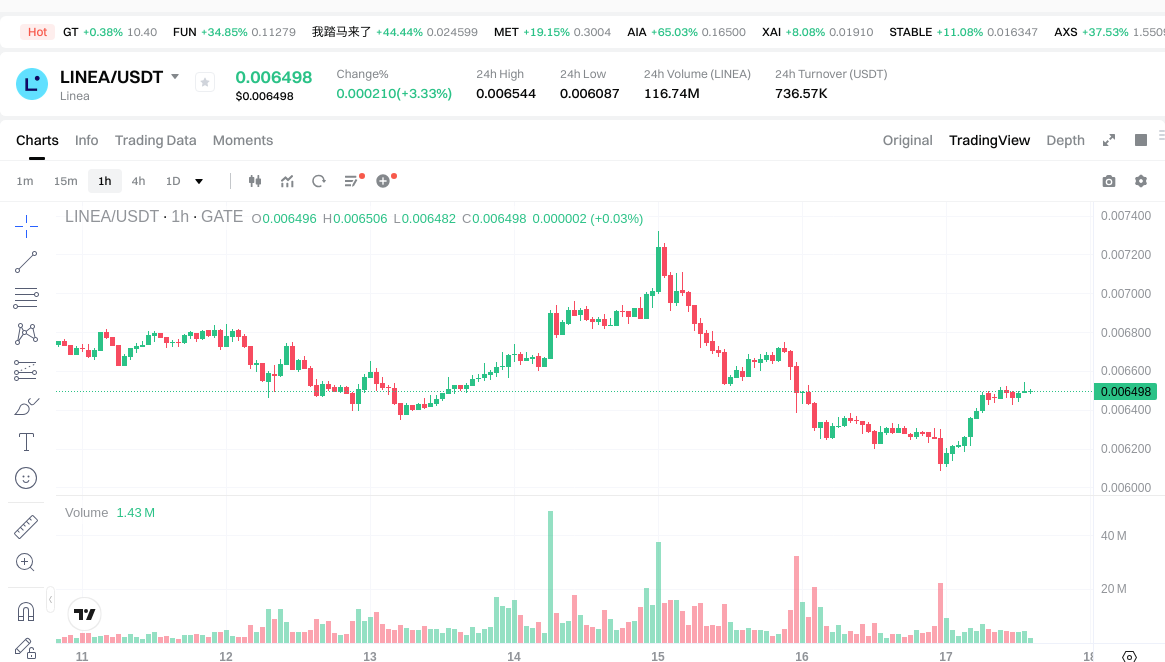
Linea (LINEA) represents a significant asset in the cryptocurrency sector as a next-generation Ethereum Layer 2 network. As of January 17, 2026, LINEA maintains a market capitalization of approximately $100.59 million with a circulating supply of 15.48 billion tokens, trading at around $0.006497. The network utilizes a zkEVM-equivalent architecture, offering full compatibility with Ethereum smart contracts and tools while exclusively using ETH as gas.
The LINEA token functions as an economic coordination tool rather than a governance or gas token, designed to reward network participants, support ecosystem development, and contribute to Ethereum public goods. With a total supply of 72.01 billion tokens and a circulation ratio of 21.5%, the token demonstrates a structured supply mechanism. The project has attracted over 392,000 holders and is listed on 34 exchanges, indicating growing market participation.
Recent price performance shows mixed signals: a 3.36% increase over 24 hours and 3.33% gain over 30 days, contrasted with a 2.68% decline over 7 days and a significant year-over-year decrease. These fluctuations reflect the dynamic nature of Layer 2 network tokens in the current market environment. The project's unique dual-burn mechanism, which reduces both ETH and LINEA supply as network activity increases, presents an approach to token economics within the Ethereum scaling ecosystem.
This article examines LINEA's investment characteristics, historical price movements, future price considerations, and associated risks to provide relevant information for those evaluating cryptocurrency investments in the Layer 2 sector.
I. Linea (LINEA) Price History Review and Investment Value Status
- 2025: Token Generation Event (TGE) → LINEA launched in January 2025, subsequently experiencing notable price volatility
- 2025: Market Performance → Price fluctuated from approximately $0.048 to $0.00575 during the year
- 2026: Current Trading Phase → Price level around $0.0065 as of January 2026
Current LINEA Investment Market Status (January 2026)
- LINEA current price: $0.006497
- 24-hour trading volume: $735,112.07
- Market capitalization: $100.59 million
- Circulating supply: 15.48 billion LINEA (21.5% of total supply)
- Price change (24h): +3.36%
- Price change (7d): -2.68%
- Price change (30d): +3.33%
- Price change (1y): -79.68%
Click to view real-time LINEA market price
II. Core Factors Affecting Whether LINEA Is a Good Investment (Is Linea(LINEA) a Good Investment)
Supply Mechanism and Scarcity (LINEA investment scarcity)
- Dual burn mechanism → impacts price and investment value
- Network activity pattern: As of November 4, 2025, every transaction on the Linea network burns both ETH and LINEA at a ratio of 20% in ETH and 80% in LINEA. This mechanism directly connects network activity with token scarcity by reducing total supply over time.
- Investment significance: The deflationary model embeds sustainable yield into operations and positions LINEA as fundamentally aligned with long-term token economics. The dual burn system makes Linea a continuous buyer of its own token while contributing to Ethereum's deflationary supply model.
Institutional Investment and Mainstream Adoption (Institutional investment in LINEA)
- Institutional backing trend: Linea is developed by ConsenSys, a blockchain technology company that has raised over $725M in funding and is also behind MetaMask and Infura.
- Enterprise adoption impact: ConsenSys' reputation and established products provide infrastructure support that may enhance LINEA's investment credibility.
- Ecosystem approach: 85% of total supply is allocated to ecosystem growth and rewards rather than insider or VC allocations, indicating a focus on long-term ecosystem development.
Macroeconomic Environment's Impact on LINEA Investment
- Layer-2 market positioning: As an Ethereum Layer-2 scaling solution, LINEA's investment value is tied to broader Ethereum adoption and the demand for scalable blockchain infrastructure.
- Network utility context: LINEA operates in an environment where Layer-2 solutions address Ethereum's scalability challenges, potentially benefiting from increased DeFi and blockchain application demand.
- Competitive landscape: Performance depends on differentiation within a crowded Layer-2 landscape and sustained user adoption.
Technology and Ecosystem Development (Technology & Ecosystem for LINEA investment)
- zkEVM technology upgrade: Full EVM equivalence architecture enables seamless developer migration and compatibility with Ethereum smart contracts and tools, potentially attracting ecosystem participants.
- Roadmap milestones: Linea's roadmap targets 0.5 gGas/s throughput (approximately 5,000 TPS) by Q4 2025 and Ethereum equivalence by Q1 2026, which may enhance network performance and investment attractiveness.
- Ecosystem expansion initiatives: Linea is pairing its burn model with developments aimed at improving liquidity and institutional adoption. The token's utility centers on incentivizing ecosystem participants via grants, rewards, and public goods funding, supporting long-term value proposition.
- Application scope: As a Layer-2 solution, LINEA's value is supported by its role in scaling Ethereum for DeFi, NFT, and payment applications while using ETH exclusively as gas.
III. LINEA Future Investment Forecast and Price Outlook (Is Linea(LINEA) worth investing in 2026-2031)
Short-term Investment Forecast (2026, short-term LINEA investment outlook)
Based on available market projections, Linea (LINEA) may experience varied price movements in 2026:
- Conservative forecast: $0.00598 - $0.00776
- Neutral forecast: $0.00650 - $0.00903
- Optimistic forecast: $0.00776 - $0.07875
Some community analyses suggest that if broader market conditions remain favorable, LINEA could potentially test higher ranges during peak months. However, price action will likely depend on network activity growth, Total Value Locked (TVL) developments, and overall Layer 2 sector performance.
Mid-term Investment Outlook (2027-2028, mid-term Linea(LINEA) investment forecast)
-
Market Phase Expectation: Linea may enter a consolidation and ecosystem expansion phase during this period, with potential for increased adoption as the zkEVM infrastructure matures.
-
Investment Return Forecast:
- 2027: $0.00575 - $0.00862, with an average trading price around $0.00777
- 2028: $0.00696 - $0.01049, with an average trading price around $0.00819
-
Key Catalysts: Network activity expansion, strategic partnerships within the Ethereum ecosystem, developments in the dual-burn mechanism implementation, and broader Layer 2 adoption trends.
Long-term Investment Outlook (Is Linea a good long-term investment?)
- Base Scenario: $0.00616 - $0.01064 (assuming steady ecosystem growth and maintained network utility)
- Optimistic Scenario: $0.00904 - $0.01330 (assuming accelerated adoption, favorable regulatory environment, and successful ecosystem scaling)
- Risk Scenario: Below $0.00575 (under conditions of intensified Layer 2 competition, reduced network activity, or adverse market conditions)
For detailed LINEA long-term investment and price predictions, visit: Price Prediction
2026-2031 Long-term Outlook
- Base Scenario: $0.00598 - $0.00999 (corresponding to steady progress and gradual mainstream application growth)
- Optimistic Scenario: $0.00904 - $0.01330 (corresponding to large-scale adoption and favorable market environment)
- Transformative Scenario: Above $0.01330 (in case of breakthrough ecosystem developments and mainstream adoption)
- Predicted High Point by 2031-12-31: $0.01330 (based on optimistic development assumptions)
Disclaimer: Price predictions are based on historical data analysis, current market trends, and technical projections. Cryptocurrency markets are highly volatile and unpredictable. These forecasts should not be considered as investment advice. Past performance does not guarantee future results. Investors should conduct their own research and consult with financial professionals before making investment decisions.
| Year |
Predicted High Price |
Predicted Average Price |
Predicted Low Price |
Price Change |
| 2026 |
0.00903222 |
0.006498 |
0.00597816 |
0 |
| 2027 |
0.0086192721 |
0.00776511 |
0.0057461814 |
19 |
| 2028 |
0.010486004544 |
0.00819219105 |
0.0069633623925 |
26 |
| 2029 |
0.01064657148858 |
0.009339097797 |
0.00616380454602 |
43 |
| 2030 |
0.010792261414213 |
0.00999283464279 |
0.006095629132101 |
53 |
| 2031 |
0.013302461476482 |
0.010392548028501 |
0.009041516784796 |
59 |
IV. Linea Investment Strategy and Risk Management (How to invest in Layer 2 Networks)
Investment Methodology (Linea investment strategy)
Long-term Holding (HODL Linea)
For conservative investors seeking exposure to Ethereum Layer 2 scaling solutions, a long-term holding strategy may be appropriate. This approach involves acquiring LINEA tokens and maintaining positions through market cycles, focusing on the fundamental value proposition of the network's zkEVM architecture and its role in Ethereum ecosystem development. Investors adopting this strategy typically prioritize the project's technological advancement and ecosystem growth over short-term price movements.
Active Trading
Active traders may engage with LINEA through technical analysis and swing trading strategies. Given the token's 24-hour volatility of 3.36% and recent price range between $0.006087 and $0.006544, short-term traders can identify potential entry and exit points based on chart patterns, volume indicators, and momentum signals. This approach requires continuous market monitoring and understanding of both crypto-specific and broader market dynamics.
Risk Management (Risk management for Linea investment)
Asset Allocation Ratios
- Conservative Investors: May consider allocating 1-3% of their crypto portfolio to LINEA, maintaining majority positions in established assets like Bitcoin and Ethereum
- Moderate Investors: Could allocate 3-7% to Layer 2 solutions including LINEA, balancing growth potential with portfolio stability
- Aggressive Investors: Might dedicate 7-15% to emerging Layer 2 networks, accepting higher volatility for potential upside
Risk Hedging Approaches
Diversification across multiple asset classes remains fundamental to risk management. Investors can consider:
- Building a portfolio combining established Layer 1 protocols, Layer 2 solutions, and stablecoins
- Utilizing derivatives instruments where available to hedge against downside risks
- Maintaining liquidity reserves to capitalize on market opportunities or manage unexpected volatility
Secure Storage Solutions
Given that LINEA operates on the Linea network (contract address: 0x1789e0043623282d5dcc7f213d703c6d8bafbb04), investors should implement appropriate security measures:
- Cold Wallets: For long-term holdings, hardware wallets supporting ERC-20 compatible tokens provide enhanced security against online threats
- Hot Wallets: For active trading, reputable software wallets with multi-signature capabilities offer convenience while maintaining reasonable security
- Hardware Wallet Recommendations: Industry-standard devices supporting Ethereum-compatible networks can securely store LINEA tokens offline
V. Linea Investment Risks and Challenges (Risks of investing in Layer 2 Networks)
Market Risks
Price Volatility: LINEA has demonstrated substantial price fluctuations, with a one-year performance showing a decline of 79.68%. The token reached a price level of $0.0484 on September 10, 2025, and subsequently touched $0.00575 on October 10, 2025. Such volatility patterns indicate significant market risk that investors must acknowledge. The current market capitalization of approximately $100.59 million and fully diluted valuation of $467.85 million suggest relatively limited liquidity compared to larger-cap assets, which can amplify price swings.
Market Manipulation Concerns: With a circulating supply representing 21.5% of the total supply and trading across 34 exchanges, concentrated token holdings and relatively modest trading volumes ($735,112 over 24 hours) may create conditions where price movements could be influenced by large holders or coordinated trading activities.
Regulatory Risks
Policy Uncertainty Across Jurisdictions: Cryptocurrency regulations continue to evolve differently across various countries and regions. Layer 2 solutions like Linea, while building upon Ethereum's infrastructure, may face distinct regulatory considerations regarding their token economics, dual-burn mechanism, and relationship to the underlying Layer 1 protocol. Changes in regulatory frameworks could impact:
- Token classification and legal status in different jurisdictions
- Exchange listing requirements and trading availability
- Tax treatment of transactions and token burns
- Cross-border transfer restrictions
Investors should monitor regulatory developments in their respective jurisdictions and assess how policy changes might affect their LINEA holdings and trading capabilities.
Technical Risks
Network Security Vulnerabilities: As a Layer 2 scaling solution utilizing zkEVM architecture, Linea's infrastructure involves complex cryptographic operations and bridge mechanisms. Potential technical risks include:
- Smart contract vulnerabilities in the protocol's core components
- Bridge security challenges when transferring assets between Ethereum mainnet and Linea
- Zero-knowledge proof system implementation risks
Upgrade and Development Risks: The project's ongoing development and potential protocol upgrades carry inherent uncertainties. Implementation challenges, consensus issues within the development community, or unforeseen technical complications during upgrades could temporarily or permanently impact network functionality and token value.
VI. Conclusion: Is Layer 2 Network Investment a Good Investment?
Investment Value Assessment
Linea represents an emerging Layer 2 scaling solution within the Ethereum ecosystem, featuring zkEVM-equivalent architecture and a distinctive dual-burn mechanism. The project's focus on Ethereum compatibility while addressing scalability challenges positions it within a competitive but growing market segment. However, the token's substantial one-year decline and significant price volatility indicate considerable market uncertainty and developmental risks that potential investors must carefully evaluate.
The relatively limited circulating supply (21.5% of maximum supply) and modest market capitalization suggest early-stage characteristics, which typically correlate with both enhanced growth potential and elevated risk profiles. The project's non-governance token model and economic coordination focus distinguish it from traditional utility tokens, potentially appealing to investors seeking alternative approaches to Layer 2 tokenomics.
Investor Recommendations
✅ Beginners
New investors exploring Layer 2 solutions should consider:
- Implementing dollar-cost averaging (DCA) strategies to mitigate timing risks
- Utilizing secure wallet solutions, preferably hardware wallets for long-term storage
- Starting with modest position sizes aligned with conservative risk tolerance
- Dedicating time to understanding zkEVM technology and Layer 2 fundamentals before committing significant capital
✅ Experienced Investors
Those with established crypto portfolios might approach LINEA through:
- Tactical swing trading strategies leveraging technical analysis during periods of increased volatility
- Portfolio allocation within a broader Layer 2 and Ethereum ecosystem investment thesis
- Regular rebalancing based on market conditions and relative performance across Layer 2 solutions
- Monitoring network metrics and ecosystem development milestones for fundamental analysis
✅ Institutional Investors
Institutional participants evaluating LINEA could consider:
- Strategic positioning as part of a comprehensive Ethereum scaling infrastructure thesis
- Structured exposure through diversified Layer 2 baskets rather than concentrated single-token positions
- Engagement with project development and governance processes where applicable
- Risk-adjusted allocation frameworks incorporating correlation analysis with broader crypto markets
⚠️ Important Notice
Cryptocurrency investments carry substantial risks, including potential total loss of invested capital. LINEA's price history demonstrates considerable volatility, and past performance does not indicate future results. This analysis provides informational content for educational purposes and does not constitute financial advice, investment recommendations, or solicitation to buy or sell any securities. Investors should conduct independent research, consult qualified financial advisors, and carefully assess their risk tolerance and financial circumstances before making any investment decisions regarding LINEA or other digital assets.
VII. FAQ
Q1: What is LINEA and how does it differ from other Layer 2 solutions?
LINEA is a zkEVM-equivalent Ethereum Layer 2 scaling solution developed by ConsenSys that offers full compatibility with Ethereum smart contracts and tools. The key differentiator is its dual-burn mechanism: every transaction on the network burns both ETH (20%) and LINEA tokens (80%), creating deflationary pressure on both assets as network activity increases. Unlike many Layer 2 tokens that serve as governance or gas tokens, LINEA functions primarily as an economic coordination tool designed to reward network participants and support ecosystem development. The network exclusively uses ETH as gas, positioning LINEA's utility around incentivizing ecosystem growth through grants, rewards, and public goods funding rather than operational transaction fees.
Q2: Is LINEA a good short-term investment in 2026?
LINEA presents a high-risk, high-volatility short-term investment opportunity with mixed signals. Recent performance shows a 3.36% gain over 24 hours and 3.33% increase over 30 days, but a 79.68% decline year-over-year indicates significant market uncertainty. Short-term forecasts for 2026 range from conservative estimates of $0.00598-$0.00776 to optimistic projections of $0.00776-$0.07875, depending on market conditions. The modest 24-hour trading volume of $735,112 and market capitalization of approximately $100.59 million suggest limited liquidity, which can amplify price swings. Short-term traders should employ technical analysis, implement strict stop-loss protocols, and only allocate capital they can afford to lose given the token's demonstrated volatility patterns.
Q3: What are the main risks of investing in LINEA?
LINEA investment carries several significant risks: (1) Market Risk - demonstrated by the 79.68% year-over-year price decline and high volatility between $0.0484 (September 2025) and $0.00575 (October 2025); (2) Liquidity Risk - relatively modest trading volumes and circulating supply representing only 21.5% of total supply may enable price manipulation; (3) Technical Risk - potential vulnerabilities in zkEVM architecture, smart contracts, and bridge mechanisms connecting to Ethereum mainnet; (4) Competition Risk - operation within a crowded Layer 2 landscape requiring sustained differentiation; (5) Regulatory Risk - evolving cryptocurrency regulations across jurisdictions may impact token classification, exchange listings, and cross-border transfers. Investors should implement appropriate position sizing, diversification strategies, and maintain awareness of these multifaceted risk factors.
Q4: How does LINEA's dual-burn mechanism affect its investment value?
The dual-burn mechanism fundamentally links LINEA's value proposition to network activity and creates a deflationary economic model. As of November 2025, every transaction burns 20% in ETH and 80% in LINEA, directly reducing circulating supply over time as network usage increases. This mechanism makes Linea a continuous buyer of its own token while contributing to Ethereum's deflationary supply dynamics. For investors, this creates several implications: (1) increased network activity theoretically supports price appreciation through supply reduction; (2) the mechanism embeds sustainable yield into network operations rather than relying solely on speculative demand; (3) it aligns token economics with long-term ecosystem health rather than short-term trading dynamics. However, the effectiveness depends entirely on sustained network adoption and transaction volume growth, making fundamental analysis of ecosystem development critical for investment evaluation.
Q5: What investment strategy is appropriate for LINEA?
Investment strategy should align with individual risk tolerance and investment horizon. Conservative investors might consider 1-3% portfolio allocation with dollar-cost averaging (DCA) implementation over extended periods, focusing on long-term ecosystem development rather than price speculation. Moderate investors could allocate 3-7% to Layer 2 solutions including LINEA, employing a combination of DCA and strategic rebalancing based on market conditions and network milestone achievements. Aggressive investors willing to accept higher volatility might dedicate 7-15% with active trading strategies leveraging technical analysis during price swings. Regardless of approach, investors should: (1) utilize secure storage solutions, preferably hardware wallets for long-term holdings; (2) maintain diversification across multiple asset classes; (3) monitor network metrics, TVL developments, and ecosystem expansion initiatives; (4) implement stop-loss protocols for active trading positions; (5) only invest capital they can afford to lose completely given cryptocurrency market volatility.
Q6: What factors could drive LINEA's price higher in the long term?
Several catalysts could potentially support LINEA's long-term value appreciation: (1) Network Activity Growth - increased transaction volume directly activates the dual-burn mechanism, reducing supply while demonstrating utility; (2) Roadmap Execution - achieving targets of 0.5 gGas/s throughput (approximately 5,000 TPS) and Ethereum equivalence as outlined in the development roadmap; (3) Ecosystem Expansion - successful deployment of the 85% token allocation dedicated to ecosystem growth, attracting developers and applications; (4) Institutional Adoption - leveraging ConsenSys' reputation (parent company that raised over $725M) and established products like MetaMask and Infura for enterprise partnerships; (5) Layer 2 Market Growth - benefiting from broader Ethereum scaling demand as DeFi and blockchain applications expand; (6) Competitive Differentiation - successfully distinguishing its zkEVM architecture and economic model within the crowded Layer 2 landscape. However, these potential catalysts carry execution risk and depend on sustained development progress and favorable market conditions.
Q7: Should institutional investors consider LINEA for their portfolios?
Institutional investors might evaluate LINEA as part of a comprehensive Ethereum scaling infrastructure thesis rather than a standalone allocation. Considerations include: (1) Strategic Positioning - LINEA offers exposure to zkEVM technology and Layer 2 scaling trends within a portfolio diversification framework; (2) Risk Management - the token's early-stage characteristics (21.5% circulation ratio, $100.59M market cap) suggest treating it as a speculative, high-risk allocation rather than core holding; (3) Structured Exposure - institutions might prefer diversified Layer 2 baskets rather than concentrated single-token positions given competition and developmental uncertainties; (4) Due Diligence Requirements - comprehensive technical audits of zkEVM architecture, evaluation of ConsenSys' developmental capacity, and assessment of regulatory implications across operating jurisdictions; (5) Correlation Analysis - understanding LINEA's price correlation with ETH, broader crypto markets, and competing Layer 2 solutions for portfolio risk modeling. Institutional participants should implement rigorous risk-adjusted allocation frameworks and maintain ongoing monitoring of network metrics, governance developments, and competitive positioning.
Q8: How should investors evaluate LINEA's long-term investment potential through 2031?
Long-term evaluation requires analyzing multiple dimensions beyond price predictions. Fundamental Analysis: Monitor network activity metrics, TVL growth, developer adoption rates, and ecosystem application deployment as indicators of sustainable value creation. The dual-burn mechanism's effectiveness depends entirely on these fundamental usage metrics rather than speculative trading. Technological Development: Track roadmap milestone achievements, particularly throughput improvements and Ethereum equivalence targets, which determine competitive positioning. Economic Model Assessment: Evaluate how the 85% ecosystem allocation translates into tangible network growth and whether the economic coordination model successfully attracts participants. Competitive Landscape: Compare LINEA's performance against other zkEVM solutions and Layer 2 alternatives regarding transaction costs, speed, security, and developer experience. Market Context: Consider broader Ethereum adoption trends and regulatory developments affecting Layer 2 solutions. Price forecasts suggesting ranges from $0.00616-$0.01330 by 2031 under various scenarios should be viewed as speculative projections rather than investment guidance. Investors should prioritize fundamental ecosystem health indicators over price targets and maintain flexibility to adjust positions based on developmental progress and changing market dynamics.
* The information is not intended to be and does not constitute financial advice or any other recommendation of any sort offered or endorsed by Gate.