This comprehensive analysis evaluates Liquity (LQTY) as an investment opportunity by examining its market position, token mechanics, and growth potential within the DeFi lending sector. Currently trading at $0.3581 with a market capitalization of $35.1 million, LQTY functions as a governance and fee-sharing token for the Liquity protocol, capturing revenue from interest-free ETH-backed borrowing and incentivizing stability providers. The article reviews LQTY's dramatic price history from its $146.94 peak in 2021 to current levels, analyzes core investment factors including fixed supply scarcity and ecosystem integration, and presents tiered price forecasts through 2031 across conservative to optimistic scenarios. Risk assessments address market volatility, regulatory uncertainty, and technical dependencies, while investment strategies provide tailored recommendations for conservative, aggressive, and institutional investors. This guide serves traders and investors seeking exposure to decentralized lending pro
Introduction: Liquity (LQTY) Investment Position and Market Outlook
LQTY is a significant asset in the cryptocurrency sector. As a secondary token issued by the Liquity protocol, a decentralized lending platform, it has established its presence in the DeFi lending space since its launch in April 2021. As of January 2026, LQTY has a market capitalization of approximately $35.10 million, with a circulating supply of around 98.03 million tokens, and a current price of approximately $0.3581. Positioned within the decentralized finance ecosystem, LQTY serves multiple functions including capturing protocol fee revenue and incentivizing stability providers, front-end operators, and liquidity providers in the LUSD:ETH Uniswap pool. With 14,304 holders and availability on 32 exchanges, LQTY has attracted attention from investors evaluating "Is Liquity (LQTY) a good investment?" This article provides a comprehensive analysis of LQTY's investment value, historical price trends, future price projections, and associated investment risks to serve as a reference for investors.
I. Historical Price Review and Current Investment Value of LQTY
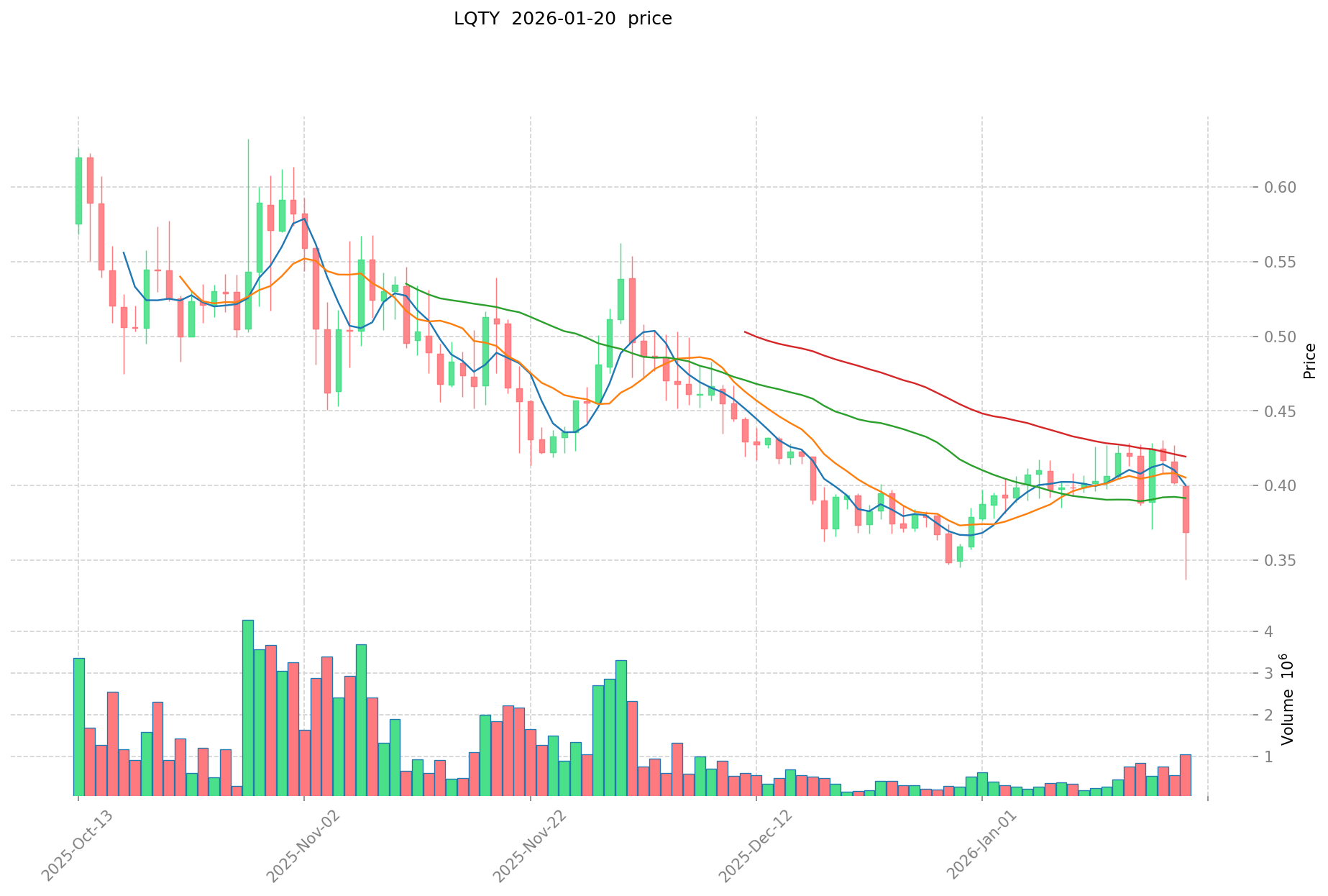
- 2021: LQTY reached a peak price of $146.94 on April 6, 2021 → Early investors experienced significant gains during this period
- 2025: LQTY price declined to $0.298378 on October 11, 2025 → Price volatility remained substantial
- Recent Period: LQTY has experienced notable price fluctuations → From multi-year trading range, current levels reflect market adjustment
Current LQTY Investment Market Status (January 2026)
- Current LQTY Price: $0.3581
- 24-hour Trading Volume: $175,809.56
- Price Changes: -0.72% (1H), -4.48% (24H), -15.89% (7D), -3.56% (30D), -80.17% (1Y)
- Circulating Supply: 98,029,649.28 LQTY (98.03% of total supply)
- Market Capitalization: $35,104,417.41
- Token Holder Count: 14,304 addresses
Click to view real-time LQTY market price
II. Core Factors Affecting Whether LQTY is a Good Investment
Supply Mechanism and Scarcity (LQTY Investment Scarcity)
- Fixed Supply Model → The total supply of LQTY is capped at 100,000,000 tokens, with approximately 98.03% already in circulation (98,029,649 tokens), creating a high circulation ratio that limits future dilution risks.
- Historical Price Performance → LQTY experienced notable price fluctuations, with historical data showing a peak price of $146.94 in April 2021 and a lower range around $0.30 in late 2025, reflecting the impact of supply dynamics and market sentiment on valuation.
- Investment Implication → The near-complete circulation of LQTY tokens suggests limited inflationary pressure from new issuance, which may support long-term value retention for investors seeking scarcity-driven assets.
Institutional Investment and Mainstream Adoption (Institutional Investment in LQTY)
- Holder Distribution → As of the latest data, LQTY has approximately 14,304 token holders, indicating a modest level of retail and potential institutional participation within the Ethereum-based DeFi ecosystem.
- Exchange Presence → LQTY is listed on 32 exchanges, providing liquidity channels and access points for diverse investor profiles, which can facilitate broader adoption and market depth.
- Policy and Adoption Context → The broader regulatory landscape for decentralized finance (DeFi) protocols continues to evolve, with policy clarity potentially influencing institutional confidence and mainstream integration of assets like LQTY.
Macroeconomic Environment's Impact on LQTY Investment
- Monetary Policy and Interest Rates → Changes in global monetary policy, including interest rate adjustments by central banks, can affect investor appetite for risk assets such as DeFi tokens, potentially shifting capital flows toward or away from projects like Liquity.
- Inflation Hedging Considerations → While LQTY operates within a decentralized borrowing protocol, its role as a governance and incentive token may offer indirect exposure to DeFi's value proposition during periods of currency depreciation or economic uncertainty.
- Geopolitical Uncertainty → Periods of geopolitical tension or financial instability may drive interest in decentralized financial systems, potentially increasing demand for protocol tokens that enable permissionless lending and borrowing.
Technology and Ecosystem Development (Technology & Ecosystem for LQTY Investment)
- Protocol Functionality → Liquity operates as a decentralized borrowing protocol on Ethereum, allowing users to collateralize ETH for interest-free loans in LUSD stablecoin, with LQTY serving as a secondary token capturing protocol fees and incentivizing stability pool participants.
- Ecosystem Incentives → LQTY rewards are distributed to stability providers (users depositing LUSD into the stability pool), front-end operators facilitating deposits, and liquidity providers in the LUSD:ETH Uniswap pool, creating utility tied to protocol usage and stability.
- DeFi Integration and Long-Term Value → The protocol's integration within the Ethereum DeFi landscape, including its role in stablecoin provision and liquidity mechanisms, contributes to its long-term investment narrative, though adoption and competitive positioning remain key variables for sustained value growth.
III. LQTY Future Investment Forecast and Price Outlook (Is Liquity(LQTY) worth investing in 2026-2031)
Short-term Investment Forecast (2026, short-term LQTY investment outlook)
- Conservative forecast: $0.2476 - $0.3589
- Neutral forecast: $0.3589 - $0.3912
- Optimistic forecast: $0.3912 - $0.4238
Mid-term Investment Outlook (2027-2029, mid-term Liquity(LQTY) investment forecast)
-
Market phase expectation: During the mid-term period, LQTY may experience gradual recovery patterns with potential price consolidation phases. The protocol's decentralized lending model and zero-interest borrowing mechanism could attract sustained user interest as DeFi adoption continues to evolve.
-
Investment return forecast:
- 2027: $0.1913 - $0.4238
- 2028: $0.3155 - $0.4633
- 2029: $0.2373 - $0.4875
-
Key catalysts: Protocol adoption rates, Ethereum ecosystem developments, stability pool growth, LUSD demand dynamics, competition from alternative lending protocols, and overall DeFi market sentiment.
Long-term Investment Outlook (Is LQTY a good long-term investment?)
- Base scenario: $0.2389 - $0.5352 (assuming steady protocol usage and moderate DeFi sector growth)
- Optimistic scenario: $0.4335 - $0.6110 (assuming increased adoption, favorable market conditions, and enhanced protocol utility)
- Risk scenario: $0.1913 - $0.2389 (under adverse market conditions, reduced DeFi activity, or increased competitive pressure)
Check LQTY long-term investment and price forecast: Price Prediction
2026-01-21 to 2031 Long-term Outlook
- Base scenario: $0.2389 - $0.5352 (corresponding to steady progress and gradual mainstream application enhancement)
- Optimistic scenario: $0.4335 - $0.6110 (corresponding to large-scale adoption and favorable market environment)
- Transformative scenario: Above $0.6110 (if ecosystem achieves breakthrough progress and mainstream popularization)
- 2031-12-31 predicted high: $0.6110 (based on optimistic development assumptions)
Disclaimer: This analysis is for informational purposes only and should not be considered financial advice. Cryptocurrency investments carry substantial risks, and past performance does not guarantee future results. Investors should conduct their own research and consult with qualified financial advisors before making investment decisions.
| Year |
Predicted High Price |
Predicted Average Price |
Predicted Low Price |
Price Change |
| 2026 |
0.391201 |
0.3589 |
0.247641 |
0 |
| 2027 |
0.423807065 |
0.3750505 |
0.191275755 |
4 |
| 2028 |
0.4633373877 |
0.3994287825 |
0.315548738175 |
11 |
| 2029 |
0.487462886163 |
0.4313830851 |
0.237260696805 |
20 |
| 2030 |
0.611032570889895 |
0.4594229856315 |
0.23889995252838 |
28 |
| 2031 |
0.572693722738946 |
0.535227778260697 |
0.433534500391164 |
49 |
IV. LQTY Investment Strategy and Risk Management (How to invest in LQTY)
Investment Methodology (LQTY investment strategy)
Long-term Holding (HODL LQTY): Suitable for Conservative Investors
For investors seeking steady exposure to decentralized lending protocols, long-term holding of LQTY may align with a patient investment approach. This strategy involves purchasing tokens and holding them through market cycles, betting on the protocol's continued adoption and utility growth. Given LQTY's role in capturing fee revenue from the Liquity protocol and incentivizing stability providers, holders may benefit from the protocol's long-term development. However, investors should note the token's substantial price decline of approximately 80.17% over the past year, suggesting that timing and entry points remain critical considerations even for long-term strategies.
Active Trading: Relying on Technical Analysis and Swing Operations
Active traders may approach LQTY through technical analysis and short-to-medium-term position management. Recent price data shows notable volatility, with 24-hour fluctuations ranging between $0.355 and $0.3795, and a 24-hour decline of 4.48%. The 7-day decline of 15.89% indicates potential swing trading opportunities for those skilled in identifying support and resistance levels. Traders should monitor the token's 24-hour trading volume of approximately $175,809, which may affect liquidity and execution quality. The substantial gap between the current price of $0.3581 and the all-time high of $146.94 (recorded on April 6, 2021) presents both risk and potential reward scenarios depending on market conditions and protocol developments.
Risk Management (Risk management for LQTY investment)
Asset Allocation Ratios: Conservative / Aggressive / Professional Investors
- Conservative Investors: May consider allocating no more than 1-2% of their cryptocurrency portfolio to LQTY, given its specialized nature as a protocol governance and fee-sharing token within the DeFi lending sector.
- Aggressive Investors: Those with higher risk tolerance and deeper understanding of DeFi protocols might allocate 5-10% of their crypto holdings to LQTY, particularly if they believe in the long-term viability of decentralized stablecoin lending platforms.
- Professional Investors: Institutional or professional participants may take strategic positions based on thorough protocol analysis, potentially allocating up to 15% of DeFi-focused portfolios while implementing sophisticated hedging strategies.
Risk Hedging Solutions: Multi-asset Portfolio + Hedging Tools
Investors can mitigate LQTY-specific risks through diversified portfolio construction across multiple DeFi protocol tokens, established cryptocurrencies like Bitcoin and Ethereum, and stablecoin positions. Hedging strategies may include maintaining correlated positions in other DeFi lending protocols, utilizing options or derivatives where available, and maintaining adequate stablecoin reserves to capitalize on potential downside opportunities. Given LQTY's correlation with Ethereum (as the protocol operates on Ethereum and uses ETH as collateral), investors should consider ETH price movements as part of their risk assessment.
Secure Storage: Hot and Cold Wallets + Hardware Wallet Recommendations
As an ERC-20 token deployed on Ethereum (contract address: 0x6DEA81C8171D0bA574754EF6F8b412F2Ed88c54D), LQTY can be stored in various wallet solutions. For long-term holdings, hardware wallets such as Ledger and Trezor offer enhanced security through offline private key storage. Cold storage solutions are recommended for holdings intended to remain untouched for extended periods. For active traders requiring frequent access, reputable hot wallets with strong security features may be appropriate, though investors should never store significant amounts solely in exchange wallets. Multi-signature wallets provide an additional security layer for larger holdings. Investors should always verify contract addresses through official sources like Etherscan before conducting transactions.
V. LQTY Investment Risks and Challenges (Risks of investing in LQTY)
Market Risks: High Volatility and Price Manipulation
LQTY exhibits substantial price volatility characteristic of smaller-cap DeFi tokens. The token's market capitalization of approximately $35.1 million and ranking of 646 indicate relatively limited liquidity compared to major cryptocurrencies. This smaller market presence may increase susceptibility to significant price swings driven by relatively modest trading volumes. The 24-hour trading volume of $175,809 suggests that large orders could potentially impact market prices. The token's dramatic decline from its all-time high of $146.94 to the current price of $0.3581 represents a decrease of over 99%, illustrating the extreme volatility that has characterized this asset. The all-time low of $0.298378 recorded on October 11, 2025, indicates recent testing of historical support levels. With only 32 exchanges listing the token, liquidity may be fragmented across platforms, potentially complicating execution for larger positions.
Regulatory Risks: Policy Uncertainty Across Different Countries
As a token associated with decentralized lending and stablecoin protocols, LQTY faces evolving regulatory scrutiny across jurisdictions. Different countries maintain varying approaches to DeFi protocols, with some implementing restrictive frameworks while others adopt more accommodating stances. Regulatory developments concerning stablecoins, lending protocols, and DeFi governance tokens could materially impact LQTY's utility and value proposition. Changes in securities classifications, tax treatment, or operational requirements for decentralized protocols may affect the Liquity ecosystem and consequently LQTY token economics. Investors should monitor regulatory developments in their jurisdictions and major crypto markets, as policy shifts could restrict access, impose compliance burdens, or limit the protocol's operational scope.
Technical Risks: Network Security Vulnerabilities and Upgrade Failures
LQTY's value proposition depends fundamentally on the security and proper functioning of the Liquity protocol deployed on Ethereum. Smart contract vulnerabilities, despite audit processes, represent persistent risks in DeFi protocols. Potential exploits or security breaches could undermine confidence in the protocol and negatively impact LQTY value. Network congestion on Ethereum may affect protocol usability and user experience, potentially driving users to competing platforms. Protocol upgrades or parameter changes, while intended to improve functionality, carry execution risks and may not achieve intended outcomes. The protocol's reliance on its LUSD stablecoin maintaining its peg and the stability pool functioning effectively creates systemic dependencies. Any failure in these mechanisms could cascade into reduced protocol usage and diminished LQTY utility. Competition from other decentralized lending protocols with different approaches or improved features may erode Liquity's market position over time.
VI. Conclusion: Is LQTY a Good Investment?
Investment Value Summary
LQTY represents exposure to a specialized segment within decentralized finance, specifically focused on interest-free lending backed by Ethereum collateral. The token's utility in capturing protocol fees and incentivizing stability providers creates a direct connection to Liquity protocol usage and success. With approximately 98.03% of maximum supply already in circulation (98,029,649 tokens out of 100,000,000 maximum supply), inflationary pressure from new token emissions appears limited. However, the token's substantial decline of 80.17% over the past year and the dramatic distance from all-time highs suggest that market sentiment toward the protocol and token has weakened considerably. The relatively modest market capitalization of $35.1 million and limited exchange availability present both risk factors and potential upside if the protocol regains market attention.
Investor Recommendations
✅ Beginners: Consider dollar-cost averaging small positions while prioritizing secure storage in hardware wallets. Focus on understanding the Liquity protocol's mechanics and LQTY's role within the ecosystem before committing significant capital. Start with minimal allocations (under 1-2% of total crypto portfolio) to gain exposure while managing risk.
✅ Experienced Investors: May explore swing trading opportunities given recent volatility, while maintaining diversified positions across multiple DeFi protocols. Consider technical analysis of support and resistance levels, particularly around the recent all-time low region. Portfolio allocation of 3-7% might be appropriate for those with conviction in the protocol's long-term potential and risk tolerance for high-volatility assets.
✅ Institutional Investors: Could approach LQTY as a strategic component within broader DeFi sector allocations, implementing sophisticated risk management and hedging strategies. Thorough due diligence on protocol fundamentals, competitive positioning, and regulatory exposure should precede position establishment. Allocation decisions should reflect comprehensive analysis of the decentralized lending landscape and Liquity's differentiation within this space.
⚠️ Disclaimer: Cryptocurrency investment carries substantial risk, including potential loss of entire invested capital. This analysis is provided for informational purposes only and does not constitute investment advice. Investors should conduct independent research, consider their financial situation and risk tolerance, and consult qualified financial advisors before making investment decisions.
VII. FAQ
Q1: What is the current price of LQTY and how has it performed recently?
As of January 21, 2026, LQTY is trading at approximately $0.3581. The token has experienced significant downward pressure recently, with declines of 4.48% over 24 hours, 15.89% over 7 days, and a substantial 80.17% over the past year. This performance reflects broader market challenges and shifting sentiment toward the DeFi lending sector. The token's price has fallen dramatically from its all-time high of $146.94 recorded on April 6, 2021, representing a decline of over 99%. The 24-hour trading volume stands at approximately $175,809, with the token trading between $0.355 and $0.3795 during the most recent session.
Q2: How does LQTY generate value for token holders?
LQTY captures value through the Liquity protocol's fee distribution mechanism. When users borrow LUSD stablecoins against ETH collateral, the protocol generates fees that are distributed to LQTY stakers. Additionally, LQTY serves as an incentive token for three key groups: stability providers who deposit LUSD into the stability pool to maintain system solvency, front-end operators who facilitate user interactions with the protocol, and liquidity providers in the LUSD:ETH Uniswap pool. This multi-faceted utility creates direct correlation between protocol usage and LQTY value proposition, though actual value realization depends on sustained protocol adoption and fee generation.
Q3: What are the main risks associated with investing in LQTY?
LQTY investment carries several significant risks. Market risk is substantial given the token's high volatility, relatively small market capitalization of $35.1 million, and limited liquidity across 32 exchanges. Regulatory risk stems from evolving policies toward DeFi protocols, stablecoins, and governance tokens across different jurisdictions, which could restrict protocol operations or token utility. Technical risks include smart contract vulnerabilities, despite audits, potential Ethereum network congestion affecting usability, and the protocol's dependence on LUSD maintaining its stablecoin peg and the stability pool functioning effectively. Competition from alternative decentralized lending protocols may also erode market share and reduce LQTY's value proposition over time.
Q4: Is LQTY suitable for long-term holding or short-term trading?
LQTY can accommodate both strategies depending on investor profile and risk tolerance. Long-term holding may suit conservative investors who believe in the decentralized lending thesis and are willing to endure volatility while betting on protocol growth over multi-year horizons. This approach benefits from LQTY's near-complete token circulation (98.03% of maximum supply), limiting future dilution. Short-term trading may appeal to experienced traders who can capitalize on the token's notable volatility, with recent data showing 24-hour price ranges of approximately 11% and weekly swings exceeding 15%. However, the relatively modest 24-hour volume of $175,809 suggests traders should carefully consider liquidity constraints when executing larger positions.
Q5: What is LQTY's price forecast for 2026-2031?
Price projections for LQTY vary significantly based on adoption scenarios and market conditions. For 2026, forecasts range from a conservative $0.2476-$0.3589 to an optimistic $0.3912-$0.4238. Mid-term projections for 2027-2029 show potential ranges from $0.1913 to $0.4875, depending on protocol adoption, DeFi sector growth, and competitive dynamics. Long-term outlooks through 2031 suggest a base scenario of $0.2389-$0.5352, an optimistic scenario of $0.4335-$0.6110, and a transformative scenario exceeding $0.6110 if the protocol achieves breakthrough adoption. The 2031 predicted high of $0.6110 assumes favorable development and mainstream integration. However, investors should note that these are projections subject to substantial uncertainty and not guarantees of future performance.
Q6: How should investors allocate LQTY in their portfolios?
Portfolio allocation for LQTY should reflect individual risk tolerance and investment expertise. Conservative investors might limit LQTY to 1-2% of their cryptocurrency portfolio, given its specialized nature as a DeFi protocol token with high volatility. Aggressive investors with deeper understanding of decentralized lending mechanisms could allocate 5-10% of crypto holdings, particularly if convinced of long-term protocol viability. Professional investors might take strategic positions up to 15% of DeFi-focused portfolios while implementing sophisticated hedging strategies. Regardless of allocation level, diversification across multiple assets, including established cryptocurrencies like Bitcoin and Ethereum, other DeFi protocols, and stablecoin positions, helps mitigate LQTY-specific risks.
Q7: What storage solutions are recommended for LQTY tokens?
LQTY, as an ERC-20 token on Ethereum (contract address: 0x6DEA81C8171D0bA574754EF6F8b412F2Ed88c54D), requires secure storage appropriate to holding duration and access needs. For long-term holdings, hardware wallets such as Ledger and Trezor offer optimal security through offline private key storage, protecting against online threats. Cold storage solutions are recommended for tokens intended to remain untouched for extended periods. Active traders requiring frequent access may use reputable hot wallets with robust security features, though significant amounts should not be stored solely on exchange platforms. Multi-signature wallets provide additional security layers for larger holdings. Investors should always verify contract addresses through official sources like Etherscan before conducting any transactions to avoid scams.
Q8: What factors could drive LQTY price appreciation in the future?
Several catalysts could potentially support LQTY value appreciation. Increased adoption of the Liquity protocol and growing demand for interest-free ETH-backed loans would directly boost fee generation distributed to LQTY holders. Broader DeFi sector growth and increasing preference for decentralized financial services could expand the total addressable market for lending protocols. Successful protocol upgrades enhancing functionality or user experience might attract more users and liquidity. Expansion of LUSD stablecoin usage in the broader DeFi ecosystem would strengthen the protocol's network effects. Additionally, favorable regulatory developments toward DeFi, institutional adoption of decentralized lending platforms, and Ethereum ecosystem growth supporting scaling solutions could create positive momentum. However, realization of these catalysts remains uncertain and dependent on competitive dynamics and market conditions.
* The information is not intended to be and does not constitute financial advice or any other recommendation of any sort offered or endorsed by Gate.