This comprehensive analysis examines whether Litecoin (LTC) represents a viable investment opportunity in 2026. The article evaluates LTC's current market position with a $5.85 billion capitalization and $76.18 price point, tracing its performance history from 2011 to present. Core investment factors examined include supply scarcity (84 million maximum cap with 91.35% circulated), institutional adoption trends, and technological advantages including faster 2.5-minute block times compared to Bitcoin. Price forecasts range from conservative ($28.60-$49.30) to optimistic scenarios ($115.61-$346.82) for 2026, with extended projections through 2031 suggesting potential appreciation to $155.27 under favorable conditions. The analysis provides actionable investment strategies across risk profiles, comprehensive risk management frameworks including portfolio allocation guidelines, and addresses key investor concerns through detailed FAQ responses, enabling readers to make informed decisions aligned with their investm
Introduction: Litecoin (LTC) Investment Position and Market Outlook
LTC is a significant asset in the cryptocurrency field. Since its launch in 2011, it has achieved notable development in the digital payment sector. As of 2026, Litecoin holds a market capitalization of approximately $5.85 billion, with a circulating supply of around 76.73 million coins and a current price maintained at $76.18. With its positioning as an open-source, peer-to-peer distributed network currency system featuring faster transaction confirmation times compared to Bitcoin, Litecoin has gradually become a focal point when investors discuss "Is Litecoin (LTC) a good investment?" This article will comprehensively analyze Litecoin's investment value, historical trends, future price predictions, and investment risks to provide reference for investors.
I. Litecoin (LTC) Price History Review and Investment Value Status
- 2011-2013: Litecoin launched as a Bitcoin fork by Charlie Lee, with prices remaining around several cents. By late 2013, LTC briefly surged above $40 before retreating.
- 2014-2016: Following the broader cryptocurrency market cooldown, LTC price remained within the $1-10 range for an extended period.
- 2017: During the cryptocurrency bull market, LTC surged from approximately $4 at the beginning of the year to $375, representing an increase of over 9,000% within one year, with market capitalization briefly exceeding $10 billion.
- 2018-2020: Market correction led to LTC declining to the $30-50 range. Despite a brief rebound to $140 in 2019, the overall trend remained downward.
- 2021: LTC reached a peak of approximately $400 in May during the second bull market cycle. However, as the crypto market weakened in the second half, prices declined, dropping to around $43 by June 2022.
- 2023: LTC experienced a brief rally approaching $110 in mid-July ahead of its halving event. Following the halving, prices declined and mostly fluctuated within the $60-100 range throughout the year.
- 2024: Despite improved overall market sentiment, LTC lacked significant upward momentum, with prices generally maintaining between $70-95.
- 2025: LTC exhibited a sideways-to-weak trend, primarily fluctuating within the $80-95 range.
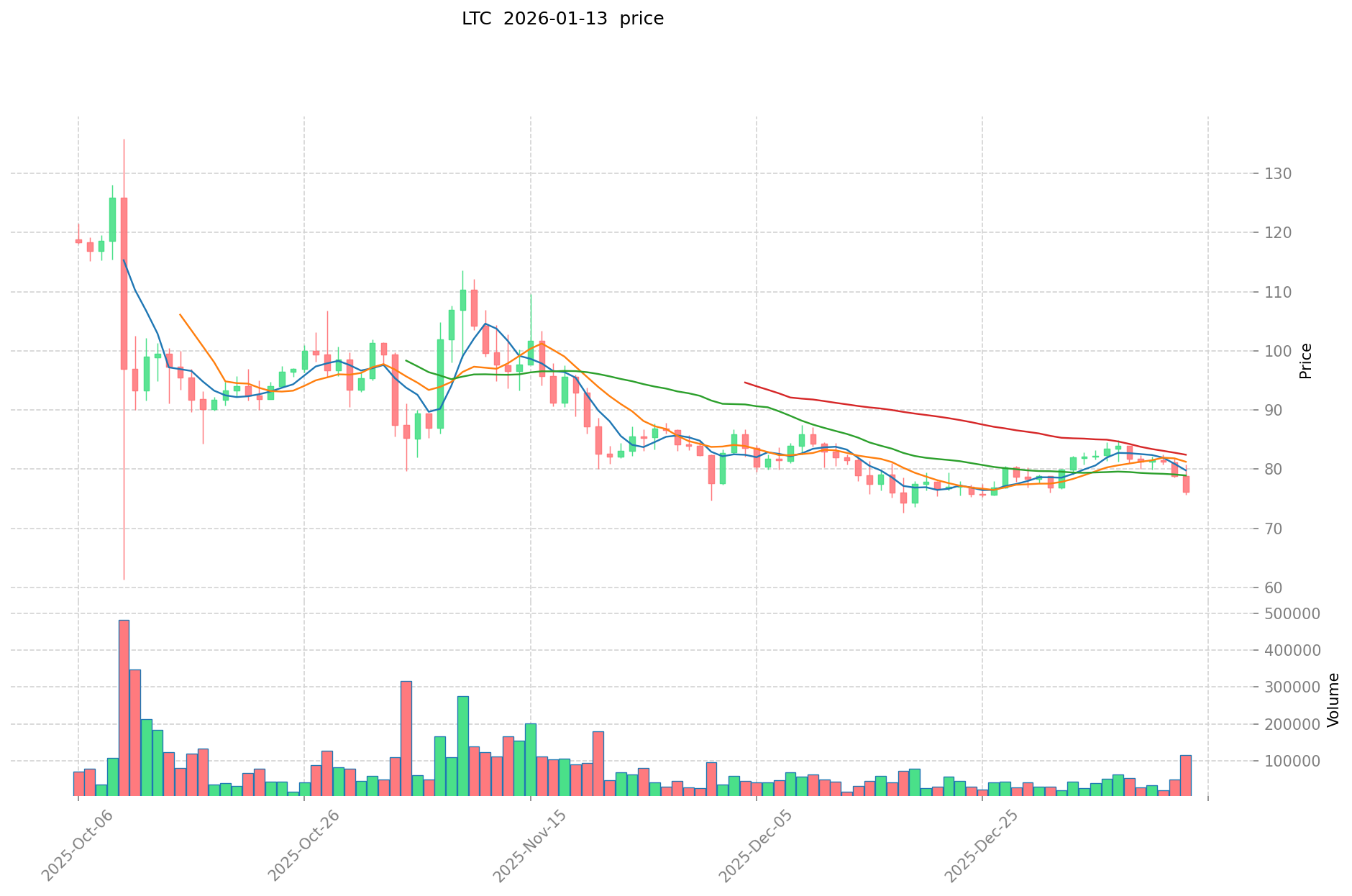
Current LTC Investment Market Status (January 2026)
- LTC current price: $76.18
- Market emotion: Neutral to cautious
- 24-hour trading volume: $866.41 million
- Circulating supply: 76.73 million LTC (91.35% of maximum supply of 84 million)
- Market capitalization: $5.85 billion
- Global ranking: 26th
- Holders: Approximately 8.87 million addresses
Click to view real-time LTC market price
II. Core Factors Influencing Whether LTC is a Good Investment
Supply Mechanism and Scarcity (LTC investment scarcity)
- Maximum Supply Cap: Litecoin has a capped maximum supply of 84,000,000 LTC, with approximately 76,730,214 LTC currently in circulation (91.35% of total supply). This fixed supply structure creates inherent scarcity that may influence long-term investment value.
- Halving Events: Litecoin undergoes periodic halving events that reduce block rewards, with the next halving projected for 2027. Historical patterns suggest these supply shocks have acted as catalysts for price appreciation, though future outcomes remain uncertain.
- Investment Significance: The limited supply mechanism positions LTC as a scarce digital asset, which some market participants consider a fundamental factor supporting long-term investment considerations.
Institutional Investment and Mainstream Adoption (Institutional investment in LTC)
- Adoption Trend: Litecoin has gained integration with payment platforms including PayPal and BitPay, expanding its utility in mainstream payment processing systems.
- ETF Development: Discussions around potential Litecoin spot ETF approval have emerged in market forecasts, though the actual impact on institutional inflows remains uncertain and dependent on regulatory developments.
- Market Position: Often described as "digital silver" relative to Bitcoin's "gold" positioning, Litecoin offers a lower-cost entry point for participants seeking exposure to established cryptocurrency networks.
Macroeconomic Environment Impact on LTC Investment
- Market Volatility: Like all cryptocurrencies, Litecoin demonstrates significant price volatility, with recent performance showing a decline of 2.4% over 24 hours and 25.52% over one year as of January 2026. Market conditions and regulatory uncertainties continue to influence investment dynamics.
- Competitive Landscape: Litecoin operates in an increasingly competitive environment with numerous alternative cryptocurrencies offering similar or enhanced features, which may affect its market share and investment appeal.
- Economic Factors: Broader macroeconomic conditions, including monetary policy shifts and regulatory developments, continue to shape the cryptocurrency investment landscape and LTC's relative attractiveness.
Technology and Ecosystem Development (Technology & Ecosystem for LTC investment)
- Transaction Efficiency: Launched in 2011 by Charlie Lee, Litecoin features a 2.5-minute block confirmation time and lower transaction fees compared to Bitcoin, positioning it for payment applications.
- Network Reliability: Litecoin maintains an established network with historical stability and continued technological maintenance, though some analysts note scalability limitations with approximately 4 million transactions per day capacity.
- Ecosystem Application: While Litecoin has established presence in payment processing, its adoption in emerging areas such as DeFi and NFT ecosystems remains more limited compared to some competing blockchain platforms.
III. LTC Future Investment Forecast and Price Outlook (Is Litecoin(LTC) worth investing in 2026-2031)
Short-term Investment Outlook (2026, short-term LTC investment outlook)
Based on current market analysis, Litecoin (LTC) is trading below $80 as of January 2026, showing technical signs of stabilization after recent volatility. Multiple forecasting models suggest varying trajectories for the year ahead.
- Conservative forecast: $28.60 - $49.30
- Neutral forecast: $75.85 - $83.50
- Optimistic forecast: $115.61 - $346.82
Technical indicators show LTC maintaining support around the $80 level, with potential resistance at the 50-day moving average ($92.94) and 200-day moving average ($99.51). The asset continues to trade within a descending wedge pattern, which historically may signal potential reversal opportunities. Market participants are monitoring the $62-$65 multi-year support zone, which aligns with the 78.6% Fibonacci retracement from 2021 highs.
Mid-term Investment Outlook (2027-2028, mid-term Litecoin(LTC) investment forecast)
-
Market stage expectations: Litecoin is expected to enter a moderate growth phase, supported by continued network activity and potential regulatory clarity in the cryptocurrency sector. The upcoming halving event scheduled for July 2027 (reducing block rewards from 6.25 LTC to 3.125 LTC) may influence supply dynamics.
-
Investment return projections:
- 2027: $123.00 - $311.00 (various analytical sources suggest a range of outcomes)
- 2028: $280.95 - $380.72
-
Key catalysts: Factors that may influence mid-term performance include ETF-related developments, institutional adoption trends, network upgrade implementations, broader cryptocurrency market sentiment, and correlation with Bitcoin price movements. On-chain transaction volumes reaching record levels (reported at $15.1 billion daily in late 2025) suggest sustained network utility.
Long-term Investment Outlook (Is LTC a good long-term investment?)
Long-term projections for Litecoin vary significantly across analytical platforms, reflecting the inherent uncertainty in cryptocurrency markets:
- Base scenario: $140.27 - $304.00 (assuming steady network growth and moderate market conditions through 2030)
- Optimistic scenario: $880.00 - $1,755.00 (contingent upon favorable regulatory frameworks, increased institutional support, and widespread adoption)
- Risk scenario: Below $100 (in case of adverse regulatory developments, technological challenges, or prolonged bear market conditions)
Click to view LTC long-term investment and price predictions: Price Prediction
2026-2031 Long-term Outlook
- Base scenario: $75.36 - $155.23 (corresponding to stable progress and steady growth in mainstream applications)
- Optimistic scenario: $85.67 - $155.27 (corresponding to large-scale adoption and favorable market environments)
- Transformational scenario: Above $200 (if ecosystem achieves breakthrough developments and mainstream prevalence)
- 2031-12-31 projected high: $155.27 (based on optimistic development assumptions)
Disclaimer: The forecasts presented are derived from publicly available analytical models and historical data patterns. Cryptocurrency markets are highly volatile and unpredictable. Price projections should not be construed as investment advice or guarantees of future performance. Multiple factors including regulatory changes, technological developments, macroeconomic conditions, and market sentiment can significantly impact actual outcomes. Investors should conduct independent research and consider their risk tolerance before making investment decisions.
| Year |
Predicted High Price |
Predicted Average Price |
Predicted Low Price |
Price Change |
| 2026 |
92.537 |
75.85 |
49.3025 |
0 |
| 2027 |
116.18703 |
84.1935 |
77.45802 |
10 |
| 2028 |
118.2245127 |
100.190265 |
67.12747755 |
31 |
| 2029 |
115.759832181 |
109.20738885 |
92.8262805225 |
43 |
| 2030 |
155.22738251139 |
112.4836105155 |
75.364019045385 |
47 |
| 2031 |
155.2723759555962 |
133.855496513445 |
85.6675177686048 |
75 |
IV. Litecoin Investment Strategy and Risk Management (How to invest in Litecoin)
Investment Methodology (Litecoin investment strategy)
-
Long-term Holding (HODL Litecoin): Suitable for conservative investors seeking to benefit from potential long-term value appreciation. This approach minimizes transaction costs and reduces exposure to short-term market volatility.
-
Active Trading: Relies on technical analysis and swing trading strategies. Traders may capitalize on price movements by monitoring key support and resistance levels, utilizing indicators, and executing trades based on market momentum.
Risk Management (Risk management for Litecoin investment)
-
Asset Allocation Ratio:
- Conservative investors: Allocate 5-10% of portfolio to Litecoin
- Moderate investors: Allocate 10-20% of portfolio to Litecoin
- Aggressive investors: May allocate 20-30% or more, understanding increased risk exposure
-
Risk Hedging Solutions: Implement diversified portfolio strategies combining multiple digital assets and traditional hedging instruments. Consider balancing Litecoin holdings with stablecoins, major cryptocurrencies, and other asset classes to reduce concentration risk.
-
Secure Storage:
- Hot wallets: Convenient for frequent trading but require robust security measures
- Cold wallets: Recommended for long-term storage, offering enhanced security through offline storage
- Hardware wallets: Recommended devices include Ledger and Trezor for institutional-grade security
V. Litecoin Investment Risks and Challenges (Risks of investing in Litecoin)
-
Market Risk: Litecoin experiences notable price volatility, with recent 24-hour fluctuations showing -2.4% movement. Weekly performance indicates -8.29% decline, and annual performance shows -25.52% decrease. Market manipulation risks exist in periods of lower liquidity.
-
Regulatory Risk: Cryptocurrency regulations vary significantly across jurisdictions. Policy uncertainty in major markets may impact Litecoin's adoption, trading availability, and overall market sentiment. Investors should monitor regulatory developments in their respective regions.
-
Technical Risk: Potential network security vulnerabilities, protocol upgrade complications, or implementation failures could affect network stability. While Litecoin has maintained operational integrity since its 2011 launch, technological risks remain inherent to blockchain systems.
VI. Conclusion: Is Litecoin a Good Investment?
-
Investment Value Summary: Litecoin presents potential opportunities for diversified cryptocurrency portfolios, with established infrastructure and widespread exchange availability across 77 platforms. However, recent price performance shows significant volatility, with the current price of $76.18 representing a substantial decline from historical peaks.
-
Investor Recommendations:
✅ Beginners: Consider dollar-cost averaging (DCA) approach combined with secure wallet storage. Start with small allocations and focus on learning market dynamics before increasing exposure.
✅ Experienced Investors: Employ swing trading strategies with appropriate position sizing. Implement portfolio diversification across multiple digital assets to balance risk and potential returns.
✅ Institutional Investors: Evaluate strategic long-term allocation as part of broader digital asset exposure. Conduct thorough due diligence on custody solutions and regulatory compliance frameworks.
⚠️ Disclaimer: Cryptocurrency investments carry substantial risk and may result in partial or total loss of capital. This analysis is provided for informational purposes only and does not constitute investment advice. Investors should conduct independent research and consult with qualified financial advisors before making investment decisions.
VII. FAQ
Q1: Is Litecoin (LTC) a good investment for beginners in 2026?
Litecoin can be considered a moderate entry point for beginners, but requires careful consideration. As an established cryptocurrency with a market cap of $5.85 billion and trading history since 2011, LTC offers relative stability compared to newer altcoins. However, its current price of $76.18 represents a 25.52% decline over the past year, and recent performance shows significant volatility with -8.29% weekly movement. Beginners should start with small allocations (5-10% of portfolio), employ dollar-cost averaging (DCA) strategies, and prioritize secure storage solutions such as hardware wallets. Understanding market fundamentals and accepting potential losses is essential before investing.
Q2: What is the expected price of Litecoin by 2027-2028?
Price projections for Litecoin vary significantly across analytical models. For 2027, forecasts range from $123.00 to $311.00, with the upcoming halving event in July 2027 potentially serving as a catalyst for price appreciation. By 2028, estimates suggest a range of $280.95 to $380.72 under favorable market conditions. These projections assume continued network growth, improved institutional adoption, and positive cryptocurrency market sentiment. However, actual outcomes depend on multiple factors including regulatory developments, Bitcoin price correlation, technological upgrades, and broader macroeconomic conditions. Investors should treat these forecasts as speculative estimates rather than guaranteed outcomes.
Q3: How does Litecoin's halving event affect its investment value?
Litecoin's halving mechanism reduces block rewards by 50% approximately every four years, with the next event scheduled for July 2027 (reducing rewards from 6.25 LTC to 3.125 LTC). This supply shock creates increased scarcity by slowing the rate of new coin issuance. Historical patterns show that halving events have preceded price appreciation cycles, though past performance does not guarantee future results. The 2023 halving saw LTC briefly rally to $110 before declining, demonstrating that other market factors play significant roles. With 91.35% of total supply already circulated (76.73 million of 84 million maximum), the halving's impact may be less pronounced compared to earlier events.
Q4: What are the main risks of investing in Litecoin?
Litecoin investment carries multiple significant risks. Market risk includes substantial price volatility, with 24-hour fluctuations reaching -2.4% and annual performance showing -25.52% decline. Regulatory risk stems from evolving cryptocurrency policies across jurisdictions that may impact trading availability and adoption. Technical risks include potential network vulnerabilities, protocol upgrade complications, and scalability limitations (approximately 4 million transactions per day capacity). Competitive pressure from alternative cryptocurrencies offering enhanced features threatens market share. Additionally, Litecoin's limited presence in emerging sectors like DeFi and NFT ecosystems may constrain growth potential compared to more versatile blockchain platforms.
Q5: Should I choose long-term holding or active trading for Litecoin?
The optimal strategy depends on individual risk tolerance, time commitment, and market expertise. Long-term holding (HODL) suits conservative investors seeking to minimize transaction costs while benefiting from potential multi-year appreciation aligned with halving cycles and mainstream adoption trends. This approach requires patience through market downturns and secure cold storage solutions. Active trading appeals to experienced participants who can analyze technical indicators, monitor support/resistance levels around $62-$92, and execute swing trades based on market momentum. Active trading demands significant time investment, emotional discipline, and acceptance of higher transaction fees. Most analysts recommend combining approaches through core long-term positions with smaller allocations for tactical trading opportunities.
Q6: How does Litecoin compare to Bitcoin as an investment?
Litecoin positions itself as "digital silver" to Bitcoin's "gold," offering faster transaction confirmation (2.5 minutes vs. 10 minutes) and lower fees, making it more practical for payment applications. With a market cap of $5.85 billion compared to Bitcoin's significantly larger capitalization, LTC offers higher potential percentage gains but also greater volatility and downside risk. Bitcoin maintains stronger institutional adoption, regulatory clarity, and brand recognition, with established spot ETF products driving investment flows. Litecoin's correlation with Bitcoin means it generally follows BTC price movements while exhibiting amplified volatility. For diversified portfolios, Litecoin may serve as a complementary holding rather than a Bitcoin replacement, providing exposure to established payment-focused cryptocurrency infrastructure at a lower price point.
* The information is not intended to be and does not constitute financial advice or any other recommendation of any sort offered or endorsed by Gate.