This comprehensive analysis examines Livepeer (LPT), an Ethereum-based decentralized video streaming platform with current market capitalization of $156.82 million and token price at $3.22. The article evaluates LPT's investment potential by analyzing price history, market factors, and network evolution, including significant AI integration expansion where AI workloads accounted for 72% of protocol revenue in Q3 2025. Price forecasts range from $2.67-$3.22 (2026 conservative) to $4.47-$6.31 (2026-2031 scenarios), contingent on adoption rates and market conditions. Key investment strategies include long-term holding for conservative investors (1-3% allocation) and active trading for experienced participants, with emphasis on cold wallet security. Critical risks encompass extreme volatility (78.84% annual decline), regulatory uncertainty, technical vulnerabilities, and unlimited token supply. The analysis provides actionable guidance for beginners, experienced investors, and institutions navigating LPT's specia
Introduction: Livepeer (LPT)'s Investment Position and Market Outlook
LPT is a significant asset in the cryptocurrency field. As an open-source live video platform service based on the Ethereum blockchain, Livepeer has established its presence in the decentralized video streaming infrastructure sector since its launch in 2018. As of January 2026, Livepeer maintains a market capitalization of approximately $156.82 million, with a circulating supply of about 48.78 million tokens, and the current price stands around $3.22. As the protocol token of the Livepeer network, LPT enables token holders to delegate tokens to transcoders for network operations while earning rewards. With its positioning in decentralized video transcoding services, LPT has gradually become a focal point when investors discuss "Is Livepeer (LPT) a good investment?" This article will comprehensively analyze LPT's investment value, historical trends, future price predictions, and investment risks to provide reference for investors.
I. Livepeer (LPT) Price History Review and Current Investment Value
- 2018: Livepeer launched its protocol token, establishing initial market presence.
- 2021: During cryptocurrency market expansion, LPT experienced significant price appreciation, reaching levels near $100, reflecting increased investor interest in decentralized video infrastructure solutions.
- 2022: Following broader cryptocurrency market corrections in early 2022, LPT price adjusted to levels around $5, demonstrating typical crypto market cyclicality.
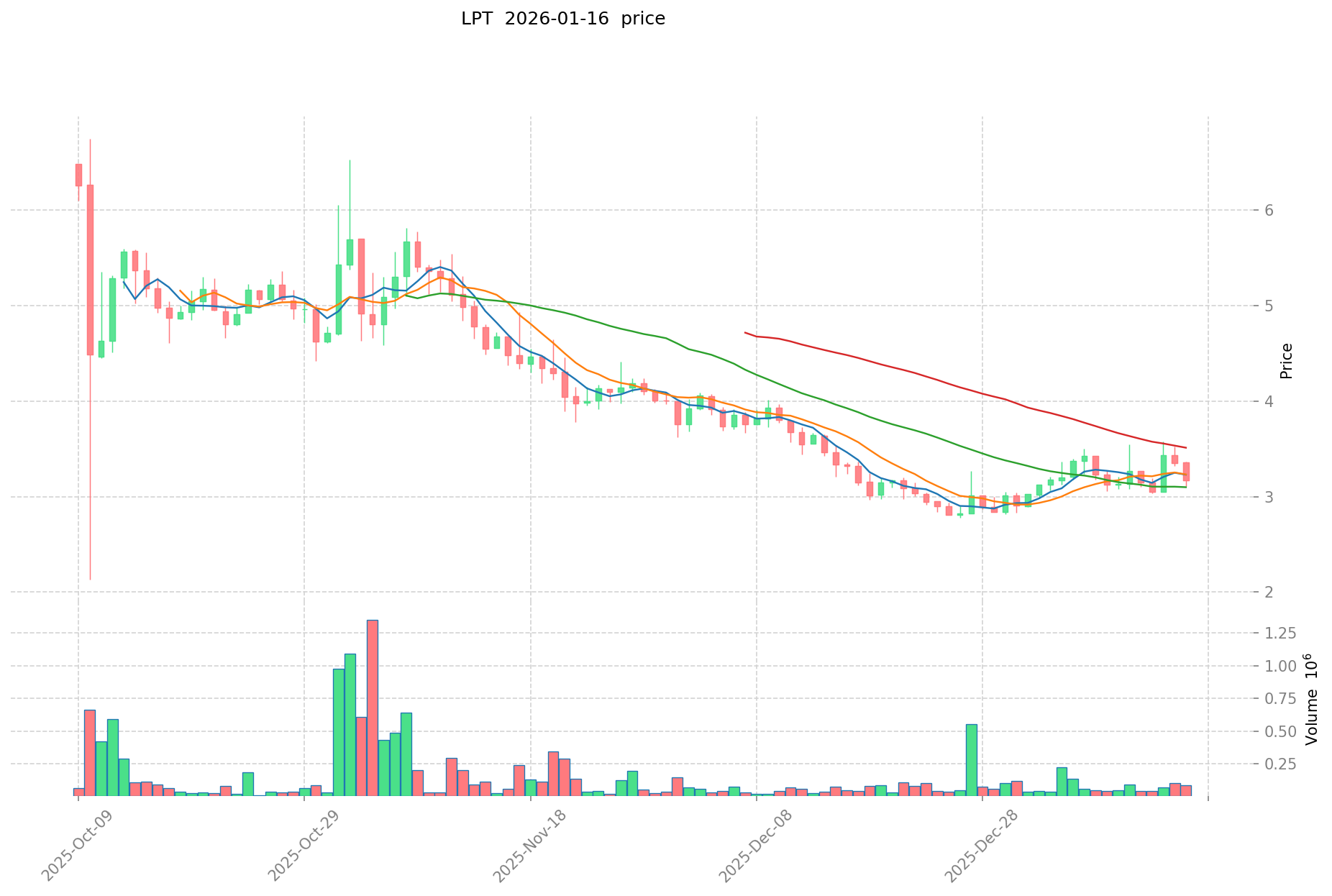
Current LPT Market Status (January 2026)
- Current LPT Price: $3.215
- 24-hour Trading Volume: $203,314.36
- Market Capitalization: $156,820,052.69
- Circulating Supply: 48,777,621.36 LPT
- Price Change (24h): -2.57%
- Price Change (7d): +2.62%
- Price Change (30d): -1.68%
- Price Change (1y): -78.84%
Click to view real-time LPT market price
II. Core Factors Influencing Whether LPT is a Good Investment
Supply Mechanism and Scarcity (LPT Investment Scarcity)
- Unlimited Supply Structure → According to the provided data, Livepeer (LPT) has an unlimited maximum supply (∞), which differs from traditional scarcity-driven crypto assets. The current circulating supply stands at approximately 48.78 million tokens, with a circulation ratio of 102.65%, indicating that the circulating supply slightly exceeds the total supply metric.
- Supply Dynamics and Price Impact → The unlimited supply model means that LPT does not rely on scarcity as a primary value driver. Instead, the token's investment value depends more heavily on network utility, demand for video processing services, and the token's role within the Livepeer protocol ecosystem.
- Investment Consideration → For investors evaluating LPT, the absence of a hard supply cap suggests that fundamental network growth and adoption metrics may be more relevant than scarcity-based valuation models when assessing long-term investment potential.
Institutional Investment and Mainstream Adoption (Institutional Investment in LPT)
- Market Presence → Livepeer (LPT) is currently listed on 43 exchanges globally, indicating a moderate level of market accessibility. The token holds a market capitalization ranking of 278, with a market dominance of 0.0046%.
- Holder Base → The network has approximately 2.17 million token holders, suggesting a distributed ownership structure that may indicate some level of retail and community adoption.
- Network Evolution → According to Q3 2025 data, Livepeer has expanded beyond video transcoding by introducing AI video processing capabilities. AI workloads accounted for over 72% of total protocol fee revenue in Q3, up from 55% in Q2, indicating a shift in network activity toward compute-intensive and AI-driven applications.
Macroeconomic Environment's Impact on LPT Investment
- Market Volatility Considerations → Cryptocurrency investments, including LPT, remain subject to broader macroeconomic conditions such as monetary policy adjustments, interest rate changes, and global economic uncertainty. These factors can influence investor risk appetite and capital allocation to digital assets.
- Sector-Specific Dynamics → As a decentralized video infrastructure and AI compute network, LPT's investment profile may be influenced by trends in digital media consumption, streaming technology adoption, and the growing demand for AI video processing services.
Technology and Ecosystem Development (Technology & Ecosystem for LPT Investment)
- Livepeer AI Integration → Launched in Q3 2024, Livepeer AI supports decentralized AI-powered video processing and real-time inference. This expansion represents a technical evolution beyond the network's original video transcoding function, potentially broadening the protocol's addressable market.
- Network Utility Model → Services using the Livepeer network pay demand-side fees in ETH to access video transcoding and AI-powered processing tasks. The protocol's fee revenue model indicates that network usage directly correlates with economic activity within the ecosystem.
- Application-Driven Growth → The shift toward AI-driven workloads, particularly through Daydream-powered applications, suggests that the network is attracting compute-intensive, short-form, and generative video tasks. Q3 2025 marked increased network utilization and AI-driven demand, which may influence the token's utility-based value proposition over time.
III. LPT Future Investment Forecast and Price Outlook (Is Livepeer(LPT) worth investing in 2026-2031)
Short-term Investment Forecast (2026, short-term LPT investment outlook)
- Conservative forecast: $2.67 - $3.22
- Neutral forecast: $3.22 - $3.92
- Optimistic forecast: $3.92 - $4.63
Mid-term Investment Outlook (2027-2028, mid-term Livepeer(LPT) investment forecast)
- Market phase expectation: The network may experience performance improvements, with price fluctuations reflecting technological developments and evolving market dynamics in decentralized video infrastructure.
- Investment return forecast:
- 2027: $2.16 - $5.65, with an average around $3.92
- 2028: $3.25 - $5.12, with an average around $4.79
- Key catalysts: Exchange listings, institutional recognition, technological advancements in the video streaming sector, and evolution of the network's arbitration mechanisms.
Long-term Investment Outlook (Is Livepeer a good long-term investment?)
- Base scenario: $4.47 - $5.58 (assuming steady development and gradual mainstream adoption)
- Optimistic scenario: $5.28 - $6.31 (assuming accelerated adoption and favorable market conditions)
- Risk scenario: $2.16 - $3.17 (under challenging market conditions or slower-than-expected adoption)
Click to view LPT long-term investment and price forecast: Price Prediction
2026-01-16 to 2031 Long-term Outlook
- Base scenario: $4.47 - $5.58 (corresponding to steady progress and gradual mainstream application enhancement)
- Optimistic scenario: $5.28 - $6.31 (corresponding to large-scale adoption and favorable market environment)
- Transformative scenario: Above $6.31 (if ecosystem achieves breakthrough progress and mainstream popularization)
- 2031-12-31 predicted high: $6.31 (based on optimistic development assumptions)
Disclaimer: Price predictions are based on analytical models and historical data. Cryptocurrency markets are highly volatile and unpredictable. These forecasts should not be considered as investment advice. Past performance does not guarantee future results. Investors should conduct their own research and consider their risk tolerance before making investment decisions.
| Year |
Predicted High Price |
Predicted Average Price |
Predicted Low Price |
Price Change |
| 2026 |
4.6296 |
3.215 |
2.66845 |
0 |
| 2027 |
5.648112 |
3.9223 |
2.157265 |
22 |
| 2028 |
5.12017042 |
4.785206 |
3.25394008 |
49 |
| 2029 |
5.943225852 |
4.95268821 |
3.1697204544 |
54 |
| 2030 |
5.72035488255 |
5.447957031 |
5.28451832007 |
70 |
| 2031 |
6.31009623115575 |
5.584155956775 |
4.46732476542 |
74 |
IV. Livepeer Investment Strategy and Risk Management (How to invest in Livepeer)
Investment Strategy (Livepeer investment strategy)
Long-term Holding (HODL Livepeer)
Long-term holding represents an investment approach suitable for conservative investors. This strategy involves purchasing LPT tokens and maintaining positions through market fluctuations. Investors following this methodology typically focus on the fundamental value proposition of the Livepeer network as a decentralized video streaming infrastructure. The approach aligns with investors who believe in the long-term adoption of decentralized video transcoding services and are willing to withstand short-term price volatility.
Active Trading
Active trading strategies rely on technical analysis and swing trading techniques. Traders employing this approach monitor price movements, trading volumes, and technical indicators to identify entry and exit points. Given LPT's 24-hour trading volume of $203,314.36, traders have opportunities to execute strategies during periods of market activity. This methodology requires continuous market monitoring and understanding of chart patterns, support and resistance levels, and market sentiment indicators.
Risk Management (Risk management for Livepeer investment)
Asset Allocation
Conservative Investors: For risk-averse participants, allocation to LPT should represent a small portion of the overall portfolio, typically 1-3% of total investment capital. This approach limits exposure to the cryptocurrency's price volatility while maintaining participation in potential upside.
Aggressive Investors: Investors with higher risk tolerance may allocate 5-10% of their portfolio to LPT, balancing potential returns against the volatility inherent in cryptocurrency markets.
Professional Investors: Experienced market participants may incorporate larger allocations based on comprehensive research, market analysis, and risk management frameworks. These investors typically employ sophisticated hedging strategies and portfolio rebalancing techniques.
Risk Hedging Solutions
Diversification across multiple digital assets can help mitigate concentration risk. Investors may consider combining LPT holdings with other cryptocurrencies, stablecoins, or traditional assets to reduce overall portfolio volatility. Position sizing and stop-loss orders represent additional tools for managing downside risk in active trading strategies.
Secure Storage
Cold Wallet Storage: For long-term holders, cold storage solutions provide enhanced security by keeping private keys offline. Hardware wallets represent a recommended option for storing significant LPT holdings, protecting assets from online threats and unauthorized access.
Hot Wallet Considerations: For active traders requiring frequent access to funds, reputable exchange wallets or software wallets with robust security features may be appropriate. However, maintaining only necessary trading amounts in hot wallets while securing the majority of holdings in cold storage represents a prudent approach.
Hardware Wallet Recommendations: Industry-standard hardware wallets compatible with ERC-20 tokens (given LPT's deployment on Ethereum) provide secure storage options. Users should purchase devices directly from manufacturers and verify device authenticity upon receipt.
V. Livepeer Investment Risks and Challenges (Risks of investing in Livepeer)
Market Risk
High Volatility: LPT demonstrates significant price fluctuations characteristic of cryptocurrency markets. Recent data shows a 24-hour price change of -2.57%, with the price ranging between $3.11 and $3.327. The 1-year performance shows a decline of -78.84%, illustrating substantial price volatility over extended periods. The current price of $3.215 represents a considerable distance from the historical high of $99.03 recorded on November 10, 2021.
Price Manipulation Concerns: With a market capitalization of approximately $156.8 million and 24-hour trading volume of $203,314.36, the relatively lower liquidity compared to larger cryptocurrencies may create conditions where concentrated trading activity could influence price movements.
Regulatory Risk
Cryptocurrency regulations vary significantly across jurisdictions and continue to evolve. Potential regulatory developments affecting blockchain networks, token classification, or cryptocurrency trading could impact LPT's accessibility, trading conditions, or valuation. Investors should monitor regulatory developments in their respective jurisdictions and globally, as policy changes may affect the operational environment for Livepeer and similar decentralized networks.
Technical Risk
Network Security: As a protocol built on Ethereum, Livepeer inherits both the security features and potential vulnerabilities of the underlying blockchain. Smart contract risks, including potential bugs or exploits in protocol code, represent considerations for investors. The project maintains active development across multiple GitHub repositories, though code complexity inherently carries implementation risks.
Upgrade Challenges: Protocol upgrades and network improvements, while necessary for long-term development, introduce technical risk. Migration challenges, compatibility issues, or unexpected outcomes from network upgrades could temporarily or permanently affect network functionality and token value.
Infrastructure Dependencies: Livepeer's functionality as a decentralized video transcoding network depends on active participation from node operators and transcoders. Changes in network participation, economic incentives, or competitive dynamics could affect network performance and utility.
VI. Conclusion: Is Livepeer a Good Investment?
Investment Value Summary
Livepeer presents characteristics of emerging blockchain infrastructure with specific utility in decentralized video streaming services. The token's long-term potential correlates with adoption of decentralized video transcoding solutions and the broader growth of Web3 infrastructure. However, the asset demonstrates substantial short-term price volatility, as evidenced by recent performance metrics and the significant decline from historical price levels.
The project's market position, with a ranking of 278 by market capitalization and market dominance of 0.0046%, indicates a relatively specialized position within the cryptocurrency ecosystem. The circulating supply of 48,777,621 LPT tokens with no maximum supply cap (∞) represents an inflationary tokenomics model that merits consideration in valuation analysis.
Investor Recommendations
✅ Beginners: Consider implementing dollar-cost averaging strategies to mitigate timing risk and establish positions gradually. Prioritize security by utilizing hardware wallets or reputable cold storage solutions for asset protection. Allocate only capital that can be sustained through market volatility without affecting financial stability.
✅ Experienced Investors: Employ swing trading strategies informed by technical analysis and market sentiment indicators. Implement portfolio diversification across multiple assets to manage concentration risk. Establish clear risk parameters including position sizing, stop-loss levels, and profit-taking strategies before entering positions.
✅ Institutional Investors: Evaluate Livepeer as a potential component of strategic blockchain infrastructure allocations. Conduct thorough due diligence on protocol fundamentals, competitive positioning, and network economics. Consider position sizing aligned with institutional risk management frameworks and regulatory compliance requirements.
⚠️ Disclaimer: Cryptocurrency investments carry substantial risk, including potential loss of principal. Market conditions can change rapidly, and past performance does not indicate future results. This content provides informational analysis and does not constitute investment advice. Investors should conduct independent research and consult qualified financial advisors before making investment decisions.
VII. FAQ
Q1: Is Livepeer (LPT) a good investment for beginners in 2026?
Livepeer may be suitable for beginners willing to accept high volatility and limited short-term predictability. As a specialized infrastructure token with a market cap of $156.8 million and ranking #278, LPT represents a niche investment within the decentralized video streaming sector. The token's 78.84% decline over the past year and current price of $3.215 (compared to its November 2021 high of $99.03) demonstrate significant volatility. Beginners should implement dollar-cost averaging strategies, allocate only 1-3% of portfolio capital, and prioritize cold storage solutions. The unlimited token supply model means scarcity-based valuation doesn't apply, requiring investors to focus instead on network adoption and utility metrics.
Q2: What are the main risks of investing in LPT?
The primary risks include extreme price volatility, regulatory uncertainty, and technical implementation challenges. Market risk is substantial, with recent data showing 24-hour price fluctuations of -2.57% and a 1-year decline of -78.84%. The relatively low 24-hour trading volume of $203,314.36 may enable price manipulation in thinner market conditions. Regulatory developments across jurisdictions could impact token accessibility and trading conditions. Technical risks encompass smart contract vulnerabilities, protocol upgrade complications, and dependency on active network participation from transcoders and node operators. The unlimited maximum supply structure introduces potential inflationary pressure that may affect long-term valuation.
Q3: How does Livepeer's AI integration affect its investment potential?
Livepeer's expansion into AI-powered video processing represents a significant strategic evolution beyond traditional transcoding services. According to Q3 2025 data, AI workloads accounted for over 72% of total protocol fee revenue, up from 55% in Q2, indicating growing demand for compute-intensive applications. This shift toward AI-driven tasks, particularly through Daydream-powered applications, expands the network's addressable market and utility proposition. The protocol's fee revenue model in ETH correlates network usage directly with economic activity. However, investors should recognize that this technological pivot introduces new competitive dynamics in the AI compute sector and requires continued development resources to maintain market positioning.
Q4: What is the realistic price prediction for LPT by 2031?
Based on analytical models incorporating historical performance and development projections, LPT forecasts range significantly depending on adoption scenarios. The base scenario projects $4.47 - $5.58 by 2031, assuming steady network growth and gradual mainstream adoption. The optimistic scenario ranges from $5.28 - $6.31, contingent upon accelerated institutional adoption and favorable market conditions. The transformative scenario suggests prices above $6.31 if the ecosystem achieves breakthrough progress. The predicted high for December 31, 2031 stands at $6.31. However, cryptocurrency markets remain highly unpredictable, and these projections should not be interpreted as guaranteed outcomes or investment advice.
Q5: Should I choose cold wallet or exchange storage for LPT holdings?
Cold wallet storage is recommended for long-term holders prioritizing security, while exchange wallets suit active traders requiring frequent access. Hardware wallets compatible with ERC-20 tokens provide optimal protection by keeping private keys offline, safeguarding significant holdings from online threats and unauthorized access. For long-term positions representing strategic allocations, cold storage eliminates exchange counterparty risk and potential platform security vulnerabilities. Active traders may maintain necessary trading amounts in reputable exchange wallets with robust security features, while securing the majority of holdings in cold storage. Regardless of chosen method, investors should purchase hardware wallets directly from manufacturers and implement multi-factor authentication on exchange accounts.
Q6: How does LPT's unlimited supply affect its investment value?
The unlimited maximum supply structure fundamentally differentiates LPT from scarcity-driven cryptocurrencies like Bitcoin. With current circulating supply at 48.78 million tokens and a circulation ratio of 102.65%, the token does not rely on supply constraints as a primary value driver. Instead, investment value depends on network utility, demand for video processing and AI services, and the token's functional role within the Livepeer protocol ecosystem. This supply model suggests that fundamental metrics—including network adoption, fee revenue generation, and active transcoder participation—become more relevant valuation indicators than traditional scarcity-based models. Investors should evaluate the token's utility proposition and network growth rather than anticipating value appreciation from supply limitations.
Q7: What allocation percentage is appropriate for LPT in a diversified portfolio?
Appropriate allocation depends on individual risk tolerance and investment objectives. Conservative investors should limit LPT exposure to 1-3% of total portfolio capital, minimizing vulnerability to cryptocurrency volatility while maintaining upside participation. Aggressive investors with higher risk tolerance may allocate 5-10%, balancing potential returns against the asset's historical volatility and current market positioning. Professional investors employing sophisticated hedging strategies and comprehensive risk management frameworks may consider larger allocations based on thorough fundamental and technical analysis. Regardless of allocation size, investors should implement diversification across multiple digital assets, stablecoins, or traditional securities to reduce overall portfolio volatility and concentration risk.
Q8: How does Livepeer compare to other blockchain infrastructure investments?
Livepeer occupies a specialized niche within blockchain infrastructure, focusing specifically on decentralized video transcoding and AI-powered video processing services. With a market cap ranking of #278 and market dominance of 0.0046%, LPT represents a smaller-scale infrastructure investment compared to broader blockchain platforms. The network's holder base of approximately 2.17 million and listings on 43 exchanges indicate moderate market accessibility. Unlike general-purpose blockchain platforms, Livepeer targets specific use cases in video streaming and AI compute tasks. The protocol's evolution from video transcoding to AI integration demonstrates technical adaptability, though success depends on capturing market share in both traditional video streaming and emerging AI video processing sectors. Investors comparing infrastructure tokens should evaluate specific utility propositions, network economics, and competitive positioning within respective market segments.
* The information is not intended to be and does not constitute financial advice or any other recommendation of any sort offered or endorsed by Gate.