Lombard (BARD) presents a comprehensive investment opportunity within the Bitcoin DeFi ecosystem, currently trading at $0.7729 with a market capitalization of $173.9 million as of January 2026. This analysis examines BARD's price history, revealing a 52.62% annual decline, alongside core factors including limited token circulation (22.5% of total supply), institutional adoption across 32 exchanges, and innovative liquid staking technology for Bitcoin holders. Short-term price predictions range from $0.71-$1.03, while mid-term forecasts (2027-2029) suggest potential growth of 16-48%, contingent upon successful protocol implementation and ecosystem expansion. Long-term scenarios project prices between $0.88-$1.96 by 2031, driven by mainstream LBTC adoption and DeFi integration growth. Investment strategies vary by risk profile, from conservative dollar-cost averaging (1-3% allocation) to active trading approaches, emphasizing secure hardware wallet storage and diversified portfolio positioning. Significant risk
Introduction: Lombard (BARD) Investment Position and Market Outlook
BARD is a notable asset in the cryptocurrency sector. As of January 16, 2026, Lombard holds a market capitalization of approximately $173.9 million, with a circulating supply of 225 million tokens and a current price around $0.7729. With its positioning in the decentralized finance space through liquid staked Bitcoin tokens (such as LBTC), BARD has become a focal point for investors considering "Is Lombard (BARD) a good investment?" The token is listed on 32 exchanges and has attracted 35,847 holders. This article provides a comprehensive analysis of BARD's investment value, historical performance, future price predictions, and associated risks to serve as a reference for investors.
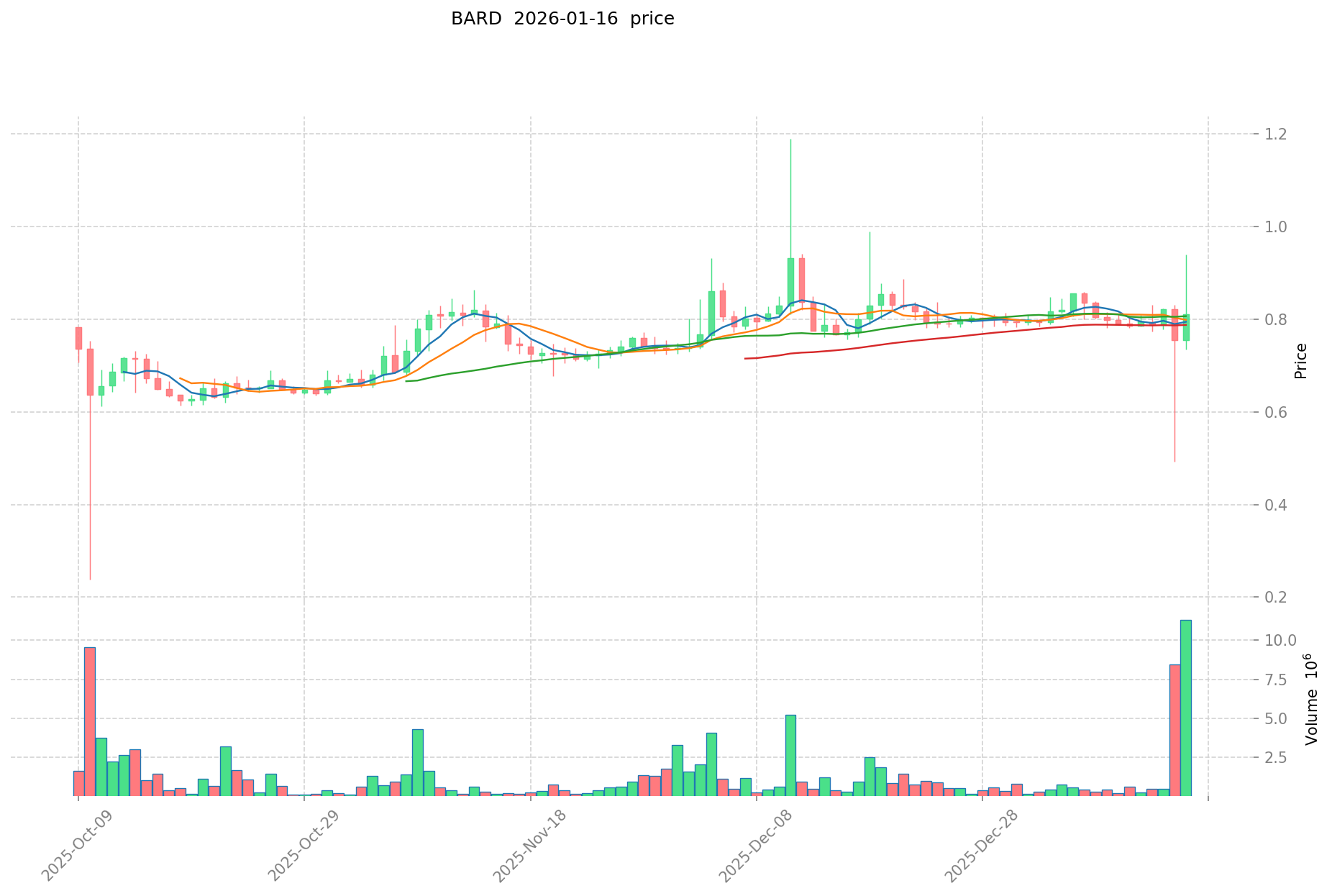
I. Lombard (BARD) Price History Review and Current Investment Value
- 2025: BARD token launched in September 2025 → Early investors witnessed initial price discovery phase
- 2025-09-23: BARD reached a notable price level of $1.5345 → Token experienced market attention during initial trading period
- 2025-10-10: Market correction phase → Price adjusted to $0.2373 from previous levels
- 2026-01-16: Recovery trajectory underway → Current trading at $0.7729, reflecting market stabilization
Current BARD Investment Market Status (January 2026)
- Current BARD Price: $0.7729
- 24-hour Trading Volume: $8.19 million
- Market Capitalization: $173.9 million
- Circulating Supply: 225 million BARD (22.5% of total supply)
- Trading Exchanges: Available on 32 exchanges
- Holder Distribution: 35,847 holders
Click to view real-time BARD market price
II. Core Factors Influencing Whether BARD Is a Good Investment
Supply Mechanism and Scarcity (BARD Investment Scarcity)
- Total supply is capped at 1,000,000,000 BARD tokens, with a maximum supply limit in place, potentially creating scarcity over time
- Current circulating supply stands at 225,000,000 tokens, representing 22.5% of the total supply, indicating that 77.5% of tokens remain locked or unvested
- The token unlock schedule presents a significant factor, as approximately 775,000,000 tokens are scheduled to be released over the coming 48 months, which may exert downward pressure on price as supply increases
- Investment significance: while the capped supply structure suggests long-term scarcity potential, the substantial upcoming token unlocks may impact near-term investment returns
Institutional Investment and Mainstream Adoption (Institutional Investment in BARD)
- Current holder count stands at 35,847 addresses as of January 2026, indicating growing user adoption
- BARD is listed on 32 cryptocurrency exchanges, suggesting a moderate level of market accessibility
- The project has gained attention within the Bitcoin DeFi ecosystem, positioning itself as a bridge between Bitcoin holders and decentralized finance opportunities
- Market capitalization currently represents 0.022% of the total cryptocurrency market, indicating relatively early-stage market penetration
Macroeconomic Environment's Impact on BARD Investment
- As a Bitcoin-related DeFi protocol utilizing liquid staked Bitcoin tokens (such as LBTC), BARD's investment appeal may correlate with broader Bitcoin adoption trends
- The project operates within the Ethereum ecosystem (ERC-20 standard), linking its performance to Ethereum network activity and DeFi sector health
- Market sentiment toward decentralized finance protocols influences BARD's investment attractiveness, particularly during periods of innovation in Bitcoin utility expansion
Technology and Ecosystem Development (Technology & Ecosystem for BARD Investment)
- The core technology focuses on liquid staking for Bitcoin, allowing BTC holders to earn yields while maintaining liquidity through LBTC tokens
- The protocol facilitates DeFi participation for Bitcoin holders, addressing a significant market need for Bitcoin utility beyond holding
- Integration with Ethereum-based DeFi protocols expands potential use cases and ecosystem applications
- Long-term investment value depends on the project's ability to attract Bitcoin holders seeking yield opportunities while maintaining security and decentralization standards
III. BARD Future Investment Prediction and Price Outlook (Is Lombard(BARD) worth investing in 2026-2031)
Short-term Investment Prediction (2026, short-term BARD investment outlook)
- Conservative prediction: $0.71 - $0.77
- Neutral prediction: $0.77 - $0.85
- Optimistic prediction: $0.85 - $1.03
Based on the current market dynamics and technical indicators, BARD demonstrates mixed signals in the short term. The token recently experienced a decline of approximately 3.7% over 24 hours, with the Relative Strength Index (RSI) moderating from near-overbought levels (71 on December 18) to around 62.98, suggesting cooling momentum. However, the project's integration with established DeFi infrastructure through Chainlink CCIP and Symbiotic, combined with its core product LBTC's expanding adoption across multiple chains, may provide support for price stabilization. The 24-hour trading volume of approximately $8.19 million indicates sustained market interest, though investors should monitor whether BARD can maintain support above the recent low of $0.76.
Mid-term Investment Outlook (2027-2029, mid-term Lombard(BARD) investment forecast)
- Market stage expectation: Expansion phase characterized by ecosystem development and cross-chain integration
- Investment return prediction:
- 2027: $0.50 - $1.06 (representing potential growth of 16% from 2026 baseline)
- 2028: $0.52 - $1.31 (representing potential growth of 26% from 2026 baseline)
- 2029: $0.86 - $1.41 (representing potential growth of 48% from 2026 baseline)
- Key catalysts: Enhanced security infrastructure through staking mechanisms, expanded protocol utility within the Lombard ecosystem, increasing Bitcoin liquidity staking adoption, and strengthened partnerships with leading DeFi protocols
The mid-term outlook for BARD appears moderately positive, contingent upon the successful implementation of Lombard's roadmap. The protocol's value proposition centers on transforming Bitcoin from a passive holding into a yield-generating, productive asset through LBTC. As the Total Value Locked (TVL) grows with increased Bitcoin staking and LBTC conversion, demand for BARD may correspondingly increase. The token's dual functionality as both a governance and utility token, particularly its role in securing LBTC cross-chain transactions, positions it as integral to the protocol's operations. However, investors should remain cognizant of market volatility and the competitive landscape within the Bitcoin DeFi sector.
Long-term Investment Outlook (Is BARD a good long-term investment?)
- Baseline scenario: $0.87 - $1.37 (assumes steady development and moderate mainstream application growth)
- Optimistic scenario: $1.28 - $1.96 (assumes accelerated adoption and favorable market conditions)
- Risk scenario: $0.71 - $0.95 (under adverse market conditions or execution challenges)
Click to view BARD long-term investment and price prediction: Price Prediction
2026-01-16 to 2031 Long-term Outlook
- Base scenario: $0.88 - $1.37 USD (corresponding to steady progress and gradual mainstream application expansion)
- Optimistic scenario: $1.28 - $1.96 USD (corresponding to large-scale adoption and favorable market environment)
- Transformative scenario: Above $1.96 USD (contingent upon breakthrough ecosystem developments and mainstream proliferation)
- 2031-12-31 predicted high: $1.96 USD (based on optimistic development assumptions)
The long-term investment thesis for BARD hinges on whether Lombard can successfully establish LBTC as the standard for Bitcoin participation in DeFi. The protocol's innovative approach to Bitcoin liquidity staking, combined with its multi-party security architecture and integration with Babylon's consensus mechanism, provides a solid technical foundation. The collaboration with established infrastructure providers like Chainlink enhances the credibility and operational security of cross-chain transfers. Furthermore, the token's restaking capabilities through partnerships with Symbiotic add additional utility dimensions within the DeFi ecosystem.
However, several considerations warrant attention. The current circulation ratio of 22.5% indicates significant token supply yet to enter the market, which may exert downward pressure on prices depending on release schedules. Additionally, the project currently trades at a market cap of approximately $173.9 million with a fully diluted valuation of $772.9 million, suggesting room for both growth and potential dilution effects. The token's performance over the past year, showing a decline of approximately 52.62%, reflects broader market corrections and early-stage project volatility.
Investors considering BARD for long-term holdings should evaluate the protocol's ability to sustain and grow its TVL, expand LBTC adoption across multiple blockchain networks, maintain strategic partnerships, and navigate the evolving regulatory landscape for crypto assets. While the project addresses a significant opportunity in unlocking Bitcoin's utility for DeFi applications, success is not guaranteed and depends on execution capabilities, market acceptance, and competitive dynamics within the rapidly evolving Bitcoin DeFi sector.
Disclaimer: The information provided constitutes price predictions and market analysis for reference purposes only and does not constitute investment advice. Cryptocurrency investments involve substantial risk, including the potential loss of principal. Past performance does not guarantee future results. Investors should conduct independent research, consider their risk tolerance and financial situation, and consult with qualified financial advisors before making investment decisions. Price predictions are inherently speculative and subject to numerous variables beyond analytical control.
| Year |
Predicted High Price |
Predicted Average Price |
Predicted Low Price |
Price Change |
| 2026 |
1.0341 |
0.766 |
0.71238 |
0 |
| 2027 |
1.062059 |
0.90005 |
0.4950275 |
16 |
| 2028 |
1.31461303 |
0.9810545 |
0.519958885 |
26 |
| 2029 |
1.41183553095 |
1.147833765 |
0.86087532375 |
48 |
| 2030 |
1.4590114986915 |
1.279834647975 |
0.9470776395015 |
65 |
| 2031 |
1.958274994866547 |
1.36942307333325 |
0.87643076693328 |
77 |
IV. Lombard Investment Strategy and Risk Management (How to invest in DeFi tokens)
Investment Methodology (Lombard investment strategy)
Long-term Holding (HODL Lombard): Suitable for conservative investors
For investors seeking steady accumulation, holding LBTC tokens over extended periods may align with the broader adoption trajectory of liquid staking solutions in the Bitcoin ecosystem. This approach minimizes transaction costs and reduces exposure to short-term volatility. Given LBTC's focus on enabling yield generation from Bitcoin holdings, long-term holders may benefit from protocol upgrades and expanding DeFi integration opportunities.
Active Trading: Reliant on technical analysis and swing operations
Traders employing technical analysis may leverage LBTC's price movements, which have shown considerable fluctuation since its launch. With a 24-hour trading volume of approximately $8.19 million and recent price changes of -3.7% (24H) and -3.74% (7D), active traders could capitalize on intraday volatility. Key technical indicators such as support levels near $0.7606 and resistance around $0.9399 may guide entry and exit decisions. However, this strategy requires continuous market monitoring and disciplined risk management.
Risk Management (Risk management for Lombard investment)
Asset Allocation Ratio: Conservative / Aggressive / Professional investors
- Conservative investors: Allocate 2-5% of total crypto portfolio to LBTC, balancing exposure with established assets like Bitcoin and Ethereum
- Aggressive investors: Consider 5-10% allocation for higher growth potential, while maintaining diversification across DeFi protocols
- Professional investors: May dedicate 10-15% to LBTC within specialized DeFi portfolios, employing advanced hedging techniques
Risk Hedging Solutions: Multi-asset portfolio + hedging instruments
Investors may mitigate concentration risk through diversified holdings across Bitcoin, liquid staking derivatives, and stablecoin positions. Options strategies, where available on supporting platforms, could provide downside protection during market corrections. Given LBTC's correlation with Bitcoin's price movements, inverse correlation assets may serve as portfolio stabilizers.
Secure Storage: Hot/cold wallets + hardware wallet recommendations
LBTC operates on the Ethereum blockchain (ERC-20 standard), requiring compatible storage solutions:
- Hardware wallets: Ledger Nano X, Trezor Model T support ERC-20 tokens with enhanced security features
- Cold storage: Air-gapped wallets for long-term holdings exceeding $10,000
- Hot wallets: MetaMask, Trust Wallet for active trading, with amount limits under $5,000
- Multi-signature wallets: Gnosis Safe for institutional holdings requiring distributed custody
Regular security audits of wallet software and firmware updates remain essential protective measures.
V. Lombard Investment Risks and Challenges (Risks of investing in DeFi tokens)
Market Risk: High volatility and price manipulation
LBTC has experienced significant price fluctuation, with a one-year decline of -52.62% from its all-time high of $1.5345 (September 23, 2025) to current levels around $0.7729. The token's relatively modest market capitalization of approximately $173.9 million (ranked #262) may expose it to amplified volatility compared to larger-cap assets. With a circulating supply representing 22.5% of total supply, future token unlocks could exert additional downward price pressure. Lower liquidity environments may facilitate price manipulation through concentrated trading activity.
Regulatory Risk: Policy uncertainty across different jurisdictions
Liquid staking derivatives face evolving regulatory scrutiny globally. Jurisdictions may classify LBTC differently—as securities, commodities, or utility tokens—affecting trading availability and compliance requirements. Regulatory developments concerning Bitcoin staking mechanisms, DeFi protocols, and cross-border token transfers could impact LBTC's operational framework. Investors should monitor regulatory announcements from the SEC, EU financial authorities, and Asian regulators that may influence market access.
Technical Risk: Network security vulnerabilities and upgrade failures
As an ERC-20 token dependent on Ethereum's infrastructure, LBTC inherits base-layer risks including network congestion, gas fee spikes, and potential smart contract vulnerabilities. Protocol-specific risks include:
- Smart contract exploits affecting the LBTC minting and redemption mechanisms
- Oracle failures impacting Bitcoin-to-LBTC conversion rates
- Cross-chain bridge vulnerabilities if expanding beyond Ethereum
- Governance risks related to protocol parameter changes
With 35,847 holders, concentrated token distribution could amplify governance attack vectors. Investors should review ongoing security audits and bug bounty program disclosures.
VI. Conclusion: Is DeFi Liquid Staking a Good Investment?
Investment Value Summary: Lombard presents notable long-term potential within the Bitcoin DeFi ecosystem, yet faces considerable short-term price volatility.
LBTC's core proposition—unlocking Bitcoin liquidity through staking derivatives—addresses a significant market gap as Bitcoin holders seek yield opportunities. The protocol's integration with DeFi platforms could drive adoption as the Bitcoin staking narrative matures. However, the token's -52.62% annual decline and modest 22.5% circulation ratio suggest caution regarding near-term price stability. Market capitalization of $173.9 million positions LBTC as a mid-cap DeFi project with growth potential contingent on protocol adoption and competitive differentiation.
Investor Recommendations:
✅ Beginners: Employ dollar-cost averaging (DCA) with 1-3% portfolio allocation + secure storage via hardware wallets
- Start with small monthly investments ($50-$200) to reduce timing risk
- Prioritize learning about ERC-20 token management and DeFi fundamentals
- Use reputable exchanges with strong security records for initial purchases
✅ Experienced Investors: Implement swing trading strategies + diversified portfolio configuration
- Monitor technical indicators and volume patterns for entry/exit optimization
- Combine LBTC with complementary DeFi positions (lending protocols, DEX tokens)
- Set stop-loss orders at 15-20% below entry points to manage downside exposure
✅ Institutional Investors: Strategic long-term allocation within DeFi-focused portfolios
- Conduct thorough due diligence on protocol governance and security infrastructure
- Evaluate LBTC against competing liquid staking solutions for Bitcoin
- Consider hedging strategies using correlated assets or derivatives where available
⚠️ Notice: Cryptocurrency investment carries substantial risk. This content is for informational purposes only and does not constitute investment advice. Conduct independent research and consult financial professionals before making investment decisions.
VII. FAQ
Q1: Is Lombard (BARD) a good investment for beginners in 2026?
BARD may be suitable for beginners with moderate risk tolerance, but requires careful consideration of its volatility profile. As a mid-cap DeFi token with a market capitalization of $173.9 million and recent price decline of 52.62% from its all-time high, BARD exhibits significant short-term volatility that may challenge inexperienced investors. Beginners should employ dollar-cost averaging strategies with 1-3% portfolio allocation, utilize hardware wallets for secure storage, and thoroughly understand the Bitcoin liquid staking mechanism before investing. The token's accessibility across 32 exchanges and growing holder base of 35,847 addresses suggests reasonable liquidity, but the substantial 77.5% of tokens yet to be released may create downward price pressure. New investors should prioritize education about ERC-20 token management and DeFi fundamentals before committing capital to BARD.
Q2: What is the expected BARD price prediction for 2027-2029?
Mid-term predictions for BARD suggest gradual appreciation with considerable range variability. For 2027, analysts project prices between $0.50-$1.06 (representing 16% potential growth from 2026 baseline), expanding to $0.52-$1.31 in 2028 (26% potential growth), and $0.86-$1.41 by 2029 (48% potential growth). These projections assume successful implementation of Lombard's roadmap, including enhanced security infrastructure, expanded protocol utility, and increased Bitcoin liquidity staking adoption. Key catalysts include growing Total Value Locked (TVL) through increased Bitcoin staking and LBTC conversion, strengthened partnerships with leading DeFi protocols, and successful cross-chain integration via Chainlink CCIP. However, investors should recognize that these predictions carry substantial uncertainty given the competitive Bitcoin DeFi landscape, token unlock schedule, and broader cryptocurrency market volatility.
Q3: How does BARD's token unlock schedule affect investment returns?
BARD's token unlock schedule represents a critical risk factor for potential investors. Currently, only 22.5% of the total 1 billion token supply is circulating (225 million tokens), with approximately 775 million tokens scheduled for release over the next 48 months. This substantial upcoming supply expansion may exert significant downward pressure on token price as new tokens enter circulation, particularly if demand growth fails to match supply increases. The unlocking mechanism introduces selling pressure from early investors, team members, and protocol reserves, potentially limiting near-term price appreciation despite positive protocol developments. Investors should monitor the specific unlock schedule, vesting periods, and lockup terms to assess timing of potential supply shocks. This supply overhang partially explains the wide price prediction ranges and suggests that BARD may experience prolonged price suppression until a larger portion of the supply achieves circulation and market absorption.
Q4: What are the main risks associated with investing in BARD?
BARD investment carries multiple risk vectors across market, regulatory, and technical dimensions. Market risk manifests through high volatility, evidenced by the 52.62% decline from all-time high and modest market capitalization that may facilitate price manipulation. The token's relatively low liquidity compared to major cryptocurrencies increases susceptibility to large-order impact and concentrated trading activity. Regulatory risk stems from evolving global frameworks for liquid staking derivatives, with potential classification variations across jurisdictions affecting trading availability and compliance requirements. Technical risks include Ethereum network dependencies (gas fees, congestion), smart contract vulnerabilities in LBTC minting/redemption mechanisms, potential oracle failures impacting Bitcoin-to-LBTC conversion rates, and governance risks from concentrated token distribution among 35,847 holders. Additionally, competitive pressures within the Bitcoin DeFi sector and execution challenges in protocol development may impair long-term value realization.
Q5: How does BARD compare to other Bitcoin liquid staking tokens?
BARD distinguishes itself through Lombard's integration with established DeFi infrastructure, including Chainlink CCIP for cross-chain functionality and Symbiotic for restaking capabilities, while partnering with Babylon's consensus mechanism for enhanced security. The protocol's multi-party security architecture and focus on transforming Bitcoin into a yield-generating asset through LBTC position it competitively within the emerging Bitcoin DeFi sector. However, comparative evaluation requires assessing total value locked (TVL), security audit history, cross-chain compatibility, and partnership ecosystem relative to competitors. BARD's current market position at rank #262 with $173.9 million market cap suggests it operates in the mid-tier segment, potentially offering higher growth potential than established leaders but carrying greater execution risk than proven protocols. The token's dual functionality as governance and utility token, particularly its role in securing LBTC cross-chain transactions, provides integrated protocol alignment that may enhance long-term value capture compared to purely governance-focused alternatives.
Q6: What is the recommended portfolio allocation for BARD investment?
Recommended BARD allocation varies significantly based on investor profile and risk tolerance. Conservative investors should limit exposure to 2-5% of total cryptocurrency portfolio, balancing BARD with established assets like Bitcoin and Ethereum to mitigate concentration risk. Aggressive investors pursuing higher growth potential may allocate 5-10% while maintaining diversification across DeFi protocols and liquid staking derivatives. Professional investors with specialized DeFi portfolios and advanced risk management capabilities might dedicate 10-15% to BARD, employing hedging techniques through options strategies (where available) and inverse correlation assets. All allocation recommendations assume BARD represents only a portion of a diversified cryptocurrency portfolio, not standalone investment concentration. Investors should regularly rebalance positions based on market conditions, protocol developments, and personal financial circumstances, while maintaining secure storage through hardware wallets (Ledger Nano X, Trezor Model T) for amounts exceeding $10,000 and hot wallets (MetaMask, Trust Wallet) for active trading positions under $5,000.
Q7: Can BARD reach $2 by 2031?
BARD reaching $2 by 2031 represents an optimistic but not impossible scenario, contingent upon multiple favorable developments. Current long-term predictions suggest a 2031 high of $1.96 under optimistic assumptions, placing the $2 threshold within reach under transformative scenarios involving breakthrough ecosystem developments and mainstream Bitcoin DeFi adoption. Achieving this price target would require: (1) successful establishment of LBTC as the standard for Bitcoin participation in DeFi, (2) substantial Total Value Locked (TVL) growth through increased Bitcoin staking, (3) expanded cross-chain integration across multiple blockchain networks, (4) sustained strategic partnerships with leading DeFi protocols, (5) favorable regulatory environment for liquid staking derivatives, and (6) broader cryptocurrency market bull cycle. However, investors should recognize that this represents a 159% increase from current levels ($0.7729), requiring compound annual growth rate (CAGR) of approximately 20% over five years. Significant obstacles include the token unlock schedule, competitive dynamics within Bitcoin DeFi, execution challenges, and broader market volatility that may prevent realization of optimistic price targets.
Q8: What security measures should BARD investors implement?
BARD investors should prioritize multi-layered security approaches tailored to holding size and trading frequency. For long-term holdings exceeding $10,000, hardware wallets (Ledger Nano X, Trezor Model T) provide optimal security through offline private key storage and ERC-20 compatibility. Cold storage solutions using air-gapped wallets eliminate online exposure for maximum protection of substantial positions. Active traders managing positions under $5,000 may utilize hot wallets (MetaMask, Trust Wallet) with enhanced security settings including two-factor authentication, biometric verification, and regular password rotation. Institutional investors should implement multi-signature wallets through Gnosis Safe for distributed custody requiring multiple authorization parties. Universal security practices include: (1) regular wallet software and firmware updates, (2) verification of contract addresses before transactions, (3) use of dedicated devices for crypto transactions, (4) backup of recovery phrases in secure physical locations, (5) avoidance of public WiFi for wallet access, and (6) continuous monitoring of wallet activity for unauthorized transactions. Given BARD's ERC-20 standard, investors must also remain vigilant about Ethereum network phishing attempts and fraudulent token contracts.
* The information is not intended to be and does not constitute financial advice or any other recommendation of any sort offered or endorsed by Gate.