This comprehensive analysis evaluates whether Lombard (BARD) represents a viable investment opportunity within the DeFi sector. Trading at $0.78 with a $175.97 million market cap, BARD is a governance token for a liquid staking protocol enabling Bitcoin holders to earn DeFi yields through LBTC innovation. The article examines BARD's price history showing a peak of $1.5345 and recent -51.66% decline, analyzes key investment factors including supply mechanics and ecosystem development, and projects long-term price trajectories reaching $1.53 by 2031 under optimistic scenarios. Strategic recommendations allocate 1-15% portfolio exposure based on investor profiles, emphasizing dollar-cost averaging and secure hardware wallet storage. Critical risk factors include extreme volatility, regulatory uncertainty, smart contract vulnerabilities, and 77.5% of tokens remaining locked in vesting schedules. The analysis concludes BARD suits risk-tolerant investors seeking Bitcoin DeFi exposure but requires disciplined risk m
Introduction: Lombard (BARD) Investment Position and Market Outlook
BARD represents a notable asset in the cryptocurrency sector, having been launched in 2025 as part of the Lombard DeFi initiative. As of January 2026, Lombard (BARD) maintains a market capitalization of approximately $175.97 million with a circulating supply of 225 million tokens, currently trading around $0.78. Positioned as a liquid staked Bitcoin token that facilitates yield earning and DeFi participation, BARD has drawn attention from investors evaluating "Is Lombard (BARD) a good investment?" The token ranks 260th by market capitalization and holds a market dominance of 0.023%, with trading activity across 32 exchanges and a holder base of approximately 35,847 addresses. This article provides a comprehensive analysis of BARD's investment characteristics, historical performance trends, future price outlook considerations, and associated investment risks to serve as a reference for potential investors.
I. Lombard (BARD) Price History Review and Current Investment Value Status
- 2025: Token Launch and Initial Trading Phase → BARD experienced significant volatility during its early trading period, with prices fluctuating between different exchange listings
- September 2025: Peak Trading Activity → BARD reached a notable price level of $1.5345 during this period, reflecting initial market enthusiasm
- October 2025 to January 2026: Market Adjustment Period → The token experienced a correction phase, with prices adjusting from higher levels to approximately $0.7821
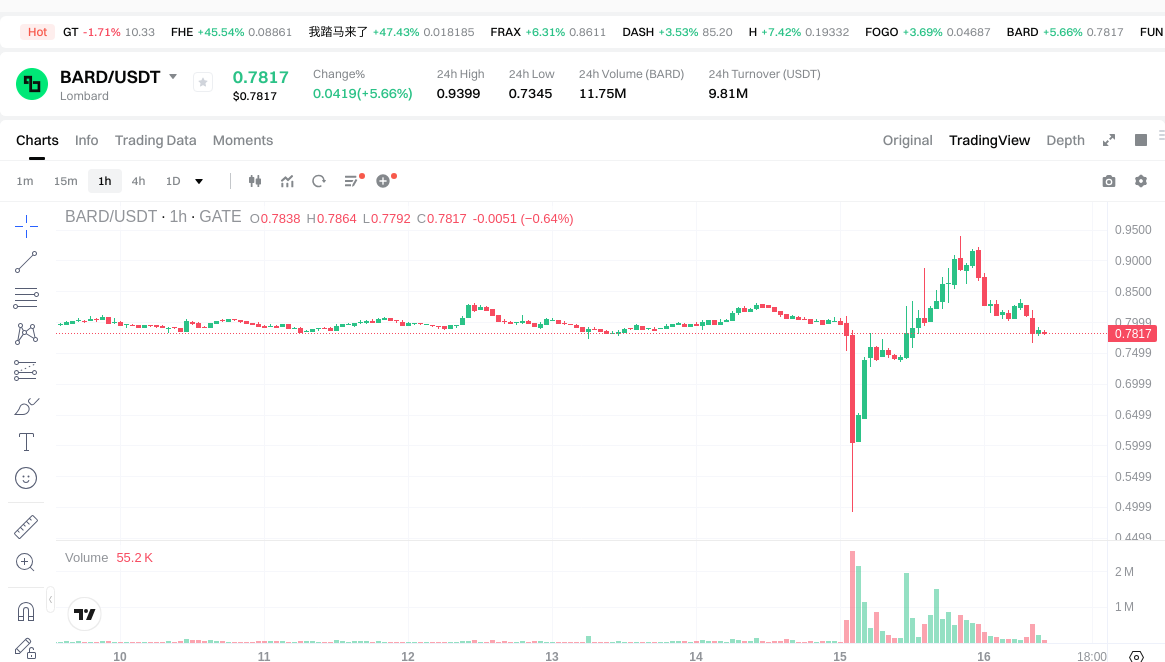
Current BARD Investment Market Status (January 2026)
- BARD current price: $0.7821
- 24-hour trading volume: $9,806,676.40
- Circulating supply: 225,000,000 BARD tokens (22.5% of total supply)
- Market capitalization: $175,972,500
- Number of holders: 35,847
- Available on 32 exchanges with Gate.com trading support
Click to view real-time BARD market price
- 1-hour change: +0.13%
- 24-hour change: +5.51%
- 7-day change: -1.26%
- 30-day change: +2.87%
- 1-year change: -51.66%
The token operates on the Ethereum blockchain using the ERC-20 standard, with its contract address verified on Etherscan. The fully diluted market cap stands at $782,100,000, based on a maximum supply of 1,000,000,000 tokens.
II. Core Factors Influencing Whether BARD is a Good Investment
Supply Mechanism and Scarcity (BARD Investment Scarcity)
-
Supply structure and circulation dynamics → BARD operates with a total supply of 1,000,000,000 tokens and a maximum supply cap of 1,000,000,000 tokens. Currently, 225,000,000 tokens are in circulation, representing 22.5% of the total supply. This indicates that 77.5% of the supply remains locked or unvested, which could influence price dynamics as tokens are gradually released into the market over the vesting period.
-
Token unlock schedule and market pressure → According to available data, a significant portion of the supply (77.5%) is subject to unlocks over a 48-month vesting period. The gradual release of tokens may create selling pressure, particularly if unlock events coincide with weak market conditions. Investors should monitor the token unlock schedule as a factor that could impact short- to medium-term price movements.
-
Investment significance of scarcity → While the circulating supply is currently limited at 22.5% of total supply, the predetermined maximum supply cap provides clarity on long-term scarcity. However, the investment value related to scarcity must be weighed against the substantial pending unlocks, which may dilute the scarcity premium over time.
Institutional Investment and Mainstream Adoption (Institutional Investment in BARD)
-
Holder distribution and adoption metrics → As of the latest data, BARD has approximately 35,847 holders. The token is listed on 32 exchanges, indicating a level of market accessibility and liquidity. The presence of BARD on multiple trading platforms suggests a degree of institutional and retail interest, though specific data on institutional ownership or large-scale enterprise adoption was not provided in the reference materials.
-
Bitcoin DeFi narrative and LBTC utility → Lombard's core product, LBTC (Liquid Staked Bitcoin), aims to unlock Bitcoin's utility in decentralized finance by enabling yield generation and DeFi participation. This positioning within the Bitcoin DeFi sector may attract institutional interest as the narrative around Bitcoin's role in DeFi continues to develop. The success of this narrative could enhance BARD's investment appeal.
-
Regulatory and policy considerations → No specific information was available in the reference materials regarding government policies or regulatory stances directly affecting BARD. Investors should remain aware that regulatory developments in the crypto and DeFi sectors may influence the investment outlook for tokens like BARD.
Macroeconomic Environment's Impact on BARD Investment
-
Monetary policy and interest rate changes → Broader macroeconomic conditions, such as shifts in monetary policy and interest rates, can influence investor appetite for risk assets, including cryptocurrencies. In environments of tightening monetary policy or rising interest rates, speculative assets may face headwinds. Conversely, accommodative policies may support demand for DeFi tokens like BARD.
-
Inflation and alternative asset demand → In periods of elevated inflation, digital assets have been discussed as potential hedges or alternatives to traditional stores of value. However, BARD's specific role in this context is tied to its utility within the Bitcoin DeFi ecosystem rather than as a standalone inflation hedge. Investors should consider how macroeconomic trends interact with Bitcoin's performance and DeFi adoption.
-
Geopolitical uncertainty and risk-on sentiment → Geopolitical instability and uncertainty can drive investors toward perceived safe-haven assets or, alternatively, increase risk aversion. The impact on BARD would depend on broader market sentiment toward cryptocurrencies and DeFi protocols during such periods.
Technology and Ecosystem Development (Technology & Ecosystem for BARD Investment)
-
LBTC and Bitcoin DeFi infrastructure → Lombard's primary innovation is LBTC, a liquid staked Bitcoin token designed to facilitate yield earning and participation in decentralized finance. This technology aims to address Bitcoin's traditionally limited role in DeFi by providing liquidity and staking functionality. The success and adoption of LBTC are central to BARD's long-term value proposition.
-
ERC-20 standard and Ethereum ecosystem integration → BARD is deployed as an ERC-20 token on the Ethereum blockchain (contract address: 0xf0db65d17e30a966c2ae6a21f6bba71cea6e9754). This integration with Ethereum's ecosystem provides access to a wide range of DeFi protocols, decentralized exchanges, and liquidity pools, which may support broader ecosystem growth and utility.
-
Community engagement and development activity → Lombard maintains active community channels, including a Discord server and Twitter presence. The project's documentation (whitepaper) is available at docs.lombard.finance. While these indicate ongoing engagement, specific details on development milestones, partnerships, or ecosystem expansion were not extensively covered in the provided materials. Investors should evaluate the project's roadmap execution and developer activity as part of assessing long-term investment potential.
-
DeFi, NFT, and payment application potential → The reference materials did not provide specific information regarding BARD's direct involvement in NFT or payment applications. The primary focus remains on Bitcoin DeFi and LBTC utility within that context. Future ecosystem expansion into adjacent areas could provide additional investment upside, but such developments would require monitoring.
III. BARD Future Investment Prediction and Price Outlook (Is Lombard (BARD) Worth Investing in 2026-2031)
Short-term Investment Prediction (2026, Short-term BARD Investment Outlook)
- Conservative prediction: $0.66 - $0.78
- Neutral prediction: $0.78 - $0.89
- Optimistic prediction: $0.89 - $1.01
Mid-term Investment Outlook (2027-2029, Mid-term Lombard (BARD) Investment Forecast)
-
Market stage expectations: BARD is anticipated to experience gradual expansion during this period, driven by continued adoption of LBTC within DeFi ecosystems and strengthened partnerships with infrastructure protocols such as Chainlink and Symbiotic. Protocol maturation and multi-chain integration efforts may support moderate price appreciation.
-
Investment return prediction:
- 2027: $0.65 - $0.92
- 2028: $0.86 - $1.24
- 2029: $0.85 - $1.33
-
Key catalysts: Expansion of LBTC adoption across DeFi platforms, enhanced cross-chain security mechanisms, protocol governance developments, and broader Bitcoin liquid staking market growth.
Long-term Investment Outlook (Is BARD a Good Long-term Investment?)
- Baseline scenario: $0.97 - $1.31 (assuming steady protocol adoption and stable market conditions)
- Optimistic scenario: $1.09 - $1.53 (assuming accelerated LBTC integration, favorable regulatory environment, and increased Bitcoin DeFi participation)
- Risk scenario: $0.66 - $0.85 (under conditions of market contraction, competitive pressure, or technical setbacks)
Click to view BARD long-term investment and price prediction: Price Prediction
2026-2031 Long-term Outlook
- Base scenario: $0.78 - $1.20 USD (corresponding to steady progress and gradual mainstream application adoption)
- Optimistic scenario: $1.00 - $1.53 USD (corresponding to large-scale adoption and favorable market environment)
- Transformative scenario: Above $1.53 USD (in case of breakthrough ecosystem developments and mainstream popularization)
- December 31, 2031 predicted high: $1.53 USD (based on optimistic development assumptions)
Disclaimer: Price predictions are based on historical data analysis, current market trends, and project fundamentals. Cryptocurrency markets are highly volatile and subject to numerous unpredictable factors. These forecasts should not be considered as financial advice. Investors should conduct thorough research and assess their own risk tolerance before making any investment decisions.
| Year |
Predicted High Price |
Predicted Average Price |
Predicted Low Price |
Price Change |
| 2026 |
1.008006 |
0.7814 |
0.66419 |
0 |
| 2027 |
0.92154409 |
0.894703 |
0.65313319 |
14 |
| 2028 |
1.2350480212 |
0.908123545 |
0.86271736775 |
16 |
| 2029 |
1.328766371044 |
1.0715857831 |
0.846552768649 |
37 |
| 2030 |
1.30819192400848 |
1.200176077072 |
1.09216023013552 |
53 |
| 2031 |
1.530104480659092 |
1.25418400054024 |
0.965721680415984 |
60 |
IV. Lombard Investment Strategy and Risk Management (How to invest in DeFi tokens)
Investment Methodology (Lombard investment strategy)
Long-term Holding (HODL Lombard)
For conservative investors seeking exposure to Bitcoin DeFi innovation, a long-term holding strategy may be considered. This approach involves:
- Accumulating BARD tokens during market corrections
- Holding through market cycles to benefit from potential protocol adoption growth
- Monitoring the development of Lombard's liquid staking ecosystem and LBTC utility expansion
Given Lombard's focus on transforming Bitcoin utility through liquid staking, long-term holders should track metrics such as total value locked (TVL), LBTC adoption rates, and integration with major DeFi protocols.
Active Trading
For traders with technical analysis capabilities, active trading strategies may involve:
- Monitoring price volatility patterns (24-hour range: $0.7345 - $0.9399 as of January 16, 2026)
- Utilizing technical indicators to identify entry and exit points
- Implementing stop-loss orders to manage downside risk
- Capitalizing on short-term price movements driven by market sentiment and trading volume ($9.81M in 24-hour volume)
Traders should be aware that BARD has experienced significant volatility, with the token showing a 5.51% increase over 24 hours but a -51.66% decline over one year from its historical high of $1.5345.
Risk Management (Risk management for Lombard investment)
Asset Allocation Ratio
Conservative Investors:
- Allocation: 1-3% of crypto portfolio
- Focus on established assets with majority allocation to Bitcoin and Ethereum
- Limited exposure to emerging DeFi protocols
Moderate Investors:
- Allocation: 3-7% of crypto portfolio
- Balanced approach with core holdings supplemented by selective DeFi exposure
- Regular rebalancing based on market conditions
Aggressive/Professional Investors:
- Allocation: 7-15% of crypto portfolio
- Active position management with higher risk tolerance
- Sophisticated strategies including yield farming and liquidity provision
Risk Hedging Solutions
Multi-asset Portfolio Construction:
- Combine BARD with Bitcoin exposure to align with protocol fundamentals
- Include stablecoins to provide liquidity during market downturns
- Diversify across different DeFi sectors (lending, DEX, liquid staking)
Risk Mitigation Tools:
- Set predetermined exit points based on percentage drawdowns
- Use dollar-cost averaging to reduce timing risk
- Monitor protocol-specific risks including smart contract audits and security measures
Secure Storage
Cold and Hot Wallet Management:
Since BARD is an ERC-20 token (contract address: 0xf0db65d17e30a966c2ae6a21f6bba71cea6e9754), investors should implement proper storage solutions:
- Cold Storage (Long-term holdings): Transfer majority of tokens to hardware wallets for enhanced security
- Hot Wallets (Active trading): Maintain minimal amounts on exchanges for trading purposes
- Implement multi-signature wallets for large holdings
Hardware Wallet Recommendations:
- Research reputable hardware wallet providers compatible with ERC-20 tokens
- Verify wallet firmware authenticity before use
- Store recovery phrases securely in multiple physical locations
- Never share private keys or recovery phrases
V. Lombard Investment Risks and Challenges (Risks of investing in DeFi tokens)
Market Risks
High Volatility:
Lombard exhibits substantial price volatility characteristic of emerging DeFi protocols:
- Historical price range: $0.2373 (October 10, 2025) to $1.5345 (September 23, 2025)
- Recent 24-hour volatility: 28% range between high and low
- One-year performance shows a -51.66% decline, indicating significant downside risk
This volatility creates both opportunities and risks, with potential for rapid gains or losses within short timeframes.
Price Manipulation Concerns:
With a circulating supply of 225 million tokens (22.5% of total supply) and a relatively small market capitalization of approximately $176 million, BARD may be susceptible to:
- Large holder influence on price movements
- Lower liquidity compared to established cryptocurrencies
- Potential for coordinated trading activities affecting price discovery
Regulatory Risks
Jurisdictional Uncertainty:
As a DeFi protocol operating in the Bitcoin liquid staking space, Lombard faces evolving regulatory landscapes:
- Varying classification of liquid staking tokens across jurisdictions
- Potential scrutiny of DeFi protocols by regulatory authorities
- Uncertain tax treatment of staking rewards and liquid staking derivatives
- Compliance requirements that may emerge for decentralized protocols
Investors should monitor regulatory developments in their jurisdictions, particularly regarding:
- Securities classification of governance tokens
- DeFi protocol registration requirements
- Cross-border transaction restrictions
Technical Risks
Smart Contract Vulnerabilities:
As an ERC-20 token deployed on Ethereum, BARD carries inherent smart contract risks:
- Potential code vulnerabilities that could be exploited
- Dependency on Ethereum network security and stability
- Risks associated with protocol upgrades and parameter changes
- Bridge security concerns if LBTC operates across multiple chains
Protocol-Specific Risks:
- Liquid staking mechanism failures affecting LBTC peg stability
- Integration risks with third-party DeFi protocols
- Oracle dependencies for price feeds and data accuracy
- Potential network congestion affecting transaction execution
Upgrade and Governance Risks:
- Protocol changes that may not align with all stakeholder interests
- Coordination challenges in decentralized governance
- Technical implementation risks during system upgrades
VI. Conclusion: Is DeFi Token a Good Investment?
Investment Value Summary
Lombard presents a unique value proposition in the Bitcoin DeFi ecosystem through its liquid staking approach with LBTC. The protocol addresses a significant market opportunity by enabling Bitcoin holders to earn yields while maintaining liquidity. However, the investment case is characterized by:
Potential Upside:
- Innovation in Bitcoin utility and DeFi integration
- Growing adoption of liquid staking solutions
- Relatively low circulating supply (22.5%) suggesting potential supply constraints
Significant Risks:
- Substantial price volatility with a -51.66% decline over one year
- Early-stage protocol with limited operational history
- Concentrated token distribution with 77.5% of supply yet to circulate
- High correlation with broader crypto market sentiment
The long-term investment potential depends on successful protocol adoption, sustained user growth, and LBTC integration across DeFi ecosystems. Short-term price movements remain highly volatile and susceptible to market sentiment shifts.
Investor Recommendations
✅ Beginners:
- Limit exposure to 1-3% of total crypto portfolio
- Implement dollar-cost averaging to mitigate timing risk
- Utilize secure hardware wallets for token storage
- Thoroughly research the protocol mechanics before investing
- Avoid using leverage or margin trading
- Only invest amounts you can afford to lose entirely
✅ Experienced Investors:
- Consider tactical allocations of 3-7% based on risk tolerance
- Employ technical analysis for entry and exit points
- Diversify across multiple DeFi protocols and sectors
- Monitor protocol metrics including TVL and LBTC adoption
- Set predetermined profit-taking and stop-loss levels
- Stay informed about protocol developments and governance proposals
✅ Institutional Investors:
- Conduct comprehensive due diligence on protocol security and audits
- Evaluate strategic allocation within broader DeFi exposure
- Implement robust risk management frameworks
- Consider custody solutions for large holdings
- Monitor regulatory developments across relevant jurisdictions
- Assess liquidity requirements for position sizing
⚠️ Disclaimer: Cryptocurrency investments carry substantial risks including total loss of capital. Market volatility, regulatory uncertainty, and technical vulnerabilities present significant challenges. This analysis is provided for informational purposes only and does not constitute financial advice, investment recommendations, or an endorsement of any particular strategy. Investors should conduct independent research, consult with qualified financial advisors, and carefully assess their risk tolerance before making investment decisions. Past performance does not guarantee future results.
VII. FAQ
Q1: What is Lombard (BARD) and what makes it different from other DeFi tokens?
Lombard (BARD) is an ERC-20 governance token for a liquid staking protocol that enables Bitcoin holders to earn yields in DeFi while maintaining liquidity. The protocol's core innovation is LBTC (Liquid Staked Bitcoin), which addresses Bitcoin's traditionally limited role in decentralized finance by providing staking functionality without locking assets. Unlike typical DeFi tokens that focus on Ethereum-based assets, BARD specifically targets the Bitcoin ecosystem, allowing BTC holders to participate in DeFi activities while maintaining exposure to Bitcoin's value. The protocol operates on Ethereum (contract address: 0xf0db65d17e30a966c2ae6a21f6bba71cea6e9754) and integrates with major infrastructure protocols such as Chainlink and Symbiotic.
Q2: How volatile is BARD's price and what are the key price milestones to date?
BARD exhibits substantial price volatility characteristic of emerging DeFi protocols. Since its launch in 2025, the token reached an all-time high of $1.5345 on September 23, 2025, but has experienced a significant correction, declining -51.66% over one year to approximately $0.78 as of January 2026. Recent short-term movements show high volatility, with a 24-hour range between $0.7345 and $0.9399 (28% spread). The historical low was $0.2373 recorded on October 10, 2025. This volatility pattern indicates both significant upside potential and substantial downside risk, making it suitable primarily for investors with high risk tolerance who can withstand dramatic price swings.
Q3: What percentage of my portfolio should I allocate to BARD based on my investor profile?
Allocation recommendations vary by investor experience and risk tolerance. Conservative investors or beginners should limit BARD exposure to 1-3% of their total crypto portfolio, focusing primarily on established assets like Bitcoin and Ethereum. Moderate or experienced investors with technical analysis capabilities may consider 3-7% allocations, implementing active risk management strategies including stop-loss orders and position rebalancing. Aggressive or professional investors might allocate 7-15% while employing sophisticated strategies such as yield farming and liquidity provision. These recommendations account for BARD's high volatility, early-stage protocol status, and the fact that only 22.5% of total supply is currently circulating, with 77.5% remaining locked and subject to vesting over 48 months.
Q4: What are the main technical and security risks associated with investing in BARD?
BARD faces several technical risks inherent to DeFi protocols. As an ERC-20 token, it carries smart contract vulnerabilities that could potentially be exploited, creating risk of fund loss. The protocol depends on Ethereum network security and stability, making it susceptible to network congestion and high transaction costs during peak periods. Specific to Lombard, there are risks related to the liquid staking mechanism, including potential LBTC peg instability, integration failures with third-party DeFi protocols, and oracle dependencies for accurate price feeds. Bridge security concerns arise if LBTC operates across multiple blockchains. Additionally, protocol upgrades and governance changes may introduce coordination challenges and technical implementation risks. Investors should verify that smart contracts have undergone professional security audits and monitor ongoing protocol developments.
Q5: What is BARD's token unlock schedule and how might it impact the price?
BARD has a total supply of 1 billion tokens, with only 225 million (22.5%) currently in circulation. The remaining 775 million tokens (77.5%) are subject to vesting over a 48-month period. This substantial locked supply represents a significant consideration for investors, as gradual token unlocks may create selling pressure, particularly if release events coincide with weak market conditions. The unlock schedule could dilute the current scarcity premium and negatively impact price appreciation in the short to medium term. Investors should actively monitor the token unlock timeline and adjust position sizing accordingly. Large unlock events may present buying opportunities during temporary price dips but also carry increased downside risk if market conditions deteriorate during major release periods.
Q6: What are the long-term price predictions for BARD through 2031?
Long-term forecasts project BARD reaching $1.53 by December 31, 2031 under optimistic development assumptions. The baseline scenario estimates a price range of $0.78-$1.20 through 2031, assuming steady protocol adoption and stable market conditions. The optimistic scenario projects $1.00-$1.53, contingent upon accelerated LBTC integration across DeFi platforms, favorable regulatory developments, and increased Bitcoin DeFi participation. A risk scenario suggests $0.66-$0.85 under conditions of market contraction, competitive pressure, or technical setbacks. Mid-term projections show gradual appreciation: 2027 ($0.65-$0.92), 2028 ($0.86-$1.24), and 2029 ($0.85-$1.33). However, these predictions are subject to extreme uncertainty given cryptocurrency market volatility, regulatory changes, and protocol execution risks.
Q7: How should I securely store my BARD tokens?
Since BARD is an ERC-20 token, proper storage requires a strategic approach balancing security and accessibility. For long-term holdings, transfer the majority of tokens to hardware wallets (cold storage) that support ERC-20 tokens, ensuring enhanced security against online threats. Maintain only minimal amounts on exchanges (hot wallets) for active trading purposes. For large holdings, implement multi-signature wallets requiring multiple approvals for transactions. Research reputable hardware wallet providers and verify firmware authenticity before use. Store recovery phrases securely in multiple physical locations, never digitally. Never share private keys or recovery phrases with anyone. For investors participating in staking or liquidity provision, understand that tokens held in DeFi protocols carry additional smart contract risks compared to self-custody solutions.
Q8: What regulatory risks should I consider before investing in BARD?
BARD operates in an evolving regulatory landscape with significant jurisdictional uncertainty. Key concerns include varying classification of liquid staking tokens across different countries, potential scrutiny of DeFi protocols by regulatory authorities, and uncertain tax treatment of staking rewards and liquid staking derivatives. Compliance requirements may emerge for decentralized protocols, affecting operational viability. Specific regulatory considerations include potential securities classification of governance tokens, DeFi protocol registration requirements that may be imposed, and cross-border transaction restrictions. The protocol's focus on Bitcoin-related activities may attract additional regulatory attention given Bitcoin's status in various jurisdictions. Investors should monitor regulatory developments in their specific countries, consult with tax professionals regarding reporting obligations, and assess whether holding BARD complies with local securities laws before investing.
* The information is not intended to be and does not constitute financial advice or any other recommendation of any sort offered or endorsed by Gate.