This comprehensive guide evaluates whether Loopring (LRC) represents a viable investment opportunity in 2026. As a layer-2 scaling protocol utilizing zkRollup technology on Ethereum, LRC currently trades at $0.05278 with a market capitalization of $65.76 million. The analysis examines LRC's historical price performance, technological fundamentals, and ecosystem positioning within decentralized exchange infrastructure. Key findings indicate that while LRC offers exposure to layer-2 scaling solutions, investors face significant risks including high volatility, modest trading liquidity ($51,542 daily volume), and regulatory uncertainty. Price forecasts range from $0.048-$0.061 in 2026 and potentially $0.07-$0.125 by 2031 under base scenarios. The guide provides tailored investment strategies for beginners (1-3% allocation), experienced traders (swing trading approaches), and institutional investors, emphasizing comprehensive risk management through portfolio diversification and secure storage solutions. Track LR
Introduction: Loopring (LRC) Investment Position and Market Outlook
LRC is a significant asset in the cryptocurrency space. Since its launch in 2017, it has established itself as an open, multi-token trading protocol based on ERC20 and smart contracts. As of January 18, 2026, Loopring maintains a market capitalization of approximately $65.76 million, with a circulating supply of around 1.25 billion tokens, and the current price hovers at $0.05278. With its positioning as a decentralized exchange protocol that enables off-chain order matching and on-chain settlement without asset custody requirements, LRC has gradually become a focal point for investors evaluating "Is Loopring (LRC) a good investment?" The token is listed on 45 exchanges and has attracted over 168,754 holders. This article provides a comprehensive analysis of LRC's investment value, historical performance, future price projections, and associated investment risks to serve as a reference for market participants.
I. Loopring (LRC) Historical Price Review and Current Investment Value
- 2021: Loopring reached a notable price peak → During this period, early investors experienced significant returns as LRC benefited from growing interest in Layer 2 scaling solutions
- 2021-2022: Market cycle transition → LRC price declined from higher levels to lower ranges as broader cryptocurrency market conditions shifted
- 2023-2024: Ongoing market adjustment → LRC continued trading at relatively modest price levels, with the token demonstrating resilience amid competitive Layer 2 ecosystem developments
Current LRC Investment Market Status (January 2026)
- LRC current price: $0.05278
- Market sentiment (Fear & Greed Index): Data indicates neutral market conditions
- 24-hour trading volume: $51,542.95
- Circulating supply: 1,245,991,468.94 LRC tokens
- Market capitalization: $65,763,429.73
- Fully diluted market cap: $72,513,037.92
- Market dominance: 0.0021%
- Token holders: 168,754 addresses
Click to view real-time LRC market price
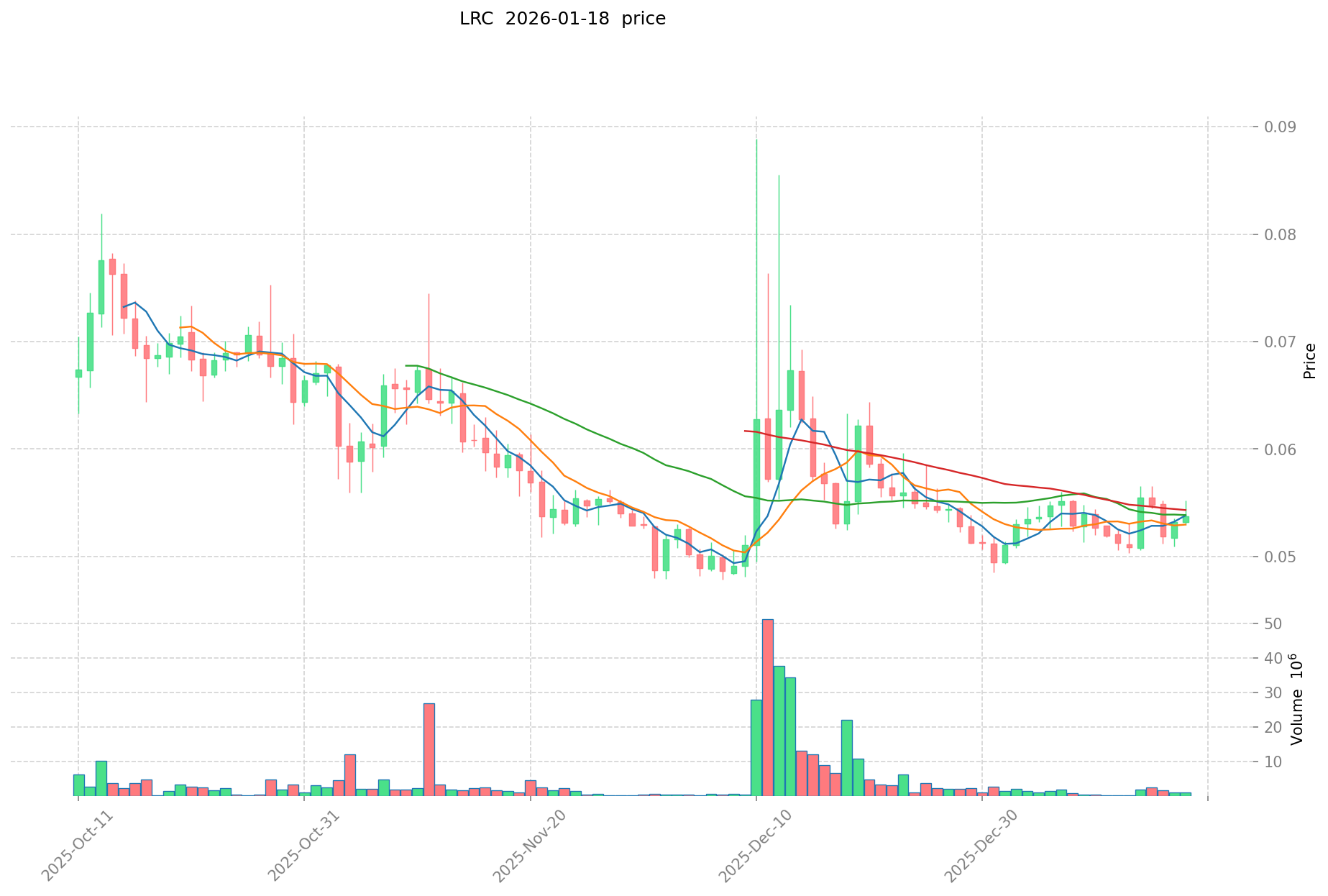
II. Core Factors Influencing Whether LRC is a Good Investment
Supply Mechanism and Scarcity (LRC Investment Scarcity)
- Supply Structure: Loopring (LRC) has a maximum supply of 1,374,513,896 tokens, with a circulating supply of approximately 1,245,991,468.94 tokens as of January 18, 2026, representing a circulation ratio of approximately 90.65%. This high circulation rate indicates that most tokens are already in market circulation.
- Supply Impact on Value: The relatively fixed supply mechanism may provide certain scarcity characteristics. However, with over 90% of tokens already circulating, the scarcity-driven price appreciation potential may be limited compared to assets with lower circulation ratios.
- Investment Implications: While scarcity can be a supporting factor for long-term investment value, investors should consider that LRC's high circulation rate means supply-side dynamics may have less impact on price movements compared to demand-side factors and broader market conditions.
Institutional Investment and Mainstream Adoption (Institutional Investment in LRC)
- Token Distribution: LRC is held by approximately 168,754 addresses according to available data, suggesting a relatively distributed holder base. However, specific institutional holding trends and major stakeholder positions are not detailed in the provided materials.
- Exchange Presence: Loopring (LRC) is listed on approximately 45 cryptocurrency exchanges, indicating reasonable market accessibility and liquidity for both retail and institutional participants.
- Adoption Considerations: The investment value of LRC may be influenced by its adoption within Layer 2 scaling solutions and decentralized exchange applications. However, specific data on enterprise adoption or institutional investment positions are not available in the reference materials.
Macroeconomic Environment's Impact on LRC Investment
- Market Context: As a cryptocurrency asset, LRC's investment attractiveness may be influenced by broader monetary policy shifts, interest rate changes, and macroeconomic conditions that affect risk appetite in digital asset markets.
- Market Position: With a market capitalization of approximately $65.76 million and a market dominance of 0.0021% as of January 18, 2026, LRC represents a smaller-cap digital asset, which may exhibit higher volatility in response to macroeconomic changes compared to larger-cap cryptocurrencies.
- Risk Considerations: Investors should be aware that smaller-cap tokens like LRC may be more sensitive to shifts in liquidity conditions, regulatory developments, and changes in investor risk preferences during different macroeconomic cycles.
Technology and Ecosystem Development (Technology & Ecosystem for LRC Investment)
- Core Technology: Loopring is described as an open, multi-token transaction protocol based on ERC20 and smart contracts, designed to enable decentralized exchange applications without asset custody requirements.
- Layer 2 Focus: According to reference materials, Loopring is focusing on Layer 2 scalability solutions. Some sources indicate that certain centralized DeFi products may be discontinued to concentrate on core Layer 2 technology.
- Ecosystem Considerations: The long-term investment value of LRC may be supported by the continued development and adoption of its Layer 2 protocol and decentralized exchange infrastructure. However, investors should monitor ongoing ecosystem development, developer activity, and application adoption metrics when evaluating investment potential.
III. LRC Future Investment Forecast and Price Outlook (Is Loopring(LRC) worth investing in 2026-2031)
Short-term Investment Forecast (2026, short-term LRC investment outlook)
- Conservative forecast: 0.048 - 0.054 USD
- Neutral forecast: 0.053 - 0.057 USD
- Optimistic forecast: 0.056 - 0.061 USD
Mid-term Investment Outlook (2027-2029, mid-term Loopring(LRC) investment forecast)
- Market stage expectation: Based on available data, LRC may experience moderate growth during this period, with price ranges expanding as the cryptocurrency market matures and potential ecosystem developments unfold.
- Investment return forecast:
- 2027: 0.028 - 0.080 USD
- 2028: 0.064 - 0.096 USD
- 2029: 0.060 - 0.119 USD
- Key catalysts: Global digital currency regulatory dynamics, technological advancements in the sector, and potential new partnerships could influence price movements.
Long-term Investment Outlook (Is LRC a good long-term investment?)
- Base scenario: 0.069 - 0.123 USD (assuming steady progress in mainstream application and ecosystem development)
- Optimistic scenario: 0.100 - 0.425 USD (assuming large-scale adoption and favorable market environment)
- Risk scenario: Below 0.048 USD (under adverse market conditions or regulatory challenges)
Click to view LRC long-term investment and price forecast: Price Prediction
2026-01-18 - 2031 Long-term Outlook
- Base scenario: 0.069 - 0.123 USD (corresponding to steady progress and gradual mainstream application improvement)
- Optimistic scenario: 0.100 - 0.425 USD (corresponding to large-scale adoption and favorable market environment)
- Transformative scenario: Above 0.425 USD (if the ecosystem achieves breakthrough progress and mainstream adoption)
- 2031-12-31 forecast high: 0.425 USD (based on optimistic development assumptions)
Disclaimer: The forecasts presented are based on available market analysis and predictions from various sources. Cryptocurrency markets are highly volatile and subject to numerous unpredictable factors. Past performance does not guarantee future results. These projections should not be considered as financial advice, and investors should conduct their own research and consult with qualified financial advisors before making investment decisions.
| Year |
Predicted High Price |
Predicted Average Price |
Predicted Low Price |
Price Change |
| 2026 |
0.0561164 |
0.05294 |
0.0481754 |
0 |
| 2027 |
0.080156454 |
0.0545282 |
0.028354664 |
3 |
| 2028 |
0.09629952761 |
0.067342327 |
0.06397521065 |
27 |
| 2029 |
0.11864034459225 |
0.081820927305 |
0.05972927693265 |
55 |
| 2030 |
0.123283682216808 |
0.100230635948625 |
0.069159138804551 |
89 |
| 2031 |
0.125168018172642 |
0.111757159082716 |
0.07487729658542 |
111 |
IV. LRC Investment Strategy and Risk Management (How to invest in LRC)
Investment Methodology (LRC investment strategy)
Long-term Holding (HODL LRC): Suitable for Conservative Investors
For investors seeking steady exposure to decentralized exchange infrastructure, long-term holding of LRC may be considered as part of a diversified portfolio. This approach typically involves purchasing LRC tokens and maintaining positions through market cycles, potentially benefiting from the development of Loopring's zkRollup technology and the broader adoption of layer-2 scaling solutions on Ethereum. Conservative investors might allocate a small percentage of their crypto portfolio to LRC while maintaining positions in more established digital assets.
Active Trading: Relying on Technical Analysis and Swing Operations
Active traders may approach LRC through technical analysis, monitoring price movements, trading volumes, and market sentiment indicators. Given LRC's historical price volatility, swing trading strategies could involve identifying support and resistance levels, utilizing moving averages, and responding to market catalysts such as protocol upgrades or partnership announcements. However, this approach requires continuous market monitoring and understanding of both crypto-specific and broader market dynamics.
Risk Management (Risk management for LRC investment)
Asset Allocation Ratio: Conservative / Aggressive / Professional Investors
- Conservative Investors: May consider allocating 1-3% of their total crypto portfolio to LRC, maintaining majority holdings in Bitcoin and Ethereum
- Aggressive Investors: Could allocate 5-10% to LRC as part of a broader altcoin strategy, accepting higher volatility for potential growth
- Professional Investors: Might take positions based on fundamental analysis of Loopring's technology, competitive positioning, and market conditions, with dynamic allocation adjustments
Risk Hedging Solutions: Multi-asset Portfolio + Risk Management Tools
Investors should consider diversification across multiple asset classes and blockchain ecosystems. Risk management approaches may include:
- Maintaining exposure to multiple layer-2 solutions and DeFi protocols
- Balancing LRC holdings with stablecoins during high volatility periods
- Setting predetermined stop-loss levels based on individual risk tolerance
- Monitoring on-chain metrics such as protocol usage and liquidity depth
Secure Storage: Hot and Cold Wallets + Hardware Wallet Recommendations
Proper storage of LRC tokens is essential for security:
- Cold Wallets: Hardware wallets such as Ledger or Trezor provide offline storage for long-term holdings, offering protection against online threats
- Hot Wallets: For active trading, reputable software wallets with strong security features may be used, though only for amounts needed for immediate transactions
- Multi-signature Solutions: Advanced users might consider multi-signature wallets for additional security layers
- Best Practices: Regular firmware updates, secure backup of recovery phrases, and never sharing private keys
V. LRC Investment Risks and Challenges (Risks of investing in LRC)
Market Risk: High Volatility and Price Manipulation Concerns
LRC exhibits significant price volatility characteristic of altcoins. Historical data shows the token has experienced substantial price fluctuations, with the current price of $0.05278 representing a considerable decline from previous levels. The 24-hour trading volume of approximately $51,542 and market capitalization of around $65.76 million indicates relatively modest liquidity compared to major cryptocurrencies, which may contribute to price volatility and potential susceptibility to large trades affecting market prices.
Regulatory Risk: Policy Uncertainty Across Different Countries
The regulatory landscape for decentralized exchanges and layer-2 protocols continues to evolve globally. Different jurisdictions maintain varying approaches to crypto regulation, which could impact:
- Token classification and securities law compliance
- Cross-border transaction monitoring and reporting requirements
- Potential restrictions on DeFi protocol operations
- Tax treatment of token holdings and trading activities
Investors should stay informed about regulatory developments in their jurisdictions and ensure compliance with applicable laws.
Technical Risk: Network Security Vulnerabilities and Upgrade Failures
As an Ethereum-based protocol utilizing zkRollup technology, Loopring faces several technical considerations:
- Smart contract vulnerabilities that could be exploited despite auditing processes
- Dependencies on Ethereum's base layer security and performance
- Risks associated with protocol upgrades and potential migration issues
- Competition from other layer-2 solutions and technological obsolescence
- Potential bridging risks when moving assets between layers
The protocol's technical complexity requires ongoing development and security maintenance, and any significant technical failures could impact token value.
VI. Conclusion: Is LRC a Good Investment?
Investment Value Summary
LRC represents an investment in layer-2 scaling infrastructure for Ethereum, specifically focused on decentralized exchange protocols. The token's long-term potential is connected to the broader adoption of zkRollup technology and the growth of decentralized trading. However, investors should recognize that LRC has experienced substantial price volatility, with significant declines from historical levels. The current circulating supply of approximately 1.25 billion tokens represents about 90.65% of the maximum supply, suggesting limited additional supply pressure.
Investor Recommendations
✅ Beginners: Consider dollar-cost averaging into small positions + secure wallet storage practices. Focus on education about layer-2 technologies before investing.
✅ Experienced Investors: May implement swing trading strategies + portfolio diversification across multiple DeFi protocols. Monitor technical developments and competitive dynamics.
✅ Institutional Investors: Could evaluate strategic long-term allocation based on thorough due diligence of protocol fundamentals, market positioning, and technological roadmap.
⚠️ Disclaimer: Cryptocurrency investments carry high risk. This content is for informational purposes only and does not constitute investment advice. Investors should conduct independent research and consider their risk tolerance before making investment decisions.
VII. FAQ
Q1: Is Loopring (LRC) a good investment for beginners in 2026?
LRC may be suitable for beginners as a small portfolio allocation (1-3%), but it carries significant risks due to high volatility and its position as a smaller-cap altcoin. As of January 18, 2026, LRC trades at $0.05278 with a market capitalization of approximately $65.76 million, representing only 0.0021% market dominance. Beginners should start with established cryptocurrencies like Bitcoin and Ethereum before allocating to altcoins like LRC. The token has experienced substantial price declines from historical peaks, and its 24-hour trading volume of around $51,542 indicates relatively modest liquidity. New investors should employ dollar-cost averaging strategies, use secure wallet storage, and never invest more than they can afford to lose.
Q2: What is the price prediction for Loopring (LRC) by 2031?
Based on available market analysis, LRC price forecasts for 2031 range from $0.07487 (low scenario) to $0.125 (high scenario), with an average prediction around $0.1118. The base scenario projects steady growth assuming continued development of Loopring's zkRollup technology and gradual mainstream adoption of layer-2 solutions. The optimistic scenario envisions prices reaching $0.425 if the protocol achieves breakthrough progress and significant ecosystem expansion. However, these projections should be treated with caution as cryptocurrency markets are highly volatile and influenced by numerous unpredictable factors including regulatory changes, technological competition, and broader market conditions. Past performance does not guarantee future results, and investors should conduct independent research before making investment decisions.
Q3: How does LRC's supply mechanism affect its investment value?
LRC has a relatively fixed supply structure with a maximum supply of 1,374,513,896 tokens and approximately 1,245,991,468 tokens already in circulation, representing a 90.65% circulation ratio. This high circulation rate means that most tokens are already in the market, which limits scarcity-driven price appreciation potential compared to assets with lower circulation ratios. While the capped supply provides some scarcity characteristics that could support long-term value, the limited remaining token supply (approximately 128.5 million tokens) means supply-side dynamics will likely have less impact on price movements than demand-side factors. Investors should focus more on ecosystem adoption, technological developments, and market demand when evaluating LRC's investment potential rather than relying primarily on supply scarcity as a value driver.
Q4: What are the main risks of investing in Loopring (LRC)?
Investing in LRC carries three primary risk categories. Market risk includes high price volatility and relatively low liquidity, with the current 24-hour trading volume of approximately $51,542 making the token potentially susceptible to price manipulation or significant swings from large trades. Regulatory risk stems from evolving global policies on decentralized exchanges and DeFi protocols, with different jurisdictions maintaining varying approaches that could impact token classification, operational restrictions, or tax treatment. Technical risk involves potential smart contract vulnerabilities, dependencies on Ethereum's base layer performance, protocol upgrade failures, and competition from other layer-2 solutions. The protocol's complexity requires ongoing development and security maintenance, and any significant technical failures could negatively impact token value. Investors should carefully assess these risks against their risk tolerance before investing.
Q5: What is the best investment strategy for LRC in 2026?
The optimal LRC investment strategy depends on investor experience and risk tolerance. Conservative investors should consider long-term holding (HODL) with a 1-3% portfolio allocation, maintaining majority holdings in established cryptocurrencies like Bitcoin and Ethereum while viewing LRC as a speculative position in layer-2 infrastructure. Aggressive investors might allocate 5-10% to LRC, potentially employing swing trading strategies based on technical analysis, support/resistance levels, and market catalysts such as protocol upgrades or partnership announcements. All investors should implement proper risk management including portfolio diversification across multiple DeFi protocols, setting predetermined stop-loss levels, and using secure storage solutions (hardware wallets for long-term holdings, reputable software wallets for active trading). Dollar-cost averaging can help mitigate volatility risk, and investors should monitor on-chain metrics such as protocol usage and liquidity depth to inform their decisions.
Q6: How does Loopring's technology compare to other Layer 2 solutions?
Loopring operates as an open, multi-token transaction protocol based on ERC20 and smart contracts, specifically utilizing zkRollup technology for layer-2 scaling on Ethereum. The protocol enables decentralized exchange applications without requiring asset custody, offering a trust-minimized trading environment. According to available information, Loopring is focusing resources on core layer-2 technology development, with some centralized DeFi products potentially being discontinued to concentrate efforts. However, LRC faces significant competition from other layer-2 solutions in the evolving Ethereum scaling landscape. The investment value of LRC depends on the continued adoption of its zkRollup implementation and the competitive positioning of its decentralized exchange infrastructure. Investors should monitor developer activity, total value locked (TVL), transaction volumes, and technological innovations when comparing Loopring to alternative layer-2 protocols like Arbitrum, Optimism, or other zkRollup implementations.
Q7: What factors could drive LRC price growth in the coming years?
Several key factors could influence LRC price appreciation through 2031. Ecosystem development remains paramount, with successful implementation and adoption of Loopring's zkRollup technology for decentralized trading potentially driving demand for LRC tokens. Broader Ethereum layer-2 adoption and increasing gas fee pressures on the main chain could benefit scaling solutions like Loopring. Strategic partnerships, protocol upgrades, and expanding use cases for the Loopring infrastructure may serve as positive catalysts. Macroeconomic conditions affecting risk appetite in digital asset markets, favorable regulatory clarity for DeFi protocols, and growing institutional interest in layer-2 solutions could also support price growth. However, these positive factors must be balanced against competitive pressures from other layer-2 protocols, potential technical challenges, and overall cryptocurrency market cycles. The token's relatively small market capitalization of $65.76 million means it could experience significant price movements in response to these factors, both positively and negatively.
Q8: Should I invest in LRC if I already hold Ethereum?
Holding both Ethereum and LRC can provide complementary exposure to different layers of the Ethereum ecosystem, but the decision depends on your investment goals and risk tolerance. Ethereum represents the base layer and maintains significantly higher liquidity, market capitalization, and established network effects. LRC offers specific exposure to layer-2 scaling infrastructure and decentralized exchange protocols, potentially providing leveraged returns if Loopring's technology gains widespread adoption. However, LRC carries substantially higher risk due to its smaller market cap ($65.76 million versus Ethereum's significantly larger capitalization), lower liquidity, and dependence on Ethereum's continued dominance. If you already hold Ethereum, allocating a small percentage (1-5% of your crypto portfolio) to LRC could provide diversification within the Ethereum ecosystem without excessive concentration risk. Ensure that any LRC allocation aligns with your overall portfolio strategy and doesn't compromise your position in more established assets. Monitor correlation between ETH and LRC prices to ensure meaningful diversification benefits.
* The information is not intended to be and does not constitute financial advice or any other recommendation of any sort offered or endorsed by Gate.