Lorenzo Protocol (BANK) is the native token of an institutional-grade Bitcoin asset management platform offering yield-bearing products like stBTC and enzoBTC. Trading at $0.05238 with a $22.27 million market cap as of January 2026, BANK has delivered 184.67% year-to-date returns across 59,287 holders on 24 exchanges including Gate. This comprehensive analysis examines BANK's tokenomics with 425.25 million tokens circulating (20.25% of total supply), evaluates market performance from $0.007 (August 2025 low) to $0.27257 (November 2025 high), and presents price forecasts through 2031 under conservative, neutral, and optimistic scenarios. The article addresses core investment considerations including supply mechanics, institutional adoption potential, and Bitcoin DeFi ecosystem positioning, while thoroughly analyzing market volatility risks, regulatory uncertainties, and technical infrastructure challenges. Practical investment strategies accommodate conservative, aggressive, and professional investor profiles,
Introduction: Lorenzo Protocol (BANK) Investment Position and Market Prospects
BANK is an emerging asset in the cryptocurrency sector, serving as the native token of Lorenzo Protocol, an institutional-grade asset management platform launched in 2025. As of January 22, 2026, BANK maintains a market capitalization of approximately $22.27 million with a circulating supply of 425.25 million tokens, currently trading at around $0.05238. Positioned as a yield-bearing token platform supporting Bitcoin liquid staking and wrapped BTC products, Lorenzo Protocol has attracted attention with over 59,000 token holders across 24 exchanges. With a 24-hour trading volume of $98,946 and year-to-date price appreciation of 184.67%, BANK has become a focal point when investors discuss "Is Lorenzo Protocol (BANK) a good investment?" This article provides a comprehensive analysis of BANK's investment value, historical performance, future price projections, and associated risks to serve as a reference for potential investors.
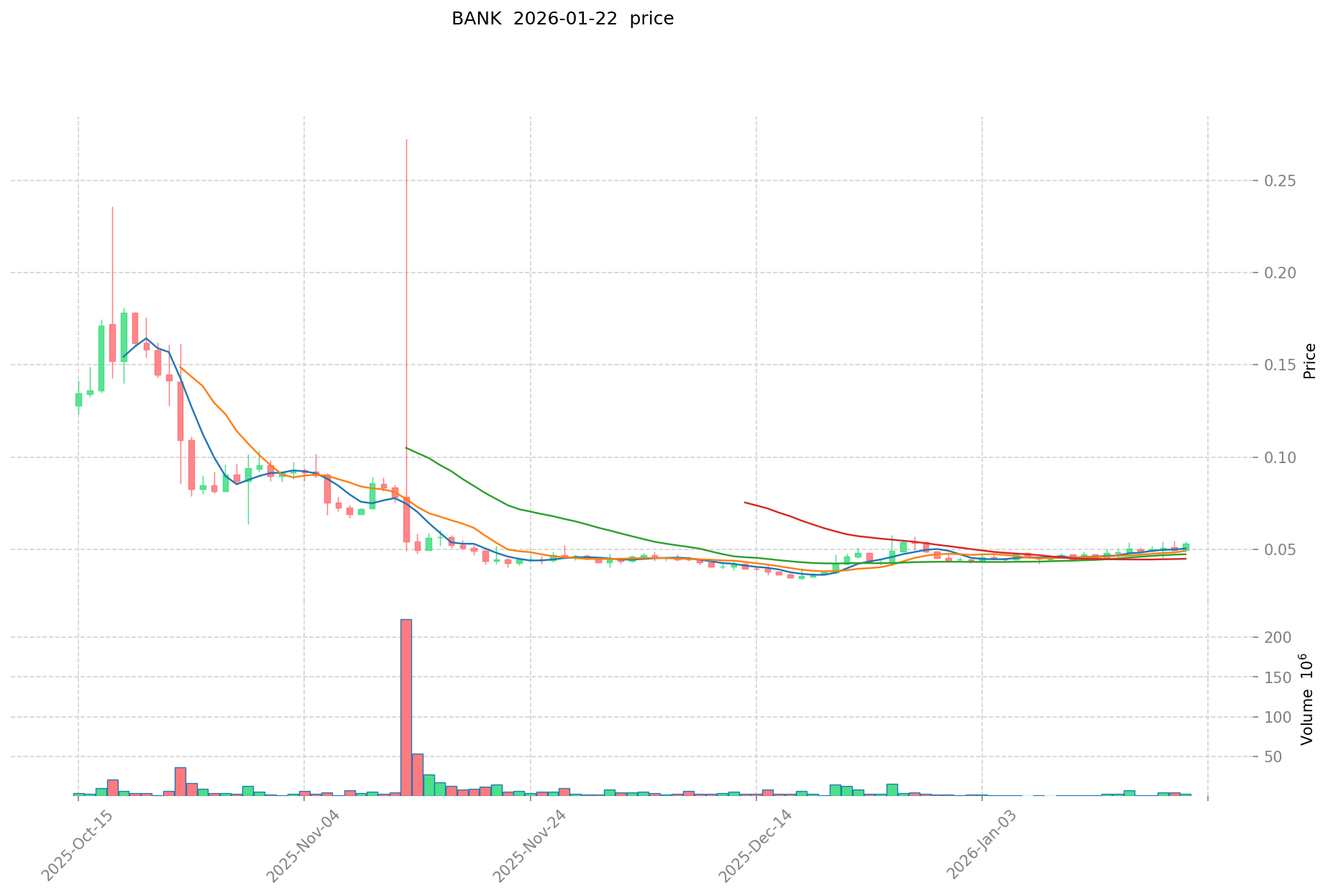
I. BANK Price History Review and Current Investment Value
- 2025: Token launch in April 2025 → Early adopters experienced significant price discovery phase
- August 2025: Market correction phase → BANK reached a reference low point of $0.007
- November 2025: Recovery momentum → Price climbed to $0.27257 within months of launch
- January 2026: Consolidation period → Trading around $0.05238 with moderate volatility
Current BANK Investment Market Status (January 2026)
- BANK current price: $0.05238
- 24-hour trading volume: $98,946.13
- Circulating supply: 425,250,000 BANK (20.25% of maximum supply)
- Market capitalization: $22,274,595
- Fully diluted market cap: $109,998,000
- Total holder addresses: 59,287
- Available on 24 exchanges globally
Click to view real-time BANK market price
II. Core Factors Affecting Whether BANK is a Good Investment (Is Lorenzo Protocol(BANK) a Good Investment)
Supply Mechanism and Scarcity (BANK investment scarcity)
-
Fixed Maximum Supply → Influences Price and Investment Value
- BANK has a maximum supply of 2,100,000,000 tokens, with 425,250,000 tokens currently in circulation (20.25% of total supply).
- The fixed supply cap creates a deflationary framework that may support long-term value appreciation as adoption increases.
-
Historical Patterns: Supply dynamics have influenced BANK price movements
- BANK has experienced notable price volatility, with historical price ranges from $0.007 to $0.27257.
- The token's recent performance shows positive trends across multiple timeframes: 1-hour (+0.13%), 24-hour (+0.86%), 7-day (+11.27%), 30-day (+9.52%), and 1-year (+184.67%).
-
Investment Significance: Scarcity as a Key Factor Supporting Long-term Investment
- With only 20.25% of total supply in circulation, the controlled token release schedule may contribute to supply-side pressure.
- The market capitalization stands at approximately $22.27 million, representing significant growth potential relative to its fully diluted valuation of $109.99 million.
Institutional Investment and Mainstream Adoption (Institutional investment in BANK)
- Community Engagement Indicators:
- BANK has approximately 59,287 token holders, indicating growing community participation.
- The token is listed on 24 exchanges, providing reasonable liquidity and accessibility for institutional and retail investors.
Technology and Ecosystem Development (Technology & Ecosystem for BANK investment)
-
Institutional-grade Asset Management Platform → Enhances Investment Appeal
- Lorenzo Protocol operates as an institutional-grade asset management platform issuing yield-bearing tokens backed by diverse underlying strategies.
- The platform features two flagship products: stBTC (BTC Liquid Staking Token powered by Babylon staking yields) and enzoBTC (wrapped BTC containing Lorenzo native yield and on-chain liquidity farming yields).
-
BTC-related Product Innovation → Long-term Value Support
- The integration of Bitcoin-related yield strategies positions BANK within the expanding Bitcoin DeFi ecosystem.
- Multi-strategy approach combining staking yields and liquidity farming creates multiple value accrual mechanisms for token holders.
-
Technical Infrastructure:
- BANK is deployed as a BEP-20 token on Binance Smart Chain (contract address: 0x3aee7602b612de36088f3ffed8c8f10e86ebf2bf).
- The BSC deployment provides benefits including lower transaction costs and faster settlement times compared to some alternative blockchain networks.
III. BANK Future Investment Forecast and Price Outlook (Is Lorenzo Protocol(BANK) worth investing in 2026-2031)
Short-term Investment Forecast (2026, short-term BANK investment outlook)
- Conservative forecast: $0.037062 - $0.0522
- Neutral forecast: $0.0522 - $0.060552
- Optimistic forecast: $0.055 - $0.060552
Mid-term Investment Outlook (2027-2029, mid-term Lorenzo Protocol(BANK) investment forecast)
- Market stage expectation: Expected gradual development phase with moderate price appreciation as the platform continues to establish its position in the BTC liquid staking and yield-bearing token sector
- Investment return forecast:
- 2027: $0.04904712 - $0.07385256
- 2028: $0.0377662824 - $0.08139285
- 2029: $0.04028946075 - $0.0849741354
- Key catalysts: Expansion of stBTC and enzoBTC adoption, growth in Babylon staking ecosystem, institutional asset management partnerships, and liquidity farming strategy performance
Long-term Investment Outlook (Is BANK a good long-term investment?)
- Base scenario: $0.0377662824 - $0.10284800526 (assuming steady platform development and maintained market position through 2030)
- Optimistic scenario: $0.08 - $0.1264634895447 (assuming accelerated adoption of BTC liquid staking solutions and expanded institutional partnerships through 2031)
- Risk scenario: $0.037 - $0.06 (under conditions of increased competition in BTC staking sector or unfavorable market dynamics)
View BANK long-term investment and price forecast: Price Prediction
2026-2031 Long-term Outlook
- Base scenario: $0.0522 - $0.0791138502 (corresponding to steady progress and gradual mainstream application growth)
- Optimistic scenario: $0.08 - $0.1264634895447 (corresponding to large-scale adoption and favorable market conditions)
- Transformational scenario: Above $0.13 (if ecosystem achieves breakthrough developments and mainstream popularization)
- 2031-12-31 predicted high: $0.1264634895447 (based on optimistic development assumptions)
Disclaimer: These forecasts are based on historical data and market analysis models. Cryptocurrency investments carry significant risks, and actual prices may differ substantially from predictions. This information does not constitute investment advice, and investors should conduct thorough research and consider their risk tolerance before making investment decisions.
| Year |
Predicted High Price |
Predicted Average Price |
Predicted Low Price |
Price Change |
| 2026 |
0.060552 |
0.0522 |
0.037062 |
0 |
| 2027 |
0.07385256 |
0.056376 |
0.04904712 |
7 |
| 2028 |
0.08139285 |
0.06511428 |
0.0377662824 |
24 |
| 2029 |
0.0849741354 |
0.073253565 |
0.04028946075 |
39 |
| 2030 |
0.10284800526 |
0.0791138502 |
0.061708803156 |
51 |
| 2031 |
0.1264634895447 |
0.09098092773 |
0.0827926442343 |
73 |
IV. BANK Investment Strategy and Risk Management (How to invest in Lorenzo Protocol)
Investment Strategy (BANK investment strategy)
Long-term Holding (HODL BANK): Suitable for Conservative Investors
For investors seeking stable exposure to the Bitcoin liquid staking sector, a long-term holding strategy may be considered. Lorenzo Protocol's institutional-grade asset management platform offers yield-bearing tokens backed by diverse underlying strategies, including stBTC powered by Babylon staking yields. The token has shown a year-over-year price increase of 184.67%, with the current price at $0.05238 as of January 22, 2026. However, investors should note that the circulating supply represents only 20.25% of the maximum supply (425,250,000 out of 2,100,000,000 tokens), which may have implications for future token economics.
Active Trading: Relies on Technical Analysis and Swing Operations
Traders focusing on short to medium-term opportunities may analyze BANK's price movements across different timeframes. Recent performance data shows: 1-hour change of 0.13%, 24-hour change of 0.86%, 7-day change of 11.27%, and 30-day change of 9.52%. The 24-hour price range fluctuated between $0.05084 and $0.05418, with trading volume reaching $98,946.13. The token is listed on 24 exchanges and operates on the BSC chain (contract address: 0x3aee7602b612de36088f3ffed8c8f10e86ebf2bf), providing multiple venues for trading activities.
Risk Management (Risk management for BANK investment)
Asset Allocation Ratio: Conservative / Aggressive / Professional Investors
- Conservative investors: May consider allocating 1-3% of their crypto portfolio to BANK
- Aggressive investors: Could allocate 5-10% depending on risk tolerance
- Professional investors: May implement dynamic allocation based on market conditions and portfolio strategy
Risk Hedging Solutions: Multi-asset Portfolio + Risk Mitigation Tools
Investors may consider diversifying across different asset classes within the crypto ecosystem, including established cryptocurrencies, stablecoins, and other DeFi protocols. Given BANK's focus on Bitcoin liquid staking, correlation with Bitcoin price movements should be monitored. The market capitalization of $22,274,595 and ranking of #831 indicate a relatively small market position, which may present both opportunities and liquidity considerations.
Secure Storage: Hot and Cold Wallets + Hardware Wallet Recommendations
For BANK tokens on BSC:
- Cold storage: Hardware wallets supporting BEP-20 tokens (such as Ledger or Trezor)
- Hot wallets: MetaMask, Trust Wallet, or other BSC-compatible wallets for active trading
- Security practices: Enable two-factor authentication, verify contract addresses, and maintain separate wallets for long-term holdings versus trading activities
V. BANK Investment Risks and Challenges (Risks of investing in Lorenzo Protocol)
Market Risk: High Volatility and Price Manipulation
BANK has demonstrated significant price volatility, with the all-time high of $0.27257 recorded on November 13, 2025, and all-time low of $0.007 on August 17, 2025. This represents a substantial price range. The relatively low market capitalization and limited circulating supply may contribute to increased price volatility. The 24-hour trading volume of $98,946.13 suggests moderate liquidity, which may result in wider spreads during periods of market stress.
Regulatory Risk: Policy Uncertainty Across Different Jurisdictions
As a liquid staking protocol operating in the Bitcoin ecosystem, Lorenzo Protocol may face evolving regulatory frameworks regarding:
- Classification of staking yields and derivative tokens
- Securities regulations applicable to yield-bearing tokens
- Cross-border cryptocurrency transaction regulations
- Compliance requirements for institutional-grade asset management platforms
Investors should monitor regulatory developments in their respective jurisdictions and the protocol's compliance measures.
Technical Risk: Network Security Vulnerabilities and Upgrade Failures
Technical considerations include:
- Smart contract risks associated with the BEP-20 token standard and Lorenzo Protocol's infrastructure
- Dependencies on Babylon staking protocol for stBTC yields
- Integration risks with on-chain liquidity farming mechanisms for enzoBTC
- Potential vulnerabilities in cross-chain operations
- Platform upgrade and maintenance risks
The protocol's institutional-grade positioning suggests professional development practices, though investors should remain aware of inherent technical risks in blockchain protocols.
VI. Conclusion: Is Lorenzo Protocol a Good Investment?
Investment Value Summary: BANK has demonstrated notable price appreciation over the past year, supported by Lorenzo Protocol's positioning as an institutional-grade Bitcoin asset management platform. The protocol's dual product offering—stBTC and enzoBTC—addresses growing demand for Bitcoin yield generation strategies. However, the token experiences significant price fluctuations and operates in a competitive liquid staking market.
Investor Recommendations:
✅ Beginners: Dollar-cost averaging combined with secure wallet storage practices. Focus on understanding the protocol's mechanics and BTC liquid staking fundamentals before allocating significant capital.
✅ Experienced Investors: Swing trading strategies utilizing technical analysis across multiple timeframes, combined with portfolio diversification across the Bitcoin DeFi ecosystem. Monitor the 80% of tokens yet to enter circulation.
✅ Institutional Investors: Strategic long-term allocation as part of a broader Bitcoin yield strategy. Conduct thorough due diligence on protocol infrastructure, security audits, and institutional partnerships.
⚠️ Disclaimer: Cryptocurrency investments carry substantial risk. This analysis is for informational purposes only and does not constitute financial advice. Investors should conduct independent research and consult with financial advisors before making investment decisions. Past performance does not guarantee future results.
VII. FAQ
Q1: What is Lorenzo Protocol (BANK) and how does it generate value for investors?
Lorenzo Protocol (BANK) is the native token of an institutional-grade Bitcoin asset management platform that issues yield-bearing tokens backed by diverse underlying strategies. The platform generates value through two flagship products: stBTC (BTC Liquid Staking Token powered by Babylon staking yields) and enzoBTC (wrapped BTC containing Lorenzo native yield and on-chain liquidity farming yields). As of January 22, 2026, BANK trades at approximately $0.05238 with a market capitalization of $22.27 million, serving 59,287 token holders across 24 exchanges. The protocol's multi-strategy approach combining staking yields and liquidity farming creates multiple value accrual mechanisms within the expanding Bitcoin DeFi ecosystem.
Q2: Is BANK a good investment for different investor profiles?
Investment suitability depends on individual risk tolerance and investment objectives. For conservative investors, a 1-3% portfolio allocation with long-term holding strategy may be appropriate, given the token's 184.67% year-over-year price increase and institutional-grade platform positioning. Aggressive investors might consider 5-10% allocation utilizing active trading strategies, as BANK has shown recent performance of +11.27% over 7 days and +9.52% over 30 days. Professional investors may implement dynamic allocation strategies. However, all investors should note significant risks: BANK has experienced substantial volatility (ranging from $0.007 to $0.27257), operates with only 20.25% of total supply in circulation, and maintains a relatively modest 24-hour trading volume of $98,946.13, which may impact liquidity during market stress periods.
Q3: What are the primary risks associated with investing in BANK?
BANK investment carries three major risk categories: Market Risk—evidenced by extreme price volatility between all-time low of $0.007 (August 2025) and all-time high of $0.27257 (November 2025), combined with relatively low liquidity and small market capitalization that may enable price manipulation. Regulatory Risk—including uncertain policy frameworks regarding staking yields classification, securities regulations for yield-bearing tokens, and compliance requirements for institutional asset management platforms across different jurisdictions. Technical Risk—encompassing smart contract vulnerabilities in BEP-20 infrastructure, dependencies on Babylon staking protocol, integration risks with liquidity farming mechanisms, and potential cross-chain operation failures. The 80% token supply yet to enter circulation presents additional dilution risk for current holders.
Q4: What is the price outlook for BANK from 2026 to 2031?
Short-term forecasts for 2026 suggest a trading range between $0.037062 (conservative low) and $0.060552 (optimistic high), with neutral expectations around $0.0522. Mid-term projections show gradual appreciation: 2027 ($0.04904712 - $0.07385256), 2028 ($0.0377662824 - $0.08139285), and 2029 ($0.04028946075 - $0.0849741354). Long-term outlook through 2031 presents three scenarios: Base scenario ($0.0522 - $0.0791138502) assuming steady platform development, Optimistic scenario ($0.08 - $0.1264634895447) anticipating accelerated BTC liquid staking adoption and expanded institutional partnerships, and Risk scenario ($0.037 - $0.06) under increased competition conditions. The predicted high for December 31, 2031 reaches $0.1264634895447 under optimistic assumptions, though investors should recognize these projections carry substantial uncertainty.
Q5: How can investors safely purchase and store BANK tokens?
BANK is deployed as a BEP-20 token on Binance Smart Chain (contract address: 0x3aee7602b612de36088f3ffed8c8f10e86ebf2bf) and is available on 24 exchanges globally. Investors can acquire BANK through centralized exchanges supporting BSC tokens or decentralized exchanges on the Binance Smart Chain network. For secure storage, cold storage solutions include hardware wallets supporting BEP-20 tokens such as Ledger or Trezor for long-term holdings. Hot wallet options for active trading include MetaMask, Trust Wallet, or other BSC-compatible wallets. Security best practices require enabling two-factor authentication, verifying contract addresses before transactions, and maintaining separate wallets for long-term holdings versus active trading activities to minimize exposure to potential security breaches.
Q6: What factors make BANK different from other cryptocurrency investments?
BANK distinguishes itself through its institutional-grade positioning in the Bitcoin liquid staking sector, offering structured yield-bearing products backed by established protocols like Babylon. Unlike many speculative tokens, Lorenzo Protocol provides tangible utility through stBTC and enzoBTC products that address specific needs in Bitcoin yield generation. The platform's dual-strategy approach combining staking rewards and liquidity farming yields creates diversified revenue streams. However, differentiation also presents challenges: the relatively small market capitalization of $22.27 million and #831 ranking indicate limited mainstream recognition compared to established DeFi protocols. The controlled token release schedule with only 20.25% circulating supply may support scarcity-driven appreciation but also raises questions about future supply dynamics and potential dilution effects on current holders.
Q7: What investment strategy works best for BANK given current market conditions?
Current market conditions as of January 22, 2026 suggest a mixed approach depending on investment timeframe and risk tolerance. For long-term holders (HODL strategy), dollar-cost averaging into positions may capitalize on BANK's volatility while building exposure to the growing Bitcoin liquid staking sector, particularly given the 184.67% year-over-year performance. Active traders can leverage technical analysis across multiple timeframes, noting recent positive momentum: 1-hour (+0.13%), 24-hour (+0.86%), 7-day (+11.27%), and 30-day (+9.52%) changes. The 24-hour price range of $0.05084 to $0.05418 presents swing trading opportunities. Portfolio allocation should remain conservative given market risks: 1-3% for risk-averse investors, 5-10% for aggressive investors with higher risk tolerance. Regardless of strategy, investors should maintain diversification across multiple crypto assets, implement stop-loss mechanisms to protect against downside volatility, and continuously monitor protocol developments, Babylon ecosystem growth, and regulatory changes affecting liquid staking platforms.
Q8: What milestones should investors monitor to evaluate BANK's investment potential?
Key performance indicators for evaluating BANK's investment trajectory include: Protocol Growth Metrics—expansion of total value locked in stBTC and enzoBTC products, growth in holder addresses beyond current 59,287 users, and increased exchange listings beyond existing 24 platforms. Market Performance Indicators—sustained trading volume increases above the current $98,946.13 daily average, narrowing of the gap between market capitalization ($22.27 million) and fully diluted valuation ($109.99 million), and improved liquidity metrics reducing price impact for larger transactions. Ecosystem Development—successful integration with additional yield strategies, partnerships with institutional asset managers, security audit results, and technical infrastructure upgrades. Token Economics—transparent communication regarding the release schedule for the remaining 80% of token supply, implementation of potential token utility expansions, and burn mechanisms or deflationary features. Investors should also track broader Bitcoin DeFi adoption trends, Babylon protocol performance, and competitive positioning against emerging liquid staking solutions.
* The information is not intended to be and does not constitute financial advice or any other recommendation of any sort offered or endorsed by Gate.