This comprehensive investment analysis examines whether Lumia (LUMIA) represents a viable opportunity in the DeFi sector. Trading at $0.10953 as of January 2026, LUMIA emerged from the ORN to LUMIA migration with a $15.17 million market cap and 57.98% circulating supply. The article evaluates critical investment factors including fixed supply mechanics, institutional accessibility across 17 exchanges via Gate and others, and macroeconomic influences. Price projections range from conservative 2026 forecasts of $0.0617-$0.1102 to optimistic long-term scenarios exceeding $0.3243 by 2031. Investment strategies span long-term HODL approaches and active trading tactics with recommended allocation ratios for different investor profiles. However, substantial risks persist including high volatility (88.64% annual decline), limited liquidity, regulatory uncertainty, and technical vulnerabilities. This analysis provides reference materials for evaluating LUMIA's risk-return profile through detailed market assessment and
Introduction: Lumia (LUMIA) Investment Position and Market Outlook
Lumia (LUMIA) represents a notable transition in the digital finance sector, emerging from the migration of $ORN to $LUMIA. As of January 24, 2026, LUMIA trades at approximately $0.10953, with a circulating supply of 138,496,021.73 tokens and a market capitalization of around $15.17 million. The token maintains a total supply of 238,888,888 units, with about 57.98% currently in circulation. Operating within the DeFi ecosystem, LUMIA has been listed on 17 exchanges and holds approximately 2,966 holders. Recent price performance shows a 2.21% increase over 24 hours, though the token has experienced a decline of 10.36% over the past week. With its market dominance at 0.00082%, LUMIA presents a case study for investors evaluating mid-cap cryptocurrency opportunities. This article provides a comprehensive analysis of LUMIA's investment characteristics, historical price movements, future price projections, and associated risks, offering reference materials for those considering "Is Lumia (LUMIA) a good investment?"
I. Lumia (LUMIA) Price History Review and Current Investment Value
Lumia experienced notable price volatility since its market debut. The token reached a significant price level of $2.52 on December 4, 2024, representing a period of market interest following the transition from $ORN to $LUMIA. This migration marked a pivotal development in the project's evolution within the digital finance ecosystem.
Subsequently, market conditions led to price adjustments, with LUMIA trading at lower levels through 2025. By October 10, 2025, the token recorded a price of $0.0528, reflecting broader market dynamics and investor sentiment shifts during this period.
Current LUMIA Investment Market Status (January 2026)
- LUMIA Current Price: $0.10953
- Market Sentiment (Fear & Greed Index): Data not available in provided materials
- 24-Hour Trading Volume: $65,171.52
- Institutional Investor Holdings: Approximately 2,966 holders currently participate in the LUMIA ecosystem
Click to view real-time LUMIA market price
As of January 24, 2026, LUMIA maintains a circulating supply of 138,496,021.73 tokens from a maximum supply of 238,888,888 tokens, representing approximately 57.98% circulation. The token demonstrates a market capitalization of $15,169,469.26, with recent price movements showing a 2.21% increase over 24 hours and a 1.069% gain in the past hour. The 7-day performance indicates a decline of 10.36%, while the 30-day trend shows a modest increase of 0.25%. LUMIA is currently available for trading on 17 cryptocurrency exchanges.
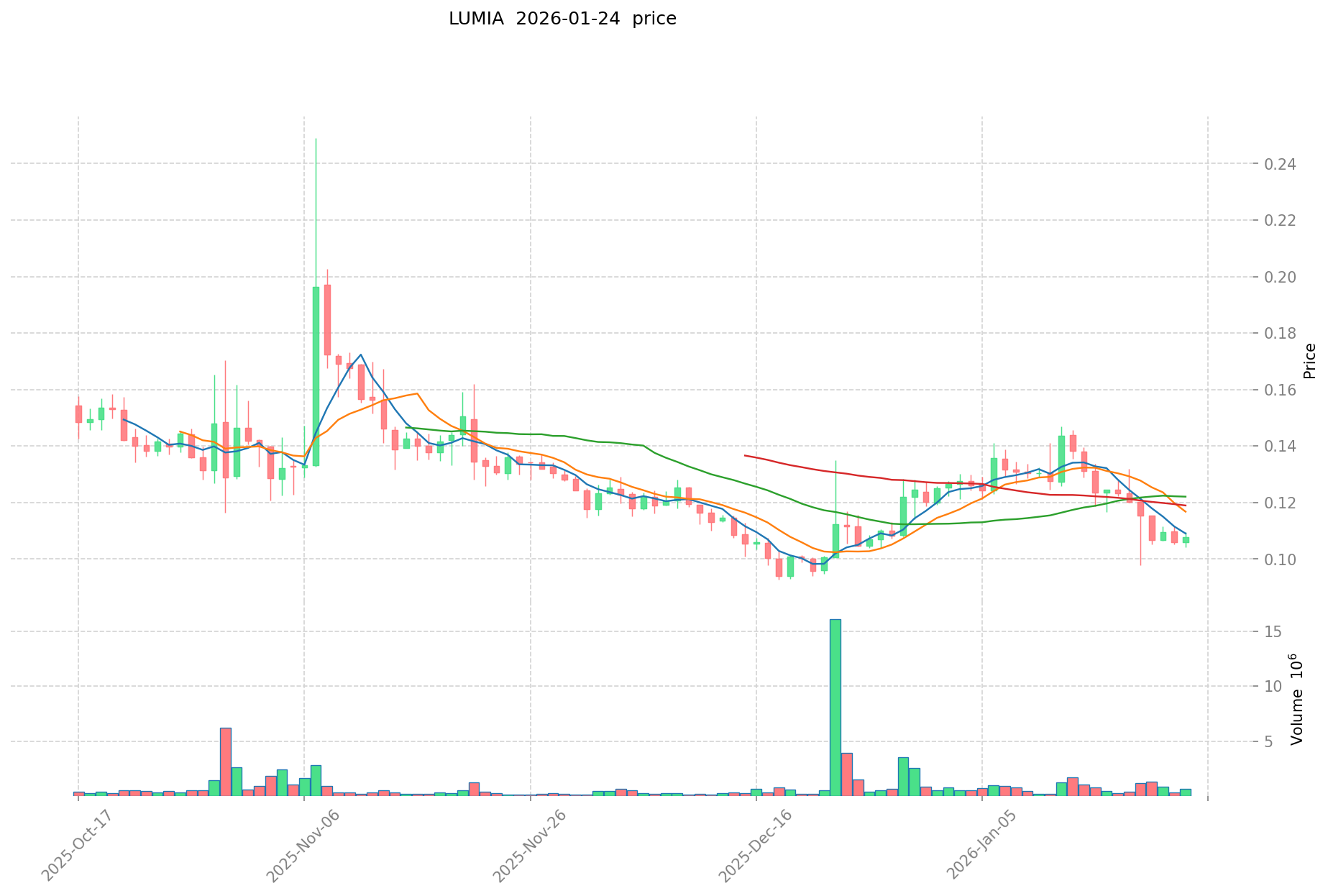
II. Core Factors Affecting Whether LUMIA is a Good Investment (Is Lumia(LUMIA) a Good Investment)
Supply Mechanism and Scarcity (LUMIA investment scarcity)
- Fixed maximum supply of 238,888,888 tokens → influences price dynamics and investment value
- Current circulating supply represents approximately 57.98% of total supply → indicates controlled token release
- Investment significance: Limited supply structure may support long-term investment considerations
Institutional Investment and Mainstream Adoption (Institutional investment in LUMIA)
- Token deployed on Ethereum network (Contract: 0xD9343a049D5DBd89CD19DC6BcA8c48fB3a0a42a7) → enables institutional accessibility
- Available on 17 exchanges → provides liquidity channels for various investor types
- Approximately 2,966 holders → reflects current adoption level
Macroeconomic Environment's Impact on LUMIA Investment
- Monetary policy and interest rate changes → may alter investment attractiveness across digital assets
- Inflation environment considerations → potential implications for alternative asset allocation
- Geopolitical uncertainty factors → could influence demand patterns in digital asset markets
Technology and Ecosystem Development (Technology & Ecosystem for LUMIA investment)
- Transition from $ORN to $LUMIA represents a strategic evolution in digital finance positioning
- DeFi integration potential → may contribute to ecosystem expansion and utility enhancement
- Network infrastructure built on Ethereum → provides established technical foundation for development
III. LUMIA Future Investment Prediction and Price Outlook (Is Lumia(LUMIA) worth investing in 2026-2031)
Short-term Investment Prediction (2026, short-term LUMIA investment outlook)
- Conservative forecast: $0.0617 - $0.1102
- Neutral forecast: $0.1102 - $0.1587
- Optimistic forecast: $0.1587 and above
Mid-term Investment Outlook (2027-2029, mid-term Lumia(LUMIA) investment forecast)
- Market stage expectation: The project may experience gradual development with potential ecosystem expansion and increased adoption in the DeFi space
- Investment return prediction:
- 2027: $0.1076 - $0.1896
- 2028: $0.1248 - $0.1815
- 2029: $0.1511 - $0.2353
- Key catalysts: Technological advancements in the DeFi ecosystem, potential partnerships, and broader market acceptance
Long-term Investment Outlook (Is LUMIA a good long-term investment?)
- Base scenario: $0.1343 - $0.2564 (assuming steady growth and moderate market conditions)
- Optimistic scenario: $0.2139 - $0.3243 (assuming favorable market environment and successful ecosystem development)
- Risk scenario: Below $0.1343 (in case of adverse market conditions or project setbacks)
Click to view LUMIA long-term investment and price prediction: Price Prediction
2026-01-24 to 2031 Long-term Outlook
- Base scenario: $0.1102 - $0.2035 USD (corresponding to steady progress and gradual mainstream application improvement)
- Optimistic scenario: $0.1344 - $0.3243 USD (corresponding to large-scale adoption and favorable market environment)
- Transformative scenario: Above $0.3243 USD (if the ecosystem achieves breakthrough progress and mainstream popularization)
- 2031-12-31 predicted high: $0.3243 USD (based on optimistic development assumptions)
Disclaimer: Price predictions are based on historical data and market analysis, and actual future prices may vary significantly due to market volatility, regulatory changes, technological developments, and other unforeseen factors. This information should not be considered as investment advice.
| Year |
Predicted High Price |
Predicted Average Price |
Predicted Low Price |
Price Change |
| 2026 |
0.1587024 |
0.11021 |
0.0617176 |
0 |
| 2027 |
0.189583242 |
0.1344562 |
0.10756496 |
22 |
| 2028 |
0.18146208752 |
0.162019721 |
0.12475518517 |
47 |
| 2029 |
0.2352850388362 |
0.17174090426 |
0.1511319957488 |
56 |
| 2030 |
0.256426344150606 |
0.2035129715481 |
0.134318561221746 |
85 |
| 2031 |
0.324257217567587 |
0.229969657849353 |
0.213871781799898 |
109 |
IV. Lumia Investment Strategy and Risk Management (How to invest in Lumia)
Investment Methodology (Lumia investment strategy)
Long-term Holding (HODL Lumia): Suitable for conservative investors
This approach involves purchasing LUMIA tokens and holding them over an extended period, typically years, regardless of short-term price fluctuations. Given LUMIA's position in the DeFi space and its transition from ORN, long-term holders may benefit from potential ecosystem growth and increased adoption. This strategy is most appropriate for investors with:
- High risk tolerance for volatility
- Belief in the long-term vision of decentralized finance
- Ability to withstand drawdowns without emotional selling
Active Trading: Relies on technical analysis and swing trading
Active traders may capitalize on LUMIA's price movements by:
- Monitoring support and resistance levels (recent 24H range: $0.10427 - $0.11017)
- Utilizing technical indicators to identify entry and exit points
- Executing swing trades during periods of higher volatility
- Setting stop-loss orders to manage downside risk
This approach requires substantial time commitment, market knowledge, and emotional discipline.
Risk Management (Risk management for Lumia investment)
Asset Allocation Ratios: Conservative / Aggressive / Professional investors
- Conservative investors: Allocate 1-3% of cryptocurrency portfolio to LUMIA, prioritizing established assets like Bitcoin and Ethereum
- Aggressive investors: May allocate 5-10% to LUMIA as part of a higher-risk altcoin strategy
- Professional investors: Utilize dynamic allocation based on market conditions, technical indicators, and fundamental developments
Risk Hedging Solutions: Multi-asset portfolio + hedging tools
- Diversify across multiple blockchain projects and asset classes
- Consider stablecoin positions to maintain liquidity during market downturns
- Utilize options or futures contracts (where available) to hedge against adverse price movements
- Maintain emergency reserves outside of cryptocurrency markets
Secure Storage: Hot/cold wallets + hardware wallet recommendations
- Cold Storage: For long-term holdings, use hardware wallets such as Ledger or Trezor to store LUMIA offline
- Hot Wallets: Keep only trading amounts in exchange wallets or software wallets for active management
- Best Practices:
- Never share private keys or seed phrases
- Enable two-factor authentication on all accounts
- Regularly update wallet software
- Verify contract addresses before transactions (LUMIA contract: 0xD9343a049D5DBd89CD19DC6BcA8c48fB3a0a42a7 on Ethereum)
V. Lumia Investment Risks and Challenges (Risks of investing in Lumia)
Market Risk: High volatility and price manipulation
- Volatility: LUMIA has experienced significant price swings, with 24-hour changes of 2.21% and 7-day changes of -10.36%. The token has declined approximately 88.64% over the past year
- Low Liquidity: With a 24-hour trading volume of approximately $65,171 and market capitalization of around $15.17 million, LUMIA may be subject to lower liquidity compared to major cryptocurrencies
- Price Manipulation: Smaller market cap tokens can be more susceptible to large holder influence and coordinated trading activities
Regulatory Risk: Policy uncertainty across different countries
- DeFi projects face evolving regulatory frameworks globally
- Potential classification changes could impact token utility and exchange listings
- Compliance requirements may affect project operations and token economics
- Cross-border regulatory inconsistencies create operational uncertainties
Technical Risk: Network security vulnerabilities and upgrade failures
- Smart Contract Risk: As an Ethereum-based token, LUMIA depends on the security of its smart contracts
- Network Dependency: LUMIA's functionality relies on Ethereum network stability and performance
- Transition Risk: The migration from ORN to LUMIA introduces implementation challenges
- Integration Risk: Dependencies on third-party protocols and services may introduce additional vulnerabilities
VI. Conclusion: Is Lumia a Good Investment?
Investment Value Summary: LUMIA represents an emerging opportunity in the DeFi sector following its transition from ORN. The project operates within the evolving decentralized finance landscape, which offers potential for growth as blockchain adoption increases. However, investors should note the token's substantial price decline over the past year and its relatively modest market capitalization of approximately $15.17 million, which contributes to heightened volatility and liquidity concerns.
Investor Recommendations:
✅ Beginners: Consider dollar-cost averaging strategies combined with secure cold wallet storage. Start with small allocations to understand market dynamics before increasing exposure.
✅ Experienced Investors: May employ swing trading strategies during periods of volatility while maintaining core positions in a diversified portfolio. Regular portfolio rebalancing is recommended.
✅ Institutional Investors: Could consider strategic long-term allocation as part of a broader DeFi exposure strategy, subject to thorough due diligence and risk assessment frameworks.
⚠️ Important Notice: Cryptocurrency investment carries substantial risk, including potential loss of principal. This content is for informational purposes only and does not constitute investment advice. Conduct independent research and consult qualified financial advisors before making investment decisions.
VII. FAQ
Q1: What is Lumia (LUMIA) and how does it differ from other DeFi tokens?
Lumia (LUMIA) is a cryptocurrency that emerged from the migration of $ORN to $LUMIA, operating within the decentralized finance (DeFi) ecosystem on the Ethereum blockchain. Unlike many DeFi tokens, LUMIA represents a strategic transition project with a fixed maximum supply of 238,888,888 tokens and a current circulating supply of approximately 57.98%. The token is deployed on Ethereum (Contract: 0xD9343a049D5DBd89CD19DC6BcA8c48fB3a0a42a7) and is available on 17 exchanges, providing broader accessibility compared to newer DeFi projects. Its positioning as an evolved project from ORN distinguishes it from tokens launching directly into the market.
Q2: What factors should I consider when determining if LUMIA is a good investment?
Several critical factors warrant evaluation: (1) Supply mechanism - LUMIA's fixed supply structure may influence long-term scarcity dynamics; (2) Market liquidity - with a market capitalization of approximately $15.17 million and 24-hour trading volume around $65,171, liquidity remains relatively modest; (3) Price volatility - the token experienced an 88.64% decline over the past year and shows weekly fluctuations of -10.36%; (4) Institutional accessibility - deployment on Ethereum enables professional investor participation; (5) Regulatory uncertainty - DeFi projects face evolving compliance frameworks globally. These factors collectively contribute to LUMIA's risk-return profile.
Q3: What are the price predictions for LUMIA between 2026 and 2031?
Price projections vary based on market scenarios. For 2026, conservative forecasts suggest a range of $0.0617 - $0.1102, while optimistic scenarios extend to $0.1587 and above. Mid-term outlook for 2027-2029 indicates potential ranges of $0.1076 - $0.2353 assuming steady ecosystem development. Long-term predictions through 2031 present base scenarios of $0.1102 - $0.2035 and optimistic scenarios reaching $0.1344 - $0.3243, with a transformative scenario exceeding $0.3243 if mainstream adoption accelerates. The 2031 predicted high stands at $0.3243 based on optimistic development assumptions. However, these projections are subject to significant uncertainty from market volatility, regulatory changes, and technological developments.
Q4: What investment strategies are suitable for LUMIA holders?
Two primary approaches exist: (1) Long-term holding (HODL) - suitable for conservative investors willing to weather volatility, allocating 1-3% of a cryptocurrency portfolio for risk-averse participants or 5-10% for aggressive investors; (2) Active trading - appropriate for experienced traders utilizing technical analysis and swing trading strategies based on LUMIA's price movements within recent ranges ($0.10427 - $0.11017 in 24-hour periods). Both strategies require proper risk management through diversified asset allocation, secure storage solutions including hardware wallets (Ledger, Trezor) for long-term holdings, and hot wallets for active trading amounts only.
Q5: What are the primary risks associated with investing in LUMIA?
Three major risk categories exist: (1) Market risk - LUMIA exhibits high volatility with significant price swings, limited liquidity due to modest market capitalization, and potential susceptibility to price manipulation given its smaller size; (2) Regulatory risk - evolving DeFi regulations globally may impact token utility, exchange listings, and operational compliance requirements across jurisdictions; (3) Technical risk - smart contract vulnerabilities on Ethereum, network dependency issues, transition implementation challenges from ORN to LUMIA, and integration risks with third-party protocols. The token's 88.64% decline over the past year exemplifies these risk factors in practice.
Q6: How does LUMIA's liquidity compare to major cryptocurrencies?
LUMIA demonstrates substantially lower liquidity compared to established cryptocurrencies. With a 24-hour trading volume of approximately $65,171 and market capitalization around $15.17 million, LUMIA's liquidity metrics represent a fraction of major assets like Bitcoin or Ethereum. The token maintains approximately 2,966 holders and is listed on 17 exchanges, indicating modest but growing accessibility. This limited liquidity environment contributes to wider bid-ask spreads, increased price volatility, and potential difficulty executing large trades without significant market impact. Investors should consider these liquidity constraints when determining position sizing and exit strategies.
Q7: What storage solutions are recommended for LUMIA tokens?
Optimal storage depends on investment timeframe: (1) Cold storage - hardware wallets such as Ledger or Trezor are recommended for long-term holdings, providing offline security against hacking attempts; (2) Hot wallets - software wallets or exchange accounts should contain only trading amounts for active management purposes; (3) Best practices include never sharing private keys or seed phrases, enabling two-factor authentication on all accounts, regularly updating wallet software, and verifying the correct contract address (0xD9343a049D5DBd89CD19DC6BcA8c48fB3a0a42a7 on Ethereum) before executing transactions. Diversifying storage methods across multiple secure locations further reduces single-point-of-failure risks.
Q8: Is LUMIA suitable for beginner cryptocurrency investors?
LUMIA presents significant challenges for beginners due to several factors: high volatility (24-hour changes of 2.21% and 7-day changes of -10.36%), limited liquidity compared to major cryptocurrencies, substantial historical decline (88.64% over the past year), and complex technical infrastructure as a DeFi token on Ethereum. Beginners considering LUMIA should employ dollar-cost averaging strategies, start with minimal allocations (1-3% of cryptocurrency portfolio), utilize secure cold wallet storage, and invest considerable time understanding DeFi mechanisms and risk management principles before increasing exposure. More established cryptocurrencies typically provide better learning environments for new investors.
* The information is not intended to be and does not constitute financial advice or any other recommendation of any sort offered or endorsed by Gate.