This comprehensive analysis evaluates whether LYX (LUKSO token) represents a viable investment opportunity as of January 2026. The article examines LYX's current market position—trading at $0.3945 with a $12.05 million market cap on Gate and other exchanges—alongside historical performance showing an 78.34% decline over the past year. The analysis covers LUKSO's differentiated technology infrastructure, including LUKSO Standards Proposals (LSPs) and Universal Profiles designed for creative economy applications, alongside detailed tokenomics with 30.54 million tokens in circulation from a 42 million maximum supply. Investment forecasts range from $0.23-$0.56 (2026 outlook) through $0.66-$1.13 (long-term), while the guide addresses critical risk factors including market volatility, limited liquidity across five exchanges, regulatory uncertainties, and technical vulnerabilities. Tailored investment strategies accommodate conservative, aggressive, and institutional investors through asset allocation frameworks, r
Introduction: LUKSO (LYX) Investment Position and Market Outlook
LYX is a notable asset in the cryptocurrency sector, having been launched in May 2023 as the native token of the LUKSO blockchain. As of January 25, 2026, LYX maintains a market capitalization of approximately $12.05 million with a circulating supply of 30.54 million tokens, and the current price is around $0.3945. Positioned as a next-generation EVM blockchain focused on the New Creative Economies, LYX has gradually become a point of discussion among investors evaluating "Is LYX a good investment?" The project leverages Casper PoS consensus mechanism and introduces innovative LUKSO Standards Proposals (LSPs) alongside Universal Profiles, aiming to enhance blockchain identity, ownership, and asset representation. This article provides a comprehensive analysis of LYX's investment value, historical price trends, future price forecasts, and associated investment risks to serve as a reference for potential investors.
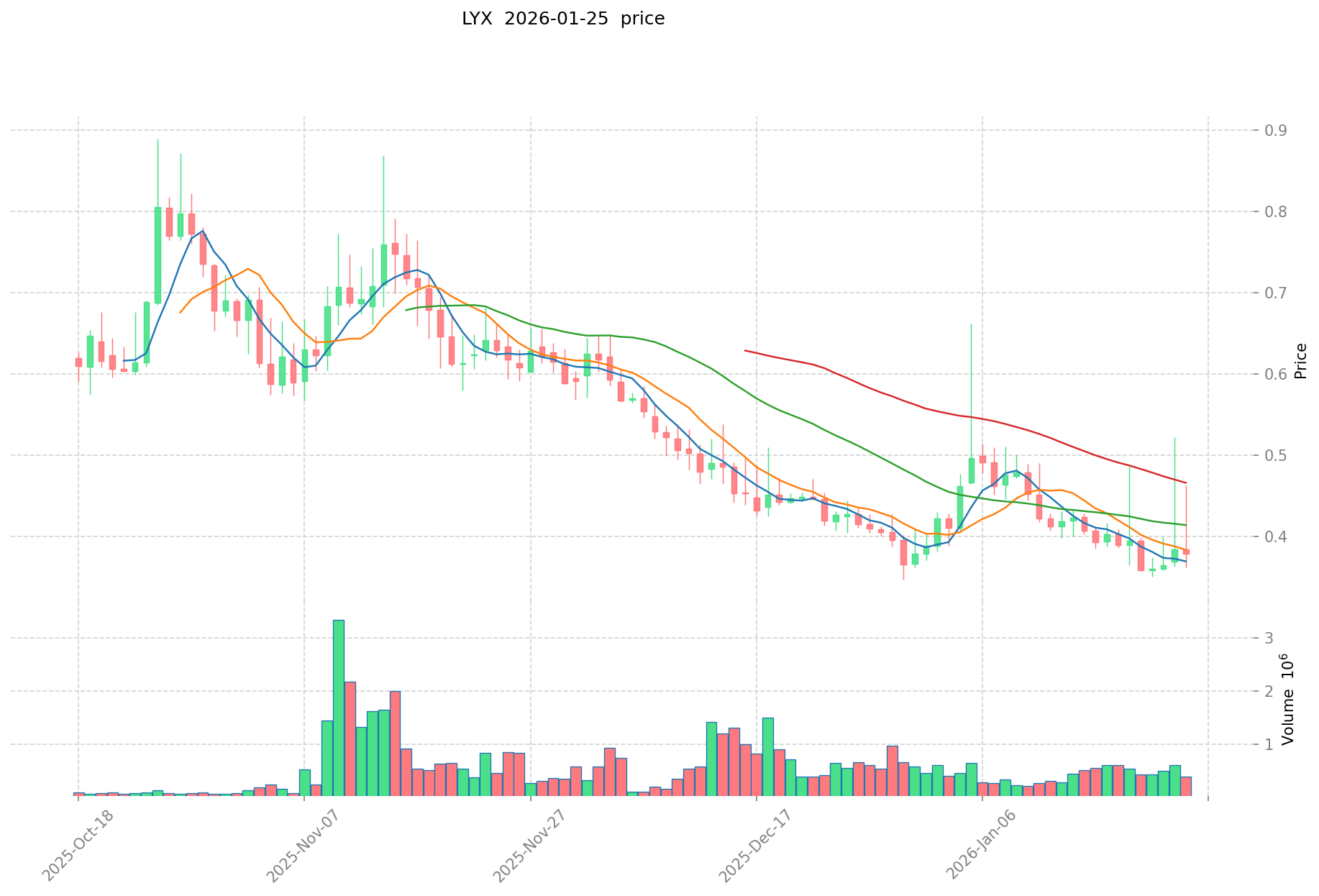
I. LYX Price History Review and Current Investment Value Status
- 2024: The token experienced notable price activity, with fluctuations reflecting broader market dynamics during this period
- Past Year Performance: LYX has shown a decline of approximately 78.34% over the one-year period, indicating significant volatility in its price trajectory
- Recent Market Cycle: Price movements have ranged between $0.3639 and $0.4215 within the 24-hour trading window
Current LYX Investment Market Status (January 2025)
- LYX current price: $0.3945
- Market sentiment (Fear & Greed Index): Data not provided in reference materials
- 24-hour trading volume: $124,290.18
- Institutional investor holdings: Data not provided in reference materials
Click to view real-time LYX market price
II. Core Factors Affecting Whether LYX is a Good Investment
Supply Mechanism and Scarcity (LYX investment scarcity)
-
Fixed Supply Cap → Impacts Price and Investment Value
LUKSO (LYX) has a maximum supply of 42,000,000 tokens, with approximately 30,535,906.59 tokens currently in circulation, representing a circulating ratio of 72.7%. This fixed supply mechanism creates a built-in scarcity model that may influence long-term investment value.
-
Historical Price Patterns
LYX has experienced significant price volatility throughout its trading history. The token reached a notable price level of $11.6 in January 2024, while more recently trading around $0.3945 as of January 25, 2026. This represents a year-over-year decline of 78.34%, reflecting broader market dynamics and investor sentiment shifts.
-
Investment Significance: Scarcity as a Long-term Support Factor
The capped supply structure, combined with ongoing token circulation approaching three-quarters of the total supply, establishes a framework where supply-side economics may play a role in future price discovery. However, scarcity alone does not guarantee investment value, as market demand, technological development, and ecosystem adoption remain critical variables.
Technology and Ecosystem Development (Technology & Ecosystem for LYX investment)
-
LUKSO Standards Proposals (LSPs): Enhancing Network Functionality
LUKSO introduces innovative blockchain standards through its LUKSO Standards Proposals (LSPs), which aim to improve functionality and user-friendliness in blockchain technology. These standards address identity management, ownership representation, asset interaction, and smart contract operations. The extensible nature of core LSPs potentially enables diverse use cases while simplifying both developer and user experiences.
-
Universal Profiles: Expanding Ecosystem Applications
A distinctive feature of the LUKSO network is Universal Profiles, which serve as interoperable blockchain-based profiles enabling verifiable digital identities. These profiles facilitate universal login capabilities and provide users with control over virtual assets and identity management. This infrastructure targets users, brands, and creators in the creative economy sector, potentially expanding the network's application scope.
-
Application Scenarios and Long-term Value Support
LUKSO positions itself within the new creative economies, focusing on interactions between brands, creators, and users with blockchain technology. While the network leverages Ethereum 2.0's technology stack and operates as a separate Layer-1 blockchain based on Casper Proof of Stake, its specialized standards and Universal Profiles framework differentiate its value proposition. The ecosystem's development trajectory and actual adoption rates will likely influence its long-term investment characteristics.
-
Market Position and Liquidity
As of January 25, 2026, LYX maintains a market capitalization of approximately $12,046,415, ranking 1116 in the broader cryptocurrency market with a market share of 0.00052%. The token is available on 5 exchanges with a 24-hour trading volume of $124,290.18, indicating moderate liquidity conditions that may affect trading execution and price stability.
III. LYX Future Investment Forecast and Price Outlook (Is LYX(LYX) worth investing in 2026-2031)
Short-term Investment Forecast (2026, short-term LYX investment outlook)
- Conservative Forecast: $0.23 - $0.39
- Neutral Forecast: $0.39 - $0.56
- Optimistic Forecast: $0.45 - $0.56
Mid-term Investment Outlook (2027-2029, mid-term LYX(LYX) investment forecast)
-
Market Stage Expectation: The mid-term period may witness gradual ecosystem development and potential adoption growth in the creative economy sector. LYX could experience moderate fluctuations as the project continues to implement its Universal Profiles and LUKSO Standards Proposals.
-
Investment Return Forecast:
- 2027: $0.31 - $0.52
- 2028: $0.35 - $0.70
- 2029: $0.54 - $0.72
-
Key Catalysts: Ecosystem expansion, Universal Profiles adoption rate, LSP implementation progress, and broader blockchain-based identity solutions market development.
Long-term Investment Outlook (Is LYX a good long-term investment?)
- Base Scenario: $0.46 - $0.79 (assuming steady ecosystem growth and moderate market adoption)
- Optimistic Scenario: $0.66 - $1.13 (assuming accelerated adoption in the creative economy and favorable market conditions)
- Risk Scenario: $0.23 - $0.35 (under adverse market conditions or slower-than-expected ecosystem development)
View LYX long-term investment and price forecast: Price Prediction
2026-01-25 - 2031 Long-term Outlook
- Base Scenario: $0.46 - $0.79 (corresponding to steady progress and gradual mainstream application growth)
- Optimistic Scenario: $0.66 - $1.13 (corresponding to large-scale adoption and favorable market environment)
- Transformative Scenario: Above $1.13 (if the ecosystem achieves breakthrough progress and mainstream adoption)
- 2031-12-31 Predicted High: $1.13 (based on optimistic development assumptions)
Disclaimer: These forecasts are based on historical data and market analysis, and do not constitute investment advice. Cryptocurrency markets are highly volatile and subject to numerous risk factors.
| Year |
Predicted High Price |
Predicted Average Price |
Predicted Low Price |
Price Change |
| 2026 |
0.562896 |
0.3909 |
0.226722 |
0 |
| 2027 |
0.5245878 |
0.476898 |
0.30521472 |
20 |
| 2028 |
0.696032631 |
0.5007429 |
0.35052003 |
26 |
| 2029 |
0.724049196255 |
0.5983877655 |
0.544532866605 |
51 |
| 2030 |
0.91248150361095 |
0.6612184808775 |
0.46285293661425 |
67 |
| 2031 |
1.125195488909241 |
0.786849992244225 |
0.535057994726073 |
99 |
IV. LYX Investment Strategy and Risk Management (How to invest in LYX)
Investment Methodology (LYX investment strategy)
Long-term Holding (HODL LYX): Suitable for Conservative Investors
For investors seeking exposure to blockchain infrastructure innovation, particularly in the creative economy and digital identity sectors, a long-term holding strategy may be considered. LYX represents a layer-1 blockchain with distinctive technical characteristics, including LUKSO Standards Proposals (LSPs) and Universal Profiles, which aim to enhance user experience and identity management in Web3 environments.
Given the project's focus on next-generation blockchain standards and its independent EVM-compatible architecture based on Casper PoS consensus, long-term holders may view LYX as a position in emerging blockchain infrastructure. However, potential investors should note the significant price volatility, with the token experiencing a -78.34% change over the past year as of January 25, 2026.
Active Trading: Technical Analysis and Swing Operations
Active traders may approach LYX through technical analysis frameworks, monitoring key price levels and volume patterns. As of the current data point, LYX demonstrates 24-hour price fluctuation between $0.3639 and $0.4215, with a 24-hour trading volume of approximately $124,290. The token's market capitalization stands at roughly $12 million with a circulating supply of 30.54 million tokens out of a maximum supply of 42 million.
Traders employing swing strategies might consider the token's recent performance metrics: +0.77% (1-hour), +1.43% (24-hour), -0.25% (7-day), and -5.77% (30-day). These fluctuations may present opportunities for short to medium-term position management, though market depth and liquidity considerations are relevant given the relatively modest trading volumes.
Risk Management (Risk management for LYX investment)
Asset Allocation Ratios: Conservative / Aggressive / Professional Investors
-
Conservative Investors: Given LYX's market position (ranked #1116 by market capitalization) and significant price volatility, conservative portfolios might limit exposure to 1-3% of total crypto allocation, with LYX positioned as a speculative component within a diversified blockchain infrastructure basket.
-
Aggressive Investors: Those with higher risk tolerance and conviction in the creative economy and digital identity thesis may allocate 5-10% of their crypto portfolio to LYX, recognizing the potential upside alongside substantial downside risks evidenced by the year-over-year performance.
-
Professional Investors: Institutional or professional participants might employ dynamic allocation strategies, adjusting positions based on development milestones, ecosystem adoption metrics, and broader market conditions, potentially ranging from 3-7% allocation with active rebalancing protocols.
Risk Hedging Approaches: Multi-Asset Portfolio + Hedging Instruments
Investors may consider portfolio construction strategies that balance LYX exposure with:
- Established layer-1 blockchain assets to offset specific project risk
- Stablecoin positions to maintain liquidity and reduce overall portfolio volatility
- Correlation analysis with broader crypto market indices to understand systematic risk exposure
Given LYX's market share of 0.00052% and fully diluted valuation to market cap ratio of 72.7%, investors should assess concentration risk and potential dilution from remaining token supply entering circulation.
Secure Storage: Hot/Cold Wallets + Hardware Wallet Recommendations
Secure custody of LYX tokens requires appropriate wallet infrastructure:
-
Cold Storage Solutions: Hardware wallets compatible with EVM-based assets are recommended for long-term holdings, providing offline private key storage and protection against online threats.
-
Hot Wallet Usage: For active trading or DeFi participation within the LUKSO ecosystem, users may maintain limited balances in software wallets with robust security features, including multi-signature capabilities where available.
-
Universal Profiles: As LUKSO's native identity and account abstraction framework, Universal Profiles offer enhanced security features compared to traditional externally owned accounts (EOAs), though users should understand the implications of smart contract-based accounts.
-
Backup Procedures: Regardless of storage method, maintaining secure backups of recovery phrases and private keys in multiple physical locations is essential, with consideration for inheritance planning.
V. LYX Investment Risks and Challenges (Risks of investing in LYX)
Market Risks: High Volatility and Price Manipulation Concerns
LYX exhibits substantial price volatility typical of lower market capitalization digital assets. The token recorded a historical high of $11.60 on January 17, 2024, and a historical low of $0.350308 on December 31, 2025, representing significant price ranges. This volatility reflects both broader crypto market dynamics and token-specific factors including limited liquidity and relatively concentrated holder distribution.
With a 24-hour trading volume of approximately $124,290 against a market capitalization of roughly $12 million, the token's liquidity profile suggests potential for elevated price impact from larger transactions. The market share of 0.00052% indicates limited trading across only 5 exchanges as of the reference data, which may contribute to price fragmentation and potential arbitrage opportunities that could affect price stability.
Regulatory Risks: Policy Uncertainty Across Jurisdictions
As a layer-1 blockchain protocol with focus on digital identity and creative economy applications, LUKSO and its native token LYX may face evolving regulatory considerations:
-
Identity and Data Privacy Regulations: Universal Profiles' approach to blockchain-based identity may intersect with data protection frameworks in various jurisdictions, potentially affecting adoption trajectories and compliance requirements.
-
Securities Classification: The token economics, including the maximum supply of 42 million tokens and current circulation of approximately 30.54 million (72.7% of total), may be subject to regulatory scrutiny regarding distribution mechanisms and ongoing token releases.
-
Cross-Border Compliance: With the platform targeting global creative economy participants, navigating diverse regulatory environments for digital assets, intellectual property representation, and decentralized applications presents ongoing challenges.
Technical Risks: Network Security Vulnerabilities and Upgrade Failures
LUKSO's technical architecture presents specific risk vectors:
-
Consensus Layer Risks: While utilizing Casper PoS consensus mechanism derived from Ethereum 2.0's technology stack, LUKSO operates as an independent layer-1 blockchain. This independence means the network maintains its own validator set and consensus security model, with associated risks of network disruptions or consensus failures distinct from Ethereum mainnet.
-
Smart Contract Innovation Risks: The LUKSO Standards Proposals (LSPs) introduce novel contract patterns for identity, asset representation, and account abstraction. As relatively new standards, potential vulnerabilities may exist in implementations, requiring ongoing security audits and community validation.
-
Upgrade and Migration Challenges: Evolution of core LSPs and network protocol upgrades present coordination risks across the ecosystem, potentially affecting backward compatibility, developer tooling, and user experience during transition periods.
-
Ecosystem Dependency: With approximately 25.2 million holders (as indicated in the data), the network's security and utility depend on sustained validator participation, development activity, and user adoption, creating network effect risks in both positive and negative directions.
VI. Conclusion: Is LYX a Good Investment?
Investment Value Summary
LYX represents exposure to blockchain infrastructure innovation focused on digital identity and creative economy applications through the LUKSO network. The project's technical differentiation via LUKSO Standards Proposals and Universal Profiles addresses specific use cases in brand-creator-user interactions within Web3 environments.
However, the token demonstrates substantial price volatility, evidenced by a -78.34% change over the past year and significant historical price ranges. With a market capitalization of approximately $12 million and limited exchange availability (5 platforms), liquidity considerations are relevant for position sizing and execution strategies.
Investor Recommendations
✅ Beginners: For those new to digital assets considering LYX exposure:
- Employ dollar-cost averaging strategies with small, consistent purchases to mitigate timing risk
- Utilize secure storage solutions, prioritizing hardware wallets or robust cold storage for holdings
- Allocate only risk capital that can be sustained through significant drawdowns
- Focus on understanding LUKSO's technical architecture and ecosystem development before establishing positions
✅ Experienced Investors: For participants with established crypto portfolios:
- Consider swing trading approaches utilizing technical analysis while respecting liquidity constraints
- Maintain diversified blockchain infrastructure exposure, positioning LYX as a component within a broader layer-1 allocation
- Monitor ecosystem metrics including developer activity, Universal Profile adoption, and LSP implementation progress
- Implement rebalancing protocols to manage concentration risk relative to overall portfolio objectives
✅ Institutional Investors: For professional and institutional participants:
- Evaluate LYX within thematic allocations to creative economy and digital identity infrastructure
- Assess position sizing relative to liquidity constraints and redemption requirements
- Conduct ongoing due diligence on governance structures, token distribution schedules, and ecosystem development milestones
- Consider strategic timing around network upgrades and ecosystem expansion events
⚠️ Disclaimer: Cryptocurrency investments involve substantial risk including potential loss of principal. Market volatility, regulatory uncertainty, and technical challenges may significantly impact asset values. This analysis is provided for informational purposes only and does not constitute investment advice. Prospective investors should conduct independent research and consult qualified financial advisors before making investment decisions.
VII. FAQ
Q1: Is LYX a good investment for 2026?
Whether LYX is a good investment depends on your risk tolerance and investment horizon. As of January 2026, LYX trades at approximately $0.3945 with a market cap of $12.05 million. The token has experienced significant volatility, declining 78.34% over the past year. Short-term forecasts for 2026 range from $0.23 (conservative) to $0.56 (optimistic). LYX offers exposure to blockchain innovation in digital identity and the creative economy through LUKSO's Universal Profiles and LSPs. However, limited liquidity (trading on only 5 exchanges) and high volatility make it suitable primarily for risk-tolerant investors who can sustain substantial drawdowns.
Q2: What makes LUKSO different from other blockchain projects?
LUKSO differentiates itself through specialized infrastructure for the creative economy. Unlike general-purpose blockchains, LUKSO implements LUKSO Standards Proposals (LSPs) and Universal Profiles—blockchain-based identities enabling verifiable digital credentials and universal login capabilities. The network operates as an independent Layer-1 blockchain using Casper PoS consensus while maintaining EVM compatibility. This architecture targets specific use cases involving brands, creators, and users in Web3 environments, focusing on identity management, asset representation, and ownership verification rather than competing as a general smart contract platform.
Q3: What are the main risks of investing in LYX?
LYX investment carries several significant risks: (1) Market Risk—extreme price volatility with historical swings from $11.60 to $0.35, and a 24-hour trading volume of only $124,290 suggesting potential price manipulation concerns; (2) Liquidity Risk—limited exchange availability (5 platforms) and low market share (0.00052%) may result in execution challenges and wider bid-ask spreads; (3) Regulatory Risk—Universal Profiles' approach to blockchain identity may face evolving data privacy and securities regulations across jurisdictions; (4) Technical Risk—as a relatively new Layer-1 with innovative LSP standards, potential smart contract vulnerabilities and network security challenges require ongoing monitoring.
Q4: How should I allocate LYX in my portfolio?
Portfolio allocation should reflect your investor profile: Conservative investors might limit LYX to 1-3% of total crypto allocation, positioning it as a speculative component within diversified blockchain infrastructure holdings. Aggressive investors with conviction in the creative economy thesis may allocate 5-10% of crypto portfolios while accepting substantial volatility. Professional investors could employ 3-7% dynamic allocation with active rebalancing based on development milestones and ecosystem adoption metrics. Regardless of allocation level, investors should employ risk management through multi-asset diversification, maintain secure cold storage for holdings, and consider correlation with broader market indices to understand systematic exposure.
Q5: What is the long-term price forecast for LYX through 2031?
Long-term forecasts suggest potential price appreciation under favorable conditions, though with significant uncertainty. Base scenario projections estimate $0.46-$0.79 by 2031, assuming steady ecosystem growth and moderate adoption. Optimistic scenarios project $0.66-$1.13 if accelerated creative economy adoption occurs. The predicted 2031 high reaches $1.13 under transformational scenarios involving breakthrough ecosystem progress. However, risk scenarios place prices at $0.23-$0.35 under adverse conditions or slower development. These forecasts depend on critical variables including Universal Profiles adoption rates, LSP implementation success, regulatory environments, and broader blockchain-based identity solutions market development. Actual outcomes may differ substantially from projections.
Q6: What storage solutions are recommended for securing LYX tokens?
Secure LYX storage requires appropriate wallet infrastructure matching your usage patterns. For long-term holdings, cold storage via hardware wallets compatible with EVM-based assets provides optimal security through offline private key storage. Active traders may utilize hot wallets with robust security features for limited balances needed for DeFi participation. Notably, LUKSO's native Universal Profiles offer enhanced security compared to traditional externally owned accounts through smart contract-based account abstraction, though users should understand the implications of this architecture. Regardless of storage method, maintain secure backups of recovery phrases across multiple physical locations and implement inheritance planning for accessibility.
Q7: How does LYX's tokenomics affect its investment potential?
LYX employs a fixed supply model with 42 million maximum tokens, of which approximately 30.54 million (72.7%) currently circulate. This capped supply creates built-in scarcity that may influence long-term value, though approximately 11.46 million tokens remain to enter circulation, representing potential dilution. The circulating ratio suggests the majority of supply is already market-accessible, reducing future inflation pressure compared to projects with lower circulation percentages. However, scarcity alone doesn't guarantee investment returns—demand drivers including ecosystem adoption, Universal Profiles usage, and LSP implementation remain critical. The fully diluted valuation to market cap ratio of 72.7% indicates moderate proximity between current and fully diluted valuations.
Q8: What are the key indicators to monitor for LYX investment decisions?
Critical metrics for evaluating LYX include: (1) Ecosystem Development—Universal Profiles adoption rates, active LSP implementations, and developer activity signal fundamental growth; (2) Network Metrics—validator participation, transaction volumes, and account creation trends indicate network health; (3) Market Indicators—trading volume consistency, exchange listing expansion, and liquidity depth affect execution quality; (4) Technical Milestones—protocol upgrades, new LSP deployments, and partnership announcements may serve as catalysts; (5) Correlation Analysis—relationship with broader crypto markets and specific creative economy tokens helps understand systematic versus idiosyncratic risk. Regular monitoring of these indicators enables informed position management and rebalancing decisions.
* The information is not intended to be and does not constitute financial advice or any other recommendation of any sort offered or endorsed by Gate.