This comprehensive analysis examines whether Magic (MAGIC) represents a viable investment opportunity within the gaming and metaverse sector. The article evaluates MAGIC's current market position (ranked #719 with $29.56M market cap), historical performance since December 2021, and ecosystem utility within Treasure's interconnected DeFi-NFT-gaming framework on Arbitrum. Coverage includes price forecasts through 2031, ranging from conservative to optimistic scenarios, alongside detailed risk assessments including market volatility, regulatory uncertainties, and technical dependencies. Investment strategies tailored for beginners, experienced traders, and institutional investors are provided, emphasizing position sizing guidelines and secure storage on Gate. The analysis acknowledges MAGIC's substantial volatility and speculative nature while exploring ecosystem growth catalysts and long-term value drivers for informed decision-making.
Introduction: Magic (MAGIC)'s Investment Position and Market Prospects
MAGIC is a digital asset in the cryptocurrency space that operates at the intersection of DeFi, NFT, and gaming through the Treasure ecosystem. Since its launch in December 2021, the project has developed an interconnected resource model connecting metaverse networks through open and composable approaches. As of January 21, 2026, MAGIC holds a market position ranked at 719, with a market capitalization of approximately $29.56 million and a circulating supply of around 317.63 million tokens. The current price stands at approximately $0.09308, representing a circulating supply ratio of 91.35% of its maximum supply of 347.71 million tokens.
As the native resource of the Treasure metaverse, MAGIC functions to activate NFTs and transform them into productive, yield-generating assets. The token is managed by MAGIC holders within the ecosystem, where participants can earn tokens through gaming activities, mining, and engagement in Bridgeworld. With a holder base of over 412,000 addresses and availability across 35 exchanges, MAGIC has established presence within the gaming and NFT sectors. This article examines MAGIC's market position, historical performance, and associated considerations, providing analysis for those exploring "Is Magic (MAGIC) a good investment?" questions with reference to current market data and project characteristics.
I. Magic (MAGIC) Price History Review and Current Investment Value
- 2021: MAGIC launched in December 2021 at the intersection of DeFi, NFT, and gaming ecosystems → Early investors experienced significant volatility as the token established its metaverse positioning
- 2022: Token reached a price peak in February 2022 → MAGIC demonstrated notable fluctuations during this period of ecosystem development
- 2025-2026: Market cycle adjustments → Price decreased from higher levels to current trading range
Current MAGIC Investment Market Status (January 2026)
- MAGIC current price: $0.09308
- 24-hour trading volume: $263,650.30
- Circulating supply: 317,629,462.52 MAGIC (91.35% of total supply)
- Market capitalization: $29,564,950.37
- Holder count: 412,454 addresses
- 24-hour price range: $0.08774 - $0.09565
Click to view real-time MAGIC market price
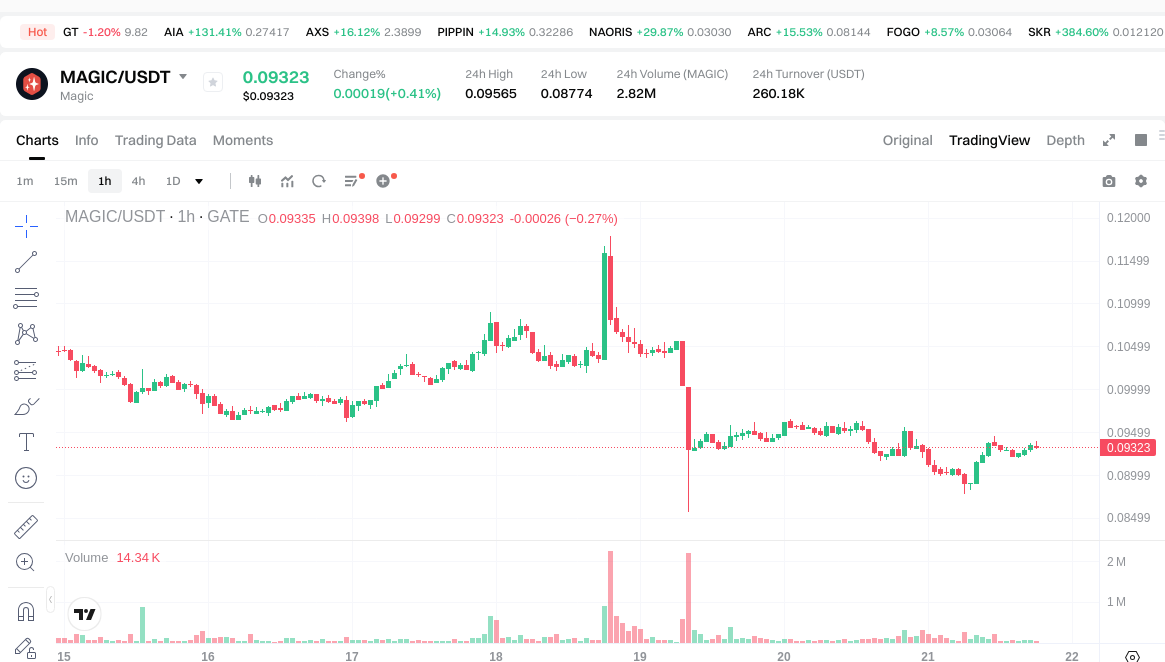
II. Core Factors Affecting Whether MAGIC is a Good Investment
Supply Mechanism and Scarcity (MAGIC Investment Scarcity)
- Supply Dynamics → Impact on Price and Investment Value: MAGIC operates with a maximum supply of 347,714,007 tokens, with approximately 91.35% already in circulation (317,629,462 tokens). This relatively high circulation ratio suggests limited additional supply pressure in the near term.
- Historical Context: The token has experienced significant price volatility, ranging from $0.01999252 to $6.32, demonstrating how market dynamics and supply-demand relationships have historically influenced valuations.
- Investment Implications: The defined supply cap may contribute to scarcity dynamics as ecosystem adoption grows, though this remains subject to broader market conditions and adoption rates.
Institutional Investment and Mainstream Adoption (Institutional Investment in MAGIC)
- Holder Base: The token maintains a holder base of 412,454 addresses, suggesting a relatively distributed ownership structure across the ecosystem.
- Exchange Presence: MAGIC is listed on 35 exchanges, providing accessibility for various investor segments seeking exposure to the Treasure ecosystem.
- Market Position: With a market capitalization of approximately $29.56 million and a market dominance of 0.0010%, MAGIC represents a smaller-cap asset within the broader cryptocurrency landscape.
Macroeconomic Environment's Impact on MAGIC Investment
- Market Sensitivity: As evidenced by the 74.75% decline over the past year, MAGIC has demonstrated sensitivity to broader cryptocurrency market conditions and risk sentiment.
- Risk Considerations: The token's price movements may reflect broader trends in speculative assets, particularly within the gaming and metaverse sectors, which can be influenced by macroeconomic factors such as interest rates and liquidity conditions.
- Volatility Profile: Recent price fluctuations, including an 11.15% decline over seven days, suggest that MAGIC may experience heightened volatility relative to more established digital assets.
Technology and Ecosystem Development (Technology & Ecosystem for MAGIC Investment)
- Ecosystem Positioning: MAGIC serves as a resource token within the Treasure ecosystem, which operates at the intersection of DeFi, NFT, and gaming on the Arbitrum network. The token functions to "activate" NFTs and transform them into yield-generating assets.
- Utility Mechanisms: Players can earn MAGIC through gameplay, mining activities, and participation in Bridgeworld, creating potential demand drivers tied to ecosystem engagement.
- Governance Structure: The Treasure ecosystem is managed by MAGIC token holders, providing governance rights that may influence the protocol's development trajectory.
- Interconnected Resource Model: The ecosystem utilizes an interconnected framework involving MAGIC (power), Treasures (NFT resources), and Legions (NFT players), designed to strengthen cross-ecosystem connections within the metaverse infrastructure.
III. MAGIC Future Investment Forecast and Price Outlook (Is Magic(MAGIC) worth investing in 2026-2031)
Short-term Investment Forecast (2026, short-term MAGIC investment outlook)
- Conservative forecast: $0.0792 - $0.0931
- Neutral forecast: $0.0931 - $0.1115
- Optimistic forecast: $0.1115 - $0.1295
Mid-term Investment Outlook (2027-2029, mid-term Magic(MAGIC) investment forecast)
-
Market stage expectation: During the mid-term period from 2027 to 2029, MAGIC is expected to experience gradual growth as the Treasure ecosystem continues developing its DeFi, NFT, and gaming integration model. The predicted average price shows an upward trajectory from approximately $0.111 in 2027 to around $0.148 in 2029, reflecting potential ecosystem expansion.
-
Investment return forecast:
- 2027: $0.104 - $0.166
- 2028: $0.079 - $0.158
- 2029: $0.101 - $0.162
-
Key catalysts: Expansion of the Treasure metaverse ecosystem, increased adoption of MAGIC token within gaming applications, development of new projects leveraging the interconnected resource model, and broader engagement in Bridgeworld activities.
Long-term Investment Outlook (Is MAGIC a good long-term investment?)
- Base scenario: $0.129 - $0.180 (assuming steady ecosystem development and maintained holder engagement across the Treasure DAO platform)
- Optimistic scenario: $0.180 - $0.239 (assuming accelerated growth in metaverse applications, expanded gaming partnerships, and increased utility of MAGIC token)
- Risk scenario: $0.079 - $0.100 (under conditions of reduced ecosystem activity, competitive pressure from alternative metaverse platforms, or broader market downturns)
View MAGIC long-term investment and price forecast: Price Prediction
2026-01-21 - 2031 Long-term Outlook
- Base scenario: $0.129 - $0.180 (corresponding to steady progress and gradual mainstream application adoption)
- Optimistic scenario: $0.180 - $0.239 (corresponding to large-scale adoption and favorable market conditions)
- Transformative scenario: Above $0.239 (if the ecosystem achieves breakthrough developments and mainstream popularization)
- 2031-12-31 predicted high: $0.239 (based on optimistic development assumptions)
Disclaimer: The forecasts presented are analytical projections based on available data and ecosystem characteristics. Cryptocurrency investments involve substantial risks, and past performance does not guarantee future results. Investors should conduct independent research and consider their risk tolerance before making investment decisions.
| Year |
Predicted High Price |
Predicted Average Price |
Predicted Low Price |
Price Change |
| 2026 |
0.1294507 |
0.09313 |
0.0791605 |
0 |
| 2027 |
0.1658226215 |
0.11129035 |
0.1035000255 |
19 |
| 2028 |
0.157954393755 |
0.13855648575 |
0.0789771968775 |
48 |
| 2029 |
0.161598429330225 |
0.1482554397525 |
0.1008136990317 |
59 |
| 2030 |
0.204503553594598 |
0.154926934541362 |
0.133237163705571 |
66 |
| 2031 |
0.239021274610414 |
0.17971524406798 |
0.129394975728945 |
93 |
IV. MAGIC Investment Strategy and Risk Management (How to invest in MAGIC)
Investment Strategy (MAGIC investment strategy)
Long-term Holding (HODL MAGIC)
For conservative investors seeking exposure to the gaming and metaverse sector, long-term holding of MAGIC may be considered as part of a diversified portfolio. This approach focuses on the potential growth of the Treasure ecosystem over time, particularly as more games and NFT projects integrate with the platform. Investors following this strategy typically monitor ecosystem developments, governance updates, and adoption metrics rather than short-term price movements.
Active Trading
Active traders may approach MAGIC through technical analysis and swing trading strategies. Given the token's price volatility, with 24-hour changes of 0.69% and weekly fluctuations of -11.15%, traders often utilize chart patterns, volume indicators, and support/resistance levels. The token's trading activity across 35 exchanges provides adequate liquidity for entry and exit positions, though traders should remain aware of the inherent volatility in gaming-related tokens.
Risk Management (Risk management for MAGIC investment)
Asset Allocation Guidelines
- Conservative investors: Consider allocating no more than 1-3% of total crypto portfolio to MAGIC, treating it as a high-risk, speculative position within the gaming/metaverse category
- Aggressive investors: May allocate 5-10% of crypto portfolio, actively monitoring ecosystem developments and market sentiment
- Professional investors: Could consider strategic positions up to 15%, combined with hedging strategies and deep fundamental analysis of the Treasure ecosystem
Risk Hedging Strategies
Investors may consider diversifying across multiple gaming and metaverse tokens rather than concentrating solely in MAGIC. Portfolio construction could include a mix of established layer-1 protocols, gaming platforms, and NFT infrastructure projects. Some investors utilize stablecoin positions or derivatives to hedge against downside risk during periods of high volatility.
Secure Storage Solutions
- Hot wallets: Suitable for active traders who need frequent access, though they carry higher security risks
- Cold wallets: Recommended for long-term holders, providing offline storage with enhanced security
- Hardware wallets: Devices such as Ledger or Trezor offer robust security features and are widely recommended for storing MAGIC tokens on the Arbitrum network
- Important note: Always verify the contract address (0x539bdE0d7Dbd336b79148AA742883198BBF60342 on Arbitrum) before any transaction
V. MAGIC Investment Risks and Challenges (Risks of investing in MAGIC)
Market Risks
MAGIC demonstrates significant price volatility, with a current price of $0.09308 showing substantial decline from its peak of $6.32 recorded in February 2022. The token has experienced a one-year decline of -74.75%, reflecting both market-wide downturns and sector-specific challenges. With a market capitalization of approximately $29.56 million and ranking at #719, MAGIC represents a relatively smaller market cap asset, which can be subject to higher volatility and liquidity constraints compared to larger cryptocurrencies.
The 24-hour trading volume of $263,650 indicates moderate liquidity, though sudden large transactions could potentially impact price significantly. Market manipulation risks may be present in smaller market cap tokens, particularly during periods of low trading volume.
Regulatory Risks
The gaming and NFT sectors face evolving regulatory landscapes across different jurisdictions. While the project operates primarily in the decentralized finance space, potential regulatory changes regarding:
- NFT classification and taxation policies
- Gaming token regulations
- Cross-border digital asset transactions
- DeFi platform oversight
These factors introduce uncertainty that could affect MAGIC's adoption and market performance. Investors should monitor regulatory developments in their respective jurisdictions and in key markets where the Treasure ecosystem operates.
Technical Risks
Network Security Considerations: As MAGIC operates on the Arbitrum network, it inherits both the benefits and risks of this Layer 2 scaling solution. Potential technical risks include:
- Smart contract vulnerabilities within the Treasure ecosystem
- Bridge security concerns between Ethereum mainnet and Arbitrum
- Potential bugs in game integrations or NFT marketplace functions
Ecosystem Dependencies: The value proposition of MAGIC is closely tied to the success and continued development of the Treasure ecosystem. Technical challenges in game development, delayed project launches, or platform upgrades could impact token utility and demand.
Operational Risks: With over 412,454 holders, any significant technical issues affecting accessibility or functionality could impact a large user base. The integration of gaming, NFTs, and DeFi creates complex interdependencies that may introduce unforeseen technical challenges.
VI. Conclusion: Is MAGIC a Good Investment?
Investment Value Summary
MAGIC presents a specialized investment opportunity within the gaming, NFT, and metaverse convergence space. The token serves as a core resource within the Treasure ecosystem, connecting multiple games and NFT projects on Arbitrum. While the ecosystem demonstrates innovative approaches to integrating DeFi, NFTs, and gaming, the token has experienced significant price decline over the past year, reflecting both market-wide corrections and sector-specific challenges.
The current circulating supply of 317.63 million tokens represents 91.35% of the maximum supply of 347.71 million, indicating limited future dilution risk. However, the substantial distance from its peak price and relatively small market capitalization suggest the asset carries considerable risk alongside its potential upside.
Recommendations for Investors
✅ Beginners: Consider dollar-cost averaging (DCA) with very small allocations as part of a broader learning experience in gaming tokens. Prioritize secure storage using hardware wallets and only invest amounts you can afford to lose entirely. Focus on understanding the Treasure ecosystem and its developments before making significant commitments.
✅ Experienced Investors: May explore swing trading opportunities based on technical analysis and ecosystem news, while maintaining strict position sizing and stop-loss discipline. Consider MAGIC as part of a diversified gaming/metaverse portfolio rather than a standalone position. Monitor key metrics including holder growth, game integrations, and ecosystem TVL (Total Value Locked).
✅ Institutional Investors: Could evaluate strategic long-term positions as part of broader gaming and metaverse sector exposure, though extensive due diligence on ecosystem development, team execution capability, and competitive positioning is essential. Consider the token's governance role and ecosystem utility when assessing long-term value.
⚠️ Disclaimer: Cryptocurrency investments carry substantial risk, including the potential for total loss of capital. MAGIC's price volatility, market cap size, and sector-specific risks make it particularly speculative. This analysis is provided for informational purposes only and does not constitute investment advice. Always conduct your own research and consult with qualified financial advisors before making investment decisions.
VII. FAQ
Q1: Is Magic (MAGIC) a good investment for 2026?
MAGIC represents a high-risk, speculative investment opportunity within the gaming and metaverse sector. With a current price of $0.09308 and market capitalization of approximately $29.56 million, the token has declined 74.75% over the past year from its peak. While the Treasure ecosystem demonstrates innovation in integrating DeFi, NFTs, and gaming on Arbitrum, the token's small market cap and price volatility suggest it carries substantial risk alongside potential upside. Conservative forecasts for 2026 range from $0.0792 to $0.1295, with actual performance heavily dependent on ecosystem development and broader market conditions.
Q2: What are the main risks of investing in MAGIC?
MAGIC faces multiple risk categories that investors should carefully consider. Market risks include significant price volatility (ranging from $0.01999252 to $6.32 historically), limited liquidity with $263,650 daily trading volume, and high correlation with broader cryptocurrency market downturns. Technical risks involve smart contract vulnerabilities, Arbitrum bridge security concerns, and potential bugs in game integrations. Regulatory risks include evolving policies regarding NFTs, gaming tokens, and DeFi platforms across different jurisdictions. Additionally, MAGIC's value proposition is closely tied to the success of the Treasure ecosystem, creating concentrated dependency risk.
Q3: How should beginners invest in MAGIC?
Beginners should approach MAGIC investment with extreme caution, allocating only 1-3% of their total crypto portfolio to this high-risk asset. Consider implementing a dollar-cost averaging (DCA) strategy with small, regular purchases rather than lump-sum investments to reduce timing risk. Prioritize secure storage using hardware wallets such as Ledger or Trezor, and always verify the Arbitrum contract address (0x539bdE0d7Dbd336b79148AA742883198BBF60342) before transactions. Focus on understanding the Treasure ecosystem's fundamentals, including its gaming integrations, NFT marketplace, and governance mechanisms. Only invest amounts you can afford to lose entirely, as the token's volatility and market position make significant losses possible.
Q4: What factors could drive MAGIC's price growth?
Several catalysts could potentially drive MAGIC's price appreciation in the mid to long term. Ecosystem expansion remains the primary driver, including new game launches integrating MAGIC, increased adoption of the Bridgeworld platform, and growing NFT marketplace activity within Treasure. The token's utility as a resource to activate NFTs and generate yield creates natural demand from ecosystem participants. Additionally, broader trends such as increasing mainstream adoption of blockchain gaming, metaverse development, and Layer 2 scaling solutions like Arbitrum could provide tailwinds. Technical factors including the limited remaining supply (8.65% until maximum supply) may contribute to scarcity dynamics as adoption grows. However, these potential catalysts remain subject to execution risk and broader market conditions.
Q5: How does MAGIC compare to other gaming and metaverse tokens?
MAGIC operates within a specialized niche at the intersection of DeFi, NFTs, and gaming through the Treasure ecosystem on Arbitrum. Unlike standalone gaming tokens, MAGIC functions as an interconnected resource across multiple games and projects within its metaverse infrastructure. With a market capitalization of approximately $29.56 million and ranking at #719, MAGIC represents a smaller market cap asset compared to established gaming platforms and metaverse projects. The token's holder base of 412,454 addresses and presence on 35 exchanges indicate moderate adoption levels. While MAGIC offers unique governance rights and ecosystem utility, its smaller size and higher volatility profile distinguish it from larger, more established gaming tokens in terms of risk-return characteristics.
Q6: What is the long-term outlook for MAGIC through 2031?
Long-term projections for MAGIC through 2031 suggest potential gradual appreciation under base case scenarios, with predicted prices ranging from $0.129 to $0.239 by 2031. The base scenario assumes steady ecosystem development and maintained holder engagement, projecting average prices increasing from approximately $0.111 in 2027 to $0.180 by 2031. The optimistic scenario, contingent on accelerated metaverse adoption and expanded gaming partnerships, suggests potential highs reaching $0.239. Conversely, risk scenarios involving reduced ecosystem activity or competitive pressure could result in prices between $0.079 and $0.100. These forecasts depend on numerous variables including technological execution, market conditions, regulatory environment, and competitive positioning within the rapidly evolving gaming and metaverse sectors.
Q7: What storage methods are recommended for MAGIC tokens?
For MAGIC token storage, the appropriate method depends on your investment strategy and holding period. Long-term holders should prioritize hardware wallets such as Ledger or Trezor, which provide offline cold storage with robust security features for storing MAGIC on the Arbitrum network. These devices offer the highest security level against hacking and unauthorized access. Active traders may utilize hot wallets for convenient access to exchanges, though these carry higher security risks and should only hold amounts needed for immediate trading. Software wallets compatible with Arbitrum, such as MetaMask, provide a middle ground for moderate-term holdings. Regardless of storage method, always verify the official MAGIC contract address (0x539bdE0d7Dbd336b79148AA742883198BBF60342 on Arbitrum), enable two-factor authentication where available, and never share private keys or seed phrases.
Q8: How can investors manage risk when holding MAGIC?
Effective risk management for MAGIC investment requires multiple strategies. Position sizing should limit MAGIC exposure to 1-3% of total crypto portfolio for conservative investors, 5-10% for aggressive investors, and up to 15% for professional investors with appropriate hedging strategies. Diversification across multiple gaming, metaverse, and NFT infrastructure projects reduces concentration risk. Consider implementing stop-loss orders to limit downside exposure, particularly during high volatility periods. Portfolio rebalancing at regular intervals helps maintain target allocations and realize gains during price increases. For larger positions, derivatives such as options or futures (where available) can provide hedging mechanisms. Monitor key ecosystem metrics including holder growth, trading volume, game integrations, and governance developments to identify potential risks early. Maintain adequate stablecoin reserves to capture opportunities during market downturns without being forced to sell existing positions.
* The information is not intended to be and does not constitute financial advice or any other recommendation of any sort offered or endorsed by Gate.