This comprehensive analysis examines whether Magic (MAGIC) represents a viable investment opportunity in 2024-2026 and beyond. Magic functions as the native token of the Treasure metaverse ecosystem, positioned at the intersection of DeFi, NFT, and gaming sectors, with current market capitalization of $29.18 million and trading on 35 exchanges including Gate. The article evaluates MAGIC's investment value through multiple dimensions: historical price performance (from $6.32 peak to current $0.09186), tokenomics with 91.35% circulation ratio, ecosystem utility for NFT activation and yield generation, and long-term price forecasts ranging from $0.0881 to $0.2530 by 2031. Key investment considerations include market volatility, regulatory risks, and ecosystem adoption potential, alongside recommended strategies for conservative, experienced, and institutional investors. Comprehensive risk analysis and strategic guidance help readers determine if MAGIC aligns with their investment objectives and risk tolerance.
Introduction: Magic (MAGIC)'s Investment Position and Market Outlook
MAGIC is a notable asset in the cryptocurrency field, having been launched in December 2021 and establishing itself at the intersection of DeFi, NFT, and gaming sectors. As of January 2026, MAGIC holds a market capitalization of approximately $29.18 million, with a circulating supply of around 317.63 million tokens, and a current price maintained around $0.09186. With its positioning as the native resource of the Treasure metaverse ecosystem, MAGIC has gradually become a focal point for investors discussing "Is Magic (MAGIC) a good investment?" The token serves to activate NFTs within the Treasure ecosystem, transforming them into productive, yield-generating assets. MAGIC is listed on 35 exchanges and has attracted a holder base of over 412,000 addresses. This article will comprehensively analyze MAGIC's investment value, historical trends, future price projections, and investment risks to provide reference for investors.
I. Token (MAGIC) Price History Review and Investment Value Status
- 2021: MAGIC token launched in December 2021 → Initial trading established baseline for ecosystem growth
- 2022: Peak price momentum in February → MAGIC reached notable price levels during broader market expansion
- 2022-2025: Multi-year market cycle → Price experienced substantial fluctuations from elevated levels to lower ranges
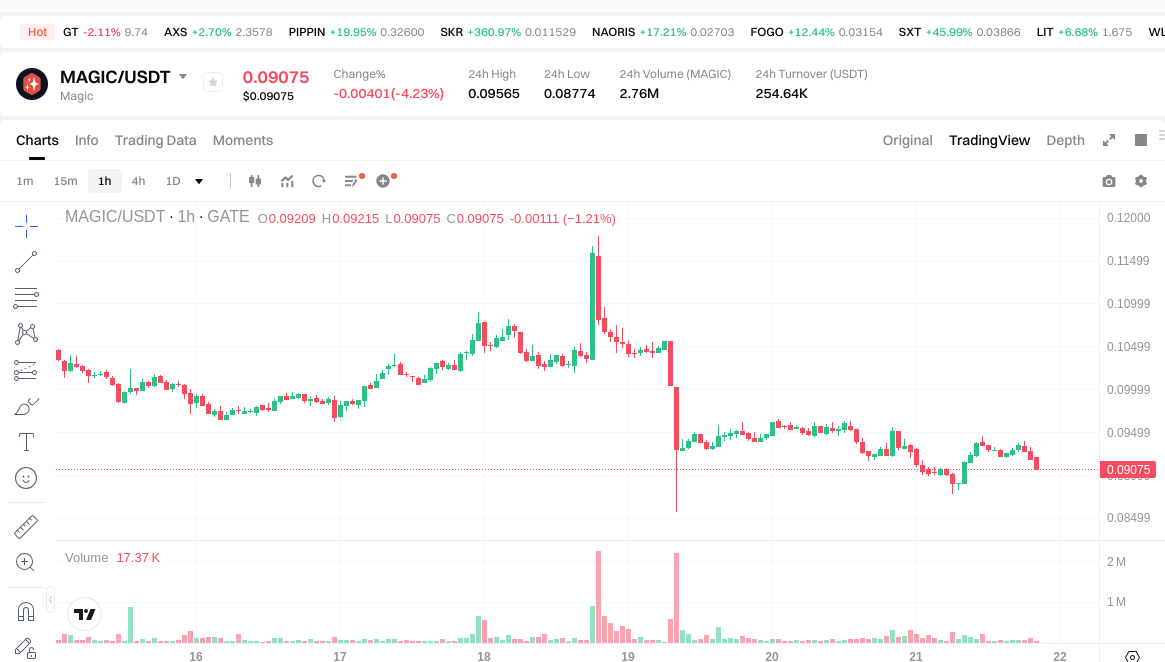
Current MAGIC Investment Market Status (January 2026)
- MAGIC current price: $0.09186
- 24-hour trading volume: $259,823.57
- Circulating supply: 317,629,462.52 MAGIC (91.35% of total supply)
- Market capitalization: $29,177,442.43
- Token holders: 412,454 addresses
Click to view real-time MAGIC market price
II. Core Factors Affecting Whether MAGIC is a Good Investment (Is Magic(MAGIC) a Good Investment)
Supply Mechanism and Scarcity (MAGIC investment scarcity)
- Supply Structure → Impact on Price and Investment Value
- Total Supply: 347,687,042.97 MAGIC
- Maximum Supply: 347,714,007 MAGIC
- Circulating Supply: 317,629,462.52 MAGIC (91.35% of total supply)
- Market Cap to Fully Diluted Valuation Ratio: 91.35%, indicating high circulation ratio
- Scarcity Characteristics: With over 91% of tokens already in circulation, MAGIC demonstrates limited remaining supply expansion potential
- Investment Significance: The high circulation ratio and defined maximum supply may provide a foundation for price stability, though scarcity alone does not guarantee investment value
Technology & Ecosystem Construction (Technology & Ecosystem for MAGIC investment)
- Ecosystem Positioning: MAGIC operates as the native resource of the Treasure metaverse, positioned at the intersection of DeFi, NFT, and gaming
- Utility Mechanism: MAGIC "activates" NFTs and transforms them into productive, yield-generating assets within the ecosystem
- Earning Opportunities: Players can earn MAGIC through gaming, mining, and participating in Bridgeworld activities
- Governance Structure: The Treasure ecosystem is managed by MAGIC holders, providing token utility beyond speculation
- Interconnected Resource Model: The ecosystem strengthens cross-ecosystem connections through MAGIC (Power), Treasures (NFT | Resources), and Legions (NFT | Players)
- Application Expansion: The integration of DeFi, NFT, and gaming applications within the metaverse framework may provide long-term value support for investment consideration
- Deployment: MAGIC contract address on Arbitrum: 0x539bdE0d7Dbd336b79148AA742883198BBF60342
- Holder Base: 412,454 holders indicate a distributed ownership structure
III. MAGIC Future Investment Forecast and Price Outlook (Is Magic(MAGIC) worth investing in 2026-2031)
Short-term Investment Forecast (2026, short-term MAGIC investment outlook)
- Conservative forecast: $0.0881 - $0.0909
- Neutral forecast: $0.0909 - $0.1100
- Optimistic forecast: $0.1100 - $0.1299
Mid-term Investment Outlook (2027-2028, mid-term Magic(MAGIC) investment forecast)
- Market stage expectation: The ecosystem may experience gradual development as the Treasure metaverse continues to evolve, with potential expansion in DeFi, NFT, and gaming integration. Market dynamics could be influenced by broader adoption of metaverse projects and Web3 gaming initiatives.
- Investment return forecast:
- 2027: $0.1071 - $0.1578
- 2028: $0.0684 - $0.1784
- Key catalysts: Ecosystem expansion, gaming partnerships, NFT utility development, MAGIC token utility enhancements, and broader metaverse adoption trends.
Long-term Investment Outlook (Is Magic a good long-term investment?)
- Baseline scenario: $0.0964 - $0.2530 (assuming steady ecosystem growth and maintained market positioning)
- Optimistic scenario: $0.2089 - $0.2530 (assuming accelerated adoption and favorable market conditions)
- Risk scenario: $0.0684 - $0.0964 (reflecting potential market downturns or competitive pressures)
Check MAGIC long-term investment and price forecast: Price Prediction
2026-01-21 to 2031 Long-term Outlook
- Baseline scenario: $0.0881 - $0.2179 (corresponding to steady progress and gradual mainstream application enhancement)
- Optimistic scenario: $0.1299 - $0.2530 (corresponding to large-scale adoption and favorable market environment)
- Transformative scenario: Above $0.2530 (if the ecosystem achieves breakthrough progress and mainstream adoption)
- 2031-12-31 predicted high: $0.2480 (based on optimistic development assumptions)
Disclaimer: Price forecasts are based on historical data and market analysis models. Cryptocurrency investments involve substantial risk, and actual prices may differ significantly from predictions due to market volatility, regulatory changes, technological developments, and other unforeseen factors. This analysis does not constitute investment advice.
| Year |
Predicted High Price |
Predicted Average Price |
Predicted Low Price |
Price Change |
| 2026 |
0.1299155 |
0.09085 |
0.0881245 |
-1 |
| 2027 |
0.1578473325 |
0.11038275 |
0.1070712675 |
20 |
| 2028 |
0.1783730048625 |
0.13411504125 |
0.0683986710375 |
45 |
| 2029 |
0.207804550664812 |
0.15624402305625 |
0.10624593567825 |
70 |
| 2030 |
0.253013758736138 |
0.182024286860531 |
0.096472872036081 |
98 |
| 2031 |
0.247971685990101 |
0.217519022798334 |
0.208818261886401 |
136 |
IV. Magic Investment Strategy and Risk Management (How to invest in Magic)
Investment Strategy (Magic investment strategy)
-
Long-term Holding (HODL Magic): Suitable for conservative investors
Long-term holding strategies involve accumulating MAGIC tokens and maintaining positions through market cycles. This approach may be suitable for investors who believe in the long-term development of the Treasure ecosystem and its integration of DeFi, NFT, and gaming elements.
-
Active Trading: Relying on technical analysis and swing trading
Active traders may utilize technical indicators, price trends, and market momentum to execute short-term trades. Given MAGIC's 24-hour volatility and price fluctuations between $0.08774 and $0.09565, swing trading opportunities may exist for experienced traders.
Risk Management (Risk management for Magic investment)
-
Asset Allocation Ratio: Conservative / Aggressive / Professional investors
Conservative investors might consider allocating a smaller percentage of their portfolio to MAGIC, while aggressive investors may increase exposure based on their risk tolerance. Professional investors should conduct thorough due diligence and consider MAGIC's market capitalization of approximately $29.18 million and its circulating supply of 317.63 million tokens.
-
Risk Hedging Solutions: Multi-asset portfolio + hedging tools
Diversification across different asset classes and cryptocurrency sectors can help mitigate concentration risk. Investors may consider combining MAGIC with other established cryptocurrencies and traditional assets to create a balanced portfolio.
-
Secure Storage: Hot and cold wallets + hardware wallet recommendations
Given that MAGIC operates on the Arbitrum network (contract address: 0x539bdE0d7Dbd336b79148AA742883198BBF60342), investors should use compatible wallets. Cold storage solutions and hardware wallets are recommended for long-term holdings, while hot wallets may be suitable for active trading needs.
V. Magic Investment Risks and Challenges (Risks of investing in Magic)
-
Market Risk: High volatility and price manipulation
MAGIC has demonstrated substantial price volatility, with a 1-year decline of approximately 75.24% and 7-day decline of 12.9% as of January 21, 2026. The current price of $0.09186 represents a significant decrease from its historical high of $6.32 recorded on February 20, 2022. The 24-hour trading volume of approximately $259,823 suggests relatively limited liquidity, which could contribute to increased volatility.
-
Regulatory Risk: Policy uncertainty across different jurisdictions
As a token that integrates gaming, NFT, and DeFi elements, MAGIC may face evolving regulatory frameworks in various jurisdictions. Changes in cryptocurrency regulations, gaming laws, or NFT-related policies could impact the Treasure ecosystem and MAGIC's utility.
-
Technical Risk: Network security vulnerabilities and upgrade failures
MAGIC operates on the Arbitrum network, and any technical issues affecting the underlying blockchain infrastructure could impact token functionality. Additionally, the Treasure ecosystem's reliance on interconnected resources and smart contracts introduces potential smart contract vulnerabilities and integration risks.
VI. Conclusion: Is Magic a Good Investment?
-
Investment Value Summary: MAGIC presents a unique proposition within the intersection of DeFi, NFT, and gaming sectors. The token serves as a resource within the Treasure metaverse ecosystem, with holders participating in governance. However, the token has experienced substantial price decline over the past year, with current market performance showing negative trends across multiple timeframes.
-
Investor Recommendations:
✅ Beginners: Dollar-cost averaging approach + secure wallet storage. New investors should start with small allocations and use hardware wallets or reputable cold storage solutions for MAGIC tokens on the Arbitrum network.
✅ Experienced Investors: Swing trading strategies + portfolio diversification. Active traders may consider technical analysis approaches while maintaining proper position sizing and stop-loss mechanisms.
✅ Institutional Investors: Strategic long-term allocation with comprehensive risk assessment. Institutions should conduct thorough due diligence on the Treasure ecosystem, governance structure, and ecosystem development roadmap.
⚠️ Disclaimer: Cryptocurrency investments carry substantial risk. This content is for informational purposes only and does not constitute investment advice. Investors should conduct independent research and consider their financial situation before making investment decisions.
VII. FAQ
Q1: Is Magic (MAGIC) a good investment for beginners in 2026?
MAGIC may be suitable for beginners who understand the high risks involved, but only as a small portion of a diversified portfolio. As a token operating at the intersection of DeFi, NFT, and gaming within the Treasure metaverse ecosystem, MAGIC offers exposure to emerging Web3 sectors. However, beginners should note that MAGIC has experienced significant volatility, with a 75.24% decline over the past year and a current price of $0.09186—substantially below its February 2022 high of $6.32. The recommended approach for new investors is dollar-cost averaging with small allocations, using secure hardware wallets for storage on the Arbitrum network (contract address: 0x539bdE0d7Dbd336b79148AA742883198BBF60342), and maintaining realistic expectations about potential risks and returns.
Q2: What is the long-term price forecast for MAGIC from 2026 to 2031?
Long-term forecasts suggest MAGIC could range between $0.0881 and $0.2530 by 2031, depending on ecosystem development and market conditions. Under a baseline scenario assuming steady ecosystem growth, prices may fluctuate between $0.0881 and $0.2179 over the 2026-2031 period. The optimistic scenario projects a range of $0.1299 to $0.2530, contingent upon accelerated adoption of the Treasure metaverse, successful gaming partnerships, and favorable broader market conditions. By 2031, the predicted high reaches $0.2480 under optimistic assumptions. However, investors should recognize that these forecasts are based on historical data and analytical models, and actual prices may differ significantly due to market volatility, regulatory changes, technological developments, and competitive pressures within the metaverse and gaming sectors.
Q3: What are the main risks of investing in Magic (MAGIC)?
The primary risks include extreme market volatility, regulatory uncertainty, and technical vulnerabilities. MAGIC has demonstrated substantial price volatility, with recent declines of 12.9% over 7 days and 75.24% over one year, indicating heightened market risk and potential for further price fluctuations. The relatively limited 24-hour trading volume of approximately $259,823 suggests lower liquidity, which could amplify volatility and make large transactions difficult to execute at desired prices. Regulatory risk stems from MAGIC's integration of gaming, NFT, and DeFi elements, which may face evolving policy frameworks across different jurisdictions. Technical risks include potential vulnerabilities in smart contracts within the Treasure ecosystem, as well as dependency on the Arbitrum network's stability and security. The current market capitalization of approximately $29.18 million also indicates a smaller project size, which typically carries higher investment risk compared to more established cryptocurrencies.
Q4: How does MAGIC's tokenomics affect its investment value?
MAGIC's tokenomics suggest limited future supply expansion but do not guarantee investment value appreciation. With a circulating supply of 317.63 million MAGIC tokens (91.35% of the maximum supply of 347.71 million), the token demonstrates a high circulation ratio, meaning most tokens are already in the market. This high circulation percentage limits potential dilution from future token releases, which could provide a foundation for price stability in favorable market conditions. However, scarcity alone does not ensure investment value—the token's utility within the Treasure ecosystem is equally important. MAGIC serves as the native resource that "activates" NFTs and transforms them into productive, yield-generating assets, providing functional utility beyond speculative value. The token also enables governance participation for the 412,454 holders, though this distributed ownership structure may slow decision-making processes. Investors should evaluate whether the current market capitalization of $29.18 million appropriately reflects the ecosystem's utility and growth potential.
Q5: What investment strategies are recommended for MAGIC?
Recommended strategies vary based on investor experience and risk tolerance, ranging from conservative holding to active trading approaches. For conservative investors and beginners, a dollar-cost averaging (DCA) strategy combined with long-term holding may be appropriate, involving regular small purchases to mitigate timing risk while maintaining positions through market cycles. This approach assumes belief in the long-term development of the Treasure ecosystem's integration of DeFi, NFT, and gaming elements. Experienced traders may employ active swing trading strategies, utilizing technical analysis to capitalize on MAGIC's price fluctuations between $0.08774 and $0.09565 within 24-hour periods. Professional investors should consider strategic long-term allocation with comprehensive risk assessment, conducting thorough due diligence on ecosystem development, governance structure, and competitive positioning. Regardless of strategy, proper asset allocation is critical: conservative investors might limit MAGIC exposure to 1-5% of their portfolio, while aggressive investors may increase this based on individual risk tolerance. All investors should implement secure storage solutions, using hardware wallets or cold storage for long-term holdings and ensuring compatibility with the Arbitrum network.
Q6: How does the Treasure ecosystem support MAGIC's investment value?
The Treasure ecosystem provides functional utility for MAGIC through its integration of gaming, NFT, and DeFi elements, though ecosystem adoption remains a key factor for investment value. MAGIC operates as the native resource within the Treasure metaverse, where it serves to "activate" NFTs and transform them into productive, yield-generating assets. This utility mechanism creates demand beyond pure speculation, as players and participants need MAGIC to unlock full functionality of their digital assets. Users can earn MAGIC through gaming activities, mining, and participating in Bridgeworld, creating multiple engagement pathways within the ecosystem. The interconnected resource model—combining MAGIC (Power), Treasures (NFT resources), and Legions (NFT players)—strengthens cross-ecosystem connections and potentially increases token utility as the platform grows. Additionally, MAGIC holders participate in governance decisions, providing stakeholder influence over ecosystem development. However, the investment value ultimately depends on the ecosystem's ability to attract and retain users, secure meaningful gaming partnerships, and differentiate itself in the competitive metaverse and Web3 gaming landscape. The current holder base of 412,454 addresses indicates some level of distribution, but ongoing ecosystem growth and adoption metrics will be critical indicators of future investment potential.
Q7: What are the key price catalysts that could affect MAGIC's investment performance?
Several catalysts could influence MAGIC's price trajectory, including ecosystem expansion, partnership announcements, and broader market trends. On the positive side, successful gaming partnerships could drive user adoption and increase demand for MAGIC tokens as players need them to activate NFTs and participate in the ecosystem. Development milestones such as new game integrations, enhanced DeFi features, or improved yield-generating mechanisms could attract investors and users. Broader metaverse adoption trends and mainstream interest in Web3 gaming could benefit MAGIC as sector-wide enthusiasm increases. Major exchange listings beyond the current 35 platforms could improve liquidity and accessibility. Conversely, negative catalysts include continued bearish cryptocurrency market conditions, as evidenced by MAGIC's 75.24% decline over the past year. Increased competition from other metaverse and gaming-focused projects could reduce MAGIC's market share and relevance. Regulatory actions targeting NFTs, gaming tokens, or DeFi protocols could limit ecosystem functionality. Technical issues on the Arbitrum network or within the Treasure ecosystem's smart contracts could undermine investor confidence. Given the current 24-hour trading volume of $259,823 and market capitalization of $29.18 million, MAGIC remains sensitive to both project-specific developments and broader cryptocurrency market sentiment.
Q8: Should I invest in Magic (MAGIC) or other metaverse tokens?
The decision between MAGIC and other metaverse tokens depends on individual risk tolerance, investment goals, and portfolio diversification strategy. MAGIC offers specific exposure to the Treasure ecosystem's integration of gaming, NFT, and DeFi elements, with a current price of $0.09186 representing a significant discount from historical highs. However, this price decline of 75.24% over the past year also indicates substantial risk and market skepticism about the project's value proposition. When comparing MAGIC to other metaverse tokens, investors should consider factors including market capitalization (MAGIC's $29.18 million is relatively small), ecosystem maturity and user adoption metrics, token utility and revenue generation mechanisms, development team track record, and competitive differentiation. Larger metaverse projects may offer more stability and liquidity but potentially lower growth multiples, while smaller projects like MAGIC carry higher risk but potentially higher reward if ecosystem adoption accelerates. Rather than choosing exclusively between MAGIC and alternatives, diversification across multiple metaverse and gaming tokens may provide balanced exposure to the sector while mitigating individual project risk. Investors should allocate based on conviction in specific ecosystems, conducting thorough research on each project's fundamentals, tokenomics, and development roadmap before making investment decisions.
* The information is not intended to be and does not constitute financial advice or any other recommendation of any sort offered or endorsed by Gate.