This comprehensive analysis examines Manta Network (MANTA), a modular blockchain infrastructure for zero-knowledge applications, to determine its investment viability in 2024-2031. Launched in January 2024 at $0.36 and currently trading at $0.06992 (as of January 2026), MANTA addresses the growing demand for ZK-as-a-Service solutions and modular Layer 2 scalability. The article evaluates MANTA's market performance, institutional backing from Binance Labs and Polychain Capital, supply mechanisms (1 billion token cap with 46% circulating), and technological infrastructure leveraging Celestia's data availability. Key sections cover price history analysis, factors affecting investment value, multi-year price forecasts through 2031, actionable investment strategies across risk profiles, and comprehensive risk management guidelines including regulatory, technical, and market volatility concerns. Ideal for investors seeking detailed market context on emerging ZK Layer 2 protocols on Gate exchange.
Introduction: Manta Network (MANTA) Investment Status and Market Outlook
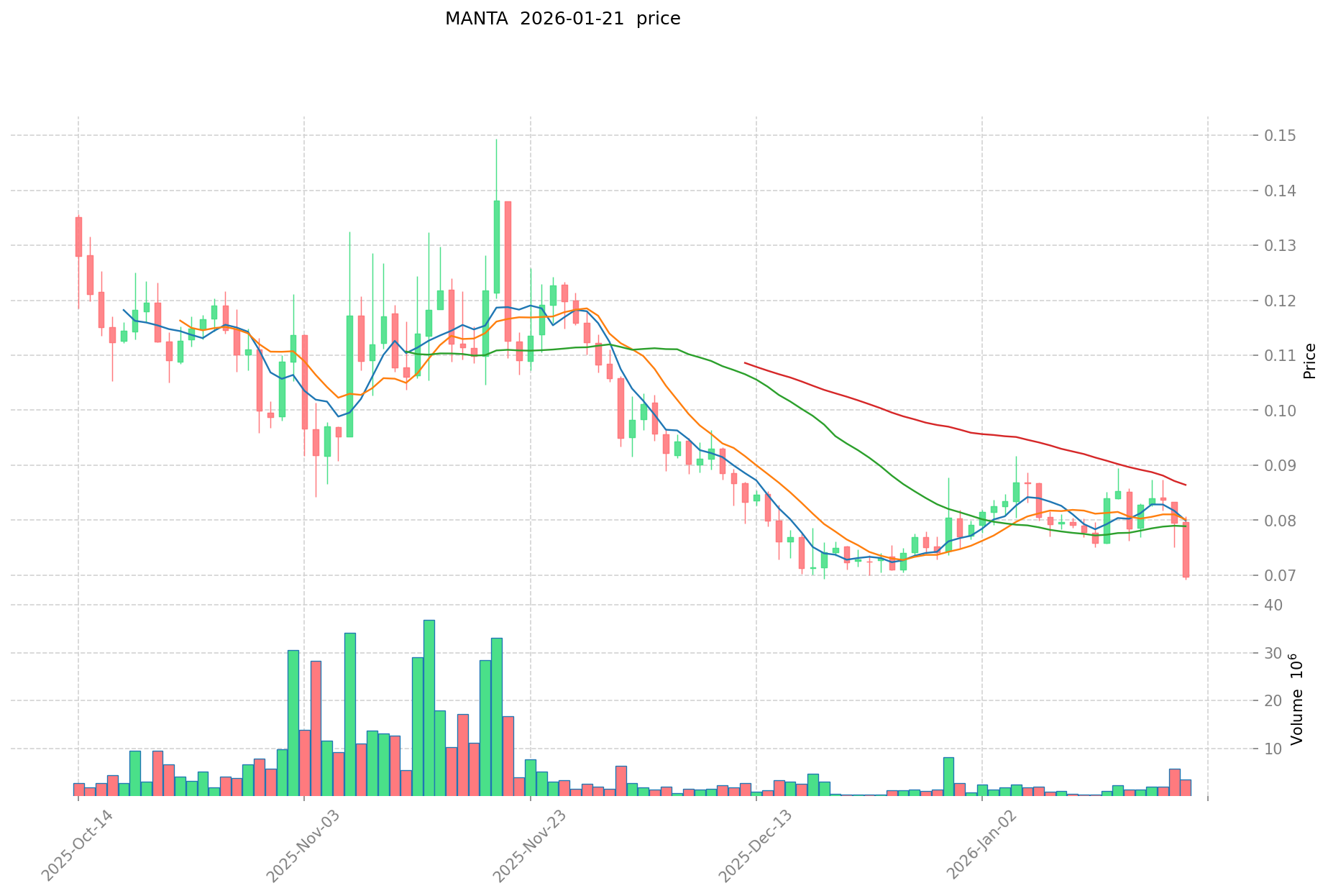
Manta Network (MANTA) represents a notable asset in the cryptocurrency sector, having launched in January 2024 with a focus on zero-knowledge proof applications. As of January 21, 2026, MANTA maintains a market capitalization of approximately $32.18 million, with a circulating supply of around 460.19 million tokens and a current trading price near $0.06992. Positioned as a modular blockchain infrastructure for ZK applications, MANTA has garnered attention from investors exploring "Is Manta Network (MANTA) a good investment?" The project emerged from a team with backgrounds from institutions including Harvard, MIT, and Algorand, securing backing from entities such as Binance Labs and Polychain Capital. This article examines MANTA's investment characteristics, historical price movements, future price considerations, and associated risks to provide informational context for market participants.
I. MANTA Token Price History Review and Current Investment Value
- 2024: Token launch on January 18 → Initial trading price at $0.36, reaching a notable price level of $10.4405 during early market activity
- 2025: Market adjustment phase → Price declined from elevated levels to $0.0405 by October 10
- 2026: Current market cycle → Trading at approximately $0.0699 as of January 21, reflecting a 89.61% decline over the past year
Current MANTA Investment Market Status (January 2026)
- MANTA current price: $0.06992
- Market sentiment (Fear & Greed Index): Data not available in provided materials
- 24-hour trading volume: $270,343.13
- Institutional investor holdings: Data not available in provided materials
Click to view real-time MANTA market price
II. Core Factors Affecting Whether MANTA Is a Good Investment
Supply Mechanism and Scarcity (MANTA Investment Scarcity)
- Total supply is capped at 1,000,000,000 MANTA tokens, with approximately 46.02% currently in circulation (460,187,344 tokens), which may influence price dynamics and investment value.
- The fixed maximum supply creates a defined scarcity model that could potentially support long-term value retention.
- Investment significance: Understanding the supply structure and token distribution is essential for evaluating long-term investment considerations.
Institutional Investment and Mainstream Adoption (Institutional Investment in MANTA)
- Manta Network has received investment from notable web3 investment funds, including Binance Labs and Polychain Capital.
- The project has participated in prominent web3 accelerators such as Alliance DAO and Berkeley Blockchain Xcelerator, which may contribute to its development trajectory.
- Institutional backing and accelerator participation could potentially influence the project's visibility and adoption within the blockchain ecosystem.
Macroeconomic Environment's Impact on MANTA Investment
- Broader monetary policy and interest rate changes may affect risk appetite for crypto assets, including MANTA.
- Market conditions and investor sentiment toward emerging blockchain technologies can influence investment dynamics.
- General uncertainty in traditional markets may lead some investors to explore alternative digital assets as part of portfolio diversification strategies.
Technology and Ecosystem Development (Technology & Ecosystem for MANTA Investment)
- Manta Network operates as a modular blockchain for zero-knowledge (ZK) applications, with Manta Pacific serving as a modular L2 ecosystem for EVM-native ZK applications.
- The project leverages Universal Circuits for ZK-as-a-Service and utilizes Celestia's data availability for modularity, aiming to provide lower gas fees.
- Technological infrastructure designed to support ZK-enabled applications may contribute to ecosystem expansion and potential use case development within DeFi and other blockchain applications.
III. MANTA Future Investment Forecast and Price Outlook (Is Manta Network(MANTA) worth investing in 2026-2031)
Short-term Investment Forecast (2026, short-term MANTA investment outlook)
- Conservative forecast: $0.041 - $0.070
- Neutral forecast: $0.070
- Optimistic forecast: $0.070 - $0.104
Mid-term Investment Outlook (2027-2029, mid-term Manta Network(MANTA) investment forecast)
-
Market stage expectation: The mid-term period may witness gradual ecosystem development as Manta Network continues to establish its position in the modular blockchain and ZK application space. The network's adoption trajectory could be influenced by broader market trends and technological advancements in zero-knowledge proof applications.
-
Investment return forecast:
- 2027: $0.062 - $0.100
- 2028: $0.074 - $0.117
- 2029: $0.097 - $0.153
-
Key catalysts: Potential factors include expansion of ZK-as-a-Service adoption, development of EVM-native ZK applications on Manta Pacific, partnerships within the modular L2 ecosystem, and overall market sentiment towards privacy-focused blockchain solutions.
Long-term Investment Outlook (Is MANTA a good long-term investment?)
- Baseline scenario: $0.079 - $0.143 (assuming steady ecosystem growth and moderate market conditions)
- Optimistic scenario: $0.128 - $0.203 (assuming accelerated adoption of ZK applications and favorable market environment)
- Risk scenario: Below $0.041 (under adverse market conditions or significant competitive pressure)
View MANTA long-term investment and price forecast: Price Prediction
2026-01-21 - 2031 Long-term Outlook
- Baseline scenario: $0.079 - $0.143 (corresponding to steady progress and gradual mainstream application growth)
- Optimistic scenario: $0.128 - $0.203 (corresponding to large-scale adoption and favorable market environment)
- Transformative scenario: Above $0.203 (if the ecosystem achieves breakthrough developments and mainstream adoption)
- 2031-12-31 forecast high: $0.203 (based on optimistic development assumptions)
Disclaimer: The above forecasts are based on historical data analysis and current market information. Cryptocurrency markets are highly volatile and unpredictable. These projections should not be considered as investment advice. Investors should conduct thorough research and consider their risk tolerance before making any investment decisions.
| Year |
Predicted High Price |
Predicted Average Price |
Predicted Low Price |
Price Change |
| 2026 |
0.1042851 |
0.06999 |
0.0412941 |
0 |
| 2027 |
0.1002081825 |
0.08713755 |
0.0618676605 |
24 |
| 2028 |
0.1170910828125 |
0.09367286625 |
0.0740015643375 |
33 |
| 2029 |
0.152803863070312 |
0.10538197453125 |
0.09695141656875 |
50 |
| 2030 |
0.143293139868867 |
0.129092918800781 |
0.078746680468476 |
84 |
| 2031 |
0.202927613708888 |
0.136193029334824 |
0.128021447574734 |
94 |
IV. MANTA Investment Strategy and Risk Management (How to invest in MANTA)
Investment Strategy (MANTA investment strategy)
Long-term Holding (HODL MANTA): Suitable for conservative investors
For investors who believe in the long-term value proposition of Manta Network's modular blockchain infrastructure and zero-knowledge (ZK) technology, a buy-and-hold strategy may be appropriate. This approach involves acquiring MANTA tokens and holding them through market cycles, focusing on the project's fundamental development rather than short-term price movements. Conservative investors may consider this strategy if they have conviction in Manta Pacific's EVM-native ZK applications ecosystem and its partnerships with established entities like Binance Labs and Polychain Capital.
Active Trading: Relies on technical analysis and swing trading
Active traders may attempt to capitalize on MANTA's price volatility by employing technical analysis tools, chart patterns, and momentum indicators. Given the token's substantial price fluctuations (recent 24-hour change of -12.3% and 7-day change of -16.84%), swing trading opportunities may present themselves. However, this approach requires significant market knowledge, time commitment, and risk tolerance, as timing market movements consistently remains challenging even for experienced traders.
Risk Management (Risk management for MANTA investment)
Asset Allocation Ratio: Conservative / Aggressive / Professional investors
- Conservative investors: May consider allocating 1-3% of their cryptocurrency portfolio to MANTA, maintaining majority holdings in more established digital assets
- Aggressive investors: Might allocate 5-10% of their crypto portfolio to MANTA, accepting higher volatility for potential growth opportunities
- Professional investors: Could implement dynamic allocation strategies (3-15%) based on market conditions, technical indicators, and fundamental project developments
Risk Hedging Solutions: Multi-asset portfolio + hedging instruments
Investors may consider diversifying across different blockchain ecosystems and use cases rather than concentrating holdings in a single Layer 2 solution. Portfolio construction might include exposure to established Layer 1 networks, stablecoins, and other Layer 2 protocols to reduce concentration risk. Some advanced investors may explore derivatives or options strategies where available, though such instruments carry their own complexities and risks.
Secure Storage: Hot and cold wallets + hardware wallet recommendations
Given MANTA's contract address on Manta Pacific (0x95CeF13441Be50d20cA4558CC0a27B601aC544E5), investors should prioritize secure storage solutions:
- Cold storage: Hardware wallets compatible with EVM chains provide enhanced security for long-term holdings by keeping private keys offline
- Hot wallets: Software wallets may be convenient for active trading but should only hold amounts intended for near-term transactions
- Multi-signature solutions: For larger holdings, multi-signature wallets can provide additional security layers
- Regular security audits: Investors should periodically verify wallet addresses, enable two-factor authentication, and maintain updated security practices
V. MANTA Investment Risks and Challenges (Risks of investing in MANTA)
Market Risk: High volatility and price manipulation concerns
MANTA exhibits significant price volatility, as evidenced by its 1-year performance decline of -89.61% from higher price levels. The token's 24-hour trading volume of approximately $270,343 suggests moderate liquidity, which may contribute to price swings during periods of concentrated buying or selling. The current price of $0.06992 represents a substantial decrease from the historical high, indicating the potential for continued volatility. Lower market capitalization assets like MANTA (with approximately $32.18 million in circulating market cap) may be more susceptible to large market movements triggered by relatively smaller transaction volumes.
Regulatory Risk: Policy uncertainty across different jurisdictions
As with all cryptocurrency projects, Manta Network operates in an evolving regulatory landscape where different countries and regions maintain varying approaches to digital assets. Changes in regulatory frameworks regarding:
- Zero-knowledge technology applications and privacy-focused blockchain solutions
- Layer 2 scaling solutions and their classification under securities laws
- Cross-border cryptocurrency transactions and reporting requirements
- Tax treatment of crypto assets and staking rewards
These regulatory developments could materially impact MANTA's adoption, trading availability, and overall market dynamics. Investors should stay informed about regulatory changes in their jurisdictions and consider how policy shifts might affect their holdings.
Technical Risk: Network security vulnerabilities and upgrade failures
Manta Network's infrastructure relies on complex technological components, including:
- Zero-knowledge proof systems and Universal Circuits for ZK-as-a-Service
- Integration with Celestia for data availability
- EVM compatibility for smart contract execution
- Cross-chain bridges and interoperability protocols
Each of these components introduces potential technical risks, including:
- Smart contract vulnerabilities that could be exploited by malicious actors
- Network congestion or performance issues during high-demand periods
- Complications during protocol upgrades or hard forks
- Dependencies on external data availability layers
- Potential bugs in zero-knowledge circuit implementations
While the project's backing by experienced founders from institutions like Harvard and MIT may provide technical expertise, no blockchain system is immune to technical challenges or security vulnerabilities.
VI. Conclusion: Is MANTA a Good Investment?
Investment Value Summary
MANTA represents exposure to the emerging zero-knowledge Layer 2 ecosystem, with a focus on modular blockchain architecture and EVM-native ZK applications. The project's technical approach and institutional backing provide certain foundational strengths. However, the token has experienced substantial price decline over the past year (-89.61%), reflecting broader market conditions and the challenges facing many cryptocurrency projects. The current circulating supply of approximately 460.19 million MANTA (46.02% of max supply) and market capitalization of around $32.18 million position it as a smaller-cap digital asset with corresponding volatility characteristics.
Investor Recommendations
✅ Beginners: Consider dollar-cost averaging (DCA) with small, regular purchases + secure wallet storage practices. Focus on education about blockchain technology and Layer 2 solutions before committing significant capital.
✅ Experienced Investors: May explore swing trading opportunities during volatile periods + implement diversified portfolio allocation across multiple Layer 2 protocols. Maintain position sizing discipline and use technical analysis tools.
✅ Institutional Investors: Could consider strategic long-term allocation as part of a broader thesis on zero-knowledge technology adoption, with appropriate due diligence on technical roadmap, team execution, and competitive positioning.
⚠️ Notice: Cryptocurrency investment carries high risk. This article is for informational purposes only and does not constitute investment advice. Investors should conduct their own research, consider their financial situation and risk tolerance, and potentially consult with financial advisors before making investment decisions. Past performance does not guarantee future results, and the total loss of invested capital is possible in cryptocurrency markets.
VII. FAQ
Q1: What is Manta Network (MANTA) and what makes it different from other blockchain projects?
Manta Network is a modular blockchain infrastructure specifically designed for zero-knowledge (ZK) applications, with Manta Pacific serving as a modular Layer 2 ecosystem for EVM-native ZK applications. What distinguishes MANTA from other projects is its focus on Universal Circuits for ZK-as-a-Service, leveraging Celestia's data availability for modularity while offering lower gas fees. The project was founded by a team with backgrounds from prestigious institutions including Harvard, MIT, and Algorand, and has secured backing from notable investors such as Binance Labs and Polychain Capital. This combination of advanced ZK technology, modular architecture, and institutional support positions Manta Network as a specialized infrastructure provider in the growing zero-knowledge application space.
Q2: How has MANTA performed since its launch, and what is its current market status?
MANTA launched in January 2024 with an initial trading price around $0.36, reaching a notable high of $10.4405 during early market activity. However, as of January 21, 2026, the token trades at approximately $0.06992, representing an 89.61% decline over the past year. The current market capitalization stands at approximately $32.18 million, with a circulating supply of around 460.19 million tokens (46.02% of the 1 billion maximum supply). The 24-hour trading volume is approximately $270,343, indicating moderate liquidity levels. This price trajectory reflects both the broader cryptocurrency market conditions and the challenges facing emerging Layer 2 protocols during this period.
Q3: What are the main risks associated with investing in MANTA?
MANTA investment carries several significant risks that potential investors should carefully consider. First, market risk includes high volatility, as evidenced by the -89.61% annual decline and recent short-term drops (-12.3% in 24 hours, -16.84% in 7 days), combined with relatively low liquidity that may amplify price swings. Second, regulatory risk stems from evolving policies regarding privacy-focused blockchain solutions, zero-knowledge technology applications, and Layer 2 protocols across different jurisdictions. Third, technical risk involves potential vulnerabilities in smart contracts, zero-knowledge proof systems, cross-chain bridges, and dependencies on external data availability layers like Celestia. Additionally, the project faces competitive pressure from other Layer 2 solutions and ZK application platforms in a rapidly evolving ecosystem.
Q4: What is the investment outlook for MANTA in the short-term and long-term?
For 2026, short-term forecasts range from a conservative $0.041-$0.070 to an optimistic $0.070-$0.104, with a neutral expectation around $0.070. Mid-term projections (2027-2029) suggest potential ranges of $0.062-$0.100 in 2027, $0.074-$0.117 in 2028, and $0.097-$0.153 in 2029, assuming gradual ecosystem development and adoption of ZK applications. Long-term outlook through 2031 presents a baseline scenario of $0.079-$0.143 under steady growth conditions, an optimistic scenario of $0.128-$0.203 with accelerated ZK adoption, and a transformative scenario above $0.203 if breakthrough developments occur. However, these forecasts are subject to high uncertainty due to market volatility, technological developments, regulatory changes, and competitive dynamics. Investors should note that these projections are not guarantees and actual performance may differ significantly.
Q5: What investment strategy is most appropriate for different types of MANTA investors?
Investment strategies should align with individual risk tolerance and expertise levels. Conservative investors might consider allocating only 1-3% of their cryptocurrency portfolio to MANTA, implementing a long-term holding (HODL) strategy focused on the project's fundamental technological development rather than short-term price movements. Aggressive investors could allocate 5-10% with active trading approaches utilizing technical analysis and swing trading to capitalize on volatility, though this requires significant market knowledge and time commitment. Professional investors might employ dynamic allocation strategies (3-15%) based on evolving market conditions and fundamental developments. Regardless of approach, all investors should prioritize secure storage using hardware wallets for long-term holdings, implement portfolio diversification across different blockchain ecosystems, and maintain appropriate position sizing discipline. Dollar-cost averaging (DCA) may be particularly suitable for beginners to mitigate timing risk while learning about the technology and market dynamics.
Q6: How does Manta Network's supply mechanism affect its investment value?
MANTA has a fixed maximum supply of 1,000,000,000 tokens, with approximately 460,187,344 tokens (46.02%) currently in circulation as of January 2026. This defined scarcity model means that 53.98% of the total supply remains to enter circulation over time, which could create selling pressure as new tokens are released through various distribution mechanisms. The capped supply creates a predictable inflation schedule that differs from proof-of-work cryptocurrencies with perpetual issuance. Understanding this supply structure is essential for evaluating long-term investment considerations, as the gradual release of the remaining tokens may impact price dynamics. The fixed maximum supply could potentially support value retention over the long term once full circulation is achieved, assuming demand for ZK application infrastructure grows correspondingly. However, the current low circulation percentage suggests that supply expansion will continue for several years, which investors should factor into their valuation models and investment timelines.
* The information is not intended to be and does not constitute financial advice or any other recommendation of any sort offered or endorsed by Gate.