This comprehensive analysis examines Map Protocol (MAPO) as an investment opportunity in 2024-2031, evaluating whether this Bitcoin interoperability solution represents a viable portfolio addition. The article examines MAPO's current market position with a $25.75 million market cap, trading at $0.00417, and reviews historical price performance showing 88.75% decline from its November 2019 launch. Core analysis covers technology infrastructure utilizing ZK light-clients, supply mechanisms affecting tokenomics, and institutional adoption factors across 7 exchanges including Gate. The guide presents tiered investment strategies for conservative, aggressive, and professional investors with specific asset allocation ratios and risk management frameworks. Comprehensive risk assessment addresses market volatility, regulatory uncertainty, and technical vulnerabilities. Price forecasts span conservative to optimistic scenarios through 2031, supported by detailed investment recommendations, secure storage protocols, an
Introduction: Map Protocol (MAPO) Investment Position and Market Outlook
MAP Protocol (MAPO) represents a blockchain interoperability solution in the cryptocurrency sector, designed as an interoperable layer for the Bitcoin network built upon ZK light-clients. Since its launch in November 2019, the project has positioned itself as a gateway for Bitcoin ecosystem developers and users, facilitating interoperability between Bitcoin Layer 2 solutions and both EVM and non-EVM ecosystems. As of January 22, 2026, MAPO holds a market capitalization of approximately $25.75 million with a circulating supply of around 6.18 billion tokens, trading at $0.00417. The token ranks 771st in the cryptocurrency market with a market dominance of 0.0012%. With its focus on cross-chain infrastructure and Bitcoin ecosystem connectivity, MAPO has become a subject of interest among investors exploring "Is Map Protocol (MAPO) a good investment?" This article provides a comprehensive analysis of MAPO's investment characteristics, historical price movements, future price outlook, and associated investment risks to serve as a reference for potential investors.
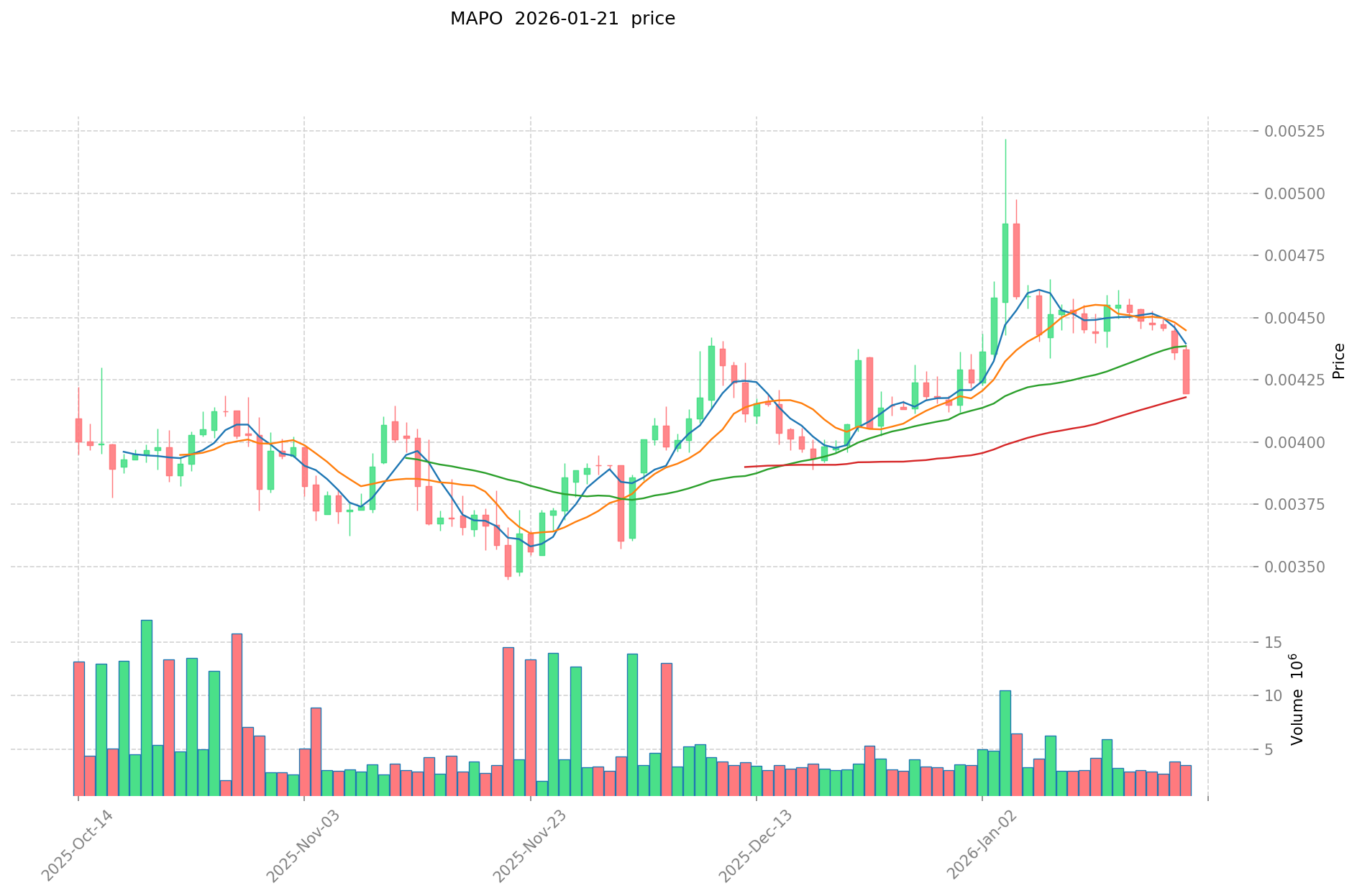
I. MAPO Token Price History Review and Current Investment Value Status
Based on available data, Map Protocol (MAPO) launched in November 2019 with an initial offering price of $0.03707. The token has experienced fluctuations across different market cycles:
- 2024: Peak Performance Period → MAPO reached $0.045 on March 14, 2024, representing its price peak during the observed period
- 2025: Market Adjustment Phase → Price declined to $0.003447 on November 21, 2025, reflecting broader market corrections
- Recent 12 Months: Extended Downtrend → Token value decreased by 56.36% year-over-year, moving from higher valuations toward current levels
Current MAPO Investment Market Status (January 2026)
- MAPO Current Price: $0.00417
- 24-Hour Trading Volume: $14,206.91
- Market Capitalization: $25,754,275.08
- Circulating Supply: 6,176,085,151.63 MAPO (61.76% of total supply)
- Fully Diluted Valuation: $40,437,424.04
- Market Dominance: 0.0012%
Click to view real-time MAPO market price
II. Core Factors Influencing Whether MAPO is a Good Investment
Supply Mechanism and Scarcity (MAPO Investment Scarcity)
- MAPO operates with a maximum supply cap of 10,000,000,000 tokens, with a total supply of 9,697,223,991 tokens. The circulating supply stands at approximately 6,176,085,151 tokens, representing roughly 61.76% of the total supply. This supply structure establishes a defined token availability framework that may influence market dynamics.
- The market capitalization to fully diluted valuation ratio currently sits at 61.76%, indicating that a substantial portion of the total token supply remains outside of active circulation. Historical price movements have shown fluctuations, with MAPO trading at $0.00417 as of January 22, 2026, compared to its all-time high of $0.045 recorded on March 14, 2024, and all-time low of $0.003447 on November 21, 2025.
- The predetermined supply parameters create a framework where token distribution patterns may affect investment considerations. The relationship between circulating and maximum supply represents a technical characteristic that some investors examine when evaluating crypto assets.
Institutional Investment and Mainstream Adoption (Institutional Investment in MAPO)
- MAP Protocol positions itself as an interoperability layer for the Bitcoin network, built upon ZK light-clients, serving as a gateway for Bitcoin ecosystem developers and users. The protocol facilitates interoperability between Bitcoin L2 solutions and both EVM and non-EVM ecosystems.
- The project is currently listed on 7 exchanges, with a 24-hour trading volume of approximately $14,206.91. Market capitalization stands at approximately $25.75 million, representing 0.0012% of the broader crypto market.
- The protocol's focus on Bitcoin ecosystem connectivity positions it within the growing infrastructure segment aimed at enhancing blockchain interoperability. The adoption trajectory will likely depend on the continued development of Bitcoin Layer 2 solutions and cross-chain application requirements.
Macroeconomic Environment's Impact on MAPO Investment
- As with broader cryptocurrency markets, MAPO's investment profile may be influenced by shifts in monetary policy, interest rate adjustments, and global liquidity conditions. Changes in traditional financial market conditions can affect capital flows into digital assets.
- During periods of monetary expansion or concerns about currency devaluation, some investors explore digital assets as alternative holdings. However, MAPO's relatively small market capitalization and focused technical positioning mean its price movements may be influenced more by sector-specific developments than broad macroeconomic trends.
- Regulatory developments affecting cryptocurrency markets, cross-border transaction frameworks, and blockchain infrastructure policies may have implications for projects operating in the interoperability space.
Technology and Ecosystem Development (Technology & Ecosystem for MAPO Investment)
- MAP Protocol's core technology centers on ZK light-client infrastructure designed to facilitate Bitcoin network interoperability. This technical approach aims to enable connections between Bitcoin-based systems and other blockchain ecosystems without requiring traditional bridge mechanisms.
- The protocol's development roadmap focuses on expanding interoperability capabilities for Bitcoin Layer 2 solutions and establishing connections across EVM and non-EVM networks. The technical implementation seeks to address cross-chain communication challenges through zero-knowledge proof verification methods.
- The long-term investment proposition relates to the protocol's ability to establish usage within the Bitcoin ecosystem infrastructure layer and its adoption by developers building cross-chain applications. The growth of Bitcoin Layer 2 solutions and demand for interoperability services will likely influence the protocol's utility and network activity levels.
III. MAPO Future Investment Forecast and Price Outlook (Is Map Protocol(MAPO) worth investing in 2026-2031)
Short-term Investment Forecast (2026, short-term MAPO investment outlook)
- Conservative forecast: 0.00225 - 0.00342 USD
- Neutral forecast: 0.00342 - 0.00417 USD
- Optimistic forecast: 0.00417 - 0.00463 USD
Mid-term Investment Outlook (2027-2029, mid-term Map Protocol(MAPO) investment forecast)
-
Market phase expectation: The token may experience gradual recovery and stabilization phases as the Bitcoin interoperability layer continues development. Price movements could reflect broader market sentiment toward cross-chain infrastructure and Bitcoin Layer 2 ecosystem expansion.
-
Investment return forecast:
- 2027: 0.00343 - 0.00590 USD
- 2028: 0.00432 - 0.00633 USD
- 2029: 0.00442 - 0.00597 USD
-
Key catalysts: Expansion of Bitcoin ecosystem interoperability, adoption by developers building on Bitcoin Layer 2 networks, integration with EVM and non-EVM ecosystems, and overall cryptocurrency market conditions.
Long-term Investment Outlook (Is MAPO a good long-term investment?)
- Base scenario: 0.00361 - 0.00693 USD (assuming steady development of cross-chain infrastructure and moderate adoption within Bitcoin ecosystem)
- Optimistic scenario: 0.00527 - 0.01027 USD (assuming significant expansion of Bitcoin Layer 2 usage and increased demand for interoperability solutions)
- Risk scenario: Below 0.00345 USD (under adverse market conditions or limited adoption of interoperability technologies)
Click to view MAPO long-term investment and price forecast: Price Prediction
2026-01-22 - 2031 Long-term Outlook
- Base scenario: 0.00360 - 0.00693 USD (corresponding to stable progress and steady improvement in mainstream applications)
- Optimistic scenario: 0.00527 - 0.01027 USD (corresponding to large-scale adoption and favorable market environment)
- Transformative scenario: Above 0.01027 USD (if ecosystem achieves breakthrough progress and mainstream adoption)
- 2031-12-31 predicted high: 0.01027 USD (based on optimistic development assumptions)
Disclaimer: Price predictions are based on historical data analysis and market trend projections. Cryptocurrency markets are highly volatile and subject to numerous unpredictable factors. This information should not be considered as investment advice. Investors should conduct their own research and assess their risk tolerance before making any investment decisions.
| Year |
Predicted High Price |
Predicted Average Price |
Predicted Low Price |
Price Change |
| 2026 |
0.0046287 |
0.00417 |
0.0022518 |
0 |
| 2027 |
0.005895129 |
0.00439935 |
0.003431493 |
5 |
| 2028 |
0.006331104585 |
0.0051472395 |
0.00432368118 |
23 |
| 2029 |
0.0059687389242 |
0.0057391720425 |
0.004419162472725 |
37 |
| 2030 |
0.008019919012189 |
0.00585395548335 |
0.005268559935015 |
40 |
| 2031 |
0.010266667126699 |
0.006936937247769 |
0.00360720736884 |
66 |
IV. MAPO Investment Strategy and Risk Management (How to invest in Map Protocol)
Investment Strategy (MAPO investment strategy)
Long-term Holding (HODL MAPO): Suitable for conservative investors
Long-term holding may be appropriate for investors who believe in the fundamental value proposition of MAP Protocol as an interoperability layer for the Bitcoin network. This approach typically involves:
- Accumulating MAPO tokens during market downturns
- Holding through market cycles without frequent trading
- Focusing on the project's technological development and ecosystem growth
- Monitoring key milestones such as network upgrades and partnership announcements
Given MAPO's significant price decline of approximately 88.75% from its initial offering price of $0.03707 to the current price of $0.00417, and a 56.36% decline over the past year, long-term holders should carefully evaluate the project's recovery potential and fundamental developments.
Active Trading: Relies on technical analysis and swing trading
Active trading strategies for MAPO may include:
- Day trading within the 24-hour price range (recent low: $0.004104, high: $0.004275)
- Swing trading based on weekly and monthly price movements
- Utilizing technical indicators to identify entry and exit points
- Monitoring trading volume patterns (current 24h volume: $14,206.91)
Traders should note MAPO's relatively low liquidity and limited exchange availability (7 exchanges), which may impact execution and increase slippage risk.
Risk Management (Risk management for MAPO investment)
Asset Allocation Ratio: Conservative / Aggressive / Professional investors
- Conservative investors: Consider allocating no more than 1-2% of crypto portfolio to MAPO, given its volatility and lower market capitalization ranking (#771)
- Aggressive investors: May allocate 3-5% while maintaining strict stop-loss levels
- Professional investors: Could implement position sizing based on risk-adjusted returns and portfolio correlation analysis
With MAPO's market cap of approximately $25.75 million and a market dominance of only 0.0012%, position sizing should reflect its speculative nature and liquidity constraints.
Risk Hedging Solutions: Multi-asset portfolio + hedging tools
- Diversify across different blockchain interoperability projects
- Maintain positions in major cryptocurrencies (BTC, ETH) to balance portfolio risk
- Consider stablecoin allocations for capital preservation
- Monitor correlation with Bitcoin price movements given MAP Protocol's focus on Bitcoin ecosystem interoperability
Secure Storage: Hot and cold wallets + hardware wallet recommendations
- Cold Storage: Hardware wallets (Ledger, Trezor) for long-term holdings
- Hot Wallets: Use reputable software wallets for active trading amounts only
- Exchange Storage: Minimize holdings on exchanges to reduce custodial risk
- Implement multi-signature solutions for larger holdings
- Regular security audits and backup procedures for wallet recovery phrases
V. MAPO Investment Risks and Challenges (Risks of investing in Map Protocol)
Market Risk: High volatility and price manipulation
- MAPO has experienced substantial price volatility, with a 24-hour change of -2.66% and 7-day decline of -8.64%
- The token reached an all-time high of $0.045 on March 14, 2024, but subsequently declined to an all-time low of $0.003447 on November 21, 2025
- Low trading volume ($14,206.91 in 24 hours) and limited exchange listings (7 exchanges) may increase susceptibility to price manipulation
- Market capitalization of approximately $25.75 million indicates relatively small size compared to established projects
- The significant gap between market cap and fully diluted valuation (61.76% ratio) suggests potential selling pressure from token unlocks
Regulatory Risk: Policy uncertainty across different jurisdictions
- Cryptocurrency regulations continue to evolve globally, with varying approaches to cross-chain interoperability protocols
- Projects facilitating Bitcoin ecosystem connectivity may face scrutiny regarding compliance requirements
- Changes in regulatory frameworks could impact MAPO's operational model and token utility
- Uncertainty around classification of interoperability tokens across different jurisdictions
- Potential restrictions on cross-chain bridges and asset transfers in certain regions
Technical Risk: Network security vulnerabilities and upgrade failures
- As an interoperability layer built on ZK light-clients, MAP Protocol faces complex technical challenges
- Smart contract vulnerabilities in cross-chain mechanisms could lead to asset losses
- Dependency on multiple blockchain ecosystems (Bitcoin L2s, EVM, and non-EVM chains) increases technical complexity
- Network upgrade failures could disrupt interoperability functions
- Competition from other interoperability solutions may affect adoption rates
- The project's circulating supply of 6.18 billion tokens (61.76% of max supply of 10 billion) indicates ongoing token distribution that may affect tokenomics
VI. Conclusion: Is Map Protocol a Good Investment?
Investment Value Summary: MAPO presents both opportunities and significant challenges for investors. As an interoperability layer for the Bitcoin network utilizing ZK light-client technology, the project addresses a relevant need in the blockchain ecosystem. However, the token has experienced substantial price depreciation, declining approximately 88.75% from its initial offering price and 56.36% over the past year. The relatively low market capitalization of $25.75 million, limited exchange availability, and modest trading volumes suggest early-stage market positioning with associated risks.
Investor Recommendations:
✅ Beginners: Consider dollar-cost averaging with small allocations + secure wallet storage
- Start with minimal exposure (less than 1-2% of crypto portfolio)
- Use hardware wallets for secure long-term storage
- Focus on understanding the project's technology and ecosystem development before increasing position size
- Monitor market conditions and project milestones carefully
✅ Experienced Investors: Swing trading + portfolio diversification
- Implement technical analysis for entry and exit points within established price ranges
- Maintain strict risk management protocols including stop-loss levels
- Diversify across multiple interoperability and Bitcoin ecosystem projects
- Track developments in ZK technology and Bitcoin L2 adoption
✅ Institutional Investors: Strategic long-term positioning considerations
- Conduct thorough due diligence on technical architecture and team capabilities
- Evaluate competitive positioning within the interoperability sector
- Consider pilot allocations with appropriate risk controls
- Monitor regulatory developments affecting cross-chain protocols
⚠️ Disclaimer: Cryptocurrency investment carries high risk. This content is for informational purposes only and does not constitute investment advice. Investors should conduct independent research and consult with financial advisors before making investment decisions.
VII. FAQ
Q1: What is the current market position of MAP Protocol (MAPO) and how does it compare to other interoperability projects?
MAP Protocol currently holds a market capitalization of approximately $25.75 million with a market ranking of #771, representing 0.0012% of the total cryptocurrency market. The token trades at $0.00417 with a 24-hour trading volume of $14,206.91 across 7 exchanges. MAPO positions itself as an interoperability layer for the Bitcoin network built on ZK light-clients, targeting Bitcoin Layer 2 ecosystem connectivity. Compared to established cross-chain projects, MAPO's market cap and liquidity remain relatively modest, indicating early-stage positioning within the competitive interoperability sector.
Q2: How has MAPO's price performed historically and what factors contributed to its volatility?
MAPO launched in November 2019 at $0.03707 and reached an all-time high of $0.045 on March 14, 2024. Subsequently, the token experienced significant decline, dropping to an all-time low of $0.003447 on November 21, 2025. This represents an approximately 88.75% decrease from its initial offering price and a 56.36% decline over the past year. The volatility stems from several factors: low trading volume ($14,206.91 daily), limited exchange availability (7 platforms), broader cryptocurrency market corrections, and the early-stage nature of Bitcoin interoperability infrastructure development. The substantial gap between circulating supply (61.76%) and maximum supply also suggests potential selling pressure from token unlocks.
Q3: What are the primary investment risks associated with MAPO?
MAPO investment carries three principal risk categories. First, market risk manifests through high volatility, limited liquidity with modest daily trading volumes, and susceptibility to price manipulation given its small market cap. Second, regulatory risk includes evolving cryptocurrency regulations affecting cross-chain protocols, potential scrutiny of Bitcoin ecosystem connectivity mechanisms, and classification uncertainty across different jurisdictions. Third, technical risk involves complexities inherent to ZK light-client architecture, smart contract vulnerabilities in cross-chain operations, dependency on multiple blockchain ecosystems, and competitive pressure from alternative interoperability solutions. The combination of these risks necessitates careful position sizing and robust risk management strategies.
Q4: What investment strategy is most appropriate for different investor profiles considering MAPO?
Conservative investors should consider allocating no more than 1-2% of their crypto portfolio to MAPO, employing dollar-cost averaging and secure hardware wallet storage for long-term holdings. Aggressive investors may allocate 3-5% while implementing strict stop-loss levels and active trading strategies based on technical analysis within established price ranges. Professional investors could pursue strategic positioning through thorough due diligence on technical architecture, competitive analysis within the interoperability sector, and pilot allocations with comprehensive risk controls. All investor types should diversify across multiple projects, monitor Bitcoin Layer 2 ecosystem developments, and maintain appropriate hedging through stablecoin allocations or major cryptocurrency positions.
Q5: What is MAPO's price forecast for 2026-2031 and what factors could influence these projections?
Short-term forecasts for 2026 range from $0.00225-$0.00463 depending on market conditions. Mid-term projections suggest potential ranges of $0.00343-$0.00590 for 2027, $0.00432-$0.00633 for 2028, and $0.00442-$0.00597 for 2029. Long-term outlook for 2031 ranges from a conservative $0.00360-$0.00693 to an optimistic $0.00527-$0.01027, with potential transformative scenarios exceeding $0.01027. These projections depend on several factors: Bitcoin Layer 2 ecosystem expansion, adoption of cross-chain interoperability solutions, technological development milestones, broader cryptocurrency market conditions, regulatory frameworks for cross-chain protocols, and competitive dynamics within the interoperability sector. However, these remain speculative estimates subject to significant uncertainty.
Q6: How does MAP Protocol's technology differentiate it from other blockchain interoperability solutions?
MAP Protocol distinguishes itself through its focus on ZK light-client infrastructure specifically designed for Bitcoin network interoperability. Unlike traditional bridge mechanisms, the protocol aims to facilitate connections between Bitcoin-based systems and other blockchain ecosystems through zero-knowledge proof verification methods. This technical approach targets interoperability between Bitcoin Layer 2 solutions and both EVM and non-EVM networks, positioning MAPO as a gateway for Bitcoin ecosystem developers. The ZK light-client architecture seeks to address cross-chain communication challenges while maintaining security properties. However, the practical effectiveness and adoption of this technology relative to competing interoperability solutions remains subject to ongoing market validation and technical development progress.
Q7: What are the key milestones investors should monitor when evaluating MAPO's investment potential?
Investors should track several critical indicators: network development progress including protocol upgrades and technical implementations; Bitcoin Layer 2 ecosystem growth and adoption rates; integration announcements with EVM and non-EVM blockchain networks; developer adoption metrics and application deployments utilizing MAP Protocol infrastructure; trading volume trends and exchange listing expansions beyond current 7 platforms; token unlock schedules affecting the 38.24% of supply not yet circulating; partnership developments with Bitcoin ecosystem projects; regulatory clarity regarding cross-chain protocols; competitive positioning updates relative to alternative interoperability solutions; and overall cryptocurrency market conditions affecting infrastructure projects. Regular monitoring of these factors provides essential context for investment decision-making.
Q8: What security measures should investors implement when holding MAPO tokens?
Investors should adopt comprehensive security protocols: utilize hardware wallets (Ledger, Trezor) for cold storage of long-term holdings; limit hot wallet usage to amounts needed for active trading only; minimize exchange storage to reduce custodial risk and potential platform vulnerabilities; implement multi-signature solutions for larger position sizes; maintain secure backup procedures for wallet recovery phrases with offline storage; regularly audit security practices and update wallet firmware; use unique, complex passwords and enable two-factor authentication across all platforms; verify contract addresses before transactions to prevent phishing attacks; and consider portfolio insurance options where available. Given MAPO's limited exchange availability and modest liquidity, security precautions become particularly important for protecting holdings against both technical vulnerabilities and potential market manipulation attempts.
* The information is not intended to be and does not constitute financial advice or any other recommendation of any sort offered or endorsed by Gate.