This comprehensive guide analyzes whether Maple (SYRUP) represents a worthwhile investment opportunity in the institutional DeFi lending sector. The article examines SYRUP's price history, current market position ($0.3871 with $445.25M market cap), and core investment factors including supply scarcity, institutional adoption, and technological development. It provides detailed price forecasts across conservative, neutral, and optimistic scenarios through 2031, while outlining investment strategies suitable for beginners, experienced traders, and institutional investors. The guide addresses critical risks including market volatility, regulatory uncertainty, and technical vulnerabilities, along with security recommendations for token storage. Investors learn risk management approaches, hedging strategies, and realistic expectations before making investment decisions in this mid-cap DeFi asset.
Introduction: Maple (SYRUP) Investment Position and Market Outlook
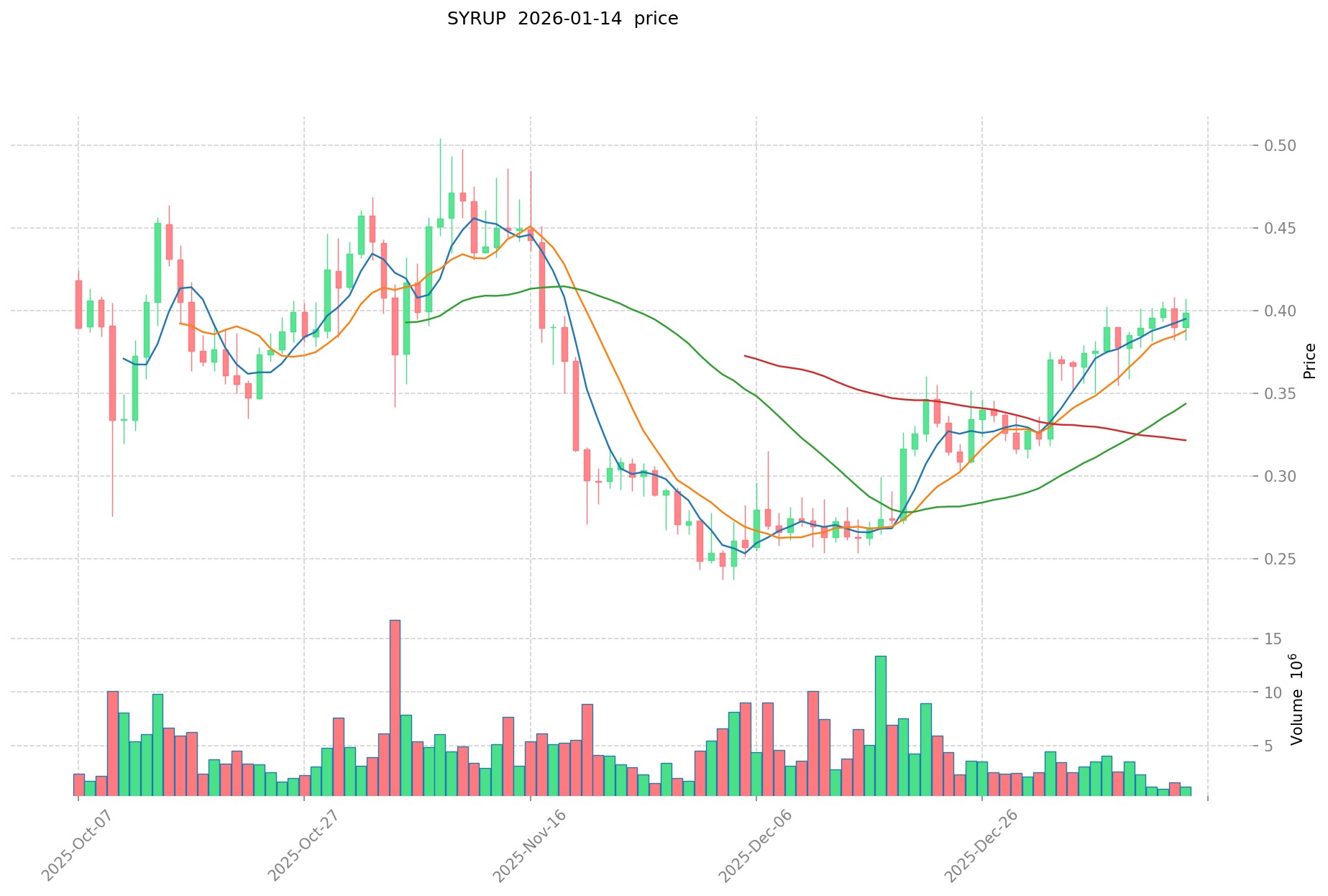
SYRUP is a notable asset in the cryptocurrency sector. Launched in November 2024, it has been associated with institutional-grade DeFi lending solutions. As of January 2026, Maple (SYRUP) maintains a market capitalization of approximately $445.25 million, with a circulating supply of about 1.15 billion tokens, and a current price around $0.3871. Positioned as a gateway connecting institutional lending to decentralized finance, SYRUP has gradually become a focal point for investors exploring questions like "Is Maple (SYRUP) a good investment?" This article comprehensively analyzes the investment value, historical price movements, future price outlook, and associated risks of SYRUP, providing reference materials for potential investors.
Founded in 2019 by a team of former bankers and credit investment professionals, Maple operates as a digital asset lending platform that combines industry-standard compliance with blockchain technology. The platform generates yield through fixed-rate, overcollateralized loans to institutional borrowers, offering short-duration lending solutions. Syrup serves as the interface that makes Maple's institutional lending marketplace accessible through DeFi channels.
As of January 15, 2026, SYRUP is ranked #141 by market capitalization, accounting for approximately 0.012% market dominance. The token shows notable price dynamics, with a 7-day change of 6.66%, a 30-day increase of 50.24%, and a 1-year performance showing growth of 227.16%. The token is available across 34 exchanges and has approximately 14,987 holders. With full token circulation at 100.02%, the market cap closely aligns with the fully diluted valuation at $445.17 million, indicating complete token distribution in the current supply structure.
I. Maple (SYRUP) Price History Review and Investment Value Status
- 2025: Maple Finance's lending product Syrup demonstrated notable growth trajectory → Outstanding loan volume expanded from near-zero levels in mid-2024 to surpassing $1.5 billion by December 2024, reflecting robust recovery momentum in DeFi lending markets
- 2025: Token performance within buyback-enabled protocols → SYRUP emerged as one of two buyback tokens achieving positive returns during 2025, attributed to fundamental business expansion with revenue growth approaching 5x year-over-year
- 2025: Market cycle dynamics → Price volatility observed amid broader DeFi sector recalibration, with trading patterns influenced by evolving institutional lending demand and protocol performance metrics
Current SYRUP Investment Market Status (January 2026)
- Current SYRUP price: $0.3871
- Market sentiment (Fear & Greed Index): Data not available in provided materials
- 24-hour trading volume: $708,996.79
- Institutional investor positions: Data regarding specific institutional holdings not disclosed in reference materials
Click to view real-time SYRUP market price
II. Core Factors Influencing Whether SYRUP is a Good Investment (Is Maple(SYRUP) a Good Investment)
Supply Mechanism and Scarcity (SYRUP investment scarcity)
- Supply Structure → Impacts price and investment value
- SYRUP has a maximum supply of 1,150,000,000 tokens with approximately 100% already in circulation (1,150,207,096.92 tokens), indicating a fully distributed supply structure
- The circulating supply ratio of over 100% suggests minimal future inflation risk from new token releases
- Investment significance: The near-complete token distribution may contribute to supply-side stability, though scarcity effects depend on demand dynamics and token utility adoption
Institutional Investment and Mainstream Adoption (Institutional investment in SYRUP)
- Institutional partnerships: Maple secured major partnerships including Bitwise in Q1 2025, expanding institutional market reach
- Maple Institutional platform: Connects institutional capital to digital asset lending opportunities with expert-managed pools reporting 99% repayment rates
- Exchange listings: SYRUP token secured listing on Coinbase, enhancing accessibility for institutional and retail investors
- Product expansion: Launched institutional-grade products including BTC Yield and Lend & Long products, broadening appeal to institutional participants
- The platform's institutional focus positions it at the intersection of traditional finance and DeFi, potentially attracting capital from regulated entities seeking digital asset exposure
Macroeconomic Environment Impact on SYRUP Investment
- Market positioning: Maple is positioned to capture opportunities at the confluence of institutional markets and DeFi, with institutional interest driven by regulatory clarity and infrastructure maturity
- Yield gap dynamics: The widening yield gap between traditional and crypto markets may enhance SYRUP's investment appeal as a DeFi credit protocol
- Regulatory developments: Increasing regulatory clarity in digital assets may reduce institutional adoption barriers, potentially benefiting Maple's institutional lending model
- Credit cycle exposure: The platform's institutional lending focus creates exposure to broader credit market conditions, with potential risks during economic downturns
Technology and Ecosystem Development (Technology & Ecosystem for SYRUP investment)
- SyrupUSDC launch: A permissionless yield-bearing stablecoin product launched in 2024, designed for DeFi-native users to generate returns on USDC without institutional credit modules
- DeFi integration: Over $200M of SyrupUSDC issued, establishing the product as a key pillar of Maple's DeFi strategy and liquidity architecture
- Growth targets: Maple aims to scale TVL to $4B by end of 2025 across institutional, SyrupUSDC, and Bitcoin products
- Product diversification: New credit, lending and yield products planned for 2025 through Maple Institutional, expanding ecosystem utility
- Market share: Maple claims 67% market share in active loan growth within institutional on-chain credit markets
- The dual-platform structure (Maple Institutional and Syrup.fi) creates a unified product offering bridging institutional-grade lending and decentralized access, potentially supporting long-term ecosystem value
III. SYRUP Future Investment Prediction and Price Outlook (Is Maple(SYRUP) worth investing in 2026-2031)
Short-term Investment Prediction (2026, short-term SYRUP investment outlook)
Based on available market analysis, SYRUP demonstrates varied price trajectories across different forecast models. Conservative estimates suggest a range between $0.157 and $0.244, reflecting potential consolidation phases. Neutral projections indicate movement within $0.347 to $0.460, considering current market dynamics and trading volumes. Optimistic scenarios point toward a range of $0.598 to $1.37, contingent upon favorable market conditions and platform adoption rates.
Mid-term Investment Outlook (2027-2029, mid-term Maple(SYRUP) investment forecast)
- Market Stage Expectation: The mid-term period may witness gradual expansion in institutional lending activity within the DeFi sector, potentially supporting token utility and demand.
- Investment Return Prediction:
- 2027: $0.323 - $0.506
- 2028: $0.244 - $0.598
- 2029: $0.384 - $0.597
- Key Catalysts: Platform development progress, regulatory environment evolution, institutional borrower participation levels, and broader DeFi market sentiment may influence price movements during this period.
Long-term Investment Outlook (Is SYRUP a good long-term investment?)
- Baseline Scenario: $0.347 - $0.861 (assuming steady platform development and moderate market growth through 2031)
- Optimistic Scenario: $0.474 - $1.37 (contingent upon accelerated institutional adoption and favorable regulatory developments)
- Risk Scenario: $0.157 - $0.323 (under conditions of market contraction or competitive pressure)
For detailed SYRUP long-term investment and price predictions: Price Prediction
2026-01-15 to 2031 Long-term Outlook
- Base Scenario: $0.347 - $0.712 (corresponding to steady progress and gradual mainstream application growth)
- Optimistic Scenario: $0.474 - $1.37 (aligned with large-scale adoption and favorable market conditions)
- Transformative Scenario: Above $1.37 (contingent upon breakthrough ecosystem developments and mainstream integration)
- 2031-12-31 Projected High: $0.861 (based on optimistic development assumptions)
Disclaimer: Price predictions are derived from analytical models and historical data patterns. Cryptocurrency markets exhibit significant volatility and uncertainty. These projections should not be construed as financial advice or guarantees of future performance. Market participants should conduct independent research and consider their risk tolerance before making investment decisions.
| Year |
Predicted High Price |
Predicted Average Price |
Predicted Low Price |
Price Change |
| 2026 |
0.44367 |
0.3858 |
0.34722 |
0 |
| 2027 |
0.5059767 |
0.414735 |
0.3234933 |
7 |
| 2028 |
0.487977201 |
0.46035585 |
0.432734499 |
19 |
| 2029 |
0.59744982213 |
0.4741665255 |
0.384074885655 |
22 |
| 2030 |
0.71262487117395 |
0.535808173815 |
0.4715111929572 |
38 |
| 2031 |
0.861418801042375 |
0.624216522494475 |
0.474404557095801 |
61 |
IV. Maple Investment Strategy and Risk Management (How to invest in DeFi Lending Tokens)
Investment Methodology (Maple investment strategy)
Long-term Holding (HODL Maple): Suitable for conservative investors
For investors seeking exposure to the institutional DeFi lending sector, a long-term holding strategy may be appropriate. Maple's focus on overcollateralized loans to institutional borrowers and its transparent blockchain-based lending model positions it within the evolving digital asset lending landscape. This approach typically involves purchasing SYRUP tokens and holding them through market cycles, allowing potential value appreciation as the platform develops its lending services.
Active Trading: Relying on technical analysis and swing trading
Active traders may consider utilizing technical analysis tools to identify entry and exit points based on price momentum and market trends. Given the 24-hour trading volume of approximately $709,000 and availability across 34 exchanges, there exists some liquidity for tactical trading approaches. However, traders should consider that recent price movements show fluctuations ranging from $0.3821 to $0.414 within 24 hours, reflecting the volatility characteristic of mid-cap digital assets.
Risk Management (Risk management for Maple investment)
Asset Allocation Ratio: Conservative / Aggressive / Professional investors
- Conservative investors: Consider allocating a small percentage (1-3%) of cryptocurrency portfolio to DeFi lending tokens like SYRUP
- Aggressive investors: May allocate 5-10% of portfolio to specialized DeFi sectors with higher risk tolerance
- Professional investors: Should conduct thorough due diligence on lending protocols and consider strategic positioning based on institutional adoption trends
Risk Hedging Strategies: Multi-asset portfolio + hedging instruments
Diversification across different cryptocurrency categories (layer-1 platforms, DeFi protocols, stablecoins) can help mitigate sector-specific risks. Some investors may also consider correlation analysis with broader cryptocurrency market movements when constructing portfolios that include DeFi lending tokens.
Secure Storage: Hot/cold wallets + hardware wallet recommendations
SYRUP tokens are ERC-20 standard tokens deployed on the Ethereum network (contract address: 0x643c4e15d7d62ad0abec4a9bd4b001aa3ef52d66). For security purposes:
- Small trading amounts: Reputable exchange wallets with two-factor authentication
- Medium holdings: Software wallets with strong encryption
- Large holdings: Hardware wallets (such as Ledger or Trezor) for cold storage
- Always verify contract addresses before transactions to avoid phishing attempts
V. Maple Investment Risks and Challenges (Risks of investing in DeFi Lending Tokens)
Market Risks: High volatility and price fluctuations
Maple demonstrates considerable price volatility, with recent data showing variations from historical low of $0.08442 to highs of $0.68. The token has experienced a 227.16% increase over one year, alongside shorter-term fluctuations including a -3.22% change in the past 24 hours and a 50.24% increase over 30 days. Such volatility patterns are common in mid-cap DeFi tokens and can result in rapid value changes. Additionally, with a market capitalization of approximately $445 million and 0.012% market dominance, the token may be susceptible to significant price movements from large transactions.
Regulatory Risks: Policy uncertainty across different jurisdictions
DeFi lending platforms operate in an evolving regulatory environment. Different countries maintain varying approaches to digital asset lending, with some jurisdictions implementing strict compliance requirements while others maintain less defined frameworks. Changes in regulatory policies regarding institutional lending, smart contract governance, or token classifications could impact platform operations and token valuations. Investors should monitor regulatory developments in their respective jurisdictions and key markets where the platform operates.
Technical Risks: Network security vulnerabilities and upgrade failures
As a DeFi lending platform utilizing smart contracts and blockchain technology, Maple faces inherent technical risks including:
- Smart contract vulnerabilities that could be exploited if security audits do not identify all potential weaknesses
- Dependency on Ethereum network performance and transaction costs
- Risks associated with institutional borrower default despite overcollateralization mechanisms
- Platform upgrade execution risks that could temporarily affect functionality
- Integration risks with other DeFi protocols and systems
The platform's holder count of 14,987 suggests a relatively concentrated ownership structure, which may influence governance decisions and token distribution patterns.
VI. Conclusion: Is DeFi Lending a Good Investment?
Investment Value Summary: Maple represents participation in the institutional DeFi lending sector, combining traditional credit market practices with blockchain technology. The platform's focus on fixed-rate, overcollateralized loans to institutional borrowers positions it within a specific niche of the DeFi ecosystem. With 100% of maximum supply in circulation and availability across multiple exchanges, the token structure shows complete distribution. However, price performance exhibits significant volatility typical of mid-cap DeFi tokens.
Investor Recommendations:
✅ Beginners: Consider dollar-cost averaging approach + secure wallet storage
- Start with small allocations to understand DeFi lending mechanisms
- Use hardware wallets for storage after gaining familiarity with ERC-20 token management
- Focus on learning about lending protocols and risk factors before increasing position sizes
✅ Experienced Investors: Swing trading opportunities + portfolio diversification
- Monitor lending market trends and institutional adoption indicators
- Consider position sizing within broader DeFi portfolio allocation
- Utilize technical analysis for potential trading opportunities while maintaining core holdings
✅ Institutional Investors: Strategic long-term allocation considerations
- Conduct comprehensive due diligence on lending mechanisms and borrower quality
- Evaluate correlation with traditional credit markets and broader DeFi sector
- Consider allocation within specialized DeFi lending exposure
⚠️ Disclaimer: Cryptocurrency investments carry high risks. This content is for informational purposes only and does not constitute investment advice. Market conditions, regulatory environments, and platform operations can change rapidly. Investors should conduct independent research and consider their financial situation, risk tolerance, and investment objectives before making investment decisions. Past performance does not guarantee future results.
VII. FAQ
Q1: What is SYRUP and how does it differ from traditional Maple (MPL) token?
SYRUP is the token associated with Maple's DeFi lending interface, Syrup.fi, which makes institutional lending accessible through decentralized channels. Unlike traditional governance tokens, SYRUP serves as a gateway token connecting retail DeFi users to institutional-grade lending products. Launched in November 2024, it operates as an ERC-20 token (contract address: 0x643c4e15d7d62ad0abec4a9bd4b001aa3ef52d66) with a fully distributed supply of 1.15 billion tokens. The platform generates returns through fixed-rate, overcollateralized loans to institutional borrowers, with reported 99% repayment rates across expert-managed pools.
Q2: Is SYRUP suitable for long-term investment compared to other DeFi lending tokens?
SYRUP may be suitable for long-term investors seeking exposure to institutional DeFi lending, though it carries significant risks. The token demonstrated strong 1-year growth of 227.16% and benefits from complete token distribution (100% circulating supply), reducing future inflation concerns. Maple's business fundamentals show promise, with loan volume exceeding $1.5 billion by December 2024 and revenue growth approaching 5x year-over-year. However, with market capitalization of $445 million and 0.012% market dominance, it remains a mid-cap asset vulnerable to volatility. Conservative investors should limit allocation to 1-3% of their cryptocurrency portfolio, while conducting thorough due diligence on the platform's lending mechanisms and competitive positioning within the institutional DeFi lending sector.
Q3: What are the main risks associated with investing in SYRUP tokens?
SYRUP faces three primary risk categories. First, market risks include extreme volatility (historical range from $0.08442 to $0.68) and concentrated ownership among 14,987 holders, which may result in sharp price movements from large transactions. Second, regulatory risks stem from evolving policies on DeFi lending across jurisdictions, with potential impacts on institutional borrower participation and platform operations. Third, technical risks include smart contract vulnerabilities, dependency on Ethereum network performance, potential institutional borrower defaults despite overcollateralization, and integration risks with other DeFi protocols. The 24-hour trading volume of approximately $709,000 suggests moderate liquidity, which may limit exit options during market stress periods.
Q4: How can investors securely store SYRUP tokens?
Security measures vary by holding size and investment approach. For small trading amounts, reputable exchange wallets with two-factor authentication provide convenient access while maintaining basic security. Medium holdings warrant migration to software wallets with strong encryption and private key control. Large holdings require hardware wallet storage (such as Ledger or Trezor devices) for maximum security through cold storage. As an ERC-20 token on Ethereum, investors must always verify the contract address (0x643c4e15d7d62ad0abec4a9bd4b001aa3ef52d66) before transactions to avoid phishing attempts. Never share private keys or recovery phrases, and maintain backup copies of wallet credentials in secure physical locations separate from primary storage.
Q5: What factors drive SYRUP price performance in 2026?
Multiple factors influence SYRUP's price trajectory. Platform fundamentals include Maple's target to scale TVL to $4 billion by end of 2025, expansion of SyrupUSDC (over $200 million issued), and new credit products through Maple Institutional. Market positioning benefits from Maple's claimed 67% market share in active loan growth within institutional on-chain credit markets and strategic partnerships including Bitwise and Coinbase listings. Macroeconomic catalysts include widening yield gaps between traditional and crypto markets, increasing regulatory clarity reducing institutional adoption barriers, and broader institutional interest at the confluence of traditional finance and DeFi. However, price predictions remain uncertain, with 2026 forecasts ranging from conservative estimates ($0.157-$0.244) to optimistic scenarios ($0.598-$1.37), depending on adoption rates and market conditions.
Q6: What investment strategy is most appropriate for SYRUP tokens?
Investment strategies depend on investor profile and risk tolerance. Conservative investors should employ dollar-cost averaging with 1-3% portfolio allocation, focusing on long-term holding (HODL) through market cycles while the platform develops its lending services. Aggressive investors may allocate 5-10% with active trading approaches utilizing technical analysis, given the token's availability across 34 exchanges and recent price fluctuations between $0.3821 and $0.414 within 24-hour periods. Professional investors should conduct comprehensive due diligence on lending mechanisms, evaluate correlation with traditional credit markets, and implement multi-asset portfolio diversification with appropriate hedging instruments. All strategies require secure storage practices matching holding size, with hardware wallets recommended for significant positions exceeding short-term trading amounts.
Q7: How does SyrupUSDC product impact SYRUP token investment value?
SyrupUSDC represents a strategic expansion of Maple's ecosystem, functioning as a permissionless yield-bearing stablecoin product designed for DeFi-native users to generate returns on USDC without institutional credit modules. Launched in 2024 with over $200 million issued, it establishes a key pillar of Maple's DeFi strategy and liquidity architecture. The product creates indirect value for SYRUP investors by expanding the platform's total addressable market beyond institutional borrowers, diversifying revenue streams, and increasing overall platform utility. The dual-platform structure bridging Maple Institutional and Syrup.fi creates a unified offering that may support long-term ecosystem growth. However, the direct mechanism linking SyrupUSDC success to SYRUP token value appreciation requires understanding of the platform's economic model and potential future token utility enhancements.
Q8: What are realistic price expectations for SYRUP through 2031?
Price projections for SYRUP vary significantly based on adoption scenarios and market conditions. Short-term 2026 estimates range from conservative ($0.157-$0.244) to optimistic ($0.598-$1.37) scenarios. Mid-term projections show gradual progression: 2027 ($0.323-$0.506), 2028 ($0.244-$0.598), and 2029 ($0.384-$0.597). Long-term 2031 forecasts suggest a predicted high of $0.861 under optimistic development assumptions, with baseline scenarios ranging $0.347-$0.712 and transformative scenarios above $1.37 contingent upon breakthrough ecosystem developments. These projections assume continued platform development, institutional adoption growth, favorable regulatory evolution, and broader DeFi market expansion. However, cryptocurrency markets exhibit significant volatility and uncertainty—these projections derive from analytical models and historical patterns, not guarantees of future performance. Investors should conduct independent research and consider that actual outcomes may differ substantially from predictions.
* The information is not intended to be and does not constitute financial advice or any other recommendation of any sort offered or endorsed by Gate.