This comprehensive analysis evaluates whether Marinade Staked SOL (MSOL) represents a viable investment opportunity within the Solana ecosystem. MSOL, a liquid staking derivative currently valued at $199.25 with $507.12 million market capitalization, enables users to earn staking rewards while maintaining liquidity through mSOL tokens. The article examines MSOL's historical price movements from 2022 lows of $8.93 to 2025 peaks of $363.77, analyzing current market conditions and future price scenarios ranging from $150.29 to $555.60 through 2031. Key investment factors include supply mechanisms, institutional adoption, technology infrastructure, and macroeconomic conditions affecting liquid staking demand. Investors receive detailed risk management guidance covering portfolio allocation strategies (5-30% depending on risk tolerance), technical risks including smart contract vulnerabilities, and regulatory uncertainties. Strategic recommendations address beginners, experienced traders, and institutional investo
Introduction: Marinade Staked SOL (MSOL) Investment Position and Market Prospects
MSOL represents a notable asset within the cryptocurrency sector, serving as a liquid staking derivative within the Solana ecosystem. As of January 15, 2026, MSOL maintains a market capitalization of approximately $507.12 million, with a circulating supply of around 2.55 million tokens, and a current price level near $199.25. The asset ranks 133rd by market capitalization and holds a market dominance of 0.014%. With a total of 148,607 holders across three exchanges, MSOL demonstrates measurable adoption within decentralized finance applications. Through Marinade.finance's staking protocol, users deposit SOL and receive mSOL tokens that accrue value via staking rewards while maintaining liquidity. Recent price movements show increases of 8.86% over seven days and 17.83% over 30 days, though the one-year performance reflects a decline of 13.05%. This article examines MSOL's investment characteristics, historical price behavior, future price scenarios, and associated risks to provide analytical reference for those evaluating "Is Marinade Staked SOL (MSOL) a good investment?"
I. MSOL Price History Review and Current Investment Value
- 2022: MSOL experienced significant volatility during the broader crypto market downturn → Price declined from higher levels to $8.93, reflecting challenging market conditions for staking derivatives
- 2023: Recovery phase began as DeFi market rebounded, with total value locked reaching $42 billion across the sector → MSOL demonstrated resilience amid improving sentiment for Solana ecosystem projects
- 2025: Strong performance observed with price appreciation → MSOL recorded a peak at $363.77 in January 2025, showing substantial growth from previous lows
Current MSOL Investment Market Status (January 2026)
- MSOL current price: $199.25
- Market sentiment (Fear & Greed Index): Data showing positive market conditions (specific value unavailable)
- 24-hour trading volume: $14,857.18
- Circulating supply: 2,545,128 MSOL with market capitalization of $507.12 million
Click to view real-time MSOL market price
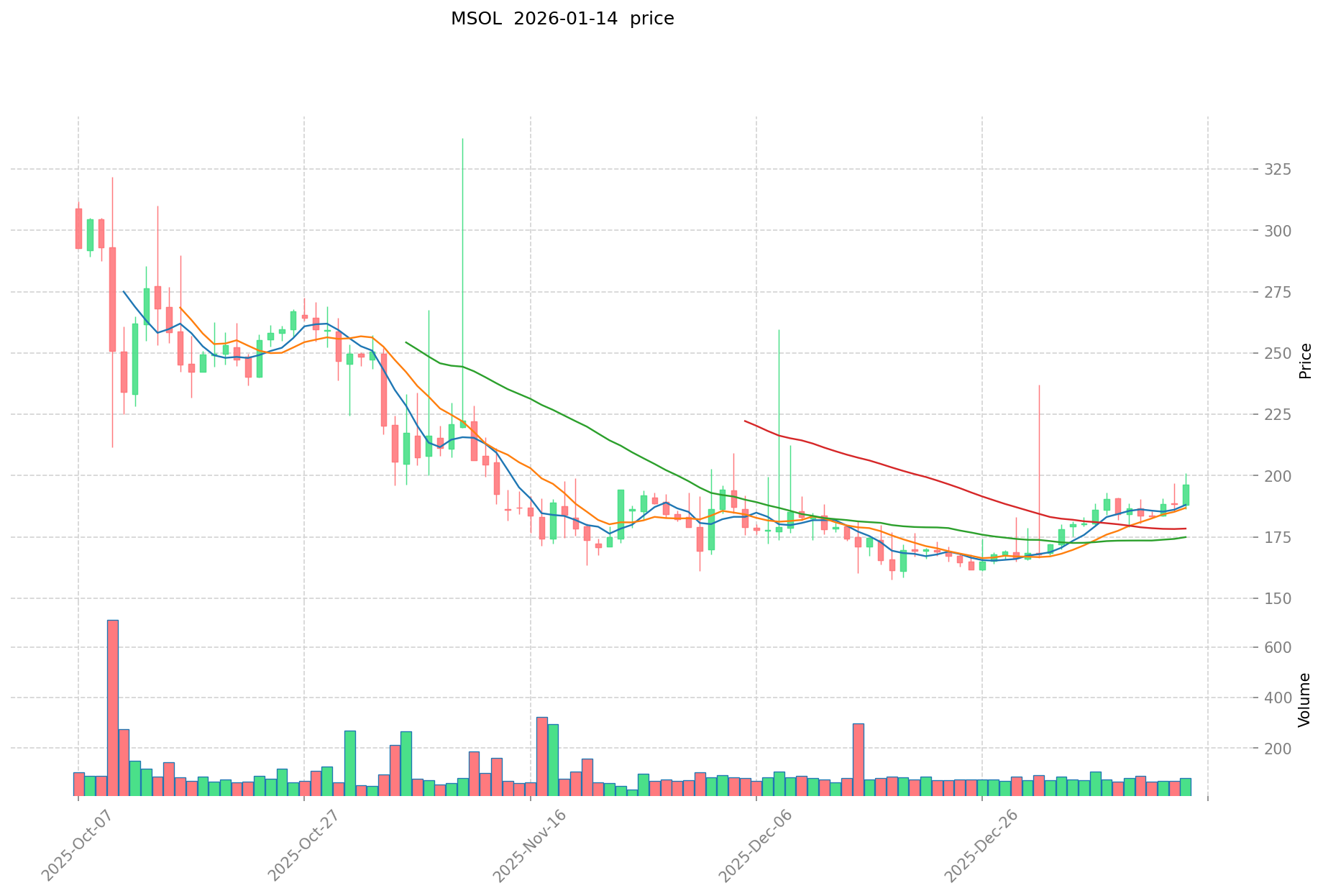
II. Core Factors Affecting Whether MSOL is a Good Investment (Is Marinade Staked SOL(MSOL) a Good Investment)
Supply Mechanism and Scarcity (MSOL investment scarcity)
- Supply Mechanism Analysis → According to available data, MSOL has a circulating supply of 2,545,128 tokens with a total supply of 2,545,211 and a maximum supply of 4,480,536 tokens. The circulating ratio stands at approximately 56.80%, indicating a moderate level of supply in circulation relative to the maximum cap.
- Historical Supply Patterns → The token has shown supply dynamics that may influence its price behavior, though specific supply change events affecting price movements are not detailed in the reference materials.
- Investment Significance → The defined maximum supply cap creates a potential scarcity framework that could support long-term valuation, as the circulating supply represents just over half of the total possible supply.
Institutional Investment and Mainstream Adoption (Institutional investment in MSOL)
- Staking Mechanism Adoption → Marinade.finance operates as a staking protocol built on Solana, offering users the ability to stake SOL and receive liquid staked SOL (mSOL) in return. This mechanism provides staking rewards while maintaining liquidity, which may appeal to both retail and institutional participants seeking yield-generating opportunities.
- Validator Network Integration → The protocol enables direct staking with validators while keeping funds in users' wallets, utilizing optimized delegation strategies. This infrastructure approach may support broader adoption among validators and staking participants.
- Holder Distribution → Available data indicates 148,607 holders as of the reference date, suggesting a degree of distribution across the user base.
Macroeconomic Environment's Impact on MSOL Investment
- Yield Environment Considerations → As a liquid staking derivative, MSOL's investment appeal may be influenced by comparative yields available in traditional financial markets. Changes in interest rate environments could affect the relative attractiveness of staking rewards versus other yield-generating instruments.
- Cryptocurrency Market Conditions → The broader digital asset market conditions, including risk appetite and liquidity flows within the crypto ecosystem, may impact MSOL's investment dynamics as a DeFi protocol token.
- Regulatory Environment → Evolving regulatory frameworks for staking mechanisms and liquid staking derivatives could influence the protocol's operational parameters and investment considerations.
Technology and Ecosystem Development (Technology & Ecosystem for MSOL investment)
- Solana Network Foundation → MSOL operates on the Solana blockchain infrastructure, with its value proposition tied to the underlying network's performance characteristics and ecosystem growth.
- Liquid Staking Innovation → The protocol's liquid staking mechanism allows users to maintain liquidity while earning staking rewards, potentially expanding the use cases for staked assets within the broader DeFi ecosystem.
- Protocol Integration Potential → As a liquid staking token, MSOL may be integrated into various DeFi applications, including lending protocols, liquidity pools, and yield optimization strategies, which could support its utility and investment case over time.
III. MSOL Future Investment Forecast and Price Outlook (Is Marinade Staked SOL(MSOL) worth investing in 2026-2031)
Short-term Investment Forecast (2026, short-term MSOL investment outlook)
- Conservative forecast: $150.29 - $200.38
- Neutral forecast: $200.38 - $234.44
- Optimistic forecast: $234.44 - $268.51
Mid-term Investment Outlook (2027-2029, mid-term Marinade Staked SOL(MSOL) investment forecast)
-
Market stage expectation: Based on available data, MSOL may experience gradual growth trajectory as liquid staking adoption within the Solana ecosystem continues to expand. The mid-term outlook suggests potential price appreciation driven by increasing demand for liquid staking solutions.
-
Investment return forecast:
- 2027: $206.31 - $328.22
- 2028: $177.24 - $419.19
- 2029: $322.24 - $437.83
-
Key catalysts: Expansion of DeFi applications utilizing liquid staking tokens, growth in Solana network activity, and broader adoption of staking protocols may serve as potential catalysts for price movement.
Long-term Investment Outlook (Is MSOL a good long-term investment?)
- Base scenario: $260.07 - $474.82 (assuming steady development and moderate market conditions through 2030-2031)
- Optimistic scenario: $474.82 - $555.60 (assuming enhanced ecosystem adoption and favorable market environment)
- Risk scenario: Below $177.24 (under conditions of significant market headwinds or reduced staking demand)
Click to view MSOL long-term investment and price forecast: Price Prediction
2026-01-15 to 2031 Long-term Outlook
- Base scenario: $150.29 - $474.82 (corresponding to steady progress and gradual mainstream application growth)
- Optimistic scenario: $474.82 - $555.60 (corresponding to large-scale adoption and favorable market conditions)
- Transformative scenario: Above $555.60 (in case of breakthrough developments in the ecosystem and mainstream adoption)
- 2031-12-31 forecast high: $555.60 (based on optimistic development assumptions)
Disclaimer: The forecasts presented are based on historical data and market analysis. Cryptocurrency markets are highly volatile and subject to numerous external factors. These projections should not be considered as financial advice, and actual results may differ significantly from predictions.
| Year |
Predicted High Price |
Predicted Average Price |
Predicted Low Price |
Price Change |
| 2026 |
268.5092 |
200.38 |
150.285 |
0 |
| 2027 |
328.22244 |
234.4446 |
206.311248 |
17 |
| 2028 |
419.1869448 |
281.33352 |
177.2401176 |
41 |
| 2029 |
437.8252905 |
350.2602324 |
322.239413808 |
75 |
| 2030 |
555.6002936445 |
394.04276145 |
260.068222557 |
97 |
| 2031 |
489.0661733736675 |
474.82152754725 |
417.84294424158 |
138 |
IV. MSOL Investment Strategy and Risk Management (How to invest in Liquid Staking Tokens)
Investment Strategy (MSOL investment strategy)
Long-term Holding (HODL MSOL)
For conservative investors seeking stable returns, long-term holding of MSOL presents a structured approach to Solana staking exposure. This strategy allows holders to accumulate staking rewards automatically while maintaining liquidity through the mSOL token. The methodology involves acquiring MSOL through established protocols and holding positions through market cycles, benefiting from the compound effect of staking rewards over extended periods.
Active Trading Approach
Active trading strategies for MSOL rely on technical analysis and swing trading methodologies. Traders monitor price movements relative to SOL, identifying opportunities when the mSOL/SOL ratio deviates from expected ranges. This approach requires understanding of both staking dynamics and broader Solana ecosystem trends, enabling participants to capitalize on short-term price movements while managing position sizing according to market volatility.
Risk Management (Risk management for MSOL investment)
Asset Allocation Guidelines
Conservative Investors: Allocation of 5-10% of cryptocurrency portfolio to liquid staking derivatives like MSOL, maintaining primary positions in established assets. This approach provides staking exposure while limiting concentration risk in derivative tokens.
Moderate Investors: 10-20% allocation to MSOL within the cryptocurrency segment, balanced with other DeFi protocols and layer-1 tokens. This strategy increases yield potential while maintaining diversified exposure across multiple blockchain ecosystems.
Aggressive Investors: Up to 30% allocation to liquid staking tokens, with active monitoring of protocol health metrics and validator performance. This approach maximizes staking yield opportunities but requires sophisticated understanding of smart contract risks and protocol mechanisms.
Risk Hedging Solutions
Effective risk management for MSOL positions involves multi-asset portfolio construction combined with risk mitigation tools. Diversification across different liquid staking protocols reduces concentration risk, while maintaining portions in underlying SOL provides hedge against protocol-specific issues. Investors may consider allocating portions to stablecoins or other blockchain assets to balance volatility exposure inherent in liquid staking derivatives.
Secure Storage Practices
Cold and Hot Wallet Management: MSOL holdings should be distributed between hot wallets for active trading and cold storage for long-term positions. Hot wallets enable quick access for DeFi interactions and trading opportunities, while cold storage protects majority holdings from online security threats.
Hardware Wallet Recommendations: Hardware wallets supporting SPL tokens provide secure offline storage for MSOL. Devices with Solana compatibility offer transaction signing capabilities while keeping private keys isolated from internet-connected devices, significantly reducing exposure to remote attack vectors.
V. MSOL Investment Risks and Challenges (Risks of investing in Liquid Staking Tokens)
Market Risks
Price Volatility: MSOL exhibits price movements influenced by both SOL market dynamics and liquid staking protocol-specific factors. Recent data shows 24-hour price changes of 3.46%, with 7-day movements reaching 8.86%, reflecting the inherent volatility in liquid staking derivatives. The token's correlation with SOL means exposure to broader Solana ecosystem sentiment, while additional volatility stems from changes in staking yields and protocol adoption rates.
Market Manipulation Concerns: As with other cryptocurrency assets, MSOL markets may face risks related to concentrated holdings and low liquidity periods. With approximately 2.55 million tokens in circulation representing 56.8% of maximum supply, distribution patterns and holder concentration warrant monitoring for potential impact on price discovery mechanisms.
Regulatory Risks
Policy Uncertainty Across Jurisdictions: Liquid staking derivatives face evolving regulatory frameworks in different regions. Authorities in various countries continue developing approaches to staking services and derivative tokens, creating uncertainty around classification and compliance requirements. Changes in regulatory treatment of staking rewards or liquid staking protocols could affect MSOL utility and accessibility in specific markets.
Compliance Considerations: As regulatory frameworks mature, liquid staking protocols may face requirements for enhanced disclosure, reporting, or operational modifications. Investors should monitor regulatory developments in their jurisdictions and assess potential impacts on protocol operations and token accessibility.
Technical Risks
Network Security Vulnerabilities: MSOL depends on the underlying Solana network security and Marinade protocol smart contracts. While Solana has established infrastructure, network disruptions or validator set issues could affect staking operations and token functionality. Smart contract vulnerabilities in the Marinade protocol represent additional technical risk vectors requiring ongoing security assessments.
Protocol Upgrade Risks: Modifications to the Marinade protocol or Solana network may introduce technical challenges during implementation. Upgrade processes that affect staking mechanisms, token economics, or validator selection could temporarily impact MSOL functionality or introduce unforeseen complications requiring protocol adjustments.
VI. Conclusion: Is Liquid Staking Token a Good Investment?
Investment Value Summary
MSOL presents investment characteristics combining staking yield generation with maintained liquidity in the Solana ecosystem. Long-term potential relates to growing adoption of liquid staking solutions and Solana network development, though short-term price movements reflect broader cryptocurrency market dynamics and protocol-specific factors. The token's performance over the past year, with observed fluctuations, demonstrates the variable nature of returns in liquid staking derivatives.
Investor Recommendations
✅ Beginners: Consider dollar-cost averaging strategies combined with secure wallet storage practices. Focus on understanding staking mechanics and protocol fundamentals before establishing positions. Utilize hardware wallets or established custodial solutions supporting SPL tokens for security.
✅ Experienced Investors: Implement swing trading strategies around technical indicators while maintaining core positions for staking yield accumulation. Diversify across multiple liquid staking protocols and monitor validator performance metrics within the Marinade network.
✅ Institutional Investors: Evaluate strategic allocation to liquid staking derivatives as part of broader blockchain infrastructure exposure. Conduct thorough due diligence on protocol security, validator selection mechanisms, and smart contract audits before establishing positions.
⚠️ Notice: Cryptocurrency investments involve substantial risk, including potential loss of principal. This content provides informational perspectives and does not constitute investment advice. Conduct independent research and consult qualified financial advisors before making investment decisions.
VII. FAQ
Q1: What makes MSOL different from directly staking SOL?
MSOL provides liquidity while earning staking rewards, whereas direct SOL staking locks tokens during the staking period. When users stake SOL through Marinade.finance, they receive mSOL tokens that represent their staked position plus accumulated rewards. These mSOL tokens can be traded, used in DeFi protocols, or held for long-term appreciation, offering flexibility that traditional staking cannot provide. Direct SOL staking requires users to choose validators manually and wait through unstaking periods to access their funds, while MSOL holders maintain immediate liquidity and benefit from Marinade's optimized validator delegation strategy across the network.
Q2: How does MSOL generate returns for investors?
MSOL generates returns through automatic staking reward accumulation that increases the token's underlying value relative to SOL. The protocol stakes deposited SOL with validators across the Solana network, earning staking rewards that accrue to all mSOL holders proportionally. As rewards compound over time, each mSOL token represents an increasing amount of SOL, creating value appreciation for holders. Additionally, mSOL can be deployed in various DeFi protocols for lending, liquidity provision, or yield farming, potentially generating additional returns beyond base staking rewards. The combination of automated reward compounding and DeFi utility creates multiple revenue streams for MSOL holders.
Q3: What are the primary risks associated with investing in MSOL?
MSOL investment risks include smart contract vulnerabilities in the Marinade protocol, Solana network disruptions, and liquid staking derivative market volatility. Smart contract risks exist despite security audits, as unforeseen bugs could affect fund safety or token functionality. The token's value depends on Solana network performance, meaning network outages or validator issues could impact staking operations. Market risks include price volatility relative to SOL, with MSOL showing 24-hour changes of 3.46% and 7-day movements of 8.86%. Regulatory uncertainty around liquid staking derivatives adds another risk dimension, as evolving frameworks could affect protocol operations. Additionally, the concentration of supply and relatively limited trading volume compared to major cryptocurrencies may create liquidity challenges during market stress.
Q4: Is MSOL suitable for short-term or long-term investment strategies?
MSOL demonstrates characteristics supporting both short-term trading and long-term holding strategies, though each approach carries distinct risk-return profiles. Short-term strategies capitalize on price volatility and mSOL/SOL ratio fluctuations, requiring technical analysis skills and active market monitoring. Recent data showing 8.86% weekly gains and 17.83% monthly increases illustrate short-term opportunity potential, though past performance doesn't guarantee future results. Long-term holding aligns better with MSOL's core value proposition of compound staking rewards, allowing investors to accumulate yield while participating in Solana ecosystem growth. The forecasted price range of $150.29-$555.60 from 2026-2031 suggests potential for appreciation over extended timeframes, though projections remain speculative and subject to numerous market variables.
Q5: How should investors allocate MSOL within a cryptocurrency portfolio?
Portfolio allocation to MSOL should align with individual risk tolerance and investment objectives, with conservative investors limiting exposure to 5-10% of cryptocurrency holdings. This conservative approach provides staking yield exposure while maintaining diversification across established digital assets. Moderate investors may increase allocation to 10-20%, balancing liquid staking returns with other DeFi protocols and layer-1 tokens for diversified blockchain ecosystem exposure. Aggressive investors might allocate up to 30% to liquid staking derivatives like MSOL, accepting higher concentration risk for potentially enhanced yield generation. All allocation strategies should incorporate regular portfolio rebalancing, monitoring of protocol health metrics, and maintenance of emergency liquidity in stablecoins or fiat currency to manage downside scenarios.
Q6: What factors could drive MSOL price appreciation in 2026-2031?
MSOL price drivers include expanding liquid staking adoption within Solana's growing DeFi ecosystem, increased integration with lending protocols and yield optimization platforms, and broader institutional acceptance of staking derivatives. The protocol's current holder base of 148,607 addresses could expand significantly as awareness of liquid staking benefits increases among SOL holders. Technical developments improving Marinade's validator selection algorithms or enhancing mSOL utility across DeFi applications may strengthen investment appeal. Macroeconomic factors including traditional finance yield environments and cryptocurrency market liquidity flows will influence relative attractiveness of staking returns. Network effects from Solana ecosystem growth, including rising transaction volumes and developer activity, could create positive feedback loops supporting MSOL valuation over the forecast period.
Q7: How does MSOL's current valuation compare to its historical performance?
MSOL currently trades at $199.25 with a market capitalization of $507.12 million, representing a decline from its January 2025 peak of $363.77 but substantial recovery from 2022 lows around $8.93. The token's one-year performance shows a 13.05% decrease, reflecting broader cryptocurrency market corrections and adjustments in liquid staking derivative valuations. Recent momentum indicators display positive trends with 8.86% weekly gains and 17.83% monthly increases, suggesting potential stabilization after previous declines. The current price positions MSOL approximately 45% below its recorded high, creating potential entry opportunities for investors with conviction in long-term Solana ecosystem growth, though historical patterns don't ensure future performance replication.
Q8: What security measures should MSOL investors implement?
MSOL security implementation requires multi-layered approaches combining hardware wallet storage, diversified custody solutions, and operational security protocols. Hardware wallets supporting SPL tokens provide offline private key storage for long-term holdings, significantly reducing exposure to online attack vectors and phishing attempts. Investors should distribute holdings between cold storage for majority positions and hot wallets for active trading or DeFi interactions, limiting potential loss from any single security breach. Additional measures include enabling two-factor authentication on exchange accounts, maintaining separate devices for cryptocurrency transactions, and regularly updating wallet firmware. Portfolio security extends beyond technical measures to include verification of protocol smart contract audits, monitoring of validator performance metrics, and staying informed about potential vulnerabilities in the Marinade protocol or broader Solana network infrastructure.
* The information is not intended to be and does not constitute financial advice or any other recommendation of any sort offered or endorsed by Gate.