This comprehensive analysis evaluates whether Marlin (POND) is a viable investment within the DeFi ecosystem. Trading at $0.00369 with a market capitalization of $30.27 million, POND functions as programmable network infrastructure for Web 3.0 applications. The article examines POND's price history—from a $0.323362 peak to current levels representing a 77.03% decline—alongside its fixed 10 billion token supply with 82% circulation. Key factors assessed include governance utility, staking mechanisms, and protocol incentives driving token demand. Investment strategies range from conservative dollar-cost averaging (1-3% allocation) for beginners to active trading approaches for experienced investors. The analysis addresses substantial risks including high volatility, regulatory uncertainty, and technical challenges, while presenting price predictions ranging from $0.0025-$0.0076 through 2031 under various scenarios. Comprehensive risk management and secure storage recommendations guide investment decisions.
Introduction: Marlin (POND)'s Investment Position and Market Outlook
POND is a notable asset in the cryptocurrency space. Since its launch in 2020, it has established itself within the DeFi and Web 3.0 infrastructure sectors. As of January 2026, Marlin holds a market capitalization of approximately $30.27 million, with a circulating supply of around 8.20 billion tokens, and the current price stands at approximately $0.00369. Positioned as a high-performance programmable network infrastructure protocol, POND has gradually attracted attention from investors evaluating "Is Marlin (POND) a good investment?" This article provides a comprehensive analysis of POND's investment value, historical performance, future price outlook, and associated investment risks to serve as a reference for market participants.
I. POND Token Price History Review and Current Investment Value
- December 2020: Token launch at $0.008 with initial exchange listings → POND reached a notable price level of $0.323362 within the first month of trading
- 2021-2025: Market cycle volatility → Price experienced significant fluctuations from peak levels to lower ranges during broader market adjustments
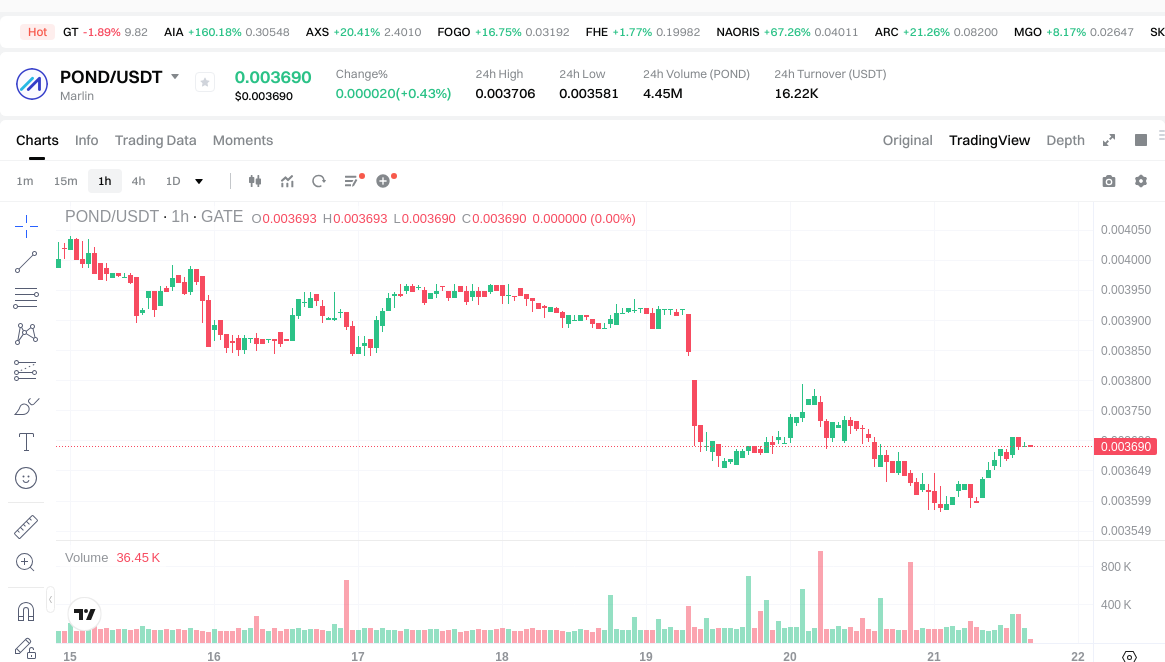
- January 2026: Current trading cycle → POND is trading near $0.003689, reflecting approximately 98.86% from previous peak levels
Current POND Investment Market Status (January 2026)
- Current POND price: $0.003689
- 24-hour trading volume: $16,266.98
- Market capitalization: $30,266,834.46
- Circulating supply: 8,202,394,162 POND (82.02% of maximum supply)
- 24-hour price range: $0.003581 - $0.003706
- Listed on 22 exchanges with 11,258 holders
Click to view real-time POND market price
II. Core Factors Affecting Whether POND is a Good Investment (Is Marlin(POND) a Good Investment)
Supply Mechanism and Scarcity (POND investment scarcity)
- Fixed Supply Cap → Influences price and investment value
- POND has a maximum supply of 10 billion tokens, with approximately 8.2 billion tokens currently in circulation (82.02% of total supply)
- The fixed supply mechanism creates a predetermined scarcity model, distinguishing it from inflationary token models
- Market Capitalization Dynamics: Current circulating market cap stands at approximately $30.27 million, with fully diluted valuation at $36.9 million
- Investment significance: The predetermined supply cap and high circulation ratio (82.02%) suggest limited future dilution risk, which may be a consideration for long-term investment evaluation
Institutional Investment and Mainstream Adoption (Institutional investment in POND)
- Token Holder Distribution: The project currently has 11,258 token holders, indicating a relatively modest level of community participation
- Exchange Presence: POND is listed on 22 exchanges, including Gate.com, suggesting a degree of liquidity accessibility for investors
- Market positioning: With a market dominance of 0.0011% and ranking at #711, POND represents a relatively small-cap asset in the broader cryptocurrency market
Macroeconomic Environment's Impact on POND Investment
- Market Performance Context:
- Short-term volatility: -0.10% (1H), +0.98% (24H)
- Medium-term decline: -8.3% (7D), -7.43% (30D)
- Long-term performance: -77.03% (1Y), reflecting significant depreciation from historical levels
- Price Range Analysis: Trading between $0.003581 (24H low) and $0.003706 (24H high), with current price at $0.00369
- Macroeconomic considerations: As a lower market cap digital asset, POND may exhibit heightened sensitivity to broader market sentiment, regulatory developments, and shifts in risk appetite within the cryptocurrency sector
Technology and Ecosystem Development (Technology & Ecosystem for POND investment)
- Core Infrastructure: Marlin Protocol provides high-performance programmable network infrastructure designed for DeFi and Web 3.0 applications
- Utility Functions:
- Governance: POND token holders can participate in governance decisions, including fund allocation and network resource distribution
- Protocol Incentives: Users can earn POND tokens as rewards when sending or receiving data within the Marlin network
- Staking Mechanism: Nodes are required to stake POND tokens to join and participate in the Marlin network
- Technical Foundation: POND operates as an ERC-20 token on the Ethereum network, leveraging Ethereum's established infrastructure and security model
- Ecosystem considerations: The protocol's focus on network infrastructure for DeFi and Web 3.0 positions it within the broader narrative of decentralized application development, though specific adoption metrics or partnership details are not available in the provided materials
III. POND Future Investment Predictions and Price Outlook (Is Marlin(POND) worth investing in 2026-2031)
Short-term Investment Prediction (2026, short-term POND investment outlook)
- Conservative prediction: $0.0025 - $0.0037
- Neutral prediction: $0.0037 - $0.0040
- Optimistic prediction: $0.0040 - $0.0045
Mid-term Investment Outlook (2027-2029, mid-term Marlin(POND) investment forecast)
-
Market stage expectation: During the mid-term period, POND may experience moderate growth as the protocol continues to develop its network infrastructure capabilities for DeFi and Web 3.0 applications. The token's utility in governance, staking, and protocol incentives could drive gradual adoption.
-
Investment return prediction:
- 2027: $0.0036 - $0.0045
- 2028: $0.0029 - $0.0049
- 2029: $0.0041 - $0.0059
-
Key catalysts: Network adoption growth, expansion of node participation, protocol upgrades enhancing performance, and broader integration within the Web 3.0 ecosystem.
Long-term Investment Outlook (Is Marlin a good long-term investment?)
- Base scenario: $0.0028 - $0.0057 (assuming steady development and moderate network growth)
- Optimistic scenario: $0.0052 - $0.0076 (assuming accelerated adoption and favorable market conditions)
- Risk scenario: Below $0.0025 (under adverse market conditions or limited ecosystem growth)
View POND long-term investment and price predictions: Price Prediction
2026-01-21 - 2031 Long-term Outlook
- Base scenario: $0.0028 - $0.0057 (corresponding to steady progress and gradual mainstream application growth)
- Optimistic scenario: $0.0052 - $0.0076 (corresponding to large-scale adoption and favorable market environment)
- Transformative scenario: Above $0.0076 (if the ecosystem achieves breakthrough progress and mainstream adoption)
- 2031-12-31 predicted high: $0.0076 (based on optimistic development assumptions)
Disclaimer: Price predictions are speculative and based on historical data and market trends. Cryptocurrency investments carry risks, and past performance does not guarantee future results. Investors should conduct their own research and consider their risk tolerance before making investment decisions.
| Year |
Predicted High Price |
Predicted Average Price |
Predicted Low Price |
Price Change |
| 2026 |
0.0045018 |
0.00369 |
0.0024723 |
0 |
| 2027 |
0.00450549 |
0.0040959 |
0.003604392 |
11 |
| 2028 |
0.00485978535 |
0.004300695 |
0.00288146565 |
16 |
| 2029 |
0.00590850982575 |
0.004580240175 |
0.00407641375575 |
24 |
| 2030 |
0.005716368750408 |
0.005244375000375 |
0.002831962500202 |
42 |
| 2031 |
0.007617716906794 |
0.005480371875391 |
0.005151549562868 |
48 |
IV. Marlin (POND) Investment Strategy and Risk Management (How to invest in cryptocurrency infrastructure tokens)
Investment Methodology (Marlin investment strategy)
Long-term Holding (HODL Marlin)
For conservative investors seeking exposure to Web 3.0 infrastructure development, a long-term holding strategy may be considered. This approach involves accumulating POND tokens during periods of price consolidation and maintaining positions through market cycles. Given Marlin's role in providing programmable network infrastructure for DeFi and Web 3.0 applications, long-term holders would be positioning themselves for potential network growth and adoption.
Key considerations for this strategy include monitoring network participation metrics, development progress, and ecosystem expansion. The token's utility in governance, protocol incentives, and node staking provides fundamental use cases that may support long-term value retention.
Active Trading
Active traders may employ technical analysis and swing trading strategies to capitalize on POND's price movements. Recent data shows the token experienced a 0.98% increase over 24 hours, with a 24-hour high of $0.003706 and low of $0.003581, indicating intraday volatility that may present trading opportunities.
Traders should note the token's significant decline of 77.03% over the past year, suggesting a sustained downtrend that requires careful risk assessment. Technical indicators, support and resistance levels, and volume analysis should inform entry and exit decisions.
Risk Management (Risk management for Marlin investment)
Asset Allocation Guidelines
Conservative Investors: Allocation to POND should represent no more than 1-3% of total cryptocurrency portfolio, with the majority held in established assets. This approach limits exposure to infrastructure tokens with higher risk profiles.
Aggressive Investors: May allocate 5-10% of cryptocurrency portfolio to POND and similar infrastructure projects, accepting higher volatility for potential growth opportunities in the Web 3.0 ecosystem.
Professional Investors: Could consider 10-15% allocation within a diversified cryptocurrency infrastructure sector strategy, with active monitoring and rebalancing protocols.
Risk Hedging Approaches
Multi-Asset Portfolio Construction: Combining POND with established cryptocurrencies, stablecoins, and tokens from different sectors can help reduce concentration risk. Infrastructure tokens should be balanced with assets demonstrating lower correlation patterns.
Defensive Tools: Consideration of stablecoin reserves for liquidity management and potential dollar-cost averaging strategies to mitigate timing risk. Setting predetermined stop-loss levels based on individual risk tolerance can help limit potential losses.
Secure Storage Solutions
Hot and Cold Wallet Strategy: For active trading, maintaining a portion of holdings in hot wallets on reputable exchanges facilitates quick transactions. However, the majority of long-term holdings should be transferred to cold storage solutions.
Hardware Wallet Recommendations: Hardware wallets supporting ERC-20 tokens (as POND operates on the Ethereum network) provide enhanced security for self-custody. Regular security audits of storage methods and maintaining backup recovery phrases in secure locations are essential practices.
V. Marlin (POND) Investment Risks and Challenges (Risks of investing in cryptocurrency infrastructure tokens)
Market Risks
High Volatility: POND has demonstrated substantial price fluctuations, including a 77.03% decline over the past year and an 8.3% decrease over the past week. Such volatility can result in rapid value changes that may not align with investor expectations or timelines.
Price Dynamics: With a relatively modest 24-hour trading volume of approximately $16,267 and a market capitalization of around $30.27 million, the token may experience liquidity constraints that can amplify price movements. The current price of $0.00369 represents a significant distance from its December 2020 level of $0.323362.
Regulatory Risks
Jurisdictional Uncertainty: Different countries maintain varying regulatory frameworks for cryptocurrency infrastructure projects. Changes in regulatory approaches toward network protocols, staking mechanisms, or token utility models could impact Marlin's operational model and token value.
Compliance Requirements: Evolving regulations regarding decentralized networks, node operations, and token governance may necessitate protocol adjustments that could affect token economics or network participation requirements.
Technical Risks
Network Security: As a protocol providing network infrastructure, Marlin faces ongoing challenges in maintaining security against potential vulnerabilities. Any exploitation of network weaknesses could affect user confidence and token value.
Development and Upgrade Challenges: The success of infrastructure projects depends on continuous technical development and successful implementation of network upgrades. Delays, failures, or complications in technical roadmap execution could impact adoption and network growth.
Competition: The blockchain infrastructure sector includes numerous competing solutions. Changes in competitive dynamics or emergence of alternative technologies could affect Marlin's market position and token demand.
VI. Conclusion: Is cryptocurrency infrastructure a Good Investment?
Investment Value Summary
Marlin (POND) presents characteristics typical of cryptocurrency infrastructure projects, with potential long-term value tied to Web 3.0 and DeFi ecosystem development. However, the token has experienced substantial price volatility, including a significant decline of 77.03% over the past year. Current market metrics show a circulating supply of approximately 8.2 billion tokens (82.02% of maximum supply), with a market capitalization around $30.27 million.
The project's utility framework—encompassing governance rights, protocol incentives, and staking requirements—provides fundamental use cases that differentiate it from purely speculative assets. However, short-term price movements remain highly volatile, as evidenced by recent percentage changes across different timeframes.
Investor Recommendations
✅ Beginners: Consider dollar-cost averaging strategies with small allocation percentages (1-3% of cryptocurrency portfolio) combined with secure self-custody solutions using hardware wallets supporting ERC-20 tokens. Focus on understanding the project's technology and use cases before committing significant capital.
✅ Experienced Investors: May employ swing trading strategies while maintaining core long-term positions. Implement disciplined risk management with predetermined entry/exit points and portfolio rebalancing protocols. Monitor network metrics, development progress, and ecosystem partnerships for informed decision-making.
✅ Institutional Investors: Could consider strategic long-term allocation within diversified cryptocurrency infrastructure portfolios, with comprehensive due diligence on protocol security, development team capabilities, and competitive positioning. Implement institutional-grade custody solutions and regular portfolio reviews.
⚠️ Disclaimer: Cryptocurrency investments carry substantial risk, including the possibility of complete loss of invested capital. Market volatility, regulatory changes, and technical challenges can significantly impact asset values. This content is provided for informational purposes only and does not constitute investment advice. Investors should conduct independent research and consult qualified financial advisors before making investment decisions.
VII. FAQ
Q1: Is Marlin (POND) a good investment for beginners in 2026?
For beginners, POND represents a high-risk investment that requires careful consideration. With a current price of $0.00369 and a significant 77.03% decline over the past year, POND demonstrates substantial volatility typical of lower market cap infrastructure tokens. Beginners should limit exposure to 1-3% of their cryptocurrency portfolio and employ dollar-cost averaging strategies to mitigate timing risk. Understanding the project's technical foundation—providing programmable network infrastructure for DeFi and Web 3.0 applications—is essential before investing. Secure storage using hardware wallets supporting ERC-20 tokens is recommended, along with maintaining realistic expectations about potential returns and losses.
Q2: What is the price prediction for POND in 2027-2029?
Based on current market trends and development projections, POND's mid-term outlook suggests gradual price appreciation if network adoption continues. For 2027, predictions range from $0.0036 to $0.0045, representing approximately 11% potential growth from current levels. By 2028, estimates project a range of $0.0029 to $0.0049, with average prices around $0.0043. Looking toward 2029, the optimistic scenario suggests $0.0041 to $0.0059, reflecting potential cumulative growth of 24%. These projections assume steady development progress, increased node participation, and broader integration within the Web 3.0 ecosystem. However, cryptocurrency price predictions carry inherent uncertainty and should not be the sole basis for investment decisions.
Q3: How does POND's fixed supply mechanism affect its investment value?
POND's fixed maximum supply of 10 billion tokens creates a predetermined scarcity model that distinguishes it from inflationary cryptocurrencies. With approximately 8.2 billion tokens already in circulation (82.02% of total supply), future dilution risk is limited compared to projects with lower circulation ratios. This high circulation percentage means that most tokens are already available in the market, reducing the potential impact of future supply releases on price. The remaining 1.8 billion tokens represent approximately 18% additional supply that could enter circulation. For investors, this fixed supply cap may provide some protection against inflation-related devaluation, though market demand and adoption remain the primary drivers of price appreciation. The token's utility in governance, staking, and protocol incentives creates ongoing demand mechanisms that interact with the fixed supply structure.
Q4: What are the main risks of investing in Marlin (POND)?
Investing in POND carries multiple risk categories that potential investors should carefully evaluate. Market risks include high volatility, as demonstrated by the 77.03% year-over-year decline and weekly fluctuations exceeding 8%. The relatively modest trading volume of approximately $16,267 and market capitalization of $30.27 million indicate potential liquidity constraints that can amplify price movements. Regulatory risks involve evolving frameworks across different jurisdictions regarding decentralized networks, staking mechanisms, and token governance models. Technical risks encompass network security vulnerabilities, development challenges, and competition from alternative infrastructure solutions in the blockchain sector. Additionally, the token's current market dominance of 0.0011% and ranking at #711 reflect its position as a smaller market cap asset subject to heightened volatility and sentiment-driven price movements.
Q5: What investment strategy is most suitable for POND?
The optimal investment strategy for POND depends on individual risk tolerance and investment objectives. Conservative investors should consider a long-term holding (HODL) approach with minimal allocation (1-3% of cryptocurrency portfolio), focusing on the protocol's potential growth as Web 3.0 infrastructure develops. This strategy involves accumulating tokens during price consolidation periods and maintaining positions through market cycles. Active traders may employ technical analysis and swing trading strategies, capitalizing on POND's intraday volatility—recent data shows a 24-hour range between $0.003581 and $0.003706. For active trading, monitoring support and resistance levels, volume patterns, and technical indicators is essential. Both strategies should incorporate robust risk management, including predetermined stop-loss levels, portfolio diversification across multiple assets and sectors, and secure storage solutions using hardware wallets for ERC-20 tokens.
Q6: How does Marlin's technology and ecosystem affect its long-term investment potential?
Marlin's core value proposition centers on providing high-performance programmable network infrastructure for DeFi and Web 3.0 applications, which positions the protocol within broader trends toward decentralized application development. The token's utility framework creates multiple demand mechanisms: governance rights allow holders to participate in protocol decisions, staking requirements mandate node operators to hold POND tokens, and protocol incentives reward network participants. Operating as an ERC-20 token on Ethereum leverages established infrastructure and security models. Long-term investment potential depends on the protocol's ability to attract node operators, expand network participation, and secure partnerships within the DeFi and Web 3.0 ecosystems. With 11,258 current holders and listings on 22 exchanges, the project demonstrates moderate community participation and liquidity accessibility, though these metrics suggest room for significant growth compared to more established protocols.
Q7: Should institutional investors consider POND for portfolio allocation?
Institutional investors evaluating POND should approach it as a speculative allocation within a diversified cryptocurrency infrastructure strategy rather than a core portfolio holding. The token's market capitalization of approximately $30.27 million and market dominance of 0.0011% position it as a small-cap asset requiring specialized due diligence and risk assessment protocols. Potential institutional allocation could range from 10-15% within a dedicated cryptocurrency infrastructure sector allocation, not total portfolio. Key evaluation criteria should include comprehensive analysis of protocol security audits, development team capabilities and track record, competitive positioning against alternative network infrastructure solutions, and realistic assessment of adoption timelines. Institutional-grade custody solutions supporting ERC-20 tokens are essential, along with regular portfolio reviews and rebalancing protocols. The token's significant price decline of 77.03% over the past year underscores the importance of robust risk management frameworks and clear exit strategies before establishing positions.
Q8: What factors could drive POND price appreciation by 2031?
Several catalysts could potentially influence POND's price trajectory toward the projected 2031 optimistic scenario range of $0.0052 to $0.0076. Network adoption growth remains the primary driver—increased participation from node operators requiring token staking would create fundamental demand. Expansion of DeFi and Web 3.0 applications utilizing Marlin's infrastructure could drive protocol usage and token utility. Successful implementation of technical upgrades enhancing network performance, security, or functionality could attract additional developers and users. Strategic partnerships with established blockchain projects or protocols could accelerate ecosystem integration. Favorable regulatory developments providing clarity for decentralized infrastructure projects could reduce uncertainty and attract institutional participation. Broader cryptocurrency market conditions, including potential bull market cycles, could provide tailwinds for infrastructure tokens. However, achieving the optimistic scenario requires execution across multiple dimensions—technical development, ecosystem growth, community expansion, and favorable market conditions—making predictions inherently uncertain.
* The information is not intended to be and does not constitute financial advice or any other recommendation of any sort offered or endorsed by Gate.