This comprehensive analysis examines whether MeasurableDataToken (MDT) represents a viable investment opportunity. MDT, launched in January 2018, operates as a decentralized big data value economy platform on Ethereum, currently trading at $0.012565 with a market cap of $7.62 million. The article evaluates MDT's investment characteristics through multiple dimensions: historical performance showing a 92.52% decline from its 2021 peak, current market position with 606.32 million circulating tokens, and technical infrastructure serving data contributors, purchasers, and suppliers. Key risk factors include high volatility, regulatory uncertainty, limited liquidity ($22,179 daily volume), and 82.24% whale concentration. Price forecasts through 2031 range from conservative scenarios ($0.00919-$0.01913) to optimistic projections ($0.01492-$0.02538). The guide provides actionable investment strategies via Gate exchange, risk management protocols, secure storage recommendations, and investor-tier recommendations from
Introduction: MeasurableDataToken (MDT)'s Investment Position and Market Prospects
MDT is a digital asset in the cryptocurrency field that focuses on decentralized big data value economics. Launched in January 2018, it has established a presence in the data economy sector. As of January 27, 2026, MDT holds a market ranking of 1335, with a market capitalization of approximately $7.62 million and a circulating supply of around 606.32 million tokens. The current trading price is approximately $0.012565. With its positioning as a medium of exchange among users, data purchasers, and data suppliers, MDT has attracted attention from observers examining "Is MeasurableDataToken (MDT) a good investment?" This article will comprehensively analyze MDT's investment characteristics, historical price movements, future price outlook, and associated risks to provide reference information for interested parties.
The token operates within a decentralized ecosystem built on blockchain technology, where it serves to quantify data value. The platform framework includes mechanisms for rewarding users who contribute anonymous big data while providing data acquisition solutions for purchasers. Over the past year, MDT has experienced significant price fluctuations, with a 72.21% decline from previous levels. The token recorded an all-time high of $0.168053 in December 2021 and an all-time low of $0.00173261 in December 2018. Currently, approximately 60.63% of the total supply is in circulation, with over 30,000 holders across 19 exchanges. Recent short-term performance shows a 1.27% decrease over 24 hours and an 8.79% decline over 30 days, while 7-day movement remained relatively stable with a 0.04% decrease.
I. MDT Price Historical Review and Current Investment Value Status
- 2021: Historical price milestone → MDT reached $0.168053 on December 26, 2021, representing a significant valuation period for early investors.
- 2018: Market cycle adjustment → Price declined to $0.00173261 on December 18, 2018, reflecting broader cryptocurrency market conditions during that period.
- Recent trend: Market volatility → The token experienced a decline from higher valuations, with reported price movements indicating market adjustments over recent periods.
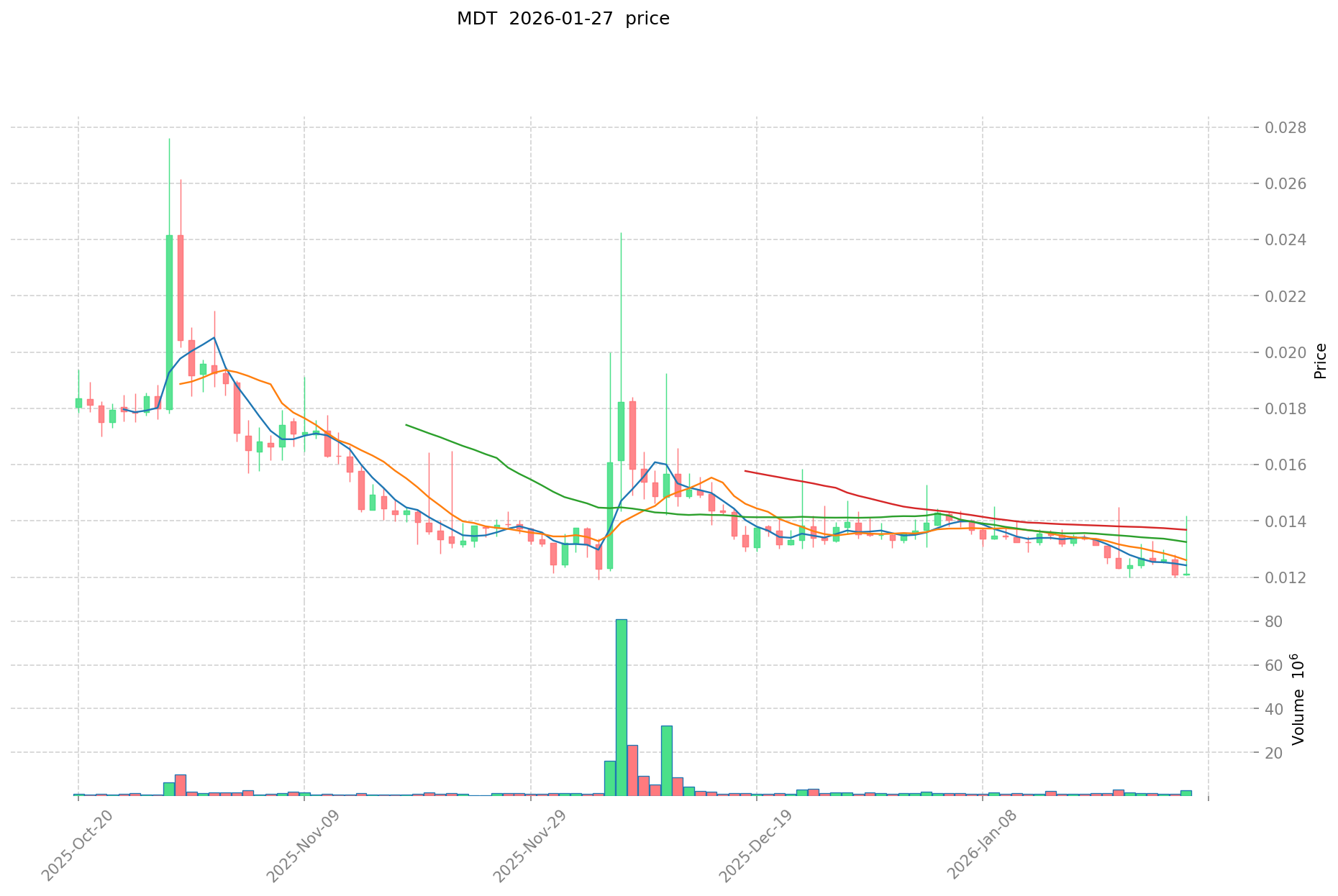
Current MDT Investment Market Status (January 2026)
- MDT current price: $0.012565
- 24-hour trading volume: $22,178.96
- Market capitalization: $7,618,407.48
- Circulating supply: 606,319,736 MDT (60.63% of total supply)
- 24-hour price change: -1.27%
Click to view real-time MDT market price
II. Core Factors Influencing Whether MDT is a Good Investment
Supply Mechanism and Scarcity (MDT investment scarcity)
- Total supply of 1,000,000,000 MDT with unlimited maximum supply → influences price dynamics and investment valuation
- Circulating supply represents approximately 60.63% of total supply (606,319,736 MDT) → indicates significant token availability in market
- Historical price range from $0.00173261 to $0.168053 demonstrates substantial volatility → reflects market response to supply-demand dynamics
- Investment significance: unlimited supply structure may impact long-term scarcity considerations for potential investors
Institutional Investment and Market Concentration (Institutional investment in MDT)
- On-chain data indicates whale concentration at 82.24% of MDT supply → suggests significant control by large holders
- High concentration enables large holders to influence price movements → relevant consideration for investment risk assessment
- Token listed on 19 exchanges with current holder count of 30,383 → indicates moderate distribution across market participants
- Market capitalization to fully diluted valuation ratio of 60.63% → reflects current circulation relative to total potential supply
Macroeconomic Environment Impact on MDT Investment
- Current trading price of $0.012565 represents 92.52% decline from historical peak → demonstrates sensitivity to broader market conditions
- 24-hour trading volume of $22,178.96 → indicates relatively limited liquidity in current market environment
- One-year performance shows -72.21% decline → reflects challenging macroeconomic conditions affecting digital asset valuations
- Market dominance of 0.00040% → positions MDT as smaller-cap asset within broader cryptocurrency ecosystem
Technology and Ecosystem Development (Technology & Ecosystem for MDT investment)
- Blockchain-based decentralized data value economy platform → aims to facilitate data exchange between users, purchasers, and suppliers
- Smart contract deployment on Ethereum network (contract address: 0x814e0908b12A99FeCf5BC101bB5d0b8B5cDf7d26) → utilizes established blockchain infrastructure
- Platform incentivizes anonymous big data contribution from users → designed to create transparent data trading environment
- Token serves as quantification and exchange unit for data value → potential utility within ecosystem development
III. MDT Future Investment Forecast and Price Outlook (Is MeasurableDataToken(MDT) worth investing in 2026-2031)
Short-term Investment Forecast (2026, short-term MDT investment outlook)
- Conservative forecast: $0.00916 - $0.01271
- Neutral forecast: $0.01271 - $0.01450
- Optimistic forecast: $0.01450 - $0.01794
Mid-term Investment Outlook (2027-2029, mid-term MeasurableDataToken(MDT) investment forecast)
- Market phase expectation: MDT may enter a gradual development phase with modest price fluctuations as the data economy ecosystem evolves and market participation potentially expands.
- Investment return forecast:
- 2027: $0.00830 - $0.01497
- 2028: $0.00871 - $0.01557
- 2029: $0.01075 - $0.01911
- Key catalysts: Advancement in blockchain-based data value ecosystems, potential growth in anonymous data sharing incentive mechanisms, and evolving regulatory frameworks for data transactions.
Long-term Investment Outlook (Is MDT a good long-term investment?)
- Base scenario: $0.00919 - $0.01913 (assuming steady adoption in data value quantification and stable market conditions)
- Optimistic scenario: $0.01492 - $0.02538 (assuming broader application of decentralized data trading platforms and favorable market sentiment)
- Risk scenario: Below $0.00830 (under adverse market conditions or significant competitive pressure)
View MDT long-term investment and price forecast: Price Prediction
2026-01-27 - 2031 Long-term Outlook
- Base scenario: $0.00919 - $0.01913 (corresponding to steady progress and gradual mainstream application enhancement)
- Optimistic scenario: $0.01492 - $0.02538 (corresponding to large-scale adoption and favorable market environment)
- Transformational scenario: Above $0.02538 (if ecosystem achieves breakthrough progress and mainstream popularization)
- 2031-12-31 predicted high: $0.02538 (based on optimistic development assumptions)
Disclaimer: Price forecasts are based on historical data analysis and current market trends. Cryptocurrency markets are highly volatile and subject to multiple risk factors. These forecasts do not constitute investment advice. Investors should conduct independent research and consult professional advisors before making investment decisions.
| Year |
Predicted High Price |
Predicted Average Price |
Predicted Low Price |
Price Change |
| 2026 |
0.01449624 |
0.012716 |
0.00915552 |
1 |
| 2027 |
0.014966732 |
0.01360612 |
0.0082997332 |
8 |
| 2028 |
0.01557220434 |
0.014286426 |
0.00871471986 |
13 |
| 2029 |
0.0191095234176 |
0.01492931517 |
0.0107491069224 |
18 |
| 2030 |
0.019231943801994 |
0.0170194192938 |
0.009190486418652 |
35 |
| 2031 |
0.025375954167055 |
0.018125681547897 |
0.012869233899006 |
44 |
IV. MDT Investment Strategy and Risk Management (How to invest in MDT)
Investment Strategy (MDT investment strategy)
Long-term Holding (HODL MDT)
Long-term holding represents a strategy suitable for conservative investors who believe in the fundamental value proposition of MDT's decentralized big data economy. This approach involves acquiring MDT tokens and maintaining positions through market cycles, focusing on the project's long-term development trajectory rather than short-term price movements. Investors following this strategy typically conduct thorough research on MDT's ecosystem development, partnership growth, and adoption metrics within the data marketplace sector.
Active Trading
Active trading strategies rely on technical analysis and swing trading techniques to capitalize on MDT's price movements. Given the token's historical volatility, traders may identify entry and exit points using technical indicators, chart patterns, and volume analysis. This approach requires continuous market monitoring and understanding of both cryptocurrency market dynamics and factors specific to the data economy sector.
Risk Management (Risk management for MDT investment)
Asset Allocation Ratio
- Conservative Investors: May consider allocating 1-3% of their cryptocurrency portfolio to MDT, maintaining majority positions in established cryptocurrencies
- Aggressive Investors: Could allocate 5-10% to MDT as part of a diversified altcoin strategy, accepting higher risk for potential returns
- Professional Investors: May employ dynamic allocation strategies based on market conditions, technical indicators, and fundamental developments
Risk Hedging Solutions
Investors can implement multi-asset portfolio strategies to mitigate MDT-specific risks. This includes maintaining positions across different cryptocurrency categories, stablecoins for liquidity management, and potentially exploring hedging instruments available on exchanges supporting MDT trading. Diversification across various blockchain projects and traditional assets can help balance the risk profile.
Secure Storage
Cold Wallet Storage: For long-term MDT holdings, cold storage solutions provide enhanced security by keeping private keys offline. Since MDT operates as an ERC-20 token on the Ethereum network (contract address: 0x814e0908b12A99FeCf5BC101bB5d0b8B5cDf7d26), it can be stored on hardware wallets supporting Ethereum-based tokens.
Hot Wallet Solutions: For active traders requiring frequent access, hot wallets offer convenience while maintaining reasonable security standards. Users should implement strong authentication measures and limit the amount stored in hot wallets.
Hardware Wallet Recommendations: Popular hardware wallet solutions supporting ERC-20 tokens include devices that offer secure chip technology and regular firmware updates. Users should always verify contract addresses before transactions and purchase hardware wallets directly from official manufacturers.
V. MDT Investment Risks and Challenges (Risks of investing in MDT)
Market Risk
High Volatility: MDT has demonstrated significant price fluctuations, with a 1-year performance showing a decline of 72.21% as of January 27, 2026. The token's 24-hour price range varies between $0.011972 and $0.01309, indicating substantial intraday volatility. The current price of $0.012565 represents a considerable distance from its all-time high of $0.168053 recorded on December 26, 2021.
Price Manipulation Concerns: With a relatively modest 24-hour trading volume of approximately $22,179 and a market capitalization of around $7.62 million, MDT's lower liquidity compared to major cryptocurrencies may increase susceptibility to price manipulation. The token's market share of 0.00040% indicates limited market depth, which can amplify price swings during periods of concentrated buying or selling activity.
Regulatory Risk
Policy Uncertainty Across Jurisdictions: The decentralized data economy sector faces evolving regulatory frameworks regarding data privacy, blockchain technology, and cryptocurrency operations. Different countries maintain varying stances on data tokenization and anonymous data sharing platforms, creating uncertainty for projects like MDT that operate in this intersection.
Compliance Challenges: As regulatory bodies worldwide develop clearer guidelines for data marketplaces and blockchain projects, MDT may need to adapt its operational model to meet compliance requirements, potentially affecting its value proposition and operational efficiency.
Technical Risk
Network Security Vulnerabilities: As an ERC-20 token on the Ethereum blockchain, MDT inherits both the security features and potential vulnerabilities of the Ethereum network. Smart contract risks, including potential bugs or exploits in the token contract, represent ongoing concerns that require continuous monitoring and potential updates.
Upgrade Implementation: The project's ability to successfully implement technical upgrades, maintain its data marketplace infrastructure, and adapt to evolving blockchain technology standards presents execution risks. Any technical failures or delays in critical updates could impact user confidence and token value.
Platform Dependencies: MDT's functionality depends on the continued operation and development of its data marketplace ecosystem. Technical challenges in maintaining platform performance, ensuring data quality, or managing the anonymous data sharing mechanisms could affect the token's utility and demand.
VI. Conclusion: Is MDT a Good Investment?
Investment Value Summary
MDT operates within the decentralized data economy sector, positioning itself as a bridge between data contributors, buyers, and suppliers. While the project addresses the relevant market need for transparent data valuation and user rewards, the token has experienced substantial price decline over the past year. The current circulation of approximately 606.32 million tokens represents 60.63% of the total supply of 1 billion tokens, with the maximum supply noted as infinite, indicating potential future supply considerations.
The token maintains presence on 19 exchanges and has attracted approximately 30,383 holders, suggesting a community base, though modest compared to major cryptocurrency projects. The significant gap between current price and all-time high, combined with limited trading volume, reflects the challenges facing mid-tier cryptocurrency projects in current market conditions.
Investor Recommendations
✅ Beginners: Consider starting with small, regular investments (dollar-cost averaging) if interested in the data economy sector. Prioritize secure storage using hardware wallets or reputable software wallets supporting ERC-20 tokens. Conduct thorough research on the project's development progress and ecosystem growth before investing.
✅ Experienced Investors: May explore swing trading opportunities based on technical analysis, while maintaining strict risk management protocols. Consider MDT as a small portion of a diversified cryptocurrency portfolio, monitoring project developments, partnership announcements, and data marketplace adoption metrics.
✅ Institutional Investors: Could evaluate MDT within a broader thesis on data economy tokenization and blockchain-based data marketplaces. Any allocation should account for liquidity constraints, regulatory considerations, and alignment with investment mandates regarding emerging blockchain projects.
⚠️ Disclaimer: Cryptocurrency investments carry substantial risk, including the potential loss of principal. This analysis is provided for informational purposes only and does not constitute investment advice. Market conditions, regulatory environments, and project fundamentals can change rapidly. Investors should conduct independent research, assess their risk tolerance, and consider consulting with financial advisors before making investment decisions.
VII. FAQ
Q1: What is MeasurableDataToken (MDT) and how does it work?
MeasurableDataToken (MDT) is a cryptocurrency designed to facilitate decentralized big data value economics. Launched in January 2018, MDT operates as an ERC-20 token on the Ethereum blockchain (contract address: 0x814e0908b12A99FeCf5BC101bB5d0b8B5cDf7d26) and serves as a quantification and exchange medium within a data marketplace ecosystem. The platform connects three key participants: users who contribute anonymous big data and receive rewards, data purchasers who acquire valuable information, and data suppliers who provide data solutions. By utilizing blockchain technology, MDT aims to create a transparent environment for data trading where contributors are fairly compensated for their data while purchasers gain access to verified information through smart contract mechanisms.
Q2: Has MDT performed well as an investment historically?
MDT has experienced significant volatility since its launch. The token reached an all-time high of $0.168053 on December 26, 2021, representing a substantial valuation peak for early investors. However, the token also recorded an all-time low of $0.00173261 on December 18, 2018, demonstrating the project's exposure to broader cryptocurrency market cycles. As of January 27, 2026, MDT trades at approximately $0.012565, which represents a 92.52% decline from its historical peak and a 72.21% decrease over the past year. These performance metrics indicate that MDT has faced considerable challenges during market downturns, though the token maintains presence on 19 exchanges with over 30,000 holders, suggesting continued community interest despite price volatility.
Q3: What are the main risks associated with investing in MDT?
Investing in MDT involves several risk categories that potential investors should carefully consider. Market risk includes high volatility, with recent data showing substantial price fluctuations and a modest 24-hour trading volume of approximately $22,179, which may increase susceptibility to price manipulation. Regulatory risk stems from evolving frameworks regarding data privacy, blockchain technology, and cryptocurrency operations across different jurisdictions, potentially affecting MDT's operational model. Technical risk encompasses network security vulnerabilities inherent in smart contracts, platform dependencies for the data marketplace ecosystem, and the challenge of successfully implementing technical upgrades. Additionally, the token's unlimited maximum supply structure may impact long-term scarcity considerations, while the high whale concentration at 82.24% of supply suggests significant control by large holders who could influence price movements.
Q4: What is the price forecast for MDT from 2026 to 2031?
Based on historical data analysis and current market trends, MDT price forecasts vary across different scenarios. For 2026, conservative estimates range from $0.00916 to $0.01271, neutral forecasts suggest $0.01271 to $0.01450, and optimistic projections indicate $0.01450 to $0.01794. Mid-term outlook for 2027-2029 shows gradual development potential, with 2027 estimates ranging from $0.00830 to $0.01497, 2028 from $0.00871 to $0.01557, and 2029 from $0.01075 to $0.01911. Long-term scenarios through 2031 include a base case of $0.00919 to $0.01913 (assuming steady adoption), an optimistic scenario of $0.01492 to $0.02538 (with broader platform application), and a transformational scenario above $0.02538 (if ecosystem achieves breakthrough progress). However, these forecasts do not constitute investment advice, and actual performance may vary significantly due to market volatility and multiple risk factors.
Q5: How should I securely store my MDT tokens?
Since MDT operates as an ERC-20 token on the Ethereum network, it can be stored using various wallet solutions depending on your investment approach. For long-term holdings, cold wallet storage provides enhanced security by keeping private keys offline—hardware wallets supporting Ethereum-based tokens offer secure chip technology and should be purchased directly from official manufacturers. Always verify the contract address (0x814e0908b12A99FeCf5BC101bB5d0b8B5cDf7d26) before transactions. For active traders requiring frequent access, hot wallet solutions offer convenience while maintaining reasonable security standards through strong authentication measures, though you should limit the amount stored in these wallets. Regardless of storage method, implement multi-layer security practices including regular software updates, secure backup procedures for recovery phrases, and careful verification of all transaction details before confirming transfers.
Q6: What investment strategy is most suitable for MDT?
The appropriate MDT investment strategy depends on your risk tolerance and investment objectives. Long-term holding (HODL) suits conservative investors who believe in MDT's fundamental value proposition within the decentralized data economy, focusing on the project's development trajectory, partnership growth, and adoption metrics rather than short-term price movements. This approach typically involves conducting thorough research on ecosystem development and maintaining positions through market cycles. Active trading strategies appeal to those willing to capitalize on MDT's price volatility using technical analysis, chart patterns, and volume indicators—though this requires continuous market monitoring and understanding of both cryptocurrency dynamics and data economy sector factors. For asset allocation, conservative investors might consider 1-3% of their cryptocurrency portfolio in MDT, aggressive investors 5-10% as part of a diversified altcoin strategy, while professional investors may employ dynamic allocation based on market conditions and fundamental developments. Risk hedging through multi-asset portfolio strategies, including positions across different cryptocurrency categories and stablecoins, can help balance the overall risk profile.
Q7: Is MDT suitable for institutional investors?
Institutional investors could evaluate MDT within a broader investment thesis on data economy tokenization and blockchain-based data marketplaces. However, several factors warrant careful consideration. The token's relatively modest market capitalization of approximately $7.62 million and limited 24-hour trading volume of around $22,179 present liquidity constraints that may impact position sizing and exit strategies for larger allocations. The high whale concentration at 82.24% of supply suggests significant control by large holders, which could affect price stability. Regulatory considerations are particularly relevant given evolving frameworks for data privacy and cryptocurrency operations across jurisdictions. Any institutional allocation should account for these liquidity constraints, align with investment mandates regarding emerging blockchain projects, and involve comprehensive due diligence on the project's technical infrastructure, development team, and competitive positioning within the data marketplace sector. Given these factors, MDT might be more suitable as a small, speculative component within a diversified cryptocurrency portfolio rather than a core holding for most institutional strategies.
Q8: What factors could drive MDT's future value?
Several catalysts could potentially influence MDT's future value trajectory. Advancement in blockchain-based data value ecosystems and growing adoption of decentralized data trading platforms could increase demand for MDT tokens as the medium of exchange within the ecosystem. The evolution of anonymous data sharing incentive mechanisms and expanding user base contributing data to the platform may enhance token utility. Regulatory clarity around data transactions and blockchain projects could reduce uncertainty and attract institutional participation. Technical developments including successful platform upgrades, enhanced data quality mechanisms, and integration with complementary blockchain services might strengthen the ecosystem's value proposition. Broader market conditions affecting cryptocurrency valuations, particularly sentiment toward utility tokens and data economy projects, will also play a significant role. Partnership announcements with data purchasers or technology companies could validate the platform's business model and drive awareness. However, these potential catalysts must be weighed against competitive pressures from alternative data marketplace solutions, execution risks in platform development, and the ongoing challenge of demonstrating sustainable revenue models in the decentralized data economy sector.
* The information is not intended to be and does not constitute financial advice or any other recommendation of any sort offered or endorsed by Gate.