This comprehensive analysis examines whether MediBloc (MED) represents a viable investment opportunity within the healthcare blockchain ecosystem. As of January 2026, MED trades at $0.003427 with a $36.48 million market capitalization, ranking 637th in the crypto market. The article evaluates MED's blockchain-based medical information platform that enables secure data integration, permission management, and cross-institutional information sharing. Key investment factors include unlimited token supply affecting scarcity dynamics, institutional adoption potential through API and SDK availability, and macroeconomic influences on healthcare digitalization. Short-term price forecasts range from $0.00207705 to $0.00507345, while long-term outlooks through 2031 span $0.003 to $0.007 depending on adoption scenarios. The analysis addresses significant risks including 66.35% annual price decline, regulatory uncertainties in healthcare data frameworks, and technical security challenges. Investment strategies emphasize r
Introduction: MediBloc (MED)'s Investment Position and Market Outlook
MED is a notable asset in the cryptocurrency field. As an open information service platform developed based on blockchain technology, MediBloc aims to securely integrate and manage medical information generated by various devices, including smartphones, and scattered across different medical institutions. As of January 20, 2026, MED has a market capitalization of approximately $36.48 million, with a circulating supply of around 10.64 billion tokens, and the current price is maintained at approximately $0.003427. The platform enables medical consumers to set different access permissions for each piece of personal information, thereby obtaining ownership and control of their own medical information. Medical service providers can input medical records into MediBloc with consumer consent, while individuals, research institutions, or enterprises can obtain required medical information resources with the information owner's permission. Software developers can use the API and SDK provided by the MediBloc platform to create various medical information-based services. With its ranking at 637 in the crypto market and a market share of 0.0012%, MED has become a point of discussion among investors considering "Is MediBloc (MED) a good investment?" This article will comprehensively analyze MED's investment characteristics, historical trends, future price outlook, and investment risks to provide reference for investors.
I. MED Price History Review and Current Investment Value
- 2021: Price movement in early April → MED reached $0.351852 on April 2, 2021
- 2020: Market volatility period → Price declined to $0.00161437 on March 13, 2020
- Recent 12 months: Annual market cycle → Price decreased by 66.35% year-over-year
Current MED Investment Market Status (January 2026)
- MED current price: $0.003427
- 24-hour trading volume: $57,538.68
- Market capitalization: $36,477,131.31
- Circulating supply: 10,644,041,819 MED
- Market share: 0.0012%
Click to view real-time MED market price
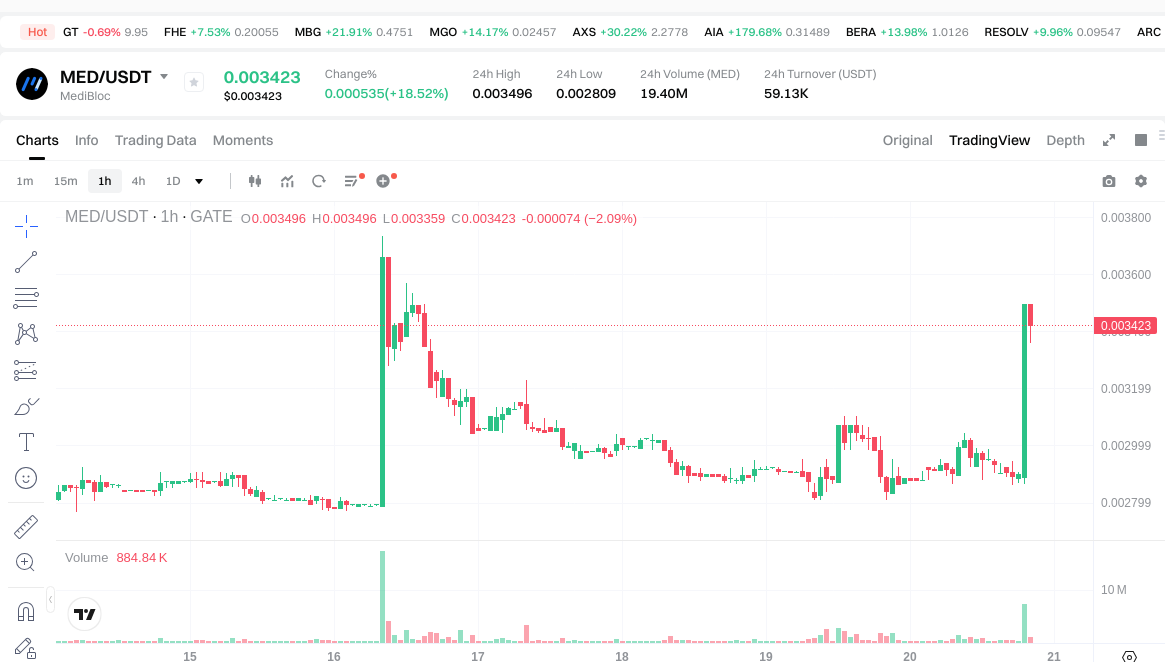
II. Core Factors Affecting Whether MED is a Good Investment (Is MediBloc(MED) a Good Investment)
Supply Mechanism and Scarcity (MED investment scarcity)
- Unlimited maximum supply mechanism → impacts price dynamics and investment value assessment
- Current circulating supply of 10.64 billion MED with total supply of 11.43 billion tokens
- Investment significance: The unlimited supply model requires careful consideration when evaluating long-term scarcity-based value propositions
Institutional Investment and Mainstream Adoption (Institutional investment in MED)
- Platform positioning: Open information service platform for medical data management utilizing blockchain technology
- API and SDK availability enables software developers to create medical information-based services
- Medical service providers and research institutions can access medical information resources with user consent, potentially expanding the ecosystem
Macroeconomic Environment's Impact on MED Investment
- Monetary policy and interest rate changes → alter investment attractiveness across digital asset markets
- Healthcare sector digitalization trends may influence demand for medical data management solutions
- Regulatory developments in healthcare data privacy could affect platform adoption and token utility
Technology & Ecosystem Building (Technology & Ecosystem for MED investment)
- Blockchain-based medical information integration: Securely consolidates data from multiple devices and medical institutions
- Permission management system: Medical consumers can set different access permissions for personal information, ensuring ownership and control
- Cross-institutional data sharing framework: Facilitates authorized access for individuals, research institutions, and enterprises seeking medical information resources
III. MED Future Investment Forecast and Price Outlook (Is MediBloc(MED) worth investing in 2026-2031)
Short-term Investment Forecast (2026, short-term MED investment outlook)
- Conservative Forecast: $0.00207705 - $0.003405
- Neutral Forecast: $0.003405
- Optimistic Forecast: $0.003405 - $0.00507345
Mid-term Investment Outlook (2027-2029, mid-term MediBloc(MED) investment forecast)
-
Market Stage Expectation: MediBloc may experience moderate growth phases as the platform continues to develop its blockchain-based medical information services. The projected price movements suggest potential consolidation periods followed by gradual appreciation.
-
Investment Return Forecast:
- 2027: $0.00411204825 - $0.00436640175
- 2028: $0.00228049108875 - $0.0050773197825
- 2029: $0.003470649268275 - $0.006847497204975
-
Key Catalysts: Platform adoption by medical institutions, API and SDK utilization by developers, regulatory developments in healthcare data management, and expansion of medical information service applications.
Long-term Investment Outlook (Is MediBloc a good long-term investment?)
- Base Scenario: $0.004961152427001 - $0.005999533167537 (assuming steady platform development and moderate adoption)
- Optimistic Scenario: $0.005884157529699 - $0.007002147460342 (assuming increased medical institution partnerships and broader ecosystem expansion)
- Risk Scenario: $0.003000920340146 - $0.004961152427001 (under challenging market conditions or slower adoption rates)
View MED long-term investment and price forecast: Price Prediction
2026-01-20 - 2031 Long-term Outlook
- Base Scenario: $0.003405 - $0.005768781891862 (corresponding to steady progress and stable mainstream application growth)
- Optimistic Scenario: $0.005884157529699 - $0.007002147460342 (corresponding to large-scale adoption and favorable market conditions)
- Transformative Scenario: Above $0.007002147460342 (if ecosystem achieves breakthrough developments and mainstream adoption)
- 2031-12-31 Projected High: $0.007002147460342 (based on optimistic development assumptions)
Disclaimer
| Year |
Predicted High Price |
Predicted Average Price |
Predicted Low Price |
Price Change |
| 2026 |
0.00507345 |
0.003405 |
0.00207705 |
0 |
| 2027 |
0.00436640175 |
0.004239225 |
0.00411204825 |
23 |
| 2028 |
0.0050773197825 |
0.004302813375 |
0.00228049108875 |
25 |
| 2029 |
0.006847497204975 |
0.00469006657875 |
0.003470649268275 |
36 |
| 2030 |
0.005999533167537 |
0.005768781891862 |
0.004961152427001 |
68 |
| 2031 |
0.007002147460342 |
0.005884157529699 |
0.003000920340146 |
71 |
IV. MED Investment Strategy and Risk Management (How to invest in MediBloc)
Investment Methodology (MED investment strategy)
-
Holding MED for the Long Term (HODL MED): Suitable for conservative investors who believe in the long-term potential of blockchain-based healthcare information platforms. This approach involves purchasing MED tokens and holding them through market cycles, minimizing transaction costs and short-term volatility impact.
-
Active Trading: Relies on technical analysis and swing trading strategies. Traders may monitor price movements, volume changes, and market sentiment indicators to identify entry and exit points. Given MED's 24-hour price change of approximately 19.69% and recent volatility patterns, active traders should establish clear profit targets and stop-loss levels.
Risk Management (Risk management for MED investment)
V. MED Investment Risks and Challenges (Risks of investing in MediBloc)
-
Market Risks: MED exhibits significant price volatility, with 1-year performance showing a decline of approximately 66.35%. The token's 24-hour price range demonstrates substantial fluctuations. Market capitalization of approximately $36.48 million indicates relatively lower liquidity compared to major cryptocurrencies, potentially leading to higher price impact during large transactions.
-
Regulatory Risks: Healthcare data management platforms face varying regulatory frameworks across jurisdictions. Changes in data privacy regulations, blockchain healthcare application policies, or cryptocurrency classification could impact MED's utility and adoption. Different countries maintain distinct approaches to blockchain-based medical information systems, creating uncertainty for cross-border operations.
-
Technical Risks: As a blockchain-based medical information platform, MED faces potential security vulnerabilities related to data protection and network integrity. Platform development progress, API and SDK functionality updates, and technical infrastructure maintenance require ongoing monitoring. Integration challenges with existing healthcare systems and adoption barriers may affect long-term value proposition.
VI. Conclusion: Is MediBloc a Good Investment?
Investment Value Summary
MED represents a blockchain solution addressing medical information management challenges. The project aims to provide an open information service platform integrating medical data from various devices and institutions. While the concept addresses real-world healthcare data fragmentation issues, the token has experienced significant price volatility, with a notable decline over the past year.
Investor Recommendations
✅ Beginners: Consider dollar-cost averaging (DCA) approach with small, regular purchases if interested in healthcare blockchain sector. Prioritize secure wallet storage and thorough research of the platform's development progress and partnerships.
✅ Experienced Investors: May employ swing trading strategies based on technical indicators while maintaining diversified portfolio allocation. Monitor project developments, partnership announcements, and broader healthcare blockchain sector trends.
✅ Institutional Investors: Evaluate MED within broader healthcare technology and blockchain infrastructure investment thesis. Consider position sizing relative to market capitalization, liquidity constraints, and regulatory landscape developments.
⚠️ Disclaimer: Cryptocurrency investments carry substantial risk. MED's price volatility, relatively lower market capitalization, and sector-specific challenges require careful consideration. This content is for informational purposes only and does not constitute investment advice. Conduct thorough due diligence and consider consulting financial advisors before making investment decisions.
VII. FAQ
Q1: What is MediBloc (MED) and how does it work?
MediBloc (MED) is a blockchain-based open information service platform designed to securely integrate and manage medical information. The platform consolidates medical data generated by various devices (including smartphones) and scattered across different medical institutions. Medical consumers can set different access permissions for each piece of personal information, thereby obtaining ownership and control of their own medical data. Medical service providers can input medical records into MediBloc with consumer consent, while individuals, research institutions, or enterprises can obtain required medical information resources with the information owner's permission. Software developers can utilize the API and SDK provided by MediBloc to create various medical information-based services.
Q2: Is MediBloc (MED) a good investment in 2026?
The investment suitability of MED depends on individual risk tolerance and investment objectives. As of January 20, 2026, MED is priced at approximately $0.003427 with a market capitalization of $36.48 million, ranking #637 in the crypto market. The token has experienced significant volatility, declining approximately 66.35% over the past year. Conservative forecasts suggest potential price ranges of $0.00207705 - $0.00507345 in 2026. While the platform addresses real healthcare data management challenges, investors should carefully consider the substantial price volatility, relatively lower market capitalization, and sector-specific risks before making investment decisions.
Q3: What are the main risks of investing in MediBloc (MED)?
MED investment carries three primary risk categories. Market risks include significant price volatility (1-year decline of approximately 66.35%) and relatively lower liquidity with 24-hour trading volume of approximately $57,538, potentially leading to higher price impact during large transactions. Regulatory risks involve varying healthcare data management frameworks across jurisdictions, with potential policy changes affecting the platform's utility and adoption. Technical risks encompass security vulnerabilities related to data protection, platform development progress, and integration challenges with existing healthcare systems. The unlimited maximum supply mechanism also impacts long-term scarcity-based value propositions.
Q4: How can I invest in MediBloc (MED) safely?
Safe MED investment requires multiple layers of security and strategic planning. For asset allocation, conservative investors should allocate 1-3% of their cryptocurrency portfolio to MED, moderate investors 3-7%, and aggressive investors up to 10%. Implement diversified portfolio strategies combining MED with major cryptocurrencies and stablecoins. For storage security, use hot wallets only for active trading amounts, while utilizing cold storage or hardware wallets (such as Ledger or Trezor) for long-term holdings. Investment strategies include long-term holding (HODL) for conservative investors believing in the platform's potential, or active trading based on technical analysis for experienced traders who can monitor the token's volatility patterns and establish clear profit targets and stop-loss levels.
Q5: What is MediBloc's price prediction for 2027-2031?
MediBloc's mid to long-term price forecasts vary based on different scenarios. For 2027, projections range from $0.00411204825 to $0.00436640175. By 2028, estimates span $0.00228049108875 to $0.0050773197825. Looking toward 2029, forecasts suggest $0.003470649268275 to $0.006847497204975. Long-term outlooks for 2030-2031 present three scenarios: base scenario ($0.003405 - $0.005768781891862) assuming steady platform development, optimistic scenario ($0.005884157529699 - $0.007002147460342) with increased medical institution partnerships, and risk scenario ($0.003000920340146 - $0.004961152427001) under challenging market conditions. The projected high for December 31, 2031 is $0.007002147460342 based on optimistic development assumptions.
Q6: What factors affect MediBloc's investment value?
Several core factors influence MED's investment value. The unlimited maximum supply mechanism impacts long-term scarcity-based value propositions, with current circulating supply of 10.64 billion MED and total supply of 11.43 billion tokens. Platform positioning as an open medical data management service with API and SDK availability enables ecosystem expansion through developer adoption. Macroeconomic factors including monetary policy changes, healthcare sector digitalization trends, and regulatory developments in healthcare data privacy affect the token's utility. Technology and ecosystem building aspects include blockchain-based medical information integration, permission management systems enabling user control, and cross-institutional data sharing frameworks facilitating authorized access for various stakeholders.
Q7: Who should invest in MediBloc (MED)?
Different investor profiles suit different MED investment approaches. Beginners should consider dollar-cost averaging (DCA) with small, regular purchases if interested in the healthcare blockchain sector, prioritizing secure wallet storage and thorough research of platform development progress. Experienced investors may employ swing trading strategies based on technical indicators while maintaining diversified portfolio allocation and monitoring project developments, partnership announcements, and sector trends. Institutional investors should evaluate MED within broader healthcare technology and blockchain infrastructure investment thesis, considering position sizing relative to market capitalization, liquidity constraints, and regulatory landscape developments. All investors must acknowledge that cryptocurrency investments carry substantial risk and should conduct thorough due diligence before making investment decisions.
Q8: How does MediBloc compare to other healthcare blockchain projects?
MediBloc distinguishes itself through its focus on medical information integration from multiple devices and institutions with a comprehensive permission management system. The platform enables medical consumers to maintain ownership and control of personal health data while facilitating authorized access for medical service providers, research institutions, and enterprises. The availability of API and SDK for developers creates opportunities for building medical information-based services on top of the platform. However, with a current market capitalization of approximately $36.48 million and ranking at #637, MED maintains a relatively smaller market presence compared to major cryptocurrencies. Investors should evaluate MED's unique value proposition within the healthcare blockchain sector context while considering the token's historical performance, including the significant 66.35% decline over the past year.
* The information is not intended to be and does not constitute financial advice or any other recommendation of any sort offered or endorsed by Gate.