MediBloc (MED) is a blockchain-based healthcare data management platform enabling secure medical information integration across institutions while giving patients data ownership and control. As of January 2026, MED trades at $0.003084 with a $32.83 million market cap, having declined 69.72% over the past year despite recent recovery. This comprehensive analysis examines MED's investment characteristics, historical performance spanning 2020-2026, and price forecasts through 2031, projecting potential ranges from $0.0018 to $0.0083 depending on adoption rates and market conditions. Key investment considerations include unlimited token supply, limited exchange listings, regulatory risks in healthcare data management, and significant market volatility with 24-hour trading volume of $98,650. The article evaluates long-term holding versus active trading strategies, recommends portfolio allocations of 1-10% based on investor risk tolerance, and emphasizes secure storage solutions. Despite substantial risks including
Introduction: MediBloc (MED) Investment Position and Market Outlook
MED is a digital asset in the cryptocurrency field that has been operating since its launch in December 2017. As a blockchain-based open information service platform focused on healthcare data management, MediBloc enables secure integration and management of medical information across multiple devices and healthcare institutions. As of January 21, 2026, MED holds a market capitalization of approximately $32.83 million, with a circulating supply of about 10.64 billion tokens, and the current price is around $0.003084. The platform allows medical consumers to set different access permissions for personal information, while healthcare providers can input medical records with patient consent. Research institutions and enterprises can obtain medical information resources with the consent of information owners. Software developers can utilize APIs and SDKs provided by the MediBloc platform to create various medical information services. This article provides a comprehensive analysis of MED's investment characteristics, historical performance, future price outlook, and associated risks to serve as a reference for investors.
I. MED Price History Review and Current Investment Value
- 2021: During the market expansion phase, MED experienced notable price movement, reaching a significant level of $0.351852 on April 2, 2021 → Investors who participated during early periods witnessed substantial portfolio changes
- 2020: Market volatility period led to price fluctuations, with MED recording a notable low point of $0.00161437 on March 13, 2020 → Price demonstrated significant recovery in subsequent periods
- 2025-2026: Recent market conditions show MED price declining from approximately $0.01018 (estimated based on 1-year change) to current levels → Reflecting broader market adjustments and project development phases
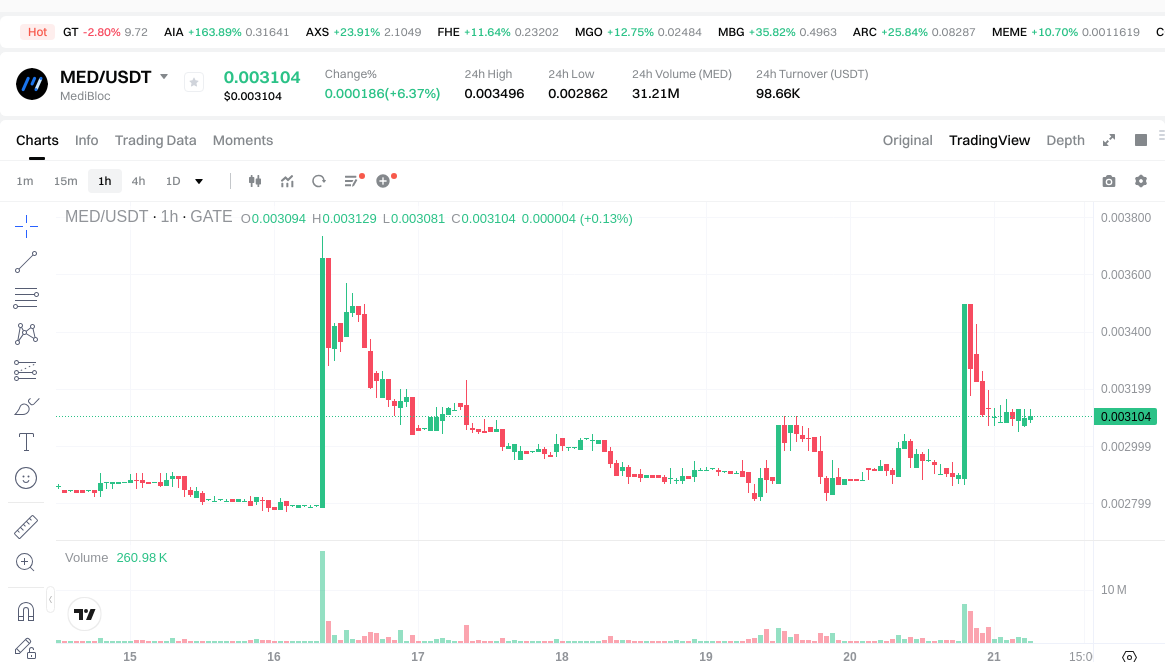
Current MED Investment Market Status (January 2026)
- MED current price: $0.003084
- Market sentiment (Fear & Greed Index): Data not available in provided materials
- 24-hour trading volume: $98,650.23
- Institutional investor holdings: Data not available in provided materials
Click to view real-time MED market price
II. Core Factors Affecting Whether MED is a Good Investment (Is MediBloc(MED) a Good Investment)
Supply Mechanism and Scarcity (MED investment scarcity)
- Unlimited maximum supply mechanism → potential dilution impact on price and investment value
- Circulating supply of 10.64 billion MED tokens with a circulation ratio of approximately 93.09%
- Investment significance: the absence of a hard supply cap may reduce scarcity-driven long-term investment support compared to assets with fixed supplies
Institutional Investment and Mainstream Adoption (Institutional investment in MED)
- Available data indicates MED is listed on 4 exchanges with relatively limited mainstream market presence
- Investment value consideration: broader exchange listings and institutional adoption trends remain areas for potential development
- Regulatory environment and policy frameworks for blockchain-based healthcare platforms may influence future investment prospects
Macroeconomic Environment's Impact on MED Investment
- Monetary policy and interest rate changes → may alter risk appetite for smaller-cap digital assets
- Economic uncertainty periods → could affect capital allocation to specialized healthcare blockchain projects
- Market conditions and broader crypto sector performance → influence MED's investment attractiveness within niche healthcare technology segments
Technology and Ecosystem Development (Technology & Ecosystem for MED investment)
- Open information service platform utilizing blockchain technology for medical data management → provides foundational use case value
- API and SDK availability for developers → supports potential ecosystem expansion for healthcare information services
- Healthcare data integration capabilities across multiple devices and institutions → represents specialized application focus that may support long-term value proposition in the medical information sector
III. MED Future Investment Forecast and Price Outlook (Is MediBloc(MED) worth investing in 2026-2031)
Short-term Investment Forecast (2026, short-term MED investment outlook)
- Conservative forecast: $0.0018 - $0.0031
- Neutral forecast: $0.0031 - $0.0037
- Optimistic forecast: $0.0037 and above
Mid-term Investment Outlook (2027-2029, mid-term MediBloc(MED) investment forecast)
-
Market stage expectation: During the 2027-2029 period, MED may experience gradual development as the blockchain-based healthcare information platform continues to evolve. The platform's focus on medical data integration and user-controlled health records could potentially attract interest from healthcare providers and research institutions seeking secure data management solutions.
-
Investment return forecast:
- 2027: $0.0019 - $0.0049
- 2028: $0.0029 - $0.0044
- 2029: $0.0022 - $0.0059
-
Key catalysts: Platform adoption by medical institutions, regulatory developments in healthcare data management, API and SDK utilization by third-party developers, and broader acceptance of blockchain solutions in the healthcare sector.
Long-term Investment Outlook (Is MediBloc a good long-term investment?)
- Base scenario: $0.0031 - $0.0064 (assuming steady platform development and gradual adoption by healthcare stakeholders)
- Optimistic scenario: $0.0059 - $0.0083 (assuming expanded partnerships with medical institutions and increased demand for decentralized health data solutions)
- Risk scenario: $0.0018 - $0.0029 (under conditions of limited adoption, regulatory challenges, or increased market competition)
For detailed MED long-term investment and price forecasts: Price Prediction
2026-01-21 - 2031 Long-term Outlook
- Base scenario: $0.0031 - $0.0064 (corresponding to steady progress and gradual mainstream application growth)
- Optimistic scenario: $0.0059 - $0.0083 (corresponding to large-scale adoption and favorable market conditions)
- Transformative scenario: Above $0.0083 (contingent upon breakthrough ecosystem developments and mainstream penetration)
- 2031-12-31 forecast high: $0.0083 (based on optimistic development assumptions)
Disclaimer: The information provided is for reference purposes only and does not constitute investment advice. Cryptocurrency markets are subject to high volatility and various risks. Past performance does not guarantee future results. Investors should conduct thorough research and consider their risk tolerance before making investment decisions.
| Year |
Predicted High Price |
Predicted Average Price |
Predicted Low Price |
Price Change |
| 2026 |
0.0037248 |
0.003104 |
0.00180032 |
0 |
| 2027 |
0.004916736 |
0.0034144 |
0.001912064 |
10 |
| 2028 |
0.00441550208 |
0.004165568 |
0.00287424192 |
35 |
| 2029 |
0.0059209383552 |
0.00429053504 |
0.0022310782208 |
39 |
| 2030 |
0.006382170872 |
0.0051057366976 |
0.003114499385536 |
65 |
| 2031 |
0.00832873298796 |
0.0057439537848 |
0.00488236071708 |
86 |
IV. MED Investment Strategy and Risk Management (How to invest in healthcare blockchain tokens)
Investment Methodology (MED investment strategy)
Long-term Holding (HODL MED)
For conservative investors seeking exposure to blockchain-based healthcare infrastructure, a long-term holding strategy may be considered. This approach involves acquiring MED tokens and maintaining positions through market cycles, focusing on the project's fundamental development rather than short-term price movements. Given MediBloc's focus on medical information management and data sovereignty, investors adopting this strategy typically evaluate the platform's adoption metrics, partnership developments, and ecosystem growth over extended periods.
Active Trading
Active trading strategies rely on technical analysis and swing trading techniques. Traders may utilize various timeframes to identify entry and exit points based on price patterns, volume indicators, and momentum signals. Given MED's 24-hour trading volume of approximately $98,650 and recent price volatility (24-hour range: $0.002862 - $0.003496), active traders should employ strict position sizing and risk management protocols. Technical indicators such as moving averages, RSI, and support/resistance levels may inform trading decisions.
Risk Management (Risk management for MED investment)
Asset Allocation Guidelines
- Conservative investors: Consider allocating no more than 1-3% of total portfolio value to MED, maintaining predominant positions in established assets
- Aggressive investors: May allocate 5-10% to MED as part of a diversified cryptocurrency portfolio, accepting higher volatility in exchange for potential returns
- Professional investors: Can implement strategic allocations based on comprehensive due diligence, portfolio construction models, and institutional risk frameworks
Risk Hedging Approaches
Implementing multi-asset portfolio construction combined with hedging instruments can help mitigate exposure. Investors may consider:
- Diversifying across multiple blockchain sectors beyond healthcare
- Maintaining positions in less correlated assets
- Utilizing position sizing techniques to limit single-asset exposure
- Implementing stop-loss mechanisms for active trading strategies
Secure Storage Solutions
Proper custody is essential for MED token security:
- Hot wallets: Suitable for active trading and frequent transactions, but require robust security practices including two-factor authentication and regular security audits
- Cold wallets: Recommended for long-term holdings, providing offline storage away from potential network threats
- Hardware wallets: Dedicated devices offering enhanced security through isolated key generation and transaction signing
Investors should research wallet compatibility with MED tokens and follow best practices for backup and recovery procedures.
V. MED Investment Risks and Challenges (Risks of investing in healthcare blockchain tokens)
Market Risk
MED demonstrates significant price volatility characteristics common to mid-cap cryptocurrency assets. The token has experienced substantial price fluctuations, with 1-year performance showing a decline of approximately 69.72%. The 24-hour price change of 8.08% illustrates ongoing volatility that investors must consider. With a market capitalization ranking of 674 and relatively modest trading volumes, MED may be susceptible to amplified price movements during periods of market stress or concentrated trading activity.
Regulatory Risk
Healthcare blockchain projects face unique regulatory considerations across different jurisdictions. Medical data management involves sensitive personal information subject to regulations such as GDPR in Europe, HIPAA in the United States, and similar frameworks in other regions. Evolving regulatory approaches to blockchain technology in healthcare, data privacy requirements, and cryptocurrency classification create ongoing uncertainty. Changes in regulatory frameworks could impact MediBloc's operations, partnership opportunities, and token utility.
Technical Risk
Blockchain healthcare platforms encounter specific technical challenges:
- Network security vulnerabilities: Smart contract exploits, consensus mechanism weaknesses, or infrastructure compromises could affect platform integrity
- Upgrade implementation: Protocol modifications or feature deployments carry execution risks that could temporarily impact network functionality
- Interoperability challenges: Integration with existing healthcare systems and multiple blockchain networks introduces technical complexity
- Scalability considerations: Healthcare data management requires robust throughput capacity and efficient data handling mechanisms
Investors should monitor the project's technical development progress, security audit reports, and incident response capabilities.
VI. Conclusion: Is Healthcare Blockchain Token a Good Investment?
Investment Value Summary
MED represents exposure to the intersection of blockchain technology and healthcare data management, a sector addressing real-world challenges in medical information ownership and interoperability. The project's focus on patient data sovereignty and providing infrastructure for healthcare information services targets a substantial market opportunity. However, the token has experienced significant price depreciation over the past year, with performance declining approximately 69.72%, while showing shorter-term recovery with 30-day gains of approximately 25.85%.
The long-term investment potential depends on multiple factors including platform adoption rates, partnership development with healthcare institutions, regulatory environment evolution, and broader cryptocurrency market conditions. Short-term price movements remain subject to considerable volatility given the token's market position and trading characteristics.
Investor Recommendations
✅ Beginners: Consider dollar-cost averaging approaches to mitigate entry timing risk, combined with secure wallet storage solutions. Prioritize education about healthcare blockchain fundamentals and platform-specific developments before committing capital.
✅ Experienced investors: May implement swing trading strategies based on technical analysis while maintaining core positions as part of diversified cryptocurrency portfolios. Regular monitoring of project milestones, partnership announcements, and ecosystem metrics can inform position adjustments.
✅ Institutional investors: Could evaluate strategic long-term allocation as part of thematic exposure to healthcare technology innovation, subject to comprehensive due diligence, compliance frameworks, and portfolio construction mandates.
⚠️ Important Notice: Cryptocurrency investments carry substantial risk including potential total loss of capital. This content is provided for informational purposes only and does not constitute investment advice, financial guidance, or recommendations to buy, sell, or hold any asset. Individuals should conduct independent research, assess their risk tolerance, and consult qualified financial advisors before making investment decisions.
VII. FAQ
Q1: What is MediBloc (MED) and what makes it different from other healthcare blockchain projects?
MediBloc is a blockchain-based open information service platform focused on healthcare data management that enables secure integration of medical information across multiple devices and healthcare institutions. Unlike traditional healthcare systems, MediBloc allows medical consumers to set different access permissions for personal information, giving patients true ownership and control over their health records. Healthcare providers can input medical records with patient consent, while research institutions and enterprises can obtain medical information resources only with the consent of information owners. The platform also provides APIs and SDKs for software developers to create various medical information services, establishing a comprehensive ecosystem for healthcare data management.
Q2: Is MED a good investment for beginners in 2026?
For beginners, MED presents a high-risk investment opportunity that requires careful consideration. The token has experienced significant volatility, declining approximately 69.72% over the past year, though showing recent recovery with 30-day gains of approximately 25.85%. Beginners should consider allocating no more than 1-3% of their total portfolio value to MED and implement dollar-cost averaging approaches to mitigate entry timing risk. It is essential to prioritize education about healthcare blockchain fundamentals and secure wallet storage solutions before committing capital. The investment value depends on platform adoption rates, regulatory developments, and broader market conditions.
Q3: What are the main risks associated with investing in MED?
MED investment carries three primary risk categories: Market Risk – the token demonstrates significant price volatility with a relatively modest trading volume of approximately $98,650 in 24 hours, making it susceptible to amplified price movements; Regulatory Risk – healthcare blockchain projects face unique regulatory considerations across jurisdictions, including data privacy regulations like GDPR and HIPAA, with evolving frameworks creating ongoing uncertainty; Technical Risk – blockchain healthcare platforms encounter challenges including network security vulnerabilities, smart contract exploits, upgrade implementation risks, interoperability challenges with existing healthcare systems, and scalability considerations for handling healthcare data efficiently.
Q4: What is the long-term price forecast for MED through 2031?
Based on analytical projections, MED presents three long-term scenarios: Base scenario forecasts prices ranging from $0.0031 to $0.0064, assuming steady platform development and gradual adoption by healthcare stakeholders; Optimistic scenario projects $0.0059 to $0.0083, contingent upon expanded partnerships with medical institutions and increased demand for decentralized health data solutions; Risk scenario estimates $0.0018 to $0.0029 under conditions of limited adoption or regulatory challenges. By 2031, the predicted high price reaches $0.0083 under optimistic development assumptions. These forecasts depend on multiple factors including platform adoption rates, partnership development, regulatory environment evolution, and broader cryptocurrency market conditions.
Q5: How should I store my MED tokens securely?
MED token storage requires implementing appropriate security measures based on investment strategy: Hot wallets are suitable for active trading and frequent transactions but require robust security practices including two-factor authentication and regular security audits; Cold wallets are recommended for long-term holdings, providing offline storage away from potential network threats; Hardware wallets offer enhanced security through dedicated devices with isolated key generation and transaction signing capabilities. Investors should research wallet compatibility with MED tokens, follow best practices for backup and recovery procedures, and never share private keys or seed phrases with anyone.
Q6: What factors could drive MED's price growth in the future?
Several key catalysts could potentially drive MED's price appreciation: Platform adoption by medical institutions seeking secure data management solutions; Regulatory developments creating favorable frameworks for healthcare blockchain applications; Increased utilization of APIs and SDKs by third-party developers building healthcare information services; Broader acceptance of blockchain solutions in the healthcare sector; Strategic partnerships with healthcare providers and research institutions; Expansion of use cases for patient data sovereignty and medical record interoperability; General cryptocurrency market recovery and increased risk appetite for specialized blockchain projects; Technological improvements addressing scalability and security considerations.
Q7: What investment strategies work best for MED tokens?
Two primary strategies are appropriate for different investor profiles: Long-term Holding (HODL) strategy suits conservative investors seeking exposure to blockchain-based healthcare infrastructure, focusing on the project's fundamental development rather than short-term price movements, evaluating platform adoption metrics, partnership developments, and ecosystem growth over extended periods; Active Trading strategy relies on technical analysis and swing trading techniques, utilizing various timeframes to identify entry and exit points based on price patterns, volume indicators, and momentum signals. Given recent volatility, active traders should employ strict position sizing and risk management protocols, using technical indicators such as moving averages, RSI, and support/resistance levels to inform trading decisions.
Q8: How does MED's unlimited supply affect its investment value?
MED's unlimited maximum supply mechanism represents an important consideration for investment decisions, as it may create potential dilution impact on price and long-term investment value compared to assets with fixed supplies like Bitcoin. Currently, approximately 10.64 billion MED tokens are in circulation with a circulation ratio of approximately 93.09%. The absence of a hard supply cap may reduce scarcity-driven investment support that characterizes deflationary assets. However, the actual impact depends on the emission schedule, token burning mechanisms (if any), demand growth from platform adoption, and utility expansion within the healthcare ecosystem. Investors should monitor token issuance rates and evaluate whether growing platform adoption can offset supply expansion effects.
* The information is not intended to be and does not constitute financial advice or any other recommendation of any sort offered or endorsed by Gate.