Metal Blockchain Token (METAL) is a Layer 0 blockchain infrastructure token utilizing Proof-of-Stake consensus through the Snow Protocol, designed to bridge popular PoW blockchains like Bitcoin, Ethereum, and Dogecoin to PoS systems. Trading at $0.15457 with a $29.14 million market cap as of January 2026, METAL demonstrates both substantial investment potential and significant risk, with annual growth of 60.24% despite high volatility and recent 11.03% 24-hour decline. The token's investment value depends on successful adoption by DeFi users and enterprises launching custom chains, with long-term forecasts suggesting possible appreciation to $0.3616 by 2031 under optimistic scenarios. This comprehensive analysis examines METAL's price performance from its $1.646 peak to $0.0353 low, evaluates core investment factors including supply mechanics and ecosystem development, and provides strategic guidance for different investor profiles. Risk management remains critical given METAL's limited exchange presence on o
Metal Blockchain Token (METAL) represents a notable asset in the cryptocurrency sector, functioning as a Layer 0 blockchain infrastructure since its launch. As of January 21, 2026, METAL maintains a market capitalization of approximately $29.14 million, with a circulating supply of around 188.50 million tokens and a current trading price near $0.15457. The token ranks 725th in the cryptocurrency market with a market dominance of 0.0016%.
As an extensible Layer 0 blockchain solution, Metal Blockchain aims to bridge traditional Proof-of-Work (PoW) blockchains such as BTC, ETH, and DOGE to Proof-of-Stake (PoS) systems through smart contract functionality and trusted bridge mechanisms. Its core positioning targets DeFi users and enterprises seeking to launch their own chains or decentralized applications. The platform utilizes the Snow Protocol to achieve consensus, enabling efficient PoS operations while eliminating the energy-intensive requirements of PoW models.
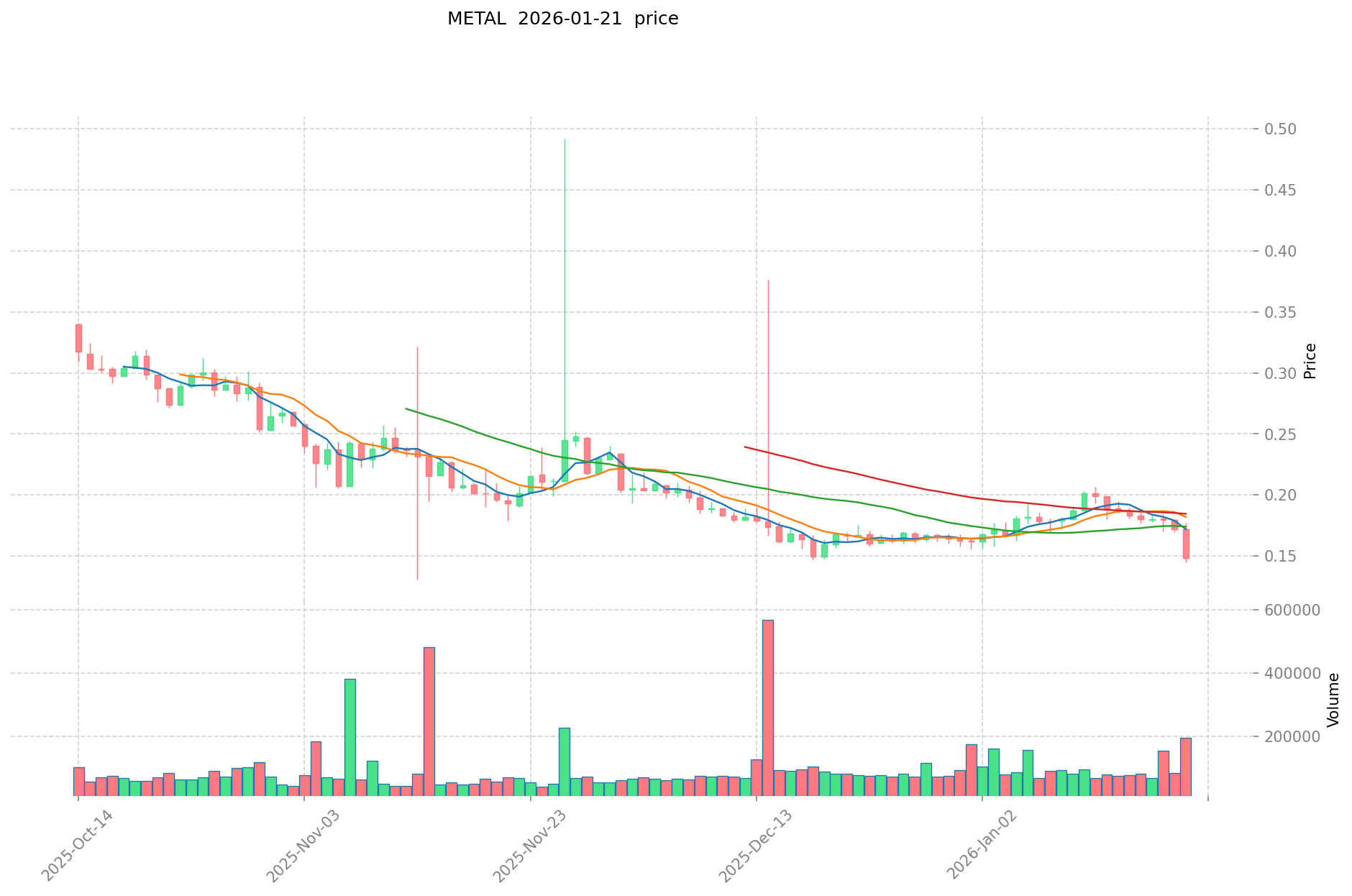
METAL's price history shows notable volatility, having experienced an annual increase of 60.24% over the past year despite recent downward pressure, with a 24-hour decline of 11.03% and a 7-day decrease of 16.88%. The token reached a recorded high of $1.646 on September 12, 2022, and a low of $0.0353 on August 5, 2024. With a fully diluted valuation of approximately $51.52 million and a total supply of 333.33 million tokens, the circulating supply represents about 28.28% of the total.
This article provides a comprehensive analysis of METAL's investment characteristics, historical performance trends, future price considerations, and associated risk factors for those evaluating "Is Metal Blockchain Token (METAL) a good investment?" The analysis aims to offer reference information for market participants examining this Layer 0 blockchain infrastructure token.
I. METAL Price History Review and Current Investment Value
- 2022: METAL reached a peak price of $1.65 in September → Market experienced significant volatility during broader crypto market downturn
- 2024: Price declined to lower levels in August → Testing support around $0.035 range
- Recent Period: Recovery phase observed → Price rebounded from lower levels with annual growth showing positive momentum
- METAL current price: $0.15457
- Market sentiment: Data not provided in reference materials
- 24-hour trading volume: $32,554.68
- Institutional investor holdings: Data not provided in reference materials
Click to view real-time METAL market price
- METAL operates with a maximum supply of 333,333,333 tokens, with current circulating supply of approximately 188.5 million tokens (28.28% of total supply) → influences price dynamics and investment value through controlled supply inflation
- Historical patterns: METAL experienced significant price appreciation from its all-time low of $0.0353 (August 2024) to current levels of $0.1546, representing substantial recovery potential, though still considerably below its previous peak of $1.65 (September 2022)
- Investment significance: The relatively low circulating supply ratio (28.28%) suggests ongoing token distribution may create gradual supply pressure, while the defined maximum supply provides long-term scarcity considerations for investment positioning
Institutional Investment and Mainstream Adoption (Institutional investment in METAL)
- Available data indicates METAL maintains limited exchange presence with listings on 2 platforms, reflecting relatively constrained mainstream adoption compared to larger market cap cryptocurrencies
- The project positions itself to serve DeFi users and enterprises seeking to launch their own chains or dApps, targeting institutional use cases through its Layer 0 blockchain infrastructure
- Broader institutional adoption metrics and specific enterprise partnerships remain limited in available documentation, suggesting this remains an emerging area for METAL's investment profile
- As a proof-of-stake Layer 0 blockchain, METAL's investment appeal may be influenced by shifts in monetary policy and interest rate environments, particularly as institutional capital allocation patterns respond to changing risk-reward dynamics in crypto markets
- The project's positioning as infrastructure for deploying blockchain networks may provide some differentiation from pure store-of-value narratives, though macroeconomic headwinds affecting risk assets could still impact investment sentiment
- Geopolitical factors and regulatory developments surrounding blockchain technology could affect METAL's adoption trajectory and investment outlook, particularly given its focus on enterprise and DeFi applications
- Core infrastructure: Metal Blockchain functions as an extensible Layer 0 blockchain utilizing the Snow Protocol for consensus, enabling any chain to deploy and achieve consensus while operating on an efficient proof-of-stake model, eliminating proof-of-work requirements
- Strategic positioning: The platform aims to bridge popular PoW blockchains (including BTC, ETH, and DOGE) to PoS through smart contract functionality and trusted bridging mechanisms, potentially expanding interoperability use cases
- Ecosystem focus: METAL targets DeFi users and enterprise clients seeking to launch custom chains or decentralized applications, with long-term investment value dependent on successful adoption within these segments and expansion of its developer and user ecosystem
- Conservative forecast: $0.1252 - $0.1546
- Neutral forecast: $0.1546 - $0.1857
- Optimistic forecast: $0.1857 - $0.2149
-
Market stage expectations: Based on historical data showing potential recovery patterns, the mid-term outlook indicates gradual development with moderate volatility. The token has demonstrated resilience after reaching its historical low in August 2024.
-
Investment return forecast:
- 2027: $0.1736 - $0.2235 (projected increase of approximately 19% from 2026 average)
- 2028: $0.1123 - $0.2572 (projected increase of approximately 32% from 2026 average)
-
Key catalysts: Layer-0 blockchain infrastructure development, PoS consensus mechanism efficiency improvements, cross-chain bridge technology advancement, and potential expansion of decentralized application ecosystem.
- Baseline scenario: $0.1524 - $0.3317 (assuming steady development of blockchain infrastructure and moderate market adoption)
- Optimistic scenario: $0.2024 - $0.3960 (assuming accelerated adoption of Layer-0 solutions and enhanced cross-chain functionality)
- Risk scenario: $0.1123 - $0.1524 (under conditions of intensified market competition or regulatory challenges)
Check METAL long-term investment and price forecast: Price Prediction
2026-01-21 - 2031 Long-term Outlook
- Base scenario: $0.1524 - $0.2675 (corresponding to steady progress and gradual mainstream application growth)
- Optimistic scenario: $0.2024 - $0.3960 (corresponding to large-scale adoption and favorable market conditions)
- Transformative scenario: Above $0.3960 (in case of breakthrough ecosystem developments and mainstream popularization)
- 2031-12-31 projected high: $0.3616 (based on optimistic development assumptions)
Disclaimer: These forecasts are based on historical data analysis and market trends. Cryptocurrency investments carry substantial risk, and past performance does not guarantee future results. Market conditions, technological developments, regulatory changes, and broader economic factors can significantly impact actual outcomes. This information does not constitute financial advice, and investors should conduct thorough research and consider their risk tolerance before making investment decisions.
| Year |
Predicted High Price |
Predicted Average Price |
Predicted Low Price |
Price Change |
| 2026 |
0.2148523 |
0.15457 |
0.1252017 |
0 |
| 2027 |
0.2235004915 |
0.18471115 |
0.173628481 |
19 |
| 2028 |
0.257173334145 |
0.20410582075 |
0.1122582014125 |
32 |
| 2029 |
0.3044442422307 |
0.2306395774475 |
0.15222212111535 |
49 |
| 2030 |
0.395962026561868 |
0.2675419098391 |
0.152498888608287 |
73 |
| 2031 |
0.361609645338527 |
0.331751968200484 |
0.202368700602295 |
114 |
- Long-term Holding (HODL METAL): Suitable for conservative investors seeking to benefit from potential long-term appreciation. This approach involves purchasing METAL tokens and holding them for extended periods, reducing exposure to short-term price fluctuations.
- Active Trading: Relies on technical analysis and swing trading strategies. Traders may utilize chart patterns, support and resistance levels, and market momentum indicators to identify entry and exit points for short-to-medium term trades.
-
Market Risk: METAL exhibits high price volatility, with 24-hour price changes exceeding 11% as observed in recent market data. The token's market capitalization represents only 0.0016% of the total crypto market, indicating susceptibility to price manipulation and limited liquidity.
-
Regulatory Risk: Cryptocurrency regulations vary significantly across jurisdictions. Policy changes in major markets could impact METAL's trading availability, compliance requirements, and overall market adoption.
-
Technical Risk: As a Layer 0 blockchain utilizing the Snow Protocol and Proof-of-Stake consensus mechanism, METAL faces potential security vulnerabilities, network upgrade failures, and smart contract bugs. The circulating supply represents only 28.28% of total supply, introducing potential inflation risks from future token releases.
-
Investment Value Summary: METAL presents potential long-term investment opportunities as a Layer 0 blockchain infrastructure, but experiences significant short-term price volatility. The token has demonstrated substantial annual growth while maintaining elevated risk levels.
-
Investor Recommendations:
✅ Beginners: Employ dollar-cost averaging (DCA) strategies combined with secure wallet storage. Start with small allocations and prioritize understanding the technology before increasing exposure.
✅ Experienced Investors: Implement swing trading strategies and maintain diversified portfolio configurations. Monitor technical indicators and market sentiment for optimal positioning.
✅ Institutional Investors: Consider strategic long-term allocation as part of blockchain infrastructure investment thesis. Conduct thorough due diligence on tokenomics and protocol development roadmap.
⚠️ Disclaimer: Cryptocurrency investments carry substantial risk. This content is provided for informational purposes only and does not constitute investment advice. Investors should conduct independent research and consult with financial advisors before making investment decisions.
VII. FAQ
Q1: What is Metal Blockchain Token (METAL) and what makes it unique as an investment?
Metal Blockchain Token (METAL) is the native token of a Layer 0 blockchain infrastructure that utilizes the Snow Protocol for consensus and operates on a Proof-of-Stake (PoS) model. What distinguishes METAL as an investment is its positioning as an extensible blockchain solution designed to bridge traditional Proof-of-Work (PoW) blockchains like BTC, ETH, and DOGE to PoS systems through smart contract functionality and trusted bridge mechanisms. The platform targets DeFi users and enterprises seeking to launch their own chains or decentralized applications, offering energy-efficient blockchain deployment without PoW requirements. With a market cap of approximately $29.14 million and a circulating supply representing 28.28% of total supply, METAL operates in the emerging Layer 0 infrastructure sector, providing potential investment exposure to cross-chain interoperability and enterprise blockchain adoption trends.
Q2: How has METAL performed historically and what is its current investment status?
METAL's price history demonstrates significant volatility characteristic of smaller-cap cryptocurrencies. The token reached its all-time high of $1.646 on September 12, 2022, before declining to an all-time low of $0.0353 on August 5, 2024. As of January 21, 2026, METAL trades at approximately $0.15457, representing a 60.24% annual increase despite recent downward pressure with an 11.03% decline in 24 hours and 16.88% decrease over 7 days. The token currently ranks 725th in the cryptocurrency market with 0.0016% market dominance and maintains a 24-hour trading volume of $32,554.68. This performance indicates recovery from 2024 lows but remains substantially below historical peaks, suggesting both risk and potential upside for investors evaluating entry points.
Q3: What are the projected price forecasts for METAL from 2026 to 2031?
Short-term forecasts for 2026 range from conservative estimates of $0.1252 - $0.1546 to optimistic projections of $0.1857 - $0.2149. Mid-term outlooks suggest gradual appreciation with 2027 projections of $0.1736 - $0.2235 (approximately 19% increase from 2026 average) and 2028 forecasts of $0.1123 - $0.2572 (approximately 32% increase). Long-term projections through 2031 indicate a predicted high of $0.3616 under optimistic development assumptions, with baseline scenarios ranging from $0.1524 - $0.3317 and transformative scenarios potentially exceeding $0.3960. These forecasts assume steady development of Layer 0 infrastructure, enhanced cross-chain functionality, and gradual mainstream adoption. However, these projections carry substantial uncertainty given cryptocurrency market volatility, technological developments, and regulatory factors that may significantly impact actual outcomes.
Q4: What investment strategies are recommended for METAL?
Two primary investment methodologies suit different investor profiles for METAL. Long-term holding (HODL) strategies are recommended for conservative investors seeking to benefit from potential long-term appreciation while reducing exposure to short-term price fluctuations. Active trading approaches utilizing technical analysis, chart patterns, and momentum indicators may suit experienced traders comfortable with higher risk levels. Asset allocation recommendations vary by investor type: conservative investors should allocate 1-3% of their crypto portfolio to METAL, aggressive investors may allocate 5-10% depending on risk tolerance, while professional investors should determine strategic allocation based on comprehensive analysis. Risk management should include diversified portfolio strategies, stablecoin hedging during high volatility periods, and secure storage using cold wallets or hardware wallets (such as Ledger or Trezor) for long-term holdings.
Q5: What are the primary investment risks associated with METAL?
METAL presents three major risk categories that investors must evaluate. Market risk remains substantial, with 24-hour price changes exceeding 11% and limited liquidity reflected in its 0.0016% market dominance, making the token susceptible to price manipulation and volatility. Regulatory risk stems from varying cryptocurrency regulations across jurisdictions, where policy changes in major markets could impact trading availability, compliance requirements, and adoption trajectory. Technical risk involves potential security vulnerabilities inherent in Layer 0 blockchain infrastructure utilizing the Snow Protocol, including network upgrade failures, smart contract bugs, and the inflation risk posed by the fact that only 28.28% of total supply currently circulates. Additionally, METAL's limited exchange presence on only 2 platforms constrains liquidity and mainstream accessibility compared to larger market cap cryptocurrencies.
Q6: Is METAL suitable for beginner investors?
METAL presents elevated risk levels that beginners should carefully consider before investing. While the token offers potential long-term opportunities as Layer 0 blockchain infrastructure, its significant price volatility (recent 11.03% 24-hour decline and 16.88% 7-day decrease) and relatively small market capitalization make it a higher-risk investment compared to established cryptocurrencies. Beginners interested in METAL should employ dollar-cost averaging (DCA) strategies to mitigate timing risk, start with small allocations (1-3% of crypto portfolio), prioritize understanding the underlying technology and use cases before increasing exposure, and utilize secure wallet storage solutions. The 60.24% annual increase demonstrates potential upside, but the gap between current price ($0.15457) and all-time high ($1.646) indicates substantial historical volatility that may continue.
Q7: How does METAL's tokenomics affect its investment value?
METAL's tokenomics present both opportunities and considerations for investors. The token operates with a maximum supply of 333,333,333 tokens, with approximately 188.5 million tokens (28.28% of total supply) currently in circulation. This relatively low circulating supply ratio suggests ongoing token distribution may create gradual supply pressure, potentially impacting price dynamics. The defined maximum supply provides long-term scarcity considerations, distinguishing METAL from unlimited supply cryptocurrencies. The token's fully diluted valuation of approximately $51.52 million compared to its current market cap of $29.14 million indicates substantial unrealized dilution risk as remaining tokens enter circulation. Investment significance stems from the controlled supply inflation mechanism, though the substantial gap between circulating and total supply introduces uncertainty regarding future token release schedules and their potential impact on market price.
Q8: What factors could drive METAL's long-term investment value?
Several key catalysts could influence METAL's long-term investment trajectory. Layer 0 blockchain infrastructure development represents the primary driver, as successful implementation of extensible blockchain solutions could attract enterprises and DeFi users seeking to deploy custom chains. Cross-chain bridge technology advancement connecting popular PoW blockchains (BTC, ETH, DOGE) to PoS systems could expand METAL's utility and adoption. Proof-of-Stake consensus mechanism efficiency improvements may enhance network performance and energy efficiency, positioning METAL favorably against PoW alternatives. Expansion of the decentralized application ecosystem on Metal Blockchain could increase demand for the native token. However, these positive factors face challenges from intensified competition in the Layer 0 sector, regulatory developments affecting blockchain technology, and macroeconomic conditions impacting risk asset allocation by institutional investors.
* The information is not intended to be and does not constitute financial advice or any other recommendation of any sort offered or endorsed by Gate.