Meteora (MET) serves as essential liquidity infrastructure within the Solana ecosystem, currently trading at $0.2966 with a market capitalization of $141.70 million as of January 2026. This comprehensive analysis examines MET's investment viability through multiple dimensions: price history reveals significant volatility with a 66.71% annual decline following its October 2025 peak of $0.6304, while future forecasts range from $0.2689 to $0.8341 through 2031 depending on adoption scenarios. Core investment considerations include moderate market liquidity across 31 Gate and other exchanges, controlled supply mechanisms with dilution risks, and utility-driven value from DeFi protocol integration. The article evaluates investment strategies for different investor profiles, presents comprehensive risk assessments covering market volatility and regulatory uncertainties, and concludes that MET represents potential long-term infrastructure exposure within Solana DeFi, suitable for diversified portfolios with appropri
Introduction: Meteora (MET) Investment Status and Market Outlook
Meteora (MET) represents a noteworthy asset within the cryptocurrency sector, functioning as a decentralized exchange designed to provide secure, sustainable, and composable liquidity infrastructure for the Solana ecosystem and the broader DeFi space. As of January 16, 2026, MET holds a market capitalization of approximately $141.70 million with a circulating supply of 477.74 million tokens, while the current trading price stands around $0.2966. The token ranks 297th in the overall cryptocurrency market with a market dominance of 0.0087%. With its positioning in the decentralized exchange and liquidity infrastructure sector, MET has become a subject of discussion among investors exploring "Is Meteora (MET) a good investment?" This article will comprehensively analyze MET's investment value, historical price trends, future price projections, and associated investment risks to provide reference information for potential investors.
I. Meteora (MET) Price History Review and Current Investment Value Status
- 2025 October: Meteora reached a price level of $0.6304 on October 23rd → representing a notable price peak during this period
- 2025 December: Market experienced downward pressure → MET declined to $0.2034 on December 18th
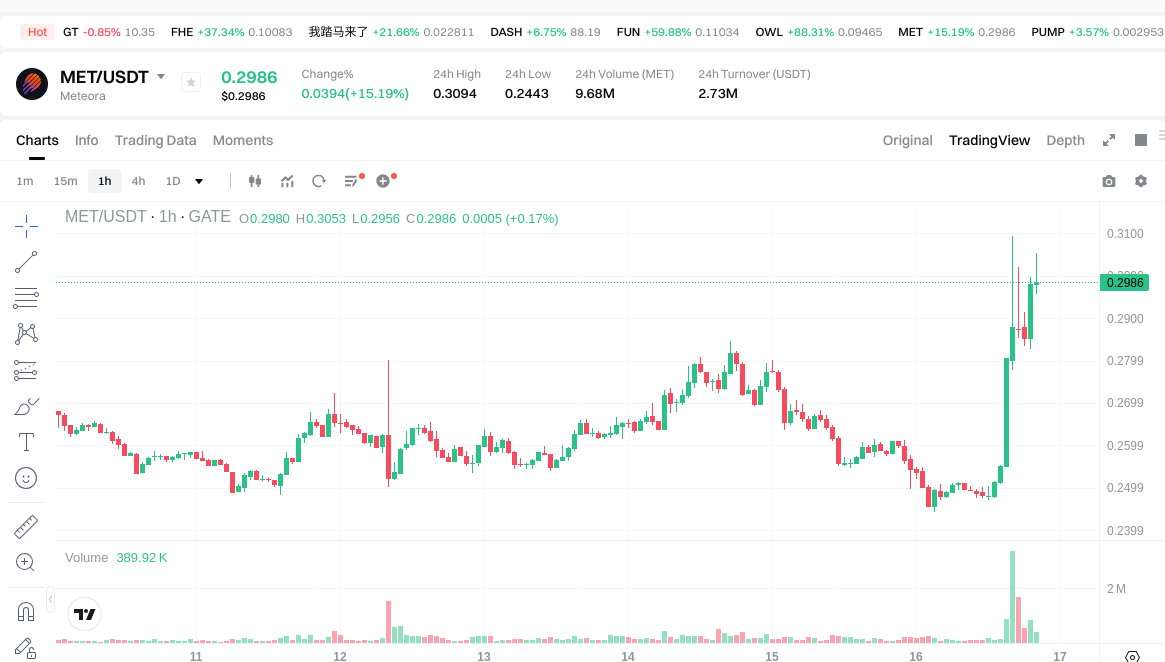
- 2026 January: Recent trading period shows recovery momentum → price fluctuated between $0.2443 and $0.3094 within 24 hours
Current MET Investment Market Status (January 2026)
- MET current price: $0.2966
- 24-hour trading volume: $2,661,617.33
- Circulating supply: 477,737,758 MET tokens
- Market capitalization: $141,697,019.02
- Token holders: 44,373 addresses
Click to view real-time MET market price
II. Core Factors Affecting Whether MET is a Good Investment
Supply Mechanism and Scarcity (MET Investment Scarcity)
- Token Supply Structure → Influences price dynamics and investment value
- MET has a maximum supply of 1,000,000,000 tokens, with approximately 477,737,758 tokens (47.77%) currently in circulation. The circulating supply represents less than half of the total supply, suggesting potential dilution risk as more tokens enter the market. The current market cap to fully diluted valuation ratio stands at 47.77%, indicating that significant token unlocks could impact price performance.
- Investment Significance: The controlled supply mechanism provides a degree of scarcity, though investors should monitor token release schedules as they may influence medium-term price action. The gap between circulating and maximum supply represents a key consideration for long-term investment evaluation.
Institutional Investment and Mainstream Adoption (Institutional Investment in MET)
- Exchange Listings and Accessibility: MET is currently listed on 31 exchanges and has recorded a 24-hour trading volume of approximately $2.66 million, demonstrating moderate liquidity for a relatively new token launched in October 2025.
- Ecosystem Integration: As a liquidity infrastructure provider for the Solana ecosystem, Meteora's adoption by Solana-based protocols and DeFi applications represents a form of institutional validation. The protocol serves as a backbone for trading, yield generation, and token launches within the Solana network.
- Market Position: MET has accumulated 44,373 holders since launch, indicating growing community adoption. However, direct data on large-scale institutional holdings was not available in the reference materials.
Macroeconomic Environment Impact on MET Investment
- DeFi Market Dynamics → Affect investment attractiveness
- As a DeFi protocol token, MET's investment value is closely tied to the broader decentralized finance sector and Solana ecosystem performance. Growth in Solana's user base and developer activity could positively influence MET's utility and demand.
- Risk Considerations: Recent market events, including liquidity concerns related to third-party token incidents on the Meteora platform (such as the NYC token situation referenced in January 2025), highlight platform-specific risks that investors should evaluate. Regulatory scrutiny following such events may impact investor sentiment.
- Market Correlation: MET's performance appears linked to both Solana's ecosystem health and overall crypto market conditions, with the token showing sensitivity to sector-wide volatility.
Technology and Ecosystem Development (Technology & Ecosystem for MET Investment)
- Dynamic Liquidity Solutions: Meteora provides advanced liquidity infrastructure through dynamic automated market makers (AMMs) and yield-optimizing vaults, differentiating it from traditional liquidity protocols.
- Composable Architecture: The protocol's composable design allows integration with various Solana-based applications, potentially expanding MET's utility as the ecosystem grows.
- Token Launch Infrastructure: Meteora offers fair-launch tools and dynamic bonding curves for new projects, positioning the platform as essential infrastructure for Solana token launches.
- DeFi Integration: MET serves multiple functions within the ecosystem, including governance participation, liquidity provision incentives, and protocol fee mechanisms. The token's utility extends across trading facilitation, yield strategies, and project launches, providing multiple value accrual pathways.
- Long-term Investment Support: The protocol's role as liquidity infrastructure positions MET as potentially strategic within Solana DeFi, though execution of roadmap items and sustained ecosystem adoption remain critical factors for investment value.
III. MET Future Investment Outlook and Price Forecast (Is Meteora (MET) worth investing in 2026-2031)
Short-term Investment Outlook (2026, short-term MET investment outlook)
- Conservative forecast: $0.2689 - $0.2988
- Neutral forecast: $0.2988 - $0.3700
- Optimistic forecast: $0.3700 - $0.4422
Mid-term Investment Outlook (2027-2029, mid-term Meteora (MET) investment forecast)
- Market phase expectation: Based on available data, MET may experience gradual growth through 2029, with potential fluctuations influenced by protocol adoption and broader DeFi market dynamics.
- Investment return forecast:
- 2027: $0.3186 - $0.4113
- 2028: $0.2189 - $0.5042
- 2029: $0.3222 - $0.6042
- Key catalysts: Growth in Solana ecosystem adoption, development of liquidity infrastructure, and overall DeFi market sentiment may influence price movement.
Long-term Investment Outlook (Is MET a good long-term investment?)
- Base scenario: $0.4049 - $0.7573 (assuming moderate protocol growth and sustained market interest through 2030)
- Optimistic scenario: $0.6416 - $0.8341 (assuming strong adoption of liquidity solutions and favorable market conditions through 2031)
- Risk scenario: Below $0.2689 (in case of prolonged market downturn or reduced DeFi activity)
Click to view MET long-term investment and price forecast: Price Prediction
2026-01-16 to 2031 Long-term Outlook
- Base scenario: $0.40 - $0.76 (corresponding to steady progress and mainstream application growth)
- Optimistic scenario: $0.64 - $0.83 (corresponding to large-scale adoption and favorable market environment)
- Transformative scenario: Above $0.83 (if the ecosystem achieves breakthrough developments and mainstream adoption)
- 2031-12-31 forecast high: $0.8341 (based on optimistic development assumptions)
Disclaimer: The above price forecasts are for reference only and do not constitute investment advice. Cryptocurrency markets are highly volatile, and actual prices may differ significantly from predictions. Investors should conduct their own research and assess risks before making investment decisions.
| Year |
Predicted High Price |
Predicted Average Price |
Predicted Low Price |
Price Change |
| 2026 |
0.442224 |
0.2988 |
0.26892 |
0 |
| 2027 |
0.41126832 |
0.370512 |
0.31864032 |
24 |
| 2028 |
0.5042483064 |
0.39089016 |
0.2188984896 |
31 |
| 2029 |
0.60421846482 |
0.4475692332 |
0.322249847904 |
50 |
| 2030 |
0.7572871425744 |
0.52589384901 |
0.4049382637377 |
77 |
| 2031 |
0.83406764452986 |
0.6415904957922 |
0.423449727222852 |
116 |
IV. Meteora Investment Strategy and Risk Management (How to invest in Meteora)
Investment Methodology (Meteora investment strategy)
Long-term Holding (HODL Meteora): Suitable for conservative investors
For investors seeking stable exposure to Solana ecosystem infrastructure, a long-term holding strategy may be considered. Meteora's focus on providing liquidity infrastructure within the DeFi space positions it as a fundamental component of the Solana network. Long-term holders typically accumulate positions during market corrections and maintain their holdings through market cycles, focusing on the project's fundamental development rather than short-term price movements.
Active Trading: Relies on technical analysis and swing trading
Active traders may capitalize on MET's price volatility, which has demonstrated significant fluctuations with a 24-hour change of 15.92% and weekly movements of 13.08%. This approach requires continuous market monitoring, technical analysis skills, and understanding of support and resistance levels. The token's 24-hour trading range between $0.2443 and $0.3094 provides opportunities for swing traders to execute short-term positions.
Risk Management (Risk management for Meteora investment)
Asset Allocation Ratios: Conservative / Aggressive / Professional investors
- Conservative investors: Allocate 1-3% of crypto portfolio to MET, prioritizing capital preservation
- Aggressive investors: May allocate 5-10% of crypto portfolio, accepting higher volatility for potential returns
- Professional investors: Utilize dynamic allocation strategies based on market conditions and fundamental analysis
Risk Hedging Solutions: Multi-asset portfolio + hedging instruments
Diversification across different blockchain ecosystems and asset classes can mitigate concentration risk. Investors may consider pairing MET positions with stablecoins or major cryptocurrencies to balance portfolio volatility. Additionally, setting predetermined stop-loss levels and taking partial profits at resistance zones can help manage downside risk.
Secure Storage: Hot/cold wallets + hardware wallet recommendations
Given that MET operates on the Solana blockchain (contract address: METvsvVRapdj9cFLzq4Tr43xK4tAjQfwX76z3n6mWQL), investors should utilize Solana-compatible wallets. For long-term holdings, hardware wallets such as Ledger or Trezor with Solana support provide enhanced security. For active trading, reputable hot wallets with strong security features may be appropriate, though users should only maintain necessary amounts for trading purposes.
V. Meteora Investment Risks and Challenges (Risks of investing in Meteora)
Market Risks: High volatility and price manipulation concerns
MET has exhibited substantial price volatility, with a 1-year performance showing a decline of 66.71% from previous levels. The token reached a recorded price of $0.6304 on October 23, 2025, and subsequently declined to $0.2034 by December 18, 2025. Such significant price swings reflect the inherent volatility in DeFi tokens. With a circulating supply of 477,737,758 tokens (47.77% of maximum supply) and a market capitalization of approximately $141.7 million, the token may be susceptible to liquidity constraints and price impact from large transactions.
Regulatory Risks: Policy uncertainty across different jurisdictions
As a decentralized exchange infrastructure token, Meteora operates in a rapidly evolving regulatory landscape. Different jurisdictions maintain varying approaches to DeFi protocols and associated tokens. Regulatory developments regarding decentralized exchanges, liquidity provision, and token classifications could impact MET's utility and market accessibility. Investors should monitor regulatory developments in their respective jurisdictions and assess potential compliance requirements.
Technical Risks: Network security vulnerabilities and upgrade failures
As infrastructure built on the Solana blockchain, MET's functionality depends on the underlying network's performance and security. Potential risks include smart contract vulnerabilities, network congestion issues, or protocol upgrade complications. The composability nature of DeFi protocols means that vulnerabilities in integrated systems could affect Meteora's operations. Additionally, as the project develops and implements upgrades to its liquidity infrastructure, technical implementation risks should be considered.
VI. Conclusion: Is Meteora a Good Investment?
Investment Value Summary: Meteora demonstrates potential as Solana ecosystem infrastructure, though subject to significant short-term price fluctuations.
Meteora's positioning as liquidity infrastructure within the growing Solana DeFi ecosystem provides fundamental utility. The project's focus on secure and composable liquidity solutions addresses core needs within decentralized finance. However, the token's price performance has shown considerable volatility, with substantial drawdowns observed within relatively short timeframes.
Investor Recommendations:
✅ Beginners: Consider dollar-cost averaging strategies combined with secure wallet storage practices. Focus on understanding the project's fundamentals and Solana ecosystem dynamics before establishing positions.
✅ Experienced Investors: May employ swing trading strategies leveraging technical analysis, while maintaining diversified portfolio allocation. Risk management protocols including position sizing and stop-loss implementation remain essential.
✅ Institutional Investors: Strategic long-term allocation may be considered as part of broader DeFi infrastructure exposure, subject to comprehensive due diligence and risk assessment frameworks.
⚠️ Notice: Cryptocurrency investments carry substantial risk. This content is provided for informational purposes only and does not constitute investment advice. Investors should conduct independent research and consider their risk tolerance before making investment decisions.
VII. FAQ
Q1: What is the current market position of Meteora (MET) and how does it compare within the DeFi sector?
As of January 16, 2026, Meteora (MET) holds a market capitalization of approximately $141.70 million with a current trading price of $0.2966. The token ranks 297th in the overall cryptocurrency market with a market dominance of 0.0087%. MET functions as a decentralized exchange providing liquidity infrastructure specifically designed for the Solana ecosystem. With 477.74 million tokens in circulation (representing 47.77% of the maximum supply of 1 billion tokens) and 44,373 token holders, Meteora demonstrates moderate adoption within its niche. The token is listed on 31 exchanges with a 24-hour trading volume of approximately $2.66 million, indicating reasonable liquidity for a project launched in October 2025. Within the competitive DeFi infrastructure landscape, Meteora's positioning focuses on providing composable liquidity solutions, dynamic automated market makers, and token launch infrastructure for the Solana network.
Q2: How volatile has MET's price been since its launch, and what factors contributed to major price movements?
MET has exhibited significant price volatility since its October 2025 launch. The token reached a recorded high of $0.6304 on October 23, 2025, before experiencing substantial downward pressure, declining to $0.2034 by December 18, 2025—representing approximately a 67.7% decline from its peak. More recently, the token has shown recovery momentum with a 24-hour price range between $0.2443 and $0.3094, reflecting a 15.92% daily change. This volatility pattern is characteristic of newly launched DeFi tokens and reflects several contributing factors: the broader cryptocurrency market dynamics, Solana ecosystem performance, overall DeFi sector sentiment, and platform-specific developments. Additionally, liquidity concerns and incidents involving third-party tokens on the Meteora platform (such as the NYC token situation) may have influenced investor sentiment and price action during certain periods.
Q3: What are the projected price forecasts for MET through 2031?
Price projections for MET vary significantly based on different scenarios and timeframes. For 2026, forecasts range from a conservative estimate of $0.2689-$0.2988 to an optimistic outlook of $0.3700-$0.4422. Mid-term projections through 2027-2029 suggest potential ranges of $0.3186-$0.4113 (2027), $0.2189-$0.5042 (2028), and $0.3222-$0.6042 (2029). Long-term forecasts extending to 2030-2031 indicate a base scenario of $0.4049-$0.7573 and an optimistic scenario reaching $0.6416-$0.8341. The 2031 predicted high stands at $0.8341 under favorable conditions. These projections assume various development trajectories including protocol adoption rates, Solana ecosystem growth, DeFi market dynamics, and broader cryptocurrency market conditions. However, it is crucial to note that these forecasts are speculative in nature, and actual prices may differ substantially due to the inherent volatility and unpredictability of cryptocurrency markets.
Q4: What are the primary risks associated with investing in Meteora (MET)?
Investing in MET carries multiple risk categories that potential investors should carefully evaluate. Market risks include substantial price volatility, demonstrated by the token's 66.71% decline from previous levels, potential liquidity constraints given its moderate market cap, and susceptibility to price manipulation or large transaction impacts. Regulatory risks stem from the evolving legal landscape surrounding DeFi protocols, with different jurisdictions maintaining varying approaches to decentralized exchanges and associated tokens. Technical risks include potential smart contract vulnerabilities, dependence on Solana network performance and security, protocol upgrade complications, and risks arising from the composable nature of DeFi systems where vulnerabilities in integrated protocols could affect Meteora's operations. Additionally, the token's supply structure presents dilution risk, as only 47.77% of the maximum supply currently circulates, meaning future token unlocks could impact price performance. Platform-specific incidents and third-party token issues have also demonstrated operational risks that may affect investor confidence.
Q5: What investment strategies are recommended for different types of MET investors?
Investment strategies for MET should align with individual risk tolerance, experience levels, and investment objectives. For conservative and beginner investors, a dollar-cost averaging approach combined with long-term holding (HODL) is recommended, allocating only 1-3% of their crypto portfolio to MET. This strategy focuses on accumulating positions during market corrections while prioritizing capital preservation and secure wallet storage practices. Aggressive and experienced investors may consider allocating 5-10% of their portfolio to MET, employing active trading strategies that capitalize on the token's price volatility through technical analysis and swing trading. This approach requires continuous market monitoring and setting predetermined stop-loss levels. Professional and institutional investors might utilize dynamic allocation strategies with comprehensive risk assessment frameworks, treating MET as part of broader DeFi infrastructure exposure. Regardless of strategy, diversification across different blockchain ecosystems, pairing MET positions with stablecoins or major cryptocurrencies for balance, and utilizing appropriate wallet solutions (hardware wallets for long-term holdings, secure hot wallets for active trading) are essential risk management practices.
Q6: How does Meteora's token utility and ecosystem role support its investment value?
Meteora's investment value is fundamentally supported by its utility within the Solana ecosystem and broader DeFi landscape. The protocol provides essential liquidity infrastructure through dynamic automated market makers (AMMs), yield-optimizing vaults, and composable architecture that allows integration with various Solana-based applications. MET serves multiple functional roles including governance participation, liquidity provision incentives, and protocol fee mechanisms. The token's utility extends across trading facilitation, yield strategies, and project launches through Meteora's fair-launch tools and dynamic bonding curves for new tokens. This positioning as backbone infrastructure for the Solana network provides multiple value accrual pathways. As the Solana ecosystem grows and developer activity increases, demand for Meteora's liquidity solutions could potentially drive token utility and value. However, the realization of this value proposition depends on sustained protocol adoption, successful execution of roadmap items, continued ecosystem integration, and Meteora maintaining competitive advantages against alternative liquidity solutions in the rapidly evolving DeFi sector.
Q7: What distinguishes Meteora from other liquidity protocols in the DeFi space?
Meteora differentiates itself through several technical and functional characteristics within the competitive liquidity protocol landscape. Unlike traditional automated market makers, Meteora employs dynamic liquidity solutions that optimize capital efficiency and yield generation. The protocol's composable architecture enables seamless integration with Solana-based applications, creating network effects as more projects build on this infrastructure. Meteora provides specialized token launch infrastructure including fair-launch mechanisms and dynamic bonding curves, positioning the platform as essential infrastructure for new Solana projects beyond simple liquidity provision. The protocol focuses specifically on the Solana ecosystem, allowing optimization for Solana's unique characteristics including high throughput and low transaction costs. This specialization contrasts with multi-chain protocols that may offer broader accessibility but potentially less optimization. Additionally, Meteora's emphasis on secure, sustainable, and composable liquidity addresses core DeFi infrastructure needs. However, this specialization also means Meteora's success is closely tied to Solana's ecosystem performance, representing both an opportunity through deep integration and a concentration risk if Solana faces challenges.
Q8: What factors should investors monitor to evaluate MET's ongoing investment potential?
Investors evaluating MET's ongoing potential should monitor several critical factors across different categories. Ecosystem metrics include Solana network growth indicators such as active addresses, transaction volumes, total value locked (TVL) across Solana DeFi protocols, and developer activity, as Meteora's success correlates with overall Solana ecosystem health. Protocol-specific metrics to track include Meteora's TVL growth, trading volume facilitated through the platform, number of integrated projects, token holder growth beyond the current 44,373 addresses, and governance participation rates. Token economics factors include monitoring token unlock schedules and potential dilution effects as more of the maximum supply enters circulation, tracking the circulating supply progression from its current 47.77% level. Market dynamics require attention to broader DeFi sector trends, regulatory developments affecting decentralized exchanges, competitive positioning relative to alternative liquidity solutions, and correlation patterns with major cryptocurrencies. Technical development progress including protocol upgrades, security audit results, new feature implementations, and partnership announcements also provide important signals. Finally, monitoring platform-specific incidents, community sentiment, and any liquidity concerns similar to previous third-party token issues helps assess operational risks affecting investment viability.
* The information is not intended to be and does not constitute financial advice or any other recommendation of any sort offered or endorsed by Gate.