# Is MeterStable (MTR) a Good Investment? Article Overview
This comprehensive analysis evaluates MeterStable (MTR) as an investment opportunity by examining its SHA256 mining-based token generation, current market position at $0.3292 (99% below its 2021 peak), and future price forecasts through 2031. The article addresses critical questions for retail investors, traders, and institutions seeking to understand MTR's utility within the Meter ecosystem, evaluate its unlimited supply mechanics, and assess associated risks including extreme volatility and low liquidity ($11,861.72 daily volume). Through detailed price performance analysis, risk frameworks, and investment strategies tailored to different investor profiles, this guide provides actionable insights for decision-making in this high-risk, specialized cryptocurrency asset. Suitable for investors exploring mining-based tokens and ecosystem-dependent digital assets on Gate.
Introduction: MeterStable (MTR) Investment Position and Market Prospects
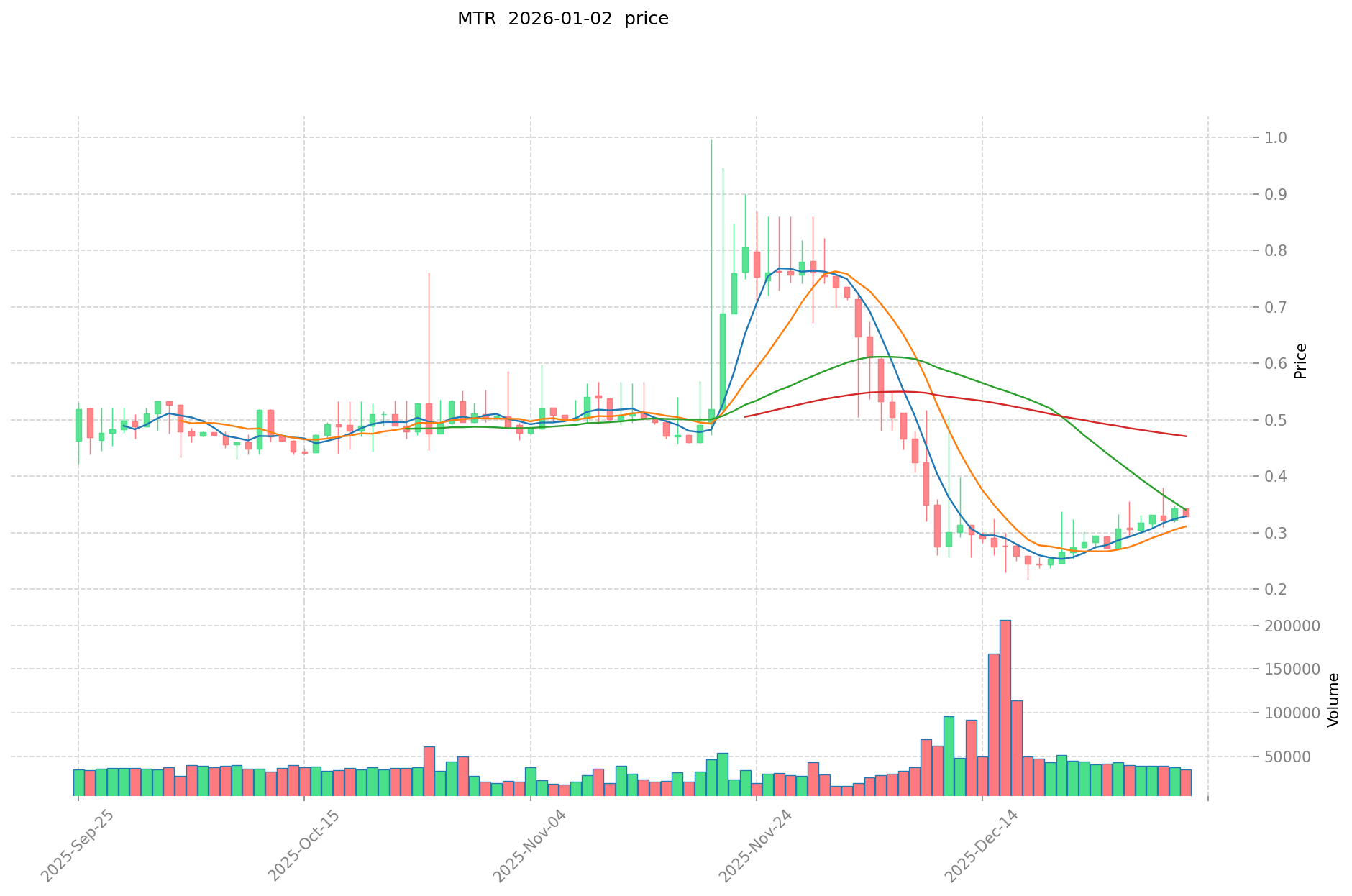
MTR is a significant asset in the cryptocurrency sector, operating as a low-volatility token generated through SHA256 mining within the Meter system. As of January 2, 2026, MTR maintains a market capitalization of approximately $128,954.55, with a circulating supply of 391,721 tokens at a current price of $0.3292. The token's unique mechanism—where an average of 10 kilowatt-hours of electricity consumption using mainstream Bitcoin mining hardware generates one MTR token—distinguishes it within the digital asset landscape. With MTR serving as the transaction fee and gas payment mechanism within the Meter ecosystem and offering future convertibility to Meter's governance token MTRG through on-chain bidding, the token has become a focal point in discussions regarding decentralized infrastructure investments. This article provides a comprehensive analysis of MTR's investment value, historical price movements, future price forecasts, and associated investment risks to inform investment decision-making.
MeterStable (MTR) Cryptocurrency Research Report
I. Price History Review and Current Investment Status of MTR
Historical Price Trends and Investment Returns
Based on available market data as of January 2, 2026:
- All-Time High (ATH): $32.69 reached on April 11, 2021 → Representing the peak valuation period in the project's early cycle
- All-Time Low (ATL): $0.181504 reached on February 3, 2025 → Marking a significant market correction phase
- Long-term Performance: From ATH to current levels represents an approximately -99.0% decline over the ~5-year period
Current MTR Market Status (January 2, 2026)
| Metric |
Value |
| Current Price |
$0.3292 |
| 24-Hour Change |
+0.03% |
| 7-Day Change |
+14.97% |
| 30-Day Change |
-52.98% |
| 1-Year Change |
-46.93% |
| Market Capitalization |
$128,954.55 |
| Circulating Supply |
391,721 MTR |
| Total Supply |
391,721 MTR |
| 24-Hour Trading Volume |
$11,861.72 |
| Market Dominance |
0.0000040% |
For real-time MTR market data, visit Gate MTR Price
II. Project Overview and Technical Specifications
Core Functionality
MTR is a low-volatility token generated through SHA256 mining within the Meter ecosystem. Key characteristics include:
- Mining Mechanism: One MTR token is produced by Bitcoin mainstream mining equipment consuming approximately 10 kilowatt-hours of electricity on average
- Transaction Role: MTR serves as the payment medium for all transaction fees and gas consumption within the Meter system
- Future Utility: MTR can be exchanged for MTRG (Meter's governance token) through on-chain competitive bidding mechanisms
- Supply Model: No pre-mining; unlimited total supply with production incentivized only when profitable relative to Bitcoin mining
Economic Model
The token supply remains uncapped, with miners producing MTR only when profitability conditions are favorable compared to Bitcoin mining alternatives. This creates a supply dynamic where production aligns with market economic conditions rather than following a predetermined schedule.
Trading Metrics
Volatility and Price Range (24-Hour)
- High: $0.3298
- Low: $0.3291
- 1-Hour Change: -0.18%
The extremely narrow trading range indicates minimal daily price volatility, consistent with the project's low-volatility token design philosophy.
IV. Key Observations
Positive Indicators
- Recent Recovery: 7-day positive performance of +14.97% suggests potential stabilization after deeper corrections
- Utility Integration: Clear functional role within the Meter ecosystem for transaction settlement
- No Pre-mining: Fair launch model without early allocator advantages
Risk Considerations
- Severe Long-term Decline: 99%+ drawdown from all-time high indicates significant historical investor losses
- Minimal Market Adoption: Market cap of ~$129,000 reflects limited ecosystem scale
- Low Trading Liquidity: $11,861.72 daily volume indicates limited trading depth and potential slippage risks
- 30-Day Negative Performance: -52.98% monthly decline demonstrates ongoing market pressure
V. Conclusion
MeterStable (MTR) represents a niche cryptocurrency with clearly defined technical utility within the Meter blockchain ecosystem. The token's current market position reflects minimal adoption relative to its historical valuation peaks. The project maintains active blockchain infrastructure as evidenced by an operational block explorer and website.
Investors should note that the significant historical decline and low market capitalization suggest this asset remains in an early or challenging adoption phase. The unlimited supply model creates potential for indefinite token dilution depending on mining incentive economics.
Report Date: January 2, 2026
Data Source: Gate Cryptocurrency Market Data
Disclaimer: This report presents factual market data and project specifications. It does not constitute investment advice or recommendations.
MeterStable (MTR) Investment Analysis Report
Report Date: January 2, 2026
I. Executive Summary
MeterStable (MTR) is a low-volatility token generated through SHA256 mining within the Meter ecosystem. As of January 2, 2026, MTR trades at $0.3292 with a market capitalization of $128,954.55. The token has experienced significant price depreciation over the past year (-46.93%), with mixed market sentiment regarding its investment potential. Current technical indicators suggest a bearish trend, though certain forecasts project potential recovery in the coming period.
II. Core Factors Affecting MTR as an Investment
I. Supply Mechanism and Scarcity (MTR Investment Scarcity)
MTR employs a unique mining-based supply mechanism with the following characteristics:
- Mining Process: MTR is generated through SHA256 mining using Bitcoin mainstream mining hardware, with approximately one MTR token produced per 10 kilowatt-hours of electricity consumed
- Supply Dynamics: Meter has no pre-mining and features unlimited total supply. Miners only produce MTR tokens when profitable compared to Bitcoin mining
- Economic Incentive Model: The supply is directly linked to Bitcoin mining profitability, creating a market-driven production mechanism rather than a fixed supply schedule
- Current Metrics:
- Circulating Supply: 391,721 MTR
- Total Supply: 391,721 MTR
- Maximum Supply: Unlimited
The unlimited supply cap distinguishes MTR from conventional scarce assets, potentially affecting its long-term value proposition for investors seeking scarcity-based appreciation.
II. Utility and Ecosystem Function
MTR serves critical functions within the Meter ecosystem:
- Transaction Fees: MTR pays all transaction fees and gas costs within the Meter system
- Future Conversion: MTR can be exchanged for MTRG (Meter Governance token) through on-chain bidding mechanisms
- Low Volatility Positioning: Designed as a low-volatility token to support stable payment and transaction functionality
III. Macroeconomic Environment Impact on MTR Investment
The broader cryptocurrency and economic environment influences MTR's investment attractiveness:
- Market Sentiment: Current technical analysis indicates a "strongly bearish" trend in short-term charts
- Volatility Metrics:
- 1-hour change: -0.18%
- 24-hour change: +0.03%
- 7-day change: +14.97%
- 30-day change: -52.98%
- 1-year change: -46.93%
The significant 30-day and 1-year declines reflect challenging market conditions for the token, though the 7-day positive change suggests potential volatility and trading opportunities.
Historical Price Levels
| Metric |
Value |
Date |
| All-Time High |
$32.69 |
April 11, 2021 |
| All-Time Low |
$0.181504 |
February 3, 2025 |
| Current Price |
$0.3292 |
January 2, 2026 |
| 24-Hour High |
$0.3298 |
- |
| 24-Hour Low |
$0.3291 |
- |
Market Position
- Market Rank: 4,607
- Market Capitalization: $128,954.55
- Market Dominance: 0.000004%
- 24-Hour Trading Volume: $11,861.72
- Circulating Supply Ratio: 100%
The token currently trades significantly below its historical peak, reflecting substantial depreciation since 2021.
IV. Investment Outlook and Forecasts
Market analysis presents conflicting perspectives on MTR's investment potential:
Bullish Scenarios
- Price forecasts range from $0.816905 to $1.246855, suggesting potential recovery upside of approximately 150-280% from current levels
Bearish Scenarios
- Multiple pessimistic forecasts predict decline to $0.2351 (WalletInvestor) and lower levels
- Technical analysis indicates "strongly bearish" signals on short-term charts
- Market sentiment shows weakness with predictions of continued underperformance in the near term
V. Risk Considerations
- Unlimited Supply: The absence of a maximum supply cap creates ongoing dilution risk as new tokens are mined based on profitability
- Price Volatility: Despite being marketed as "low volatility," MTR has experienced significant price swings, with -46.93% annual decline
- Market Capitalization Decline: Sharp depreciation from historical highs indicates reduced market confidence
- Technical Bearishness: Current technical indicators suggest continued downward pressure
- Liquidity Concerns: Relatively low 24-hour trading volume of $11,861.72 may limit entry and exit flexibility
Disclaimer: This report is provided for informational purposes only and does not constitute investment advice. Cryptocurrency investments carry significant risks, and potential investors should conduct thorough due diligence and consult with qualified financial advisors before making investment decisions.
III. MTR Future Investment Prediction and Price Outlook
Short-term Investment Prediction (2026, short-term MTR investment outlook)
- Conservative forecast: $0.2506 - $0.3010
- Neutral forecast: $0.3010 - $0.3430
- Optimistic forecast: $0.3430 - $0.3900
Mid-term Investment Outlook (2027-2029, mid-term MeterStable(MTR) investment forecast)
- Market phase expectation: MTR is expected to enter a gradual recovery phase with moderate volatility as the Meter ecosystem matures and mining economics stabilize relative to Bitcoin profitability dynamics.
- Investment return forecast:
- 2027: $0.2018 - $0.3936
- 2028: $0.2993 - $0.4708
- 2029: $0.3887 - $0.4806
- Key catalysts: Expansion of Meter ecosystem adoption, increased utility of MTR for transaction fees and gas, development of efficient conversion mechanisms to governance token MTRG, and mining profitability relative to Bitcoin.
Long-term Investment Outlook (Is MeterStable a good long-term investment?)
- Base scenario: $0.3865 - $0.4706 (2031, assuming steady ecosystem growth and stable mining operations comparable to Bitcoin economics)
- Optimistic scenario: $0.4942 - $0.5095 (2031, assuming accelerated DeFi adoption and increased institutional participation in Meter protocol)
- Risk scenario: $0.2594 - $0.3500 (2031, assuming reduced mining profitability or competition from alternative low-volatility tokens)
Click to view MTR long-term investment and price forecast: Price Prediction
2026-01-02 to 2031 Long-term Outlook
- Base scenario: $0.2594 - $0.4706 USD (corresponding to steady ecosystem development and stable mining economics relative to Bitcoin)
- Optimistic scenario: $0.3887 - $0.5095 USD (corresponding to significant Meter ecosystem expansion and favorable market conditions)
- Transformative scenario: $0.5095 USD and above (if breakthrough progress is achieved in ecosystem development and mainstream adoption accelerates)
- 2031-12-31 predicted high: $0.5095 USD (based on optimistic development assumptions)
Disclaimer: This analysis is based on historical data and available forecasts for informational purposes only and should not be considered as investment advice.
| 年份 |
预测最高价 |
预测平均价格 |
预测最低价 |
涨跌幅 |
| 2026 |
0.342992 |
0.3298 |
0.250648 |
0 |
| 2027 |
0.39358332 |
0.336396 |
0.2018376 |
2 |
| 2028 |
0.4708366614 |
0.36498966 |
0.2992915212 |
10 |
| 2029 |
0.480600134805 |
0.4179131607 |
0.388659239451 |
26 |
| 2030 |
0.49418231252775 |
0.4492566477525 |
0.40433098297725 |
36 |
| 2031 |
0.509457038551335 |
0.471719480140125 |
0.259445714077068 |
43 |
MeterStable (MTR) Investment Analysis Report
I. Project Overview
MeterStable (MTR) is a low-volatility token generated through SHA256 mining within the Meter system. According to project specifications, one MTR token can be produced by Bitcoin mainstream mining equipment consuming an average of 10 kilowatt-hours of electricity.
Core Functionality
- Transaction Fees and Gas: MTR serves as the primary payment mechanism for all transaction fees and gas within the Meter ecosystem
- Future Governance Conversion: MTR can potentially be exchanged for Meter's governance token (MTRG) through on-chain bidding mechanisms
- Mining Model: The Meter system implements a zero pre-mining model with unlimited total supply, with miners producing MTR tokens only when operations remain profitable compared to Bitcoin mining
Current Market Data (as of January 2, 2026)
| Metric |
Value |
| Current Price |
$0.3292 |
| 24H Volume |
$11,861.72 |
| Market Capitalization |
$128,954.55 |
| Circulating Supply |
391,721 MTR |
| Total Supply |
391,721 MTR |
| Market Ranking |
#4607 |
| Market Dominance |
0.0000040% |
Historical Price Movement
| Period |
Change |
Price Change |
| 1 Hour |
-0.18% |
-$0.000594 |
| 24 Hours |
+0.03% |
+$0.000099 |
| 7 Days |
+14.97% |
+$0.042864 |
| 30 Days |
-52.98% |
-$0.370928 |
| 1 Year |
-46.93% |
-$0.291113 |
All-Time Price Metrics
- All-Time High: $32.69 (April 11, 2021)
- All-Time Low: $0.181504 (February 3, 2025)
- Current Price vs. ATH: -98.99% decline
- Current Price vs. ATL: +81.36% recovery
Analysis: MTR has experienced severe price depreciation from its peak, with the token trading at less than 1% of its historical high. The 7-day recovery of 14.97% suggests potential stabilization, though the 52.98% decline over 30 days indicates continued downward pressure.
III. Investment Strategy and Risk Management
Investment Methodologies
- Long-term Holding (HODL MTR): Suitable for conservative investors seeking exposure to SHA256-based mining economies and the Meter ecosystem's development
- Active Trading: Dependent on technical analysis and short-term price volatility—the extreme price depreciation and current recovery signals create opportunities for tactical positioning
Risk Management Framework
IV. Investment Risks and Challenges
Market Risks
- Extreme Volatility: 98.99% decline from ATH demonstrates severe price instability; potential for further downside or rapid recoveries
- Low Liquidity: Daily volume of $11,861.72 relative to market cap presents liquidity constraints for large positions
- Price Discovery Challenges: Limited exchange availability (1 exchange) restricts efficient price discovery
Regulatory Risks
- Proof-of-Work Mining Scrutiny: Regulatory frameworks in various jurisdictions continue to evaluate energy-intensive mining activities
- Policy Uncertainty: Changing cryptocurrency regulations across jurisdictions could impact mining profitability and token utility
Technical Risks
- Network Security: SHA256 mining system dependence on Bitcoin mining infrastructure security
- Ecosystem Development: Successful implementation of MTRG conversion mechanisms remains contingent on protocol upgrades
Fundamental Risks
- Mining Economics: Token production directly dependent on Bitcoin profitability; sustained Bitcoin weakness could eliminate MTR production incentives
- Adoption Risk: Limited market penetration and exchange presence constrains ecosystem development
V. Conclusion: Is MeterStable (MTR) a Good Investment?
Investment Value Summary
MTR presents a specialized investment thesis centered on SHA256 mining economics and the Meter ecosystem's potential development. However, the token's 99% decline from peak valuations, combined with minimal market capitalization rank and liquidity constraints, indicates significant challenges to mainstream adoption. The unlimited supply model introduces perpetual inflationary pressure absent in capped-supply alternatives.
Investment Recommendations
✅ Retail Investors:
- Dollar-cost averaging strategies with strict position sizing (under 1% portfolio allocation)
- Secure storage via hardware wallets for any accumulated positions
✅ Experienced Traders:
- Technical analysis-based swing trading around documented support/resistance levels
- Portfolio hedging against downside risk given extreme volatility profile
✅ Institutional Investors:
- Strategic long-term positioning only after comprehensive due diligence on Meter ecosystem fundamentals
- Emphasis on energy economics analysis and mining profitability modeling
⚠️ Critical Disclaimer: Cryptocurrency investments carry substantial risk, including potential total capital loss. MTR's extreme price volatility, minimal market presence, and technical complexity create elevated risk profiles unsuitable for risk-averse investors. This analysis is provided for informational purposes only and does not constitute investment advice, financial recommendation, or endorsement. Investors must conduct independent research and consult qualified financial advisors before any investment decision.
Report Generated: January 2, 2026
Data Source: Gate Data / Official Meter.io Resources
MeterStable (MTR) Frequently Asked Questions (FAQ)
I. What is MeterStable (MTR) and how does its mining mechanism work?
Answer: MeterStable (MTR) is a low-volatility token generated through SHA256 mining within the Meter ecosystem. The token is produced by Bitcoin mainstream mining equipment consuming an average of 10 kilowatt-hours of electricity per token generated. Unlike traditional cryptocurrencies with fixed supply schedules, MTR features unlimited total supply with miners producing tokens only when operations remain profitable compared to Bitcoin mining. This creates a market-driven production mechanism directly linked to Bitcoin mining economics.
II. What is the current market status of MTR as of January 2, 2026?
Answer: As of January 2, 2026, MTR trades at $0.3292 with the following metrics: market capitalization of $128,954.55, circulating supply of 391,721 tokens, 24-hour trading volume of $11,861.72, and market ranking of #4,607. The token has experienced significant historical depreciation, trading 98.99% below its all-time high of $32.69 (April 11, 2021) but has recovered 81.36% from its all-time low of $0.181504 (February 3, 2025). Short-term performance shows mixed signals with a 7-day gain of 14.97% offset by a 30-day decline of 52.98%.
III. What are the primary use cases and utility of MTR within the Meter ecosystem?
Answer: MTR serves three primary functions within the Meter ecosystem: (1) Transaction Fee Payment—MTR is used to pay all transaction fees and gas costs within the Meter system; (2) Governance Conversion—MTR can be exchanged for Meter's governance token (MTRG) through on-chain bidding mechanisms, providing future utility expansion; (3) Low-Volatility Settlement—MTR is designed as a stable payment medium to support reliable transaction functionality and ecosystem stability.
IV. What price forecasts and investment outlooks exist for MTR through 2031?
Answer: Price forecasts present multiple scenarios: Short-term (2026) neutral forecast ranges from $0.3010 to $0.3430; Mid-term (2027-2029) predicts gradual recovery with 2029 forecasts between $0.3887-$0.4806; Long-term (2031) base scenario projects $0.3865-$0.4706, optimistic scenario $0.4942-$0.5095, and risk scenario $0.2594-$0.3500. These forecasts depend on Meter ecosystem adoption acceleration, mining profitability relative to Bitcoin, and successful implementation of ecosystem features. However, forecasts carry significant uncertainty and should not serve as investment guarantees.
V. What are the major investment risks associated with holding MTR?
Answer: Key investment risks include: (1) Extreme Volatility—98.99% historical decline from peak demonstrates severe price instability; (2) Unlimited Supply—no maximum supply cap creates perpetual inflationary pressure through mining-based token generation; (3) Low Liquidity—$11,861.72 daily trading volume relative to market capitalization constrains large position entry/exit; (4) Mining Economics Dependency—token production depends on Bitcoin profitability; sustained weakness could eliminate production incentives; (5) Limited Market Adoption—rank #4,607 and 0.000004% market dominance reflect minimal ecosystem penetration; (6) Regulatory Uncertainty—energy-intensive mining faces ongoing scrutiny across jurisdictions.
VI. What investment strategies and position sizing are recommended for MTR?
Answer: Recommended strategies vary by investor type: (1) Conservative Investors—dollar-cost averaging with strict allocation limits under 1% of portfolio; (2) Experienced Traders—technical analysis-based swing trading around support/resistance levels with portfolio hedging; (3) Institutional Investors—strategic long-term positioning only after comprehensive due diligence on mining economics and ecosystem fundamentals. Position sizing should reflect risk tolerance, with conservative portfolios allocating 0-1%, moderate portfolios 1-3%, and professional strategies 3-5% maximum. All positions should include stop-loss discipline and secure storage via hardware wallets for extended holdings.
VII. How does the unlimited supply mechanism affect MTR's long-term value proposition compared to capped-supply cryptocurrencies?
Answer: The unlimited supply model fundamentally differentiates MTR from capped-supply cryptocurrencies like Bitcoin. While capped supplies create scarcity-based value appreciation potential, MTR's unlimited supply introduces perpetual inflationary pressure proportional to mining profitability. New tokens enter circulation whenever Bitcoin mining remains profitable, creating ongoing dilution independent of market demand. This mechanism aligns token production with energy economics rather than investor scarcity expectations, making MTR more suitable for stable transaction functionality than appreciation-focused investment strategies. The unlimited supply creates indefinite dilution potential, reducing MTR's comparative advantage for long-term value preservation against deflationary or fixed-supply alternatives.
VIII. What security and storage considerations should investors implement for MTR holdings?
Answer: Security recommendations include: (1) Cold Storage—hardware wallets for long-term positions to protect against exchange hacking or platform failures; (2) Hot Wallets—limit amounts to active trading quantities only, minimizing exposure in internet-connected wallets; (3) Official Channels—access MTR exclusively through legitimate Meter ecosystem interfaces and verified exchanges (currently Gate and one additional exchange); (4) Private Key Management—maintain sole custody of private keys and backup recovery phrases in secure locations; (5) Network Security—verify official resources via https://www.meter.io/ and block explorer https://scan.meter.io/ before transaction execution; (6) Due Diligence—confirm wallet compatibility and smart contract interaction security before transferring significant amounts to minimize protocol-level vulnerabilities.
Report Generated: January 2, 2026
Disclaimer: This FAQ provides informational content only and does not constitute investment advice or financial recommendations. Cryptocurrency investments carry substantial risk including potential total capital loss. Investors must conduct independent research and consult qualified financial advisors before investment decisions.
* The information is not intended to be and does not constitute financial advice or any other recommendation of any sort offered or endorsed by Gate.