MetFi DAO (METFI) is a decentralized autonomous organization operating as a community-driven investment vehicle focused on early-stage Web3 and Metaverse project incubation. As of January 2026, METFI trades at $0.05455 with a market capitalization of $15.13 million, representing an 88.6% decline over the past year from its peak of $3.48. This comprehensive analysis examines METFI's tokenomics with 277.31 million tokens in circulation from a maximum supply of 500 million, security credentials including CertiK audit recognition, and two-year liquidity lock mechanisms. The article evaluates investment potential through price forecasts ranging from $0.03 to $0.1178 through 2031, risk management strategies for different investor profiles, and key risks including market volatility, regulatory uncertainty, and early-stage portfolio dependencies. Investors can access real-time METFI market data and price tracking on Gate, with recommendations tailored to conservative, aggressive, and institutional investor categories
Introduction: MetFi DAO (METFI) Investment Position and Market Outlook
METFI is a notable asset in the cryptocurrency sector, operating as a decentralized investment vehicle focused on Web3 and Metaverse project incubation. As of January 24, 2026, MetFi DAO holds a market capitalization of approximately $15.13 million, with a circulating supply of around 277.31 million tokens and a current trading price near $0.05455. Positioned as a community-driven DAO ecosystem that provides early-stage access to Web3 startups, METFI has garnered attention among investors exploring "Is MetFi DAO (METFI) a good investment?" This article provides a comprehensive analysis of METFI's investment characteristics, historical performance, future price considerations, and associated risks to serve as a reference for potential investors.
I. METFI Price History Review and Current Investment Value Status
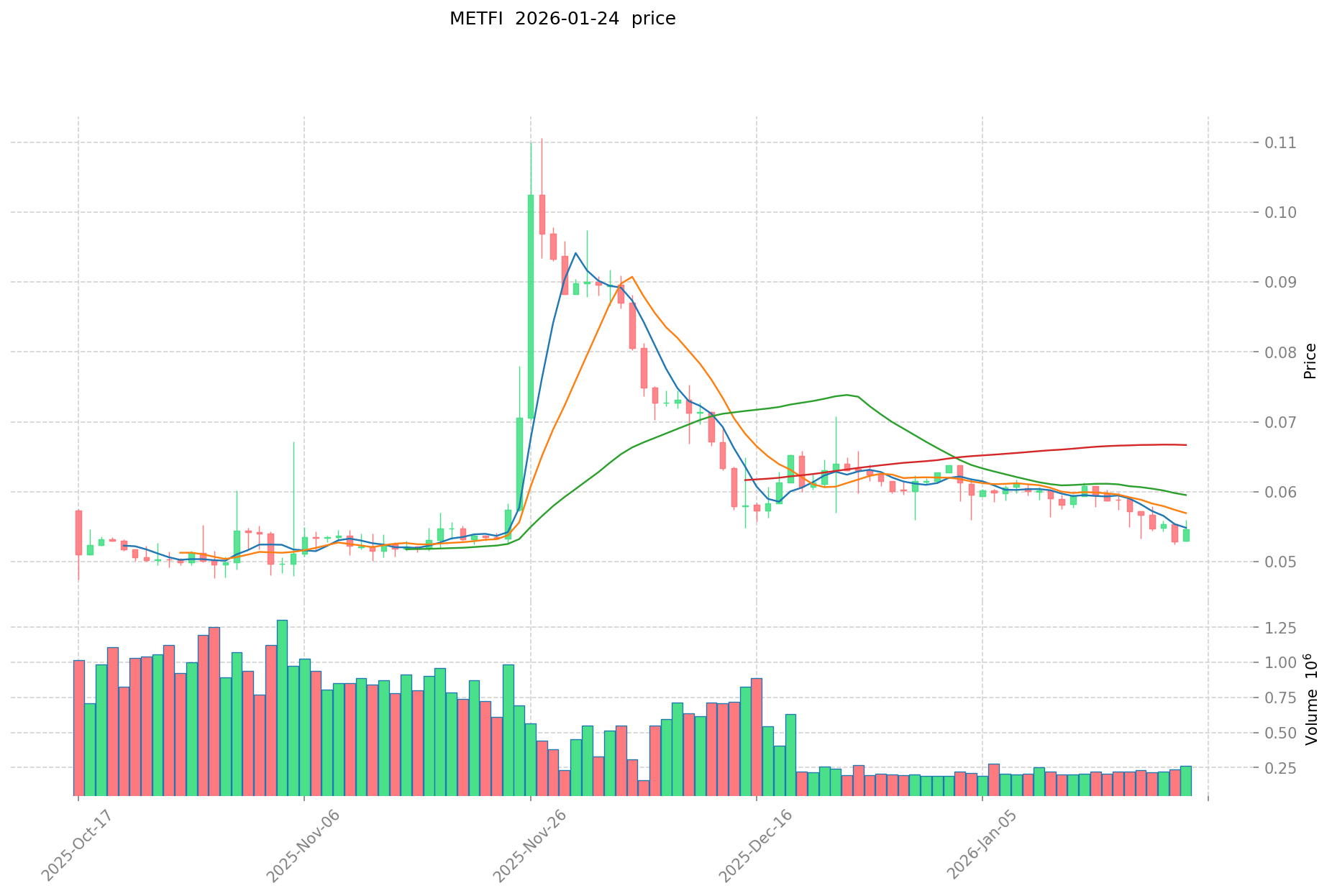
Based on available data, METFI experienced significant price volatility since its launch. The token reached a notable price level of $3.48 in May 2023, representing a period of heightened market interest. However, the asset subsequently underwent a substantial correction, declining to $0.04744 by October 2025, reflecting broader market pressures and sector-wide adjustments.
As of January 2026, METFI trades at $0.05455, showing modest recovery from recent lows. Over the past year, the token has declined approximately 88.6%, while shorter-term movements show a 1.6% increase over 24 hours and a 7.13% decrease over 7 days.
Current METFI Investment Market Status (January 2026)
- METFI Current Price: $0.05455
- 24-Hour Trading Volume: $13,091.65
- Market Capitalization: $15,127,296.91
- Circulating Supply: 277,310,667.53 METFI (55.46% of max supply)
- Fully Diluted Valuation: $24,560,854.44
- Total Holders: 19,307
- Price Range (24H): $0.05359 - $0.05596
Click to view real-time METFI market price
II. Core Factors Influencing Whether METFI is a Good Investment (Is MetFi DAO(METFI) a Good Investment)
Supply Mechanism and Scarcity (METFI investment scarcity)
- Maximum Supply and Circulation → Impact on Price and Investment Value
- MetFi DAO has a max supply of 500,000,000 METFI tokens, with approximately 277,310,667.53 tokens currently in circulation, representing a circulating ratio of around 55.46%.
- Investment Significance: The limited supply mechanism may contribute to scarcity considerations for long-term investment evaluation.
Institutional Investment and Mainstream Adoption (Institutional investment in METFI)
- Security and Compliance Recognition: MetFi DAO has been audited by Certik, one of the leading blockchain security auditors, and is ranked in the top 5% of projects on their platform.
- Liquidity Lock Mechanism: MetFi has locked its liquidity for 2 years through Team Finance, which provides a degree of transparency and reduces certain operational risks.
- Community-Driven Investment Model: MetFi DAO positions itself as a decentralized investment tool, allowing community members to access early-stage Web3 and Metaverse startups, with 100% of investment assets owned and distributed by the MetFi community.
Macroeconomic Environment Impact on METFI Investment
- Market Performance Context: As of January 24, 2026, METFI is trading at $0.05455, showing a 1.6% increase over 24 hours but experiencing a -7.13% decline over 7 days and -15.04% over 30 days.
- Volatility Profile: METFI has experienced notable price fluctuations, with its current price substantially below its historical reference point of $3.48 recorded on May 9, 2023.
- Market Conditions: The token's performance reflects broader market dynamics affecting smaller-cap crypto assets, with total market capitalization around $15.13 million and relatively modest 24-hour trading volume of approximately $13,091.65.
Technology and Ecosystem Development (Technology & Ecosystem for METFI investment)
- DeFi Utility NFT Ecosystem: MetFi describes itself as a DeFi utility NFT ecosystem focused on investing and incubating Metaverse and Web3 projects.
- Liquidity Control: MetFi DAO maintains control over its own liquidity, which may provide flexibility to adapt to market conditions and pursue investment opportunities.
- Web3 and Metaverse Focus: The project aims to function as an incubator for Metaverse and Web3 startups, positioning itself within emerging technology sectors.
- Holder Base: The token has approximately 19,307 holders, indicating a distributed ownership structure.
- Technical Infrastructure: METFI operates on the BSC (Binance Smart Chain) network with contract address 0x3e7f1039896454b9cb27c53cc7383e1ab9d9512a.
III. METFI Future Investment Forecast and Price Outlook (Is MetFi DAO(METFI) worth investing in 2026-2031)
Short-term Investment Forecast (2026, short-term METFI investment outlook)
- Conservative estimate: $0.0300025 - $0.05455
- Neutral estimate: $0.05455 - $0.06507
- Optimistic estimate: $0.06507 - $0.0758245
Mid-term Investment Outlook (2027-2029, mid-term MetFi DAO(METFI) investment forecast)
- Market stage expectation: MetFi DAO may experience gradual development during the mid-term period, with potential fluctuations reflecting evolving market conditions and ecosystem developments.
- Investment return forecast:
- 2027: $0.04432733 - $0.0866990425
- 2028: $0.044047024825 - $0.0873346181875
- 2029: $0.0457177740425 - $0.102864991595625
- Key catalysts: Ecosystem expansion, strategic partnerships, DeFi and Web3 investment performance, community engagement, and overall cryptocurrency market sentiment.
Long-term Investment Outlook (Is METFI a good long-term investment?)
- Base scenario: $0.052555928456024 - $0.092251936907187 (assuming steady platform development and maintained community participation)
- Optimistic scenario: $0.092251936907187 - $0.11776421005887 (assuming successful Web3 and Metaverse investment portfolio growth and increased adoption)
- Risk scenario: $0.0300025 - $0.052555928456024 (considering market downturns or challenges in ecosystem expansion)
View METFI long-term investment and price forecast: Price Prediction
2026-01-24 - 2031 Long-term Outlook
- Base scenario: $0.052555928456024 - $0.092251936907187 (corresponding to steady progress and gradual mainstream application growth)
- Optimistic scenario: $0.092251936907187 - $0.11776421005887 (corresponding to large-scale adoption and favorable market conditions)
- Transformational scenario: Above $0.11776421005887 (in case of breakthrough ecosystem developments and mainstream popularization)
- 2031-12-31 predicted high: $0.11776421005887 (based on optimistic development assumptions)
Disclaimer
| Year |
Predicted High Price |
Predicted Average Price |
Predicted Low Price |
Price Change |
| 2026 |
0.0758245 |
0.05455 |
0.0300025 |
0 |
| 2027 |
0.0866990425 |
0.06518725 |
0.04432733 |
19 |
| 2028 |
0.0873346181875 |
0.07594314625 |
0.044047024825 |
39 |
| 2029 |
0.102864991595625 |
0.08163888221875 |
0.0457177740425 |
49 |
| 2030 |
0.102399649966978 |
0.092251936907187 |
0.071033991418534 |
69 |
| 2031 |
0.11776421005887 |
0.097325793437082 |
0.052555928456024 |
78 |
IV. METFI Investment Strategy and Risk Management (How to invest in MetFi DAO)
Investment Strategy (METFI investment strategy)
Long-term Holding (HODL METFI)
For conservative investors, a long-term holding approach may be considered, given MetFi DAO's focus on early-stage Web3 and Metaverse project investments. The platform's locked liquidity mechanism and community-driven asset distribution model could provide a foundation for patient capital allocation. However, investors should carefully evaluate the project's execution capabilities and market positioning before committing to extended holding periods.
Active Trading
Traders employing technical analysis may monitor METFI's price movements, noting recent volatility patterns: +0.18% (1H), +1.6% (24H), -7.13% (7D), and -15.04% (30D). The 24-hour trading range between $0.05359 and $0.05596 suggests opportunities for short-term position management, though market depth considerations remain important given the relatively modest 24-hour trading volume of approximately $13,091.
Risk Management (Risk management for METFI investment)
Asset Allocation Ratios
- Conservative Investors: Consider allocating no more than 1-3% of crypto portfolio to METFI, given its mid-tier market ranking (#1005) and significant price decline of -88.6% over the past year.
- Aggressive Investors: May allocate 5-10% while maintaining strict stop-loss disciplines and portfolio rebalancing protocols.
- Professional Investors: Should conduct thorough due diligence on MetFi DAO's investment portfolio and governance mechanisms before determining appropriate exposure levels.
Risk Hedging Solutions
- Diversify across multiple DeFi and DAO tokens to reduce single-project concentration risk
- Consider pairing METFI positions with stablecoin holdings or established cryptocurrencies
- Monitor the project's investment performance and community governance decisions regularly
Secure Storage
- Cold Wallets: Hardware wallets such as Ledger or Trezor are recommended for long-term METFI holdings
- Hot Wallets: For active trading, use reputable wallets with multi-signature capabilities
- BSC Network: METFI operates on the Binance Smart Chain (contract: 0x3e7f1039896454b9cb27c53cc7383e1ab9d9512a), so ensure wallet compatibility with BEP-20 tokens
V. METFI Investment Risks and Challenges (Risks of investing in MetFi DAO)
Market Risks
METFI demonstrates substantial price volatility, with the current price of $0.05455 representing a significant decline from its all-time high of $3.48 recorded on May 9, 2023. The token reached an all-time low of $0.04744 on October 17, 2025, indicating considerable downside pressure. The relatively low 24-hour trading volume suggests limited liquidity, which may amplify price swings during periods of selling or buying pressure.
Regulatory Risks
As a DAO-structured investment platform focused on early-stage Web3 and Metaverse projects, MetFi DAO operates in an evolving regulatory landscape. Different jurisdictions maintain varying approaches to decentralized investment vehicles, tokenized securities, and DAO governance structures. Investors should monitor regulatory developments that may affect DAO operations, token classifications, or cross-border investment activities.
Technical Risks
- Smart Contract Vulnerabilities: While MetFi DAO received recognition from CertiK as a top 5% project, smart contract platforms remain subject to potential security vulnerabilities or unforeseen exploit vectors.
- Liquidity Lock Mechanisms: The project's two-year liquidity lock, while designed to prevent sudden exits, may limit operational flexibility during market stress periods.
- Governance Risks: As a community-driven DAO, decision-making processes depend on token holder participation and may face coordination challenges or governance disputes.
- Portfolio Performance: MetFi DAO's value proposition depends significantly on the success of its underlying Web3 and Metaverse investments, which themselves carry early-stage project risks.
VI. Conclusion: Is MetFi DAO a Good Investment?
Investment Value Summary
METFI presents as a specialized DeFi platform targeting early-stage Web3 and Metaverse project investments through a DAO structure. With a market capitalization of approximately $15.13 million and a circulating supply representing 55.46% of maximum supply, the token maintains a modest market presence (ranking #1005). The significant year-over-year price decline of -88.6% reflects substantial market challenges, while the project's liquidity lock mechanism and community-focused asset distribution model represent structural risk mitigation features.
Investor Recommendations
✅ Beginners: Consider starting with small allocations and utilizing secure hardware wallets for storage. Regularly review the project's governance updates and investment portfolio performance before increasing exposure.
✅ Experienced Investors: May employ tactical trading strategies around technical support and resistance levels while maintaining disciplined position sizing. Evaluate MetFi DAO's investment portfolio quality and community governance effectiveness as key performance indicators.
✅ Institutional Investors: Should conduct comprehensive due diligence on the DAO's legal structure, investment track record, and governance mechanisms. Consider METFI as a potential satellite position within broader Web3 and DAO-focused portfolio strategies, rather than a core holding.
⚠️ Disclaimer: Cryptocurrency investments carry substantial risks, including potential total loss of capital. This content is provided for informational purposes only and does not constitute investment advice, financial guidance, or recommendations to buy or sell any digital assets. Investors should conduct independent research and consult qualified financial advisors before making investment decisions.
VII. FAQ
Q1: What is MetFi DAO (METFI) and how does its investment model work?
MetFi DAO (METFI) is a decentralized autonomous organization (DAO) that functions as a community-driven investment vehicle focused on incubating and investing in early-stage Web3 and Metaverse projects. The platform operates as a DeFi utility NFT ecosystem where 100% of investment assets are owned and distributed by the MetFi community. With a maximum supply of 500 million tokens and approximately 277.31 million in circulation as of January 2026, METFI token holders participate in governance decisions and benefit from the DAO's investment portfolio performance. The project has implemented a two-year liquidity lock through Team Finance and operates on the Binance Smart Chain (BSC) network.
Q2: Has METFI experienced significant price volatility, and what was its historical price performance?
Yes, METFI has demonstrated substantial price volatility since its launch. The token reached a notable peak of $3.48 on May 9, 2023, representing a period of significant market interest. However, it subsequently underwent a severe correction, declining to an all-time low of $0.04744 on October 17, 2025. As of January 24, 2026, METFI trades at approximately $0.05455, reflecting an 88.6% decline over the past year. Short-term movements show mixed performance with a 1.6% increase over 24 hours but a 7.13% decline over 7 days, indicating ongoing volatility that investors should carefully consider.
Q3: What are the main investment risks associated with METFI?
METFI presents several key investment risks: First, market risk is significant, with the current price representing a substantial decline from its all-time high and relatively low 24-hour trading volume of approximately $13,091, indicating limited liquidity. Second, regulatory risk exists as DAO-structured investment platforms operate in an evolving legal landscape across different jurisdictions. Third, technical risks include potential smart contract vulnerabilities despite CertiK audit recognition, liquidity lock limitations during market stress, governance coordination challenges, and dependence on the success of underlying Web3 and Metaverse portfolio investments. These factors collectively contribute to high risk levels that require careful consideration and risk management strategies.
Q4: What are the projected price forecasts for METFI through 2031?
Based on various scenarios, METFI price projections suggest: For 2026, a range between $0.0300025 (conservative) and $0.0758245 (optimistic). Mid-term forecasts for 2027-2029 show gradual potential development with 2027 estimates ranging from $0.04432733 to $0.0866990425, 2028 from $0.044047024825 to $0.0873346181875, and 2029 from $0.0457177740425 to $0.102864991595625. Long-term projections through 2031 suggest a base scenario between $0.052555928456024 and $0.092251936907187, with an optimistic scenario reaching up to $0.11776421005887 by year-end 2031. These projections assume continued ecosystem development, successful portfolio investments, and favorable market conditions.
Q5: What investment strategies are appropriate for different types of METFI investors?
Investment strategies should align with risk tolerance and experience levels: Conservative and beginner investors should consider allocating only 1-3% of their crypto portfolio to METFI, employing a long-term holding (HODL) approach with secure cold wallet storage, while regularly monitoring the project's governance and portfolio performance. Aggressive investors may allocate 5-10% while implementing strict stop-loss disciplines and technical trading strategies based on price movements. Professional and institutional investors should conduct comprehensive due diligence on the DAO's legal structure, investment track record, and governance mechanisms, potentially treating METFI as a satellite position within broader Web3-focused strategies rather than a core holding. All investors should diversify holdings and maintain disciplined risk management protocols.
Q6: How does MetFi DAO's security and compliance compare to other crypto projects?
MetFi DAO has implemented several security and compliance measures that provide certain safeguards: The project has undergone auditing by CertiK, one of the leading blockchain security firms, and is ranked in the top 5% of projects on their platform, indicating a relatively strong security posture. Additionally, MetFi has locked its liquidity for two years through Team Finance, which provides transparency and reduces certain operational risks associated with sudden liquidity withdrawals. The project operates on the Binance Smart Chain with a verified contract address (0x3e7f1039896454b9cb27c53cc7383e1ab9d9512a). However, investors should note that security audits do not eliminate all risks, and the DAO structure still faces evolving regulatory considerations across different jurisdictions.
Q7: What factors should investors monitor when evaluating METFI's investment potential?
Investors should monitor several key factors: First, track the performance of MetFi DAO's underlying Web3 and Metaverse investment portfolio, as the token's value proposition depends significantly on these early-stage projects. Second, observe community governance participation and decision-making effectiveness, which directly impact the DAO's operational success. Third, watch market metrics including trading volume (currently around $13,091 per 24 hours), holder growth (currently 19,307 holders), and price stability patterns. Fourth, monitor ecosystem expansion developments, strategic partnerships, and adoption metrics. Fifth, stay informed about regulatory developments affecting DAO structures and tokenized investment vehicles. Finally, assess broader cryptocurrency market sentiment and conditions, as METFI's performance correlates with overall market trends affecting smaller-cap digital assets.
Q8: Is METFI suitable as a long-term investment, and what are the key considerations?
METFI's suitability as a long-term investment depends on multiple factors and individual risk tolerance. Positive considerations include the project's focus on emerging Web3 and Metaverse sectors, community-driven investment model with 100% asset ownership distribution, locked liquidity mechanism providing operational transparency, and relatively limited supply with 55.46% circulation ratio. However, significant challenges exist: the token has declined 88.6% over the past year, currently trades 98.4% below its all-time high, maintains modest market capitalization around $15.13 million, and demonstrates limited liquidity with low trading volumes. Long-term success depends heavily on the DAO's ability to generate returns from its investment portfolio and attract broader adoption. Conservative investors should limit exposure to 1-3% of crypto holdings, while all investors should maintain realistic expectations and implement strict risk management protocols.
* The information is not intended to be and does not constitute financial advice or any other recommendation of any sort offered or endorsed by Gate.