This comprehensive analysis examines whether mETH Protocol (COOK) represents a viable investment opportunity in the Ethereum staking ecosystem. COOK, launched in late 2024 by Mantle, currently trades at $0.003618 with a $3.47 million market cap. The article evaluates COOK's historical performance (peaked at $0.04584 in November 2024, declined 82.67% year-to-date), core investment factors including limited supply dynamics and institutional backing, and multi-year price forecasts ranging from $0.00262 to $0.00851 through 2031. Key sections cover the token's vertically integrated staking technology, suitable investment strategies for different investor profiles, and critical risks including market volatility, regulatory uncertainty, and technical vulnerabilities. Available on Gate and four other exchanges with limited liquidity, COOK offers long-term potential for DeFi-focused investors, though substantial market risks require careful portfolio allocation and risk management strategies.
Introduction: mETH Protocol (COOK) Investment Status and Market Outlook
COOK is a notable asset in the cryptocurrency space, representing mETH Protocol, which was launched in late 2024 as the first fully vertically integrated staking and restaking protocol built by Mantle. As of January 30, 2026, COOK has a market capitalization of approximately $3.47 million, with a circulating supply of 960 million tokens out of a maximum supply of 5 billion. The current price stands at around $0.003618, reflecting market volatility with a 24-hour trading volume of $11,623.05. Positioned as a protocol that combines simplicity and scalability to enhance capital efficiency while accruing Ethereum staking yields, COOK has attracted attention among investors exploring opportunities in the DeFi staking sector. The token is listed on 5 exchanges and holds approximately 0.00061% market dominance. This article provides a comprehensive analysis of COOK's investment characteristics, historical price movements, future price projections, and associated investment risks to serve as a reference for investors.
I. COOK Price History Review and Current Investment Value Status
- 2024: COOK reached a notable price level of $0.04584 on November 9, 2024 → Price subsequently experienced downward movement
- 2025-2026: Market correction phase → Price declined from higher levels to $0.003588
- Current cycle: Trading near lower price range → COOK shows price fluctuation between $0.003588 and $0.00372 in recent period
Current COOK Investment Market Status (January 2026)
- COOK current price: $0.003618
- 24-hour trading volume: $11,623.05
- Price changes: -0.27% (1H), -2.61% (24H), -3.50% (7D), -5.89% (30D)
- Market capitalization: $3,473,280
Click to view real-time COOK market price
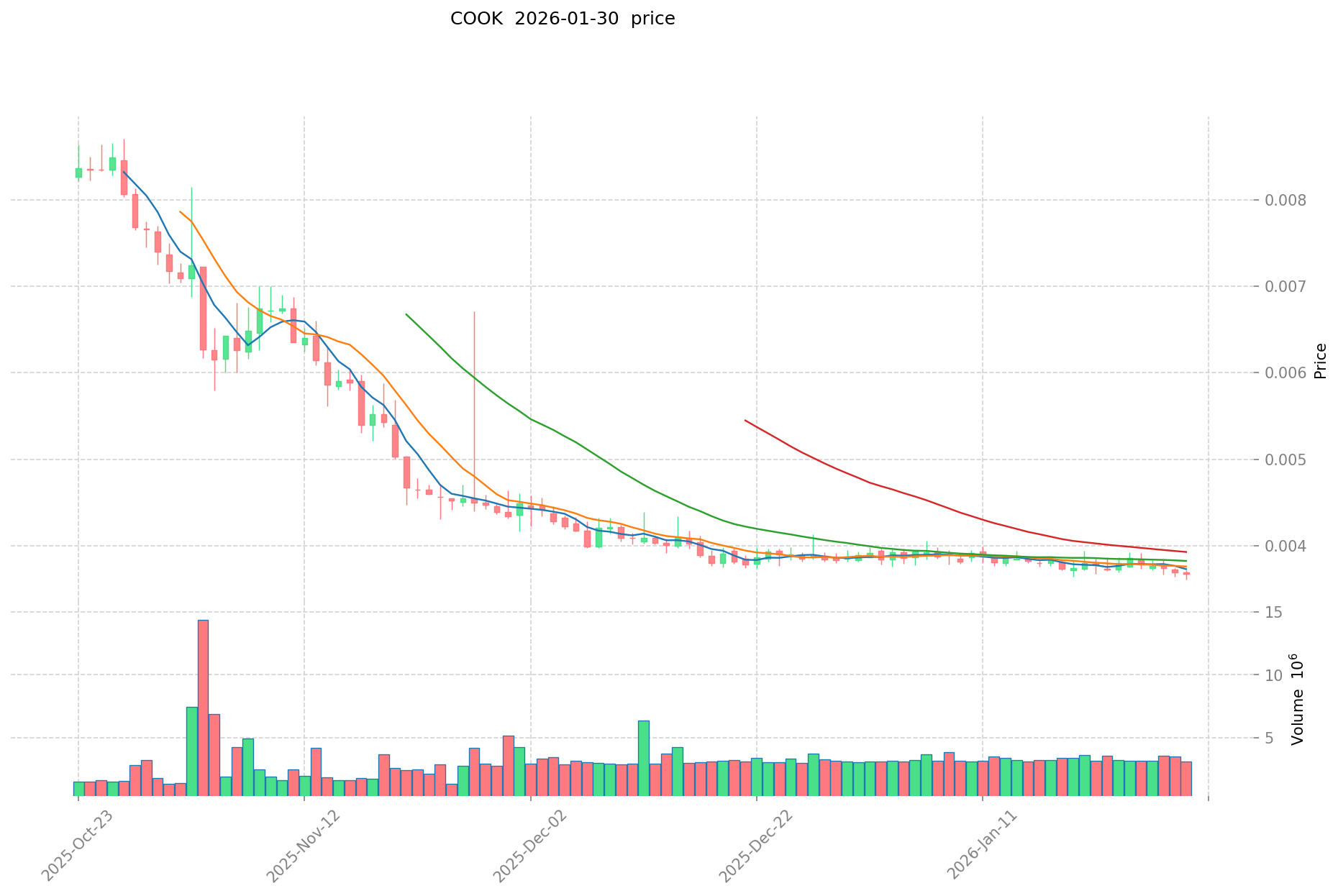
II. Core Factors Affecting Whether COOK is a Good Investment (Is mETH Protocol(COOK) a Good Investment)
Supply Mechanism and Scarcity (COOK investment scarcity)
- mETH Protocol (COOK) has a maximum supply of 5,000,000,000 tokens, with current circulating supply at 960,000,000 tokens, representing approximately 19.2% of total supply → This controlled release mechanism may influence price dynamics and investment value over time
- The token's circulating supply represents less than one-fifth of maximum supply, suggesting substantial tokens remain unreleased → This supply structure requires consideration when evaluating long-term investment positioning
- Investment significance: The supply dynamics and release schedule represent factors investors may consider when assessing the asset's characteristics, though scarcity alone does not determine investment outcomes
Institutional Investment and Mainstream Adoption (Institutional investment in COOK)
- Current holder count stands at 198 addresses as of the latest data → This represents a relatively limited holder base compared to more established digital assets
- The protocol is built by Mantle, providing institutional backing through its association with an established blockchain infrastructure project → This connection to a recognized ecosystem participant may contribute to development resources and technical support
- Trading availability across 5 exchanges indicates initial market access, though mainstream adoption metrics remain in early stages → Market accessibility represents one consideration among multiple factors affecting investment viability
Macroeconomic Environment's Impact on COOK Investment
- As a digital asset operating within the Ethereum staking ecosystem, COOK's investment characteristics may be influenced by broader monetary policy trends affecting risk asset allocation → Changes in interest rate environments historically correlate with capital flows into or out of digital asset markets
- The protocol's positioning within the staking infrastructure sector connects its performance to Ethereum's role in the evolving digital finance landscape → Macroeconomic factors affecting Ethereum adoption may have downstream implications for staking-related protocols
- Market volatility indicators show COOK experienced price movements ranging from -0.27% (1H) to -82.67% (1Y), reflecting sensitivity to both short-term market conditions and longer-term sector trends → These fluctuations occur within broader macroeconomic contexts that affect digital asset valuations
Technology and Ecosystem Development (Technology & Ecosystem for COOK investment)
- mETH Protocol represents a vertically integrated staking and restaking solution designed to combine simplicity with scalability → This architectural approach aims to provide users access to Ethereum staking yields while maintaining capital efficiency
- The protocol operates through contracts deployed on both Ethereum (0x9f0c013016e8656bc256f948cd4b79ab25c7b94d) and Mantle networks → This multi-chain deployment strategy enables participation across different blockchain environments within the Ethereum ecosystem
- Technical documentation available through the Mantle documentation portal provides transparency into protocol mechanisms → Access to technical specifications allows potential participants to evaluate the protocol's operational framework and underlying architecture
III. COOK Future Investment Forecast and Price Outlook (Is mETH Protocol(COOK) worth investing in 2026-2031)
Short-term COOK Investment Outlook (2026)
- Conservative Forecast: $0.00262 - $0.00363
- Neutral Forecast: $0.00363 - $0.00450
- Optimistic Forecast: $0.00450 - $0.00538
Mid-term mETH Protocol(COOK) Investment Forecast (2027-2029)
-
Market Stage Expectation: The token may enter a growth phase as the staking and restaking protocol ecosystem develops, with potential expansion in capital efficiency features attracting more users to the Mantle ecosystem.
-
Investment Return Forecast:
- 2027: $0.00239 - $0.00640
- 2028: $0.00501 - $0.00676
- 2029: $0.00476 - $0.00677
-
Key Catalysts: Protocol adoption rates, Ethereum staking yield trends, Mantle network development, competitive landscape in liquid staking derivatives, and broader DeFi market conditions.
Long-term Investment Outlook (Is COOK a good long-term investment?)
- Base Scenario: $0.00617 - $0.00734 (2031, assuming steady protocol development and moderate market growth)
- Optimistic Scenario: $0.00734 - $0.00851 (2031, assuming accelerated adoption and favorable market conditions)
- Risk Scenario: Below $0.00476 (under adverse market conditions or increased competition)
Check COOK long-term investment and price forecast: Price Prediction
2026-2031 Long-term Outlook
- Base Case: $0.00262 - $0.00734 (corresponding to steady progress and gradual mainstream application growth)
- Optimistic Case: $0.00640 - $0.00851 (corresponding to large-scale adoption and favorable market environment)
- Transformative Case: Above $0.00851 (if the ecosystem achieves breakthrough developments and mainstream adoption)
- December 31, 2031 Predicted High: $0.00851 (based on optimistic development assumptions)
Disclaimer: Price forecasts are based on historical data analysis and market trend projections. Cryptocurrency investments carry substantial risks including high volatility and potential loss of principal. These predictions should not be construed as investment advice. Market conditions, regulatory changes, technological developments, and macroeconomic factors may significantly impact actual outcomes. Investors should conduct independent research and consult financial advisors before making investment decisions.
| Year |
Predicted High Price |
Predicted Average Price |
Predicted Low Price |
Price Change |
| 2026 |
0.00537536 |
0.003632 |
0.00261504 |
0 |
| 2027 |
0.0063952256 |
0.00450368 |
0.0023869504 |
24 |
| 2028 |
0.006757321472 |
0.0054494528 |
0.005013496576 |
50 |
| 2029 |
0.00677475972096 |
0.006103387136 |
0.00476064196608 |
68 |
| 2030 |
0.008242013988454 |
0.00643907342848 |
0.005730775351347 |
77 |
| 2031 |
0.008515030701821 |
0.007340543708467 |
0.006166056715112 |
102 |
IV. COOK Investment Strategy and Risk Management (How to invest in mETH Protocol)
Investment Methodology (COOK investment strategy)
Long-term Holding (HODL COOK): Suitable for conservative investors
For investors seeking steady exposure to Ethereum staking infrastructure, a long-term holding strategy may be considered. mETH Protocol positions itself as a vertically integrated staking and restaking solution built by Mantle, offering users opportunities to accrue Ethereum staking yields while enhancing capital efficiency. This approach typically involves purchasing COOK tokens and holding them through market cycles, betting on the protocol's fundamental development and adoption growth.
Active Trading: Reliant on technical analysis and swing operations
More experienced traders may employ active trading strategies based on technical indicators and market momentum. Given COOK's 24-hour price volatility of -2.61% and 7-day change of -3.50%, short to medium-term traders could identify potential entry and exit points. However, the token's relatively low 24-hour trading volume of approximately $11,623 suggests limited liquidity, which may impact execution and increase slippage risks.
Risk Management (Risk management for COOK investment)
Asset Allocation Ratio: Conservative / Aggressive / Professional investors
- Conservative investors: May allocate 1-3% of their crypto portfolio to COOK, given its specialized nature and market cap ranking of 1739
- Aggressive investors: Could consider 5-10% allocation as part of a DeFi-focused strategy
- Professional investors: May integrate COOK into broader Ethereum staking yield strategies with dynamic position sizing
Risk Hedging Solutions: Multi-asset portfolio + hedging instruments
Investors should consider diversification across multiple crypto assets to mitigate concentration risk. Hedging strategies might include maintaining positions in more liquid assets like ETH or stablecoins, or using derivatives where available. Given COOK's correlation with Ethereum staking themes, monitoring ETH market movements and staking rate changes is essential.
Secure Storage: Hot/cold wallets + hardware wallet recommendations
COOK is deployed on Ethereum and Mantle networks as an ERC20-compatible token. Recommended storage solutions include:
- Hardware wallets (Ledger, Trezor) for long-term holdings
- Non-custodial software wallets with multi-signature capabilities for active positions
- Exchange wallets only for trading purposes with minimal balances
- Regular security audits of wallet addresses and transaction permissions
V. COOK Investment Risks and Challenges (Risks of investing in mETH Protocol)
Market Risk: High volatility and price manipulation concerns
COOK has experienced significant price fluctuations, with a 1-year decline of -82.67% from its high. The token's 24-hour trading volume of approximately $11,623 indicates limited liquidity, which may amplify price volatility and increase susceptibility to large order impacts. With only 198 holders and a circulating supply of 960 million tokens (19.2% of total supply), concentration risk remains a consideration.
Regulatory Risk: Policy uncertainty across jurisdictions
As a staking and restaking protocol token, COOK may face evolving regulatory scrutiny regarding its classification as a security or utility token in different jurisdictions. Regulatory developments affecting Ethereum staking, DeFi protocols, or token offerings could materially impact the protocol's operations and token value. Investors should monitor regulatory announcements from major crypto markets.
Technical Risk: Network security vulnerabilities and upgrade failures
The protocol's technical infrastructure carries inherent risks including:
- Smart contract vulnerabilities that could lead to fund losses
- Integration risks with Ethereum staking mechanisms and Mantle network operations
- Protocol upgrade challenges that may affect token functionality
- Dependency on underlying blockchain infrastructure (Ethereum and Mantle)
While the protocol is built by Mantle, investors should conduct due diligence on security audits and past incident history.
VI. Conclusion: Is mETH Protocol a Good Investment?
Investment Value Summary: COOK presents long-term potential linked to Ethereum staking infrastructure growth, but short-term price volatility remains substantial.
mETH Protocol's positioning as a vertically integrated staking solution offers exposure to the growing Ethereum staking ecosystem. However, the token has experienced significant price decline (-82.67% over one year) and trades at relatively low volumes, indicating early-stage adoption and market uncertainty.
Investor Recommendations:
✅ Beginners: Consider dollar-cost averaging with secure wallet storage, starting with minimal allocation until gaining familiarity with DeFi staking protocols
✅ Experienced Investors: May employ swing trading strategies while maintaining core positions, diversifying across multiple staking and DeFi tokens
✅ Institutional Investors: Could explore strategic long-term allocation as part of broader Ethereum infrastructure investments, subject to thorough due diligence
⚠️ Disclaimer: Cryptocurrency investments carry significant risks. This content is for informational purposes only and does not constitute investment advice. Investors should conduct independent research and consult financial professionals before making investment decisions.
VII. FAQ
Q1: What is the current market position and trading volume of COOK?
COOK currently has a market capitalization of approximately $3.47 million with a 24-hour trading volume of $11,623.05, ranking #1739 among cryptocurrencies. The token is listed on 5 exchanges with 198 holders, indicating limited liquidity and early-stage adoption. The circulating supply stands at 960 million tokens (19.2% of the 5 billion maximum supply), suggesting substantial tokens remain unreleased. This relatively low liquidity environment means that large orders may significantly impact price movements, and investors should be prepared for potential slippage when executing trades.
Q2: How has COOK performed historically and what are its price trends?
COOK reached a notable price peak of $0.04584 on November 9, 2024, but has since experienced substantial decline. As of January 30, 2026, the token trades at approximately $0.003618, representing an 82.67% decrease over one year. Recent performance shows negative momentum with declines of -0.27% (1H), -2.61% (24H), -3.50% (7D), and -5.89% (30D). This downward trajectory reflects broader market correction and the token's sensitivity to both short-term volatility and longer-term sector trends within the Ethereum staking ecosystem.
Q3: What makes mETH Protocol's technology unique in the staking sector?
mETH Protocol distinguishes itself as the first fully vertically integrated staking and restaking protocol built by Mantle, combining simplicity with scalability to enhance capital efficiency. The protocol is deployed on both Ethereum (contract: 0x9f0c013016e8656bc256f948cd4b79ab25c7b94d) and Mantle networks, enabling cross-chain participation within the Ethereum ecosystem. This multi-chain architecture allows users to access Ethereum staking yields while maintaining operational flexibility. The protocol's vertical integration approach aims to streamline the staking process, though investors should review available technical documentation through the Mantle documentation portal to understand the underlying mechanisms.
Q4: What are the predicted price ranges for COOK through 2031?
Short-term forecasts for 2026 range from $0.00262 (conservative) to $0.00538 (optimistic), with a neutral projection of $0.00363-$0.00450. Mid-term predictions show potential growth: 2027 ($0.00239-$0.00640), 2028 ($0.00501-$0.00676), and 2029 ($0.00476-$0.00677). Long-term projections for 2031 estimate a base scenario of $0.00617-$0.00734 and an optimistic scenario of $0.00734-$0.00851. These forecasts depend on multiple factors including protocol adoption rates, Ethereum staking trends, Mantle network development, competitive dynamics, and broader DeFi market conditions. However, actual outcomes may vary significantly due to market volatility and unforeseen developments.
Q5: What investment strategies are suitable for different types of COOK investors?
Conservative investors may consider a long-term holding (HODL) strategy with 1-3% portfolio allocation, betting on Ethereum staking infrastructure growth over extended timeframes. Aggressive investors could allocate 5-10% as part of a DeFi-focused strategy, potentially incorporating active trading based on technical indicators. Professional investors might integrate COOK into broader Ethereum staking yield strategies with dynamic position sizing. Regardless of approach, investors should implement proper risk management including diversification across multiple crypto assets, secure storage solutions (hardware wallets for long-term holdings), and regular monitoring of Ethereum staking rate changes and market conditions affecting the protocol.
Q6: What are the primary risks associated with investing in COOK?
COOK faces multiple risk categories: Market risk includes high volatility (82.67% annual decline) and limited liquidity ($11,623 daily volume) that may amplify price swings and concentration risk with only 198 holders. Regulatory risk involves potential classification uncertainties as staking protocols face evolving scrutiny across jurisdictions. Technical risks encompass smart contract vulnerabilities, integration challenges with Ethereum staking mechanisms and Mantle network operations, protocol upgrade failures, and dependency on underlying blockchain infrastructure. The token's early-stage adoption, combined with 80.8% of total supply yet to be released, presents additional uncertainty regarding future dilution and market dynamics.
Q7: How does COOK compare to other staking protocol tokens in terms of market adoption?
COOK represents an early-stage staking protocol token with limited mainstream adoption compared to established competitors. With 198 holders and trading availability on only 5 exchanges, the token has yet to achieve the network effects of larger staking derivatives. The market capitalization of $3.47 million and 0.00061% market dominance indicate minimal market penetration relative to the broader crypto ecosystem. However, its backing by Mantle provides institutional support and potential access to resources for development. Investors should compare COOK's adoption metrics, yield mechanisms, and capital efficiency features against competing protocols like Lido, Rocket Pool, or other liquid staking derivatives when evaluating relative positioning.
Q8: What factors should investors monitor to assess COOK's future potential?
Key monitoring factors include: (1) Protocol adoption metrics such as total value locked (TVL), user growth, and transaction volumes; (2) Ethereum staking yield trends and overall ETH network developments; (3) Mantle network ecosystem growth and partnership announcements; (4) Competitive landscape changes in the liquid staking derivatives sector; (5) Regulatory developments affecting staking protocols in major jurisdictions; (6) Token release schedule and its impact on circulating supply dynamics; (7) Security audit reports and any technical incidents; (8) Macroeconomic conditions influencing risk asset allocation and digital asset markets. Regular review of these indicators can help investors make informed decisions about position adjustments or exit strategies.
* The information is not intended to be and does not constitute financial advice or any other recommendation of any sort offered or endorsed by Gate.