This comprehensive analysis examines mETH Protocol (COOK) as an investment opportunity within the Ethereum staking ecosystem. The article evaluates COOK's core characteristics: current price of $0.003586 with $3.44 million market cap, limited liquidity across 5 exchanges, and early-stage adoption with 198 holders. Key discussion areas include supply dynamics (5 billion maximum, 19.2% circulating), technological differentiation through vertical staking integration, and historical performance showing 82.69% decline from November 2024 peak. The analysis presents scenario-based price forecasts through 2031, investment strategies for different investor profiles, and critical risk assessments including market volatility, regulatory uncertainty, smart contract vulnerabilities, and token dilution potential. Suitable for investors evaluating small-cap DeFi protocols on Gate exchange.
Introduction: mETH Protocol (COOK) Investment Position and Market Outlook
COOK represents the mETH Protocol, a staking and restaking infrastructure developed by Mantle. Launched in October 2024, the protocol positions itself as a vertically integrated solution within the Ethereum staking ecosystem. As of January 30, 2026, COOK trades at approximately $0.003586 with a market capitalization of $3.44 million and a circulating supply of 960 million tokens out of a maximum supply of 5 billion. The token is available on 5 exchanges and has 198 holders. With its focus on combining staking yield accumulation and capital efficiency, COOK has attracted attention from observers examining its role in the evolving decentralized finance landscape. This article examines COOK's investment characteristics, historical price movements, future price analysis, and associated risks to provide a reference framework for market participants.
I. COOK Price History and Current Investment Value
- November 2024: COOK reached a notable price level of $0.04584, representing a significant valuation point in its early trading history
- October 2024: The token commenced trading on exchanges, marking the beginning of its market presence
- January 2026: Price experienced downward movement to $0.003586, reflecting broader market dynamics and evolving investor sentiment
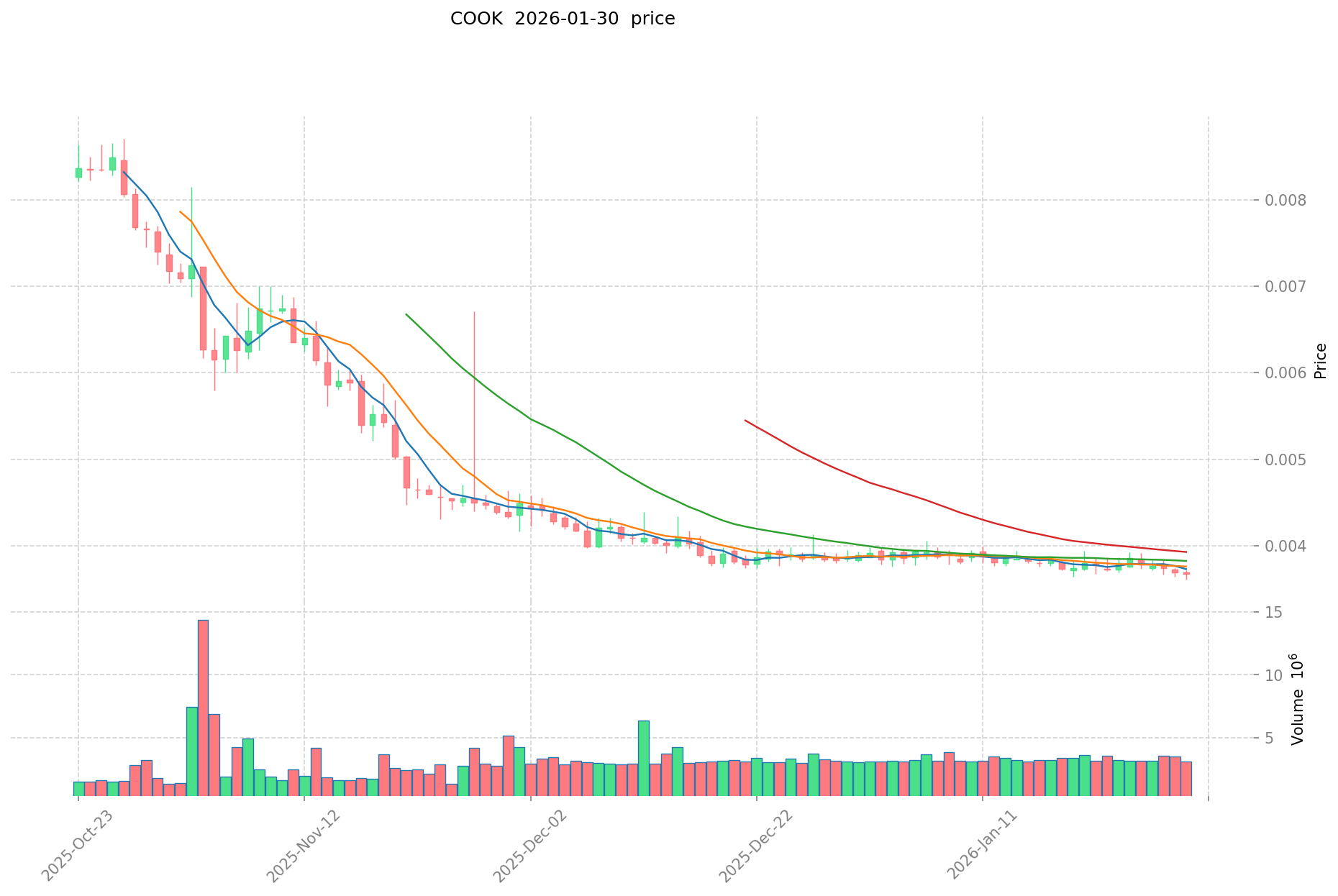
Current COOK Investment Market Status (January 2026)
- COOK Current Price: $0.003586
- 24-Hour Trading Volume: $11,660.01
- Market Capitalization: $3,442,560
- Circulating Supply: 960,000,000 COOK (19.2% of total supply)
- Total Supply: 5,000,000,000 COOK
- 24-Hour Price Change: -2.00%
- 7-Day Price Change: -2.22%
- 30-Day Price Change: -6.67%
Click to view real-time COOK market price
II. Core Factors Influencing Whether COOK is a Good Investment (Is mETH Protocol(COOK) a Good Investment)
Supply Mechanism and Scarcity (COOK investment scarcity)
- Supply structure impacts price and investment value → mETH Protocol (COOK) has a maximum supply of 5,000,000,000 tokens, with a current circulating supply of 960,000,000 tokens, representing a circulation ratio of 19.2%.
- Historical price patterns → The token experienced price fluctuations, with recorded prices ranging from $0.003586 to higher levels during different market periods.
- Investment significance → The limited circulation ratio and controlled supply structure may contribute to the token's scarcity characteristics, which could serve as a foundation for long-term investment considerations.
Institutional Investment and Mainstream Adoption (Institutional investment in COOK)
- Holder distribution → As of the latest data, mETH Protocol (COOK) has 198 token holders, indicating an early-stage adoption level.
- Protocol integration → mETH Protocol is built by Mantle and represents the first fully vertically integrated staking and restaking protocol in the market, which may attract interest from institutional participants focused on Ethereum staking infrastructure.
- Exchange presence → The token is listed on 5 exchanges, providing accessibility for both retail and institutional investors.
Macroeconomic Environment's Impact on COOK Investment
- Market positioning → mETH Protocol operates within the Ethereum staking and restaking sector, an area that may be influenced by broader cryptocurrency market sentiment and regulatory developments affecting staking mechanisms.
- Capital efficiency focus → The protocol's emphasis on capital efficiency and Ethereum staking yields positions it within the broader DeFi ecosystem, which can be affected by changes in monetary policy and interest rate environments.
- Market conditions → The token's performance may reflect broader market dynamics, with recent price movements showing declines across various timeframes (-0.58% in 1H, -2% in 24H, -2.22% in 7D, -6.67% in 30D, -82.69% in 1Y).
Technology and Ecosystem Development (Technology & Ecosystem for COOK investment)
- Vertical integration → mETH Protocol combines staking and restaking functionalities in a single protocol, designed to simplify user experience while maintaining scalability.
- Ethereum staking focus → The protocol enables users to accumulate Ethereum staking yields while potentially enhancing capital efficiency, which may attract participants seeking exposure to Ethereum's proof-of-stake ecosystem.
- Multi-chain deployment → The token operates on both Ethereum (ETH) and Mantle (MNT) chains, as evidenced by contract addresses on both networks, which may provide broader accessibility and integration opportunities within different blockchain ecosystems.
III. COOK Future Investment Forecast and Price Outlook (Is mETH Protocol(COOK) worth investing in 2026-2031)
Short-term Investment Forecast (2026, short-term COOK investment outlook)
- Conservative forecast: $0.0032472 - $0.003608
- Neutral forecast: $0.003608 - $0.0044
- Optimistic forecast: $0.0044 - $0.0050512
Mid-term Investment Outlook (2027-2029, mid-term mETH Protocol(COOK) investment forecast)
-
Market stage expectation: The protocol may experience gradual development as Ethereum staking and restaking mechanisms continue to evolve. The mETH Protocol's vertical integration approach could contribute to its positioning within the DeFi ecosystem.
-
Investment return forecast:
- 2027: $0.003550272 - $0.00497904
- 2028: $0.003258024 - $0.0058644432
- 2029: $0.004417880544 - $0.006784602264
-
Key catalysts: Ethereum network developments, staking yield dynamics, protocol adoption rates, and broader DeFi market conditions may influence price movements.
Long-term Investment Outlook (Is COOK a good long-term investment?)
- Base scenario: $0.003444579385104 - $0.006021991932 (assuming steady protocol development and moderate market conditions)
- Optimistic scenario: $0.006021991932 - $0.008580134104713 (assuming enhanced adoption and favorable ecosystem growth)
- Risk scenario: Below $0.003444579385104 (under challenging market conditions or reduced protocol usage)
View COOK long-term investment and price forecast: Price Prediction
2026-01-30 to 2031 Long-term Outlook
- Base scenario: $0.003444579385104 - $0.006021991932 (corresponding to steady progress and gradual mainstream application enhancement)
- Optimistic scenario: $0.006021991932 - $0.008580134104713 (corresponding to large-scale adoption and favorable market environment)
- Transformative scenario: Above $0.008580134104713 (if the ecosystem achieves breakthrough progress and mainstream popularization)
- 2031-12-31 predicted high: $0.008580134104713 (based on optimistic development assumptions)
Disclaimer: The above forecasts are derived from historical data and analytical models and do not constitute investment advice. Cryptocurrency markets involve substantial risks, and actual performance may differ significantly from projections.
| Year |
Predicted High Price |
Predicted Average Price |
Predicted Low Price |
Price Change |
| 2026 |
0.0050512 |
0.003608 |
0.0032472 |
0 |
| 2027 |
0.00497904 |
0.0043296 |
0.003550272 |
20 |
| 2028 |
0.0058644432 |
0.00465432 |
0.003258024 |
29 |
| 2029 |
0.006784602264 |
0.0052593816 |
0.004417880544 |
46 |
| 2030 |
0.00650375128656 |
0.006021991932 |
0.0057208923354 |
67 |
| 2031 |
0.008580134104713 |
0.00626287160928 |
0.003444579385104 |
74 |
IV. COOK Investment Strategy and Risk Management (How to invest in mETH Protocol)
Investment Methodology (COOK investment strategy)
Long-term Holding (HODL COOK): This approach may suit conservative investors who believe in the long-term potential of staking and restaking protocols within the Ethereum ecosystem. Given mETH Protocol's focus on capital efficiency and staking yields, long-term holders might benefit from protocol developments and broader adoption of liquid staking solutions.
Active Trading: Traders employing technical analysis and swing trading strategies should note COOK's price volatility. Recent data shows fluctuations with a 24-hour range between $0.003586 and $0.00372, presenting opportunities for short-term price movements. However, the token has experienced significant drawdowns, with a one-year decline of 82.69%, requiring careful risk assessment.
Risk Management (Risk management for COOK investment)
Asset Allocation Ratios:
- Conservative investors: Consider limiting COOK exposure to 1-3% of total crypto portfolio
- Moderate investors: May allocate 3-7% depending on risk tolerance
- Aggressive/Professional investors: Could consider higher allocations while maintaining diversification
Risk Hedging Strategies: Investors should consider diversifying across multiple DeFi protocols and Layer 2 solutions rather than concentrating solely in staking protocols. Combining COOK with established cryptocurrencies and stablecoins may help balance portfolio volatility.
Secure Storage:
- Cold wallets: Hardware wallets like Ledger or Trezor for long-term holdings
- Hot wallets: MetaMask or similar ERC-20 compatible wallets for active trading
- Security practices: Enable two-factor authentication and verify contract addresses (0x9f0c013016e8656bc256f948cd4b79ab25c7b94d on both Ethereum and Mantle networks)
V. COOK Investment Risks and Challenges (Risks of investing in mETH Protocol)
Market Risks: COOK exhibits high volatility characteristics common to smaller-cap crypto assets. With a market capitalization of approximately $3.44 million and a market dominance of only 0.00061%, the token is susceptible to significant price swings. The current price of $0.003586 represents a substantial decrease from its peak of $0.04584 in November 2024, demonstrating the potential for sharp corrections.
Regulatory Risks: Staking and restaking protocols operate in an evolving regulatory environment. Different jurisdictions maintain varying approaches to DeFi protocols and staking services, which could impact protocol operations and token utility. Investors should monitor regulatory developments in major markets that may affect Ethereum-based staking solutions.
Technical Risks: As a protocol integrating staking and restaking functionalities, mETH Protocol faces several technical considerations:
- Smart contract vulnerabilities could affect user funds
- Protocol upgrades or changes to the Ethereum network may impact functionality
- Competition from other liquid staking derivatives could affect adoption
- The protocol's integration with Mantle creates dependencies on multiple infrastructure layers
Liquidity Considerations: With only 5 exchanges listing COOK and a 24-hour trading volume of approximately $11,660, liquidity remains limited. This may result in wider bid-ask spreads and potential difficulty executing larger trades without significant price impact.
Token Supply Dynamics: With 960 million tokens in circulation out of a maximum supply of 5 billion (19.2% circulating), future token releases could create selling pressure. The fully diluted market cap of $17.93 million suggests potential dilution as more tokens enter circulation.
VI. Conclusion: Is mETH Protocol a Good Investment?
Investment Value Summary: COOK represents exposure to the growing liquid staking sector within the Ethereum ecosystem, particularly through its integration with Mantle's infrastructure. The protocol's focus on capital efficiency and staking yields addresses real utility needs. However, the token has experienced substantial price declines and faces considerable competition in the crowded staking derivatives market.
Investor Recommendations:
✅ Beginners: Consider starting with established cryptocurrencies before exploring smaller protocols. If interested in COOK, utilize dollar-cost averaging strategies with small amounts and store tokens in secure, self-custody wallets after verifying contract addresses.
✅ Experienced Investors: May explore tactical allocations within a diversified DeFi portfolio. Monitor protocol developments, total value locked metrics, and Ethereum staking ecosystem trends. Consider swing trading opportunities while maintaining strict stop-loss disciplines given volatility patterns.
✅ Institutional Investors: Could evaluate COOK as part of a broader thesis on liquid staking derivatives and Layer 2 scaling solutions. Due diligence should include smart contract audits, team assessment, and competitive positioning analysis within the Mantle and Ethereum ecosystems.
⚠️ Disclaimer: Cryptocurrency investments carry high risks, including potential total loss of capital. This content is for informational purposes only and does not constitute investment advice. Conduct thorough research and consider consulting financial advisors before making investment decisions.
VII. FAQ
Q1: What is mETH Protocol (COOK) and how does it generate value?
mETH Protocol (COOK) is a vertically integrated staking and restaking infrastructure developed by Mantle, launched in October 2024. The protocol enables users to accumulate Ethereum staking yields while enhancing capital efficiency through its combined staking and restaking functionalities. Value generation stems from its role in the Ethereum proof-of-stake ecosystem, where it simplifies user experience while maintaining scalability. The protocol operates on both Ethereum (ETH) and Mantle (MNT) chains, providing broader accessibility across different blockchain ecosystems.
Q2: What are the main risks associated with investing in COOK?
The primary risks include: (1) High market volatility, with COOK experiencing an 82.69% decline over one year and dropping from $0.04584 to $0.003586; (2) Limited liquidity with only 5 exchange listings and approximately $11,660 in daily trading volume; (3) Smart contract vulnerabilities inherent in DeFi protocols; (4) Regulatory uncertainty surrounding staking and restaking services; (5) Token dilution potential, as only 19.2% of the 5 billion total supply is currently circulating; (6) Competition from other liquid staking derivatives in the crowded market.
Q3: How does COOK's current price compare to its historical performance?
COOK currently trades at $0.003586 (as of January 30, 2026), representing a significant decline from its November 2024 peak of $0.04584. The token has experienced consistent downward pressure across multiple timeframes: -2.00% in 24 hours, -2.22% over 7 days, -6.67% over 30 days, and -82.69% over one year. With a market capitalization of $3.44 million and only 960 million tokens in circulation out of 5 billion total supply, the token's price movements reflect both broader market dynamics and its early-stage adoption level with only 198 holders.
Q4: What is the long-term price forecast for COOK through 2031?
Long-term forecasts suggest varying scenarios: Base scenario projects a range of $0.003444 - $0.006022 assuming steady protocol development; Optimistic scenario estimates $0.006022 - $0.008580 with enhanced adoption; Transformative scenario exceeds $0.008580 if breakthrough mainstream adoption occurs. The 2031 predicted high is $0.008580 under optimistic assumptions. However, these projections are model-based estimates and actual performance may differ significantly due to market volatility, regulatory changes, technological developments, and competitive dynamics in the liquid staking sector.
Q5: What investment strategies are suitable for different types of COOK investors?
For beginners, consider starting with small allocations (1-3% of crypto portfolio) using dollar-cost averaging strategies and secure self-custody storage. Experienced investors may explore tactical allocations (3-7%) within diversified DeFi portfolios, utilizing swing trading opportunities while monitoring protocol metrics and Ethereum ecosystem trends. Institutional investors could evaluate COOK as part of a broader liquid staking derivatives thesis, conducting thorough due diligence including smart contract audits and competitive analysis. All investor types should implement strict risk management, diversify across multiple protocols, and maintain security practices including hardware wallets and two-factor authentication.
Q6: How does COOK's supply mechanism affect its investment potential?
COOK has a maximum supply of 5 billion tokens with only 960 million (19.2%) currently in circulation, creating both scarcity characteristics and potential dilution concerns. The limited circulation ratio may support price appreciation as demand grows, but the remaining 80.8% of tokens represents significant future supply that could create selling pressure upon release. The fully diluted market cap of $17.93 million versus current market cap of $3.44 million highlights this disparity. Investors should monitor token unlock schedules and vesting periods to assess potential supply-side impacts on price dynamics.
Q7: What role does mETH Protocol's technology play in its investment thesis?
The protocol's vertical integration of staking and restaking functionalities represents its core technological differentiation. By combining these mechanisms in a single protocol, mETH aims to simplify user experience while enhancing capital efficiency compared to using separate platforms. Its deployment on both Ethereum and Mantle chains provides multi-chain accessibility. However, this integration also creates technical dependencies and requires robust smart contract security. The protocol's success depends on maintaining competitive staking yields, securing protocol integrations, and adapting to Ethereum network upgrades—factors that directly impact the investment thesis and token utility.
Q8: How does COOK compare to competitors in the liquid staking derivatives market?
COOK operates in a highly competitive liquid staking derivatives market alongside established protocols. While mETH Protocol offers vertical integration as a differentiator, it faces competition from larger, more established liquid staking solutions with greater liquidity and adoption. COOK's market capitalization of $3.44 million and market dominance of 0.00061% indicate early-stage positioning. The protocol's integration with Mantle provides potential differentiation through Layer 2 scaling benefits, but adoption metrics (198 holders, 5 exchange listings) suggest limited current market penetration. Investors should compare COOK's yields, security audits, total value locked, and ecosystem partnerships against competitors when evaluating relative investment merit.
* The information is not intended to be and does not constitute financial advice or any other recommendation of any sort offered or endorsed by Gate.