This comprehensive analysis examines whether Mina (MINA) represents a viable investment opportunity. Trading at $0.089 with a market cap of $112.83 million, MINA offers a unique lightweight blockchain architecture utilizing zero-knowledge proof technology with constant 22KB block sizes. The article evaluates MINA's technological differentiation through its Snapp ecosystem, analyzes historical price performance including an 84.75% one-year decline, and provides price forecasts ranging from $0.12-$0.16 (base scenario) to $0.19-$0.24 (optimistic scenario) by 2030-2031. Key discussion topics include supply dynamics, trading strategies for different investor profiles, comprehensive risk management frameworks addressing market, regulatory, and technical risks, and secure storage solutions. Suitable for investors seeking mid-cap cryptocurrency exposure, MINA requires careful risk assessment and portfolio positioning through dollar-cost averaging or tactical allocation strategies aligned with individual risk toleranc
Introduction: Mina (MINA) Investment Status and Market Outlook
MINA is a significant asset in the cryptocurrency sector, having been launched in April 2021 as one of the lightest blockchain protocols. As of January 2026, Mina maintains a market capitalization of approximately $112.83 million, with a circulating supply of around 1.27 billion tokens, and the current price stands at approximately $0.089. Positioning itself as the "world's lightest blockchain," Mina has gradually become a focal point for investors discussing "Is Mina (MINA) a good investment?" This article will comprehensively analyze Mina's investment value, historical trends, future price predictions, and investment risks to provide reference for investors.
Mina Protocol (formerly Coda Protocol) represents a blockchain encryption protocol with a constant block size of approximately 22KB, achieved through zero-knowledge proof (SNARK) technology. The protocol compresses the entire blockchain into snapshots similar in size to social media posts, enabling efficient verification regardless of transaction volume. As of January 17, 2026, MINA is ranked 339th by market capitalization and is traded on 27 exchanges, with a 24-hour trading volume of approximately $335,755.
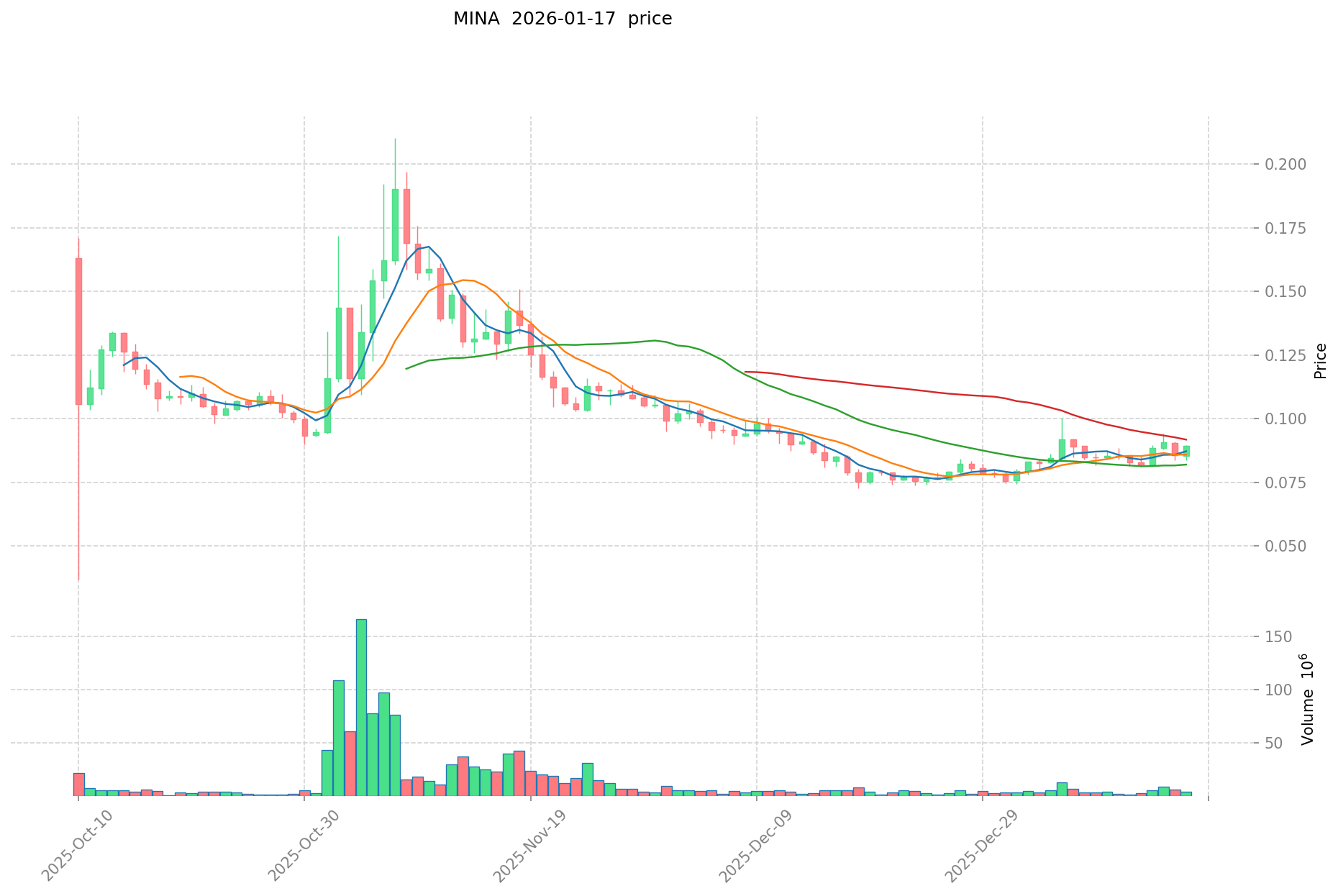
The protocol's technical architecture emphasizes decentralization through full-node participation, where all network nodes can accept and verify zero-knowledge proofs. Mina's application ecosystem, known as Snapps (SNARK-powered applications), enables scenarios including credit verification, document validation, and balance confirmation. Recent market data shows MINA experienced a 4.51% increase over 24 hours, a 3.86% gain over 7 days, and a 12.32% rise over 30 days, though the 1-year performance indicates an 84.75% decline from previous levels. The token's price history includes a recorded peak of $9.09 in June 2021 and a low of $0.063 in October 2025.
I. Mina (MINA) Price History Review and Current Investment Value
- 2021: Initial offering and market debut → Price reached $9.09, providing substantial returns for early participants
- 2022-2023: Cryptocurrency market downturn → Price declined significantly from previous levels
- 2024-2025: Gradual market recovery → Price exhibited volatility with fluctuating patterns
Current MINA Investment Market Status (January 2026)
- MINA current price: $0.08882
- Market sentiment (Fear & Greed Index): Data indicates positive sentiment with 24-hour price increase
- 24-hour trading volume: $335,755.31
- Market capitalization: $112,827,288.71
Click to view real-time MINA market price
II. Core Factors Influencing Whether MINA is a Good Investment
Supply Mechanism and Scarcity (MINA Investment Scarcity)
- Supply dynamics → Influence on price and investment value
- Current circulating supply stands at approximately 1.27 billion MINA tokens, with a circulating ratio of 100.77%, while maximum supply is listed as unlimited. This supply structure presents considerations for long-term scarcity assessment.
- The reference materials indicate discussions within the community regarding supply management, with proposals suggesting that reducing supply through staking mechanisms could potentially enhance holder motivation and reverse current market trends.
- Investment significance: Supply characteristics and tokenomics remain important considerations when evaluating long-term investment potential.
Technology and Ecosystem Development (Technology & Ecosystem for MINA Investment)
- Lightweight blockchain design: Mina maintains a constant blockchain size of approximately 22KB through zero-knowledge proof (SNARK) technology, potentially offering advantages in verification efficiency and accessibility.
- Snapp ecosystem: The protocol supports development of applications (Snapps) that can utilize verified private data from external sources, enabling use cases such as credit verification, document verification, and balance verification.
- Full node architecture: All network participants can operate as full nodes, with each node capable of accepting and verifying zero-knowledge proofs, which may contribute to decentralization objectives.
- Privacy and scalability optimization: The protocol design focuses on supporting new application categories with enhanced privacy features and scalability considerations.
- Ecosystem development and technical implementation continue to evolve, with ongoing community discussions regarding tokenomics and network sustainability.
- As of January 17, 2026, MINA is trading at $0.08882, with recent price movements showing increases of 0.33% (1H), 4.51% (24H), 3.86% (7D), and 12.32% (30D).
- The token experienced a significant decline of 84.75% over a one-year period, with the historical range spanning from $0.063436 to $9.09 (recorded in June 2021).
- Market capitalization stands at approximately $112.83 million, with the token ranked 339th by market cap and holding a 0.0033% market dominance.
- Some market analyses reference price targets ranging from $1.15 to $2.41 for 2025 outlook, though these represent speculative forecasts subject to market conditions.
Community Sentiment and Development Direction
- Reference materials indicate ongoing community discussions regarding tokenomics adjustments and staking reward mechanisms to address perceived challenges in supply dynamics and market perception.
- Community proposals suggest focusing on marketing strategies and supply management to potentially enhance attractiveness to both existing and prospective token holders.
- The project maintains active development channels including GitHub repositories and social media presence, with 27 exchanges currently listing the token.
III. MINA Future Investment Forecast and Price Outlook (Is Mina (MINA) worth investing in 2026-2031)
Short-term Investment Forecast (2026, short-term MINA investment outlook)
- Conservative forecast: $0.067 - $0.089
- Neutral forecast: $0.089 - $0.099
- Optimistic forecast: $0.099 - $0.108
Mid-term Investment Outlook (2027-2029, mid-term Mina (MINA) investment forecast)
- Market stage expectation: MINA may experience gradual growth during this period, with potential price appreciation driven by protocol developments and broader market conditions.
- Investment return forecast:
- 2027: $0.071 - $0.125
- 2028: $0.086 - $0.153
- 2029: $0.116 - $0.184
- Key catalysts: Technical advancements in zero-knowledge proof technology, expansion of Snapp ecosystem, increased network adoption, and overall crypto market sentiment.
Long-term Investment Outlook (Is MINA a good long-term investment?)
- Base scenario: $0.118 - $0.158 (assuming steady protocol development and moderate market growth)
- Optimistic scenario: $0.188 - $0.243 (assuming accelerated adoption and favorable market conditions)
- Risk scenario: Below $0.067 (under adverse market conditions or significant protocol challenges)
Click to view MINA long-term investment and price forecast: Price Prediction
2026-01-17 to 2031 Long-term Outlook
- Base scenario: $0.12 - $0.16 USD (corresponding to steady progress and gradual mainstream application growth)
- Optimistic scenario: $0.19 - $0.24 USD (corresponding to large-scale adoption and favorable market environment)
- Transformative scenario: Above $0.25 USD (if ecosystem achieves breakthrough progress and mainstream adoption)
- 2031-12-31 predicted high: $0.243 USD (based on optimistic development assumptions)
Disclaimer: These forecasts are based on statistical models and historical patterns. Cryptocurrency markets are highly volatile and unpredictable. Multiple factors including regulatory changes, technological developments, and market sentiment can significantly impact actual prices. This information is for reference only and should not be considered as investment advice.
| Year |
Predicted High Price |
Predicted Average Price |
Predicted Low Price |
Price Change |
| 2026 |
0.1076416 |
0.08896 |
0.06672 |
0 |
| 2027 |
0.124842016 |
0.0983008 |
0.070776576 |
10 |
| 2028 |
0.15285282896 |
0.111571408 |
0.08590998416 |
25 |
| 2029 |
0.1837748446872 |
0.13221211848 |
0.1163466642624 |
48 |
| 2030 |
0.218031004585368 |
0.1579934815836 |
0.1184951111877 |
77 |
| 2031 |
0.242535793578984 |
0.188012243084484 |
0.135368815020828 |
111 |
IV. Mina Investment Strategy and Risk Management (How to invest in Mina)
Investment Strategy (Mina investment strategy)
Long-term Holding (HODL Mina)
Long-term holding represents a fundamental approach for investors seeking to participate in Mina's technological development trajectory. This strategy aligns with the protocol's vision of creating a lightweight, accessible blockchain infrastructure. Investors adopting this methodology typically focus on the protocol's core technological advantages, including its constant 22KB blockchain size and zero-knowledge proof capabilities.
For conservative investors, this approach may involve systematic accumulation during market downturns, with particular attention to the project's development milestones and ecosystem expansion. The strategy requires patience and conviction in the protocol's long-term value proposition, particularly its unique positioning in the blockchain scalability landscape.
Active Trading
Active trading strategies for MINA involve leveraging technical analysis and market sentiment indicators to capitalize on price fluctuations. Given the asset's volatility characteristics, traders may employ various analytical frameworks including support and resistance levels, momentum indicators, and volume analysis.
Traders should consider MINA's 24-hour price range of $0.08361 to $0.08956 as recorded on January 17, 2026, which reflects the intraday volatility patterns typical of mid-cap cryptocurrencies. The 24-hour trading volume of approximately $335,755 provides insight into liquidity conditions for executing trades.
Risk Management (Risk management for Mina investment)
Asset Allocation Framework
Conservative Investors: May consider limiting MINA exposure to 2-5% of their cryptocurrency portfolio, with the remainder allocated to established assets and traditional instruments. This approach prioritizes capital preservation while maintaining exposure to Mina's technological potential.
Moderate Investors: Could allocate 5-10% to MINA, balancing growth potential with diversification across multiple blockchain protocols and asset classes. This strategy acknowledges both opportunities and uncertainties in the Layer 1 blockchain space.
Aggressive Investors: With higher risk tolerance, might allocate 10-15% or more to MINA, potentially employing leveraged positions or concentrated exposure. This approach requires sophisticated market understanding and active portfolio monitoring.
Risk Hedging Solutions
Diversification across multiple blockchain protocols and cryptocurrencies can help mitigate protocol-specific risks. Investors might consider maintaining positions in complementary technologies or competing Layer 1 solutions to reduce concentration risk.
Periodic portfolio rebalancing based on predetermined thresholds can help maintain target allocations despite price volatility. Some investors may also employ stablecoin positions as temporary safe havens during periods of elevated market uncertainty.
Secure Storage Practices
Cold Wallet Solutions: For long-term holders, hardware wallets such as Ledger or Trezor devices offer enhanced security by keeping private keys offline. This approach significantly reduces exposure to online threats and exchange-related risks.
Hot Wallet Considerations: For active traders requiring frequent access, reputable software wallets with robust security features may be appropriate. However, maintaining only necessary trading amounts in hot wallets while storing the majority in cold storage represents a prudent practice.
Multi-Signature Options: Advanced users might implement multi-signature wallet configurations, requiring multiple approvals for transactions, thereby adding additional security layers against unauthorized access.
V. Mina Investment Risks and Challenges (Risks of investing in Mina)
Market Risk
MINA demonstrates significant price volatility, with the asset experiencing an 84.75% decline over the one-year period ending January 17, 2026. Such substantial price movements reflect the inherent volatility in cryptocurrency markets, particularly affecting mid-cap assets with market capitalizations around $112.8 million.
The relatively modest 24-hour trading volume of approximately $335,755 suggests potential liquidity constraints during periods of market stress. Lower liquidity conditions may result in wider bid-ask spreads and increased slippage for larger transactions, potentially affecting execution quality.
Market manipulation risks exist across cryptocurrency markets, with lower-cap assets potentially more susceptible to coordinated trading activities. Investors should maintain awareness of unusual price movements and volume patterns that may indicate non-organic market behavior.
Regulatory Risk
Cryptocurrency regulatory frameworks continue evolving across jurisdictions, creating uncertainty for projects like Mina. Different countries maintain varying approaches to digital asset classification, taxation, and permissible activities, which can impact trading availability and investor participation.
Changes in regulatory postures, particularly in major markets, could affect MINA's accessibility through exchanges and impact overall market sentiment. Investors should monitor regulatory developments in their jurisdictions and consider potential compliance requirements for cryptocurrency holdings.
The decentralized nature of Mina's protocol design may offer some resilience against certain regulatory actions, though this does not eliminate regulatory risks entirely. Cross-border regulatory coordination efforts could introduce additional compliance considerations for the protocol and its users.
Technical Risk
While Mina's zero-knowledge proof architecture represents a technological innovation, the complexity of such systems introduces potential technical vulnerabilities. Smart contract interactions and protocol upgrades carry inherent risks of bugs or implementation issues that could affect network functionality.
The protocol's relatively novel approach to blockchain compression, while offering scalability advantages, means the technology operates with less extensive real-world testing compared to more established blockchain architectures. This creates uncertainty regarding long-term technical robustness under various network conditions.
Network security depends on maintaining adequate validator participation and stake distribution. Concentration of stake among limited participants could theoretically affect network security and decentralization characteristics, though the current full-node design aims to mitigate such concerns.
VI. Conclusion: Is Mina a Good Investment?
Investment Value Assessment
Mina Protocol presents a distinctive technological proposition within the blockchain landscape through its constant-size blockchain architecture and zero-knowledge proof capabilities. The project addresses genuine scalability challenges facing blockchain technology, potentially positioning it for long-term relevance as the industry matures.
However, the asset demonstrates significant price volatility, with substantial drawdowns observed over the past year. The current market capitalization of approximately $112.8 million places MINA in the mid-cap category, suggesting both growth potential and elevated risk compared to established cryptocurrencies.
The protocol's technological advantages, including its lightweight design and full-node accessibility, represent differentiating factors that could support long-term value creation. Nevertheless, short-term price movements remain subject to broader market sentiment, liquidity conditions, and competitive dynamics within the Layer 1 blockchain space.
Investor Recommendations
✅ Beginners: Consider implementing a dollar-cost averaging approach, making periodic small purchases rather than lump-sum investments. Prioritize secure storage solutions, beginning with reputable hardware wallets once accumulation reaches meaningful levels. Focus on understanding the protocol's technological fundamentals before committing significant capital.
✅ Experienced Investors: May employ tactical allocation adjustments based on technical analysis and market cycle positioning. Consider maintaining core holdings while actively trading a portion of the position to capitalize on volatility. Implement systematic rebalancing protocols to maintain target portfolio weights across multiple assets.
✅ Institutional Investors: Could evaluate strategic allocation as part of diversified blockchain protocol exposure. Consider the protocol's technological differentiation and potential ecosystem development when assessing long-term positioning. Implement appropriate custody solutions and compliance frameworks consistent with institutional standards.
⚠️ Important Notice: Cryptocurrency investments carry substantial risk, including the possibility of complete capital loss. Market conditions can change rapidly, and past performance does not indicate future results. This content provides informational context only and does not constitute investment advice, financial guidance, or a recommendation to buy or sell any asset. Investors should conduct thorough independent research and consider consulting qualified financial professionals before making investment decisions.
VII. FAQ
Q1: What makes Mina Protocol different from other blockchain investments?
Mina distinguishes itself through its constant 22KB blockchain size achieved via zero-knowledge proof (SNARK) technology, making it the world's lightest blockchain. Unlike traditional blockchains that grow indefinitely, Mina compresses the entire blockchain into snapshots similar in size to social media posts. This enables any network participant to operate as a full node without requiring extensive storage capacity, potentially enhancing decentralization. The protocol's Snapp ecosystem also enables privacy-preserving applications for credit verification, document validation, and balance confirmation, creating unique use cases not easily replicated by conventional blockchain architectures.
Q2: Is MINA suitable for long-term investment given its significant price decline?
The suitability depends on individual risk tolerance and investment objectives. MINA experienced an 84.75% decline over the one-year period ending January 2026, reflecting substantial volatility typical of mid-cap cryptocurrencies. However, the protocol's technological innovation in blockchain scalability and zero-knowledge proofs presents potential long-term value propositions. Long-term holders should focus on the project's development trajectory, ecosystem growth, and fundamental technological advantages rather than short-term price movements. Conservative investors might limit MINA exposure to 2-5% of their portfolio, while acknowledging both the innovation potential and inherent risks associated with emerging blockchain protocols.
Q3: What are the primary risks when investing in Mina (MINA)?
Three major risk categories affect MINA investments: First, market risk manifests through significant price volatility and relatively modest trading volume of approximately $335,755 per 24 hours, which may create liquidity constraints during market stress. Second, regulatory risk stems from evolving cryptocurrency frameworks across jurisdictions, potentially affecting trading availability and market sentiment. Third, technical risk involves the complexity of zero-knowledge proof systems and the protocol's relatively novel architecture, which operates with less extensive real-world testing compared to established blockchains. Additionally, the unlimited maximum supply structure presents considerations for long-term scarcity assessment, though community discussions indicate potential future tokenomics adjustments.
Q4: What trading strategies work best for MINA?
Two primary strategies suit different investor profiles: Long-term holding (HODL) aligns with investors believing in Mina's technological vision and willing to weather short-term volatility while focusing on protocol development milestones and ecosystem expansion. This approach typically involves systematic accumulation during market downturns with 2-5 year time horizons. Active trading capitalizes on MINA's volatility patterns, utilizing technical analysis of support/resistance levels and momentum indicators within the typical intraday range (e.g., $0.08361-$0.08956 on January 17, 2026). Active traders should monitor the 24-hour trading volume for liquidity assessment and employ strict risk management including stop-loss orders. Hybrid approaches combining core long-term holdings with tactical trading positions can balance growth potential with volatility management.
Q5: How should investors securely store MINA tokens?
Security storage depends on holding duration and trading frequency: For long-term holders, cold wallet solutions such as Ledger or Trezor hardware wallets provide optimal security by keeping private keys offline, significantly reducing exposure to online threats and exchange hacks. Once MINA accumulation reaches meaningful levels, transitioning from exchange custody to hardware wallets becomes prudent. For active traders requiring frequent access, reputable software wallets with robust security features may be appropriate, though maintaining only necessary trading amounts in hot wallets while storing the majority in cold storage represents best practice. Advanced users might implement multi-signature wallet configurations requiring multiple approvals for transactions, adding additional security layers against unauthorized access.
Q6: What price levels could MINA reach by 2030-2031?
Price forecasts suggest multiple scenarios based on different development trajectories: The base scenario projects $0.12-$0.16 by 2030-2031, assuming steady protocol development and gradual mainstream adoption. The optimistic scenario anticipates $0.19-$0.24, contingent upon accelerated ecosystem growth and favorable market conditions. Specifically, 2030 projections indicate a predicted high of $0.218, average of $0.158, and low of $0.118, representing approximately 177% growth from January 2026 levels. By 2031, the predicted high reaches $0.243 with an average of $0.188. However, these forecasts remain speculative and subject to numerous variables including regulatory developments, technological breakthroughs, competitive dynamics, and broader cryptocurrency market cycles. Investors should treat such projections as reference points rather than guaranteed outcomes.
Q7: What indicators suggest whether MINA is currently overvalued or undervalued?
Multiple metrics inform valuation assessment: The current price of $0.089 represents a 98% decline from the June 2021 peak of $9.09, suggesting significant downward adjustment from initial market enthusiasm. Recent positive momentum includes 4.51% (24H), 3.86% (7D), and 12.32% (30D) gains, indicating potential short-term recovery. The market capitalization of approximately $112.8 million positions MINA as a mid-cap asset with both growth potential and elevated risk. The 100.77% circulating supply ratio indicates nearly full token circulation, though the unlimited maximum supply raises questions about long-term scarcity. Technical valuation requires comparing Mina's unique lightweight blockchain proposition against competing Layer 1 solutions, considering factors such as developer activity, ecosystem growth, and real-world application adoption. The relatively modest trading volume suggests current market pricing may not fully reflect fundamental value, though this also indicates liquidity constraints.
Q8: Should beginners invest in MINA or focus on more established cryptocurrencies first?
Beginners should approach MINA with particular caution given its mid-cap status and significant volatility characteristics. New cryptocurrency investors typically benefit from first establishing core positions in more established assets with deeper liquidity and longer track records before exploring emerging protocols. If beginners choose to invest in MINA, implementing dollar-cost averaging through small periodic purchases mitigates timing risk and reduces the impact of short-term volatility. Initial allocation should represent only a small percentage (1-3%) of overall cryptocurrency exposure until comprehensive understanding of the protocol's technology, ecosystem, and risk factors develops. Priority should be placed on learning secure storage practices, understanding basic blockchain concepts, and developing familiarity with market dynamics before committing significant capital. Educational resources about zero-knowledge proofs and lightweight blockchain architecture can help beginners assess whether Mina's value proposition aligns with their investment thesis and risk tolerance.
* The information is not intended to be and does not constitute financial advice or any other recommendation of any sort offered or endorsed by Gate.