This comprehensive analysis evaluates whether Mira (MIRA) represents a viable investment opportunity for cryptocurrency investors. As of January 2026, MIRA trades at $0.1202 with a market cap of $22.98 million, functioning as a decentralized verification network enabling autonomous AI applications across healthcare, finance, and legal sectors. The article examines MIRA's historical price performance, current market positioning on Gate and 25 other exchanges, and supply dynamics with 191.2 million circulating tokens against a 1 billion maximum supply. Key sections address core investment factors including institutional adoption potential, technology infrastructure, macroeconomic influences, and diverse investment strategies tailored for beginners through institutional investors. Detailed risk assessment covers market volatility, regulatory uncertainties, and technical challenges, while FAQ sections provide practical guidance on portfolio allocation, storage security, and performance monitoring for informed inv
Introduction: Mira (MIRA)'s Investment Position and Market Outlook
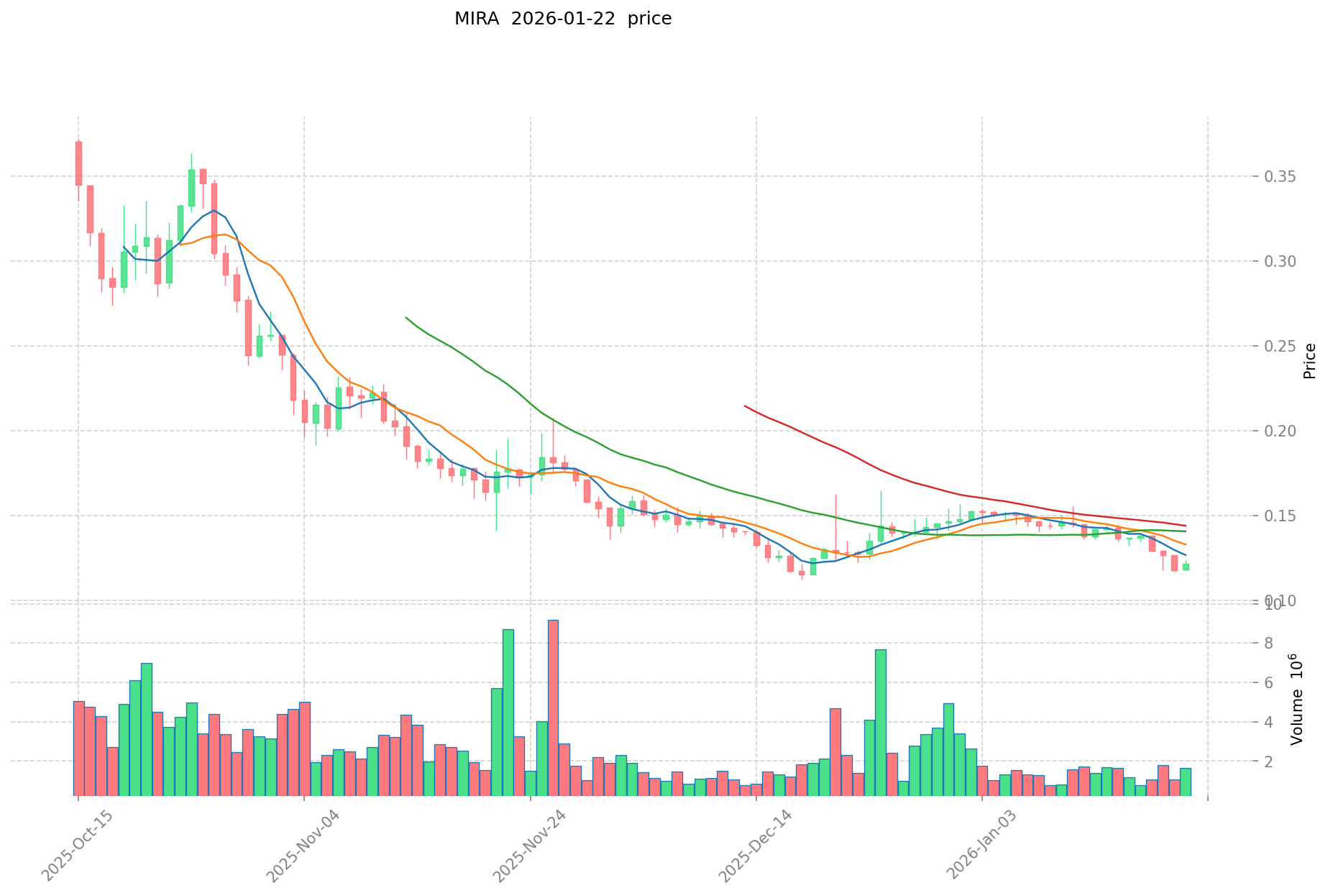
MIRA is a notable asset in the cryptocurrency field. As of January 22, 2026, Mira holds a market capitalization of approximately $22.98 million, with a circulating supply of 191.2 million tokens and a current price around $0.1202. The token ranks #817 in the overall cryptocurrency market with a market dominance of 0.0037%. With its positioning as a decentralized verification network enabling autonomous AI, Mira has gradually become a focal point for investors discussing "Is Mira (MIRA) a good investment?" This article will comprehensively analyze Mira's investment value, historical price movements, future price predictions, and investment risks to provide reference for investors.
I. Mira (MIRA) Price History Review and Current Investment Value
- September 2025: Token reached a notable price level of $2.6662 during early trading periods → Market participants observed significant valuation fluctuations
- December 2025: Price adjustment phase occurred → MIRA experienced downward movement to $0.1122
- January 2026: Current market stabilization phase → Trading around $0.1202 following recent market adjustments
Current MIRA Investment Market Status (January 2026)
- MIRA current price: $0.1202
- 24-hour trading volume: $157,571.64
- Circulating supply: 191,200,000 MIRA (19.12% of total supply)
- Market capitalization: $22,982,240
- Fully diluted market cap: $120,200,000
Click to view real-time MIRA market price
II. Core Factors Affecting Whether MIRA is a Good Investment
Supply Mechanism and Scarcity (MIRA investment scarcity)
- Supply Structure: MIRA has a maximum supply of 1,000,000,000 tokens, with a current circulating supply of 191,200,000 tokens, representing approximately 19.12% of the total supply. The controlled release of tokens may influence price dynamics and investment value over time.
- Market Circulation: With a significant portion of tokens yet to enter circulation, the gradual supply expansion could impact scarcity dynamics. The circulating market cap stands at approximately $22.98 million, while the fully diluted market cap reaches $120.2 million.
- Investment Significance: The gap between circulating and maximum supply suggests potential dilution effects that investors should consider when evaluating long-term scarcity value.
Institutional Investment and Mainstream Adoption (Institutional investment in MIRA)
- Market Presence: MIRA is listed on 26 exchanges and has attracted 13,021 token holders, indicating growing community interest and accessibility for retail investors.
- Network Foundation: As a decentralized verification network for autonomous AI, MIRA targets high-stakes domains including healthcare, finance, and legal services, which could attract institutional attention if adoption materializes in these sectors.
- Adoption Potential: The project's consensus-based verification mechanism aims to address AI reliability concerns, positioning MIRA as infrastructure for trustworthy AI outputs, though institutional validation remains in early stages.
Macroeconomic Environment's Impact on MIRA Investment
- Risk Asset Positioning: As an emerging crypto asset with high volatility (experiencing price fluctuations from $0.1122 to $2.6662 since launch), MIRA's investment appeal may be influenced by broader monetary policy shifts and risk appetite in financial markets.
- Technology Sector Correlation: Given MIRA's focus on AI verification infrastructure, its investment value may correlate with trends in both the artificial intelligence sector and the broader crypto market, which are sensitive to interest rate environments and technology investment cycles.
- Market Uncertainty: The token's relatively short trading history (launched in September 2025) means its behavior during various macroeconomic conditions remains largely untested.
Technology and Ecosystem Development (Technology & Ecosystem for MIRA investment)
- Verification Infrastructure: MIRA's core technology routes outputs through multiple independent AI models requiring consensus agreement, creating mathematically verifiable results without human intervention while maintaining real-time performance.
- Target Applications: The network is designed to enable autonomous AI operation in accuracy-critical domains such as healthcare, finance, and legal services, where traditional AI systems face deployment challenges due to reliability concerns.
- Technical Foundation: Built on the Base blockchain ecosystem, MIRA leverages existing infrastructure while focusing on solving AI hallucination problems and eliminating single points of failure in AI verification processes.
III. MIRA Future Investment Forecast and Price Outlook (Is Mira (MIRA) worth investing in 2026-2031)
Short-term Investment Outlook (2026, short-term MIRA investment outlook)
- Conservative forecast: $0.085 - $0.10
- Neutral forecast: $0.10 - $0.12
- Optimistic forecast: $0.12 - $0.15
Mid-term Investment Forecast (2027-2029, mid-term Mira (MIRA) investment forecast)
- Market stage expectation: The project is positioned in the early growth phase of decentralized AI verification infrastructure, with potential for gradual ecosystem expansion as autonomous AI applications gain traction in high-stakes domains.
- Investment return forecast:
- 2027: $0.11 - $0.16
- 2028: $0.08 - $0.18
- 2029: $0.14 - $0.21
- Key catalysts: Adoption progress in healthcare, finance, and legal sectors; consensus mechanism optimization; partnerships with enterprise AI providers; regulatory clarity around autonomous AI systems.
Long-term Investment Outlook (Is MIRA a good long-term investment?)
- Base scenario: $0.13 - $0.24 (assuming steady development of decentralized verification networks and moderate adoption in critical AI applications)
- Optimistic scenario: $0.21 - $0.26 (assuming accelerated enterprise adoption, successful deployment in multiple high-stakes domains, and favorable market conditions for AI infrastructure)
- Risk scenario: $0.08 - $0.12 (under conditions of technical challenges, competitive pressure from centralized solutions, or regulatory constraints on autonomous AI systems)
View MIRA long-term investment and price forecast: Price Prediction
2026-01-22 - 2031 Long-term Outlook
- Base scenario: $0.13 - $0.19 USD (corresponding to steady progress and gradual mainstream application expansion)
- Optimistic scenario: $0.21 - $0.26 USD (corresponding to large-scale adoption and favorable market environment)
- Transformational scenario: Above $0.26 USD (contingent on breakthrough ecosystem developments and mainstream prevalence)
- 2031-12-31 predicted high: $0.26 USD (based on optimistic development assumptions)
Disclaimer: The above price forecasts are based on historical data analysis and market trend projections. Cryptocurrency investments involve substantial risks including high volatility, regulatory uncertainty, and potential loss of principal. This analysis does not constitute investment advice, and investors should conduct independent research and risk assessment before making any investment decisions.
| Year |
Predicted High Price |
Predicted Average Price |
Predicted Low Price |
Price Change |
| 2026 |
0.15025 |
0.1202 |
0.085342 |
0 |
| 2027 |
0.15821325 |
0.135225 |
0.1054755 |
12 |
| 2028 |
0.18339890625 |
0.146719125 |
0.07776113625 |
22 |
| 2029 |
0.21292613015625 |
0.165059015625 |
0.14030016328125 |
37 |
| 2030 |
0.236240716113281 |
0.188992572890625 |
0.130404875294531 |
57 |
| 2031 |
0.257266139847363 |
0.212616644501953 |
0.142453151816308 |
76 |
IV. Mira Investment Strategy and Risk Management (How to invest in AI)
Investment Methodology (Mira investment strategy)
-
Long-term Holding (HODL Mira): Suitable for conservative investors who believe in the long-term potential of decentralized AI verification networks. This approach involves purchasing MIRA tokens and holding them through market fluctuations, focusing on the project's fundamental value proposition in enabling autonomous AI systems across critical sectors like healthcare, finance, and legal services.
-
Active Trading: Relies on technical analysis and momentum trading strategies. Given MIRA's volatility patterns, with 1-hour changes of approximately -0.66% and 7-day fluctuations of around -16.06%, traders may identify short-term opportunities through chart patterns, volume analysis, and market sentiment indicators. This approach requires continuous monitoring and understanding of broader AI sector trends.
Risk Management (Risk management for Mira investment)
-
Asset Allocation Ratios:
- Conservative investors: Consider allocating 1-3% of crypto portfolio to emerging AI infrastructure projects like MIRA
- Moderate investors: May allocate 5-8% to AI-focused tokens with innovative verification mechanisms
- Experienced investors: Could allocate up to 10-15% while maintaining diversification across multiple AI and blockchain projects
-
Risk Hedging Solutions: Implement multi-asset portfolio strategies combining established cryptocurrencies with emerging AI tokens. Consider diversification across different blockchain ecosystems and AI application sectors to mitigate concentration risk.
-
Secure Storage: Utilize cold wallet solutions for long-term holdings and hardware wallets for enhanced security. Given MIRA's deployment on Base blockchain, ensure wallet compatibility with the network. Consider multi-signature wallets for larger holdings and regular security audits of storage solutions.
V. Mira Investment Risks and Challenges (Risks of investing in AI)
-
Market Risk: MIRA demonstrates notable volatility characteristics, with price movements ranging from -0.66% in 1-hour periods to -16.06% over 7-day periods. The token's relatively modest market cap of approximately $22.98 million and 24-hour trading volume of around $157,571 indicate potential for substantial price swings. The circulating supply represents 19.12% of total supply, suggesting potential dilution considerations as more tokens enter circulation.
-
Regulatory Risk: Decentralized AI verification networks operate in evolving regulatory landscapes across jurisdictions. Different countries maintain varying approaches to AI governance and cryptocurrency regulation, creating uncertainty for projects combining both technologies. Compliance requirements for AI systems in regulated sectors like healthcare and finance may impact Mira's adoption trajectory.
-
Technical Risk: As a verification network routing outputs through multiple AI models, Mira faces potential challenges including network security vulnerabilities, smart contract risks on the Base blockchain, and operational complexities in maintaining consensus mechanisms. The success of the platform depends on continuous technical development and the ability to scale verification processes while maintaining reliability.
VI. Conclusion: Is AI a Good Investment?
-
Investment Value Summary: Mira presents an innovative approach to AI verification through decentralized consensus mechanisms, addressing genuine challenges in AI reliability. The project's focus on enabling autonomous AI in critical applications offers growth potential as demand for trustworthy AI systems expands. However, the token exhibits significant price volatility, with market cap positioning at rank 817 and a relatively early-stage adoption profile with approximately 13,021 holders.
-
Investor Recommendations:
✅ Beginners: Consider dollar-cost averaging strategies combined with secure wallet storage. Start with small allocations to understand market dynamics before increasing exposure. Focus on learning about both AI verification technology and Base blockchain ecosystem.
✅ Experienced Investors: Explore tactical trading opportunities while maintaining core positions. Implement portfolio diversification across multiple AI infrastructure projects and monitor developments in Mira's verification network adoption.
✅ Institutional Investors: Evaluate strategic long-term positioning based on the growing need for verifiable AI outputs in enterprise applications. Consider Mira as part of broader AI infrastructure thesis while conducting thorough due diligence on technical architecture and market positioning.
⚠️ Disclaimer: Cryptocurrency investments carry substantial risk due to market volatility, technological uncertainties, and regulatory changes. This content is for informational purposes only and does not constitute investment advice. Conduct independent research and consult qualified financial advisors before making investment decisions.
VII. FAQ
Q1: What makes MIRA different from other AI-related cryptocurrency projects?
MIRA distinguishes itself through its decentralized verification network that routes AI outputs through multiple independent models requiring consensus agreement, creating mathematically verifiable results without human intervention. Unlike traditional AI projects, MIRA specifically addresses the hallucination problem and single points of failure in AI systems by implementing a consensus-based verification mechanism. Built on the Base blockchain, it targets accuracy-critical domains including healthcare, finance, and legal services where AI reliability is paramount for autonomous operation.
Q2: How volatile is MIRA as an investment, and what factors contribute to its price movements?
MIRA demonstrates significant volatility with price fluctuations ranging from -0.66% in 1-hour periods to -16.06% over 7-day periods. The token's relatively modest market capitalization of approximately $22.98 million and 24-hour trading volume of around $157,571 contribute to price sensitivity. Historical data shows substantial price swings from $2.6662 in September 2025 to $0.1122 in December 2025. Key factors influencing price movements include adoption progress in target sectors, broader cryptocurrency market sentiment, macroeconomic conditions affecting risk assets, and developments in the AI technology sector.
Q3: What is MIRA's token supply structure, and how might it impact long-term investment value?
MIRA has a maximum supply of 1,000,000,000 tokens with a current circulating supply of 191,200,000 tokens, representing approximately 19.12% of the total supply. The circulating market cap stands at $22.98 million while the fully diluted market cap reaches $120.2 million. This significant gap between circulating and maximum supply suggests potential dilution effects as more tokens enter circulation. The controlled release mechanism may influence scarcity dynamics and price performance over time, creating considerations for investors evaluating long-term value appreciation potential.
Q4: What are the primary risks associated with investing in MIRA?
Primary investment risks include market risk stemming from high volatility and relatively low liquidity with 24-hour trading volume around $157,571. Regulatory risk exists due to evolving frameworks governing both decentralized AI systems and cryptocurrencies, particularly in healthcare, finance, and legal sectors where MIRA targets adoption. Technical risks involve smart contract vulnerabilities on the Base blockchain, potential consensus mechanism failures, and challenges in scaling verification processes. Additionally, the project faces competitive pressure from both centralized verification solutions and other decentralized AI infrastructure projects.
Q5: How accessible is MIRA for different types of investors?
MIRA is listed on 26 exchanges, providing reasonable accessibility for retail investors across multiple platforms. The token has attracted 13,021 holders, indicating growing community interest. For beginners, dollar-cost averaging strategies with small initial allocations (1-3% of crypto portfolio) are recommended to understand market dynamics. Experienced traders can explore tactical opportunities through technical analysis given the token's volatility patterns. Institutional investors may consider strategic positioning as part of broader AI infrastructure thesis, though the project remains in early adoption stages with limited institutional validation.
Q6: What is the realistic price outlook for MIRA over the next five years?
Based on market analysis and historical performance, MIRA's price forecasts vary significantly across scenarios. Short-term 2026 projections range from $0.085 (conservative) to $0.15 (optimistic). Mid-term forecasts for 2027-2029 range from $0.11 to $0.21 depending on adoption progress in target sectors. Long-term 2031 projections estimate $0.26 in optimistic scenarios with accelerated enterprise adoption, $0.13-$0.24 in base scenarios with steady development, and $0.08-$0.12 in risk scenarios facing competitive or regulatory challenges. These forecasts depend heavily on technical development progress, mainstream application expansion, and overall market conditions.
Q7: What portfolio allocation strategy should investors consider for MIRA?
Portfolio allocation should align with individual risk tolerance and investment experience. Conservative investors are advised to allocate 1-3% of their cryptocurrency portfolio to emerging AI infrastructure projects like MIRA, prioritizing capital preservation. Moderate risk investors may allocate 5-8% while maintaining diversification across multiple AI and blockchain projects. Experienced investors comfortable with higher volatility could allocate up to 10-15% while implementing risk management through multi-asset strategies. All investors should utilize secure storage solutions including cold wallets and hardware wallets compatible with the Base blockchain network.
Q8: How should investors monitor and evaluate MIRA's investment performance?
Investors should track multiple performance indicators including price movements relative to broader cryptocurrency markets and AI sector trends, trading volume patterns indicating liquidity changes, and holder growth reflecting community adoption. Key fundamental metrics include verification network adoption progress in healthcare, finance, and legal sectors, partnership developments with enterprise AI providers, technical upgrades to consensus mechanisms, and competitive positioning against alternative verification solutions. Regular assessment of circulating supply increases and their impact on market dilution is essential. Market ranking changes and dominance percentage shifts provide context for relative performance evaluation.
* The information is not intended to be and does not constitute financial advice or any other recommendation of any sort offered or endorsed by Gate.