Mitosis (MITO) is a modular-era liquidity protocol that enables cross-chain DeFi participation through 1:1 convertible derivative tokens. Currently priced at $0.06525 with a $12.81 million market cap, MITO offers specialized infrastructure for liquidity providers across Ethereum L1 and L2 rollups. This comprehensive analysis examines MITO's investment potential through multiple dimensions: historical price volatility (ranging from $0.05 to $0.45 in 2025), core value proposition in cross-chain liquidity, and risk factors including high volatility and regulatory uncertainty. The article provides detailed price forecasts through 2031, ranging from conservative ($0.0599-$0.0652 in 2026) to optimistic scenarios ($0.0712-$0.0953 by 2031). Investment strategies cater to different risk profiles, from conservative dollar-cost averaging to active swing trading. With 19.63% circulating supply and 75,114 token holders across 18 Gate-listed exchanges, MITO presents elevated-risk exposure to the modular blockchain ecosyste
Introduction: Mitosis (MITO) Investment Position and Market Prospects
MITO is a notable asset in the cryptocurrency field. As of 2026, Mitosis market capitalization stands at approximately $12.81 million, with a circulating supply of around 196.27 million tokens, and the current price is maintained at approximately $0.06525. With its positioning as a liquidity protocol for the modular era that redefines cross-chain liquidity, MITO has gradually become a focal point when investors discuss "Is Mitosis (MITO) a good investment?" The protocol makes cross-chain liquidity provision more attractive by issuing derivative tokens that are 1:1 convertible to locked assets, enabling liquidity providers to participate in various DeFi applications on supported Ethereum L1 chains and L2 rollups. This article will comprehensively analyze MITO's investment value, historical trends, future price predictions, and investment risks to provide reference for investors.
I. Token (MITO) Price History Review and Current Investment Value
- 2025: Token launched on January 27 → Price fluctuated between approximately $0.05 and $0.45 throughout the year
- September 2025: MITO reached a notable price level of $0.45 on September 14 → Market experienced significant volatility during this period
- October 2025: Market correction phase → Price declined from higher levels to approximately $0.05 by October 10
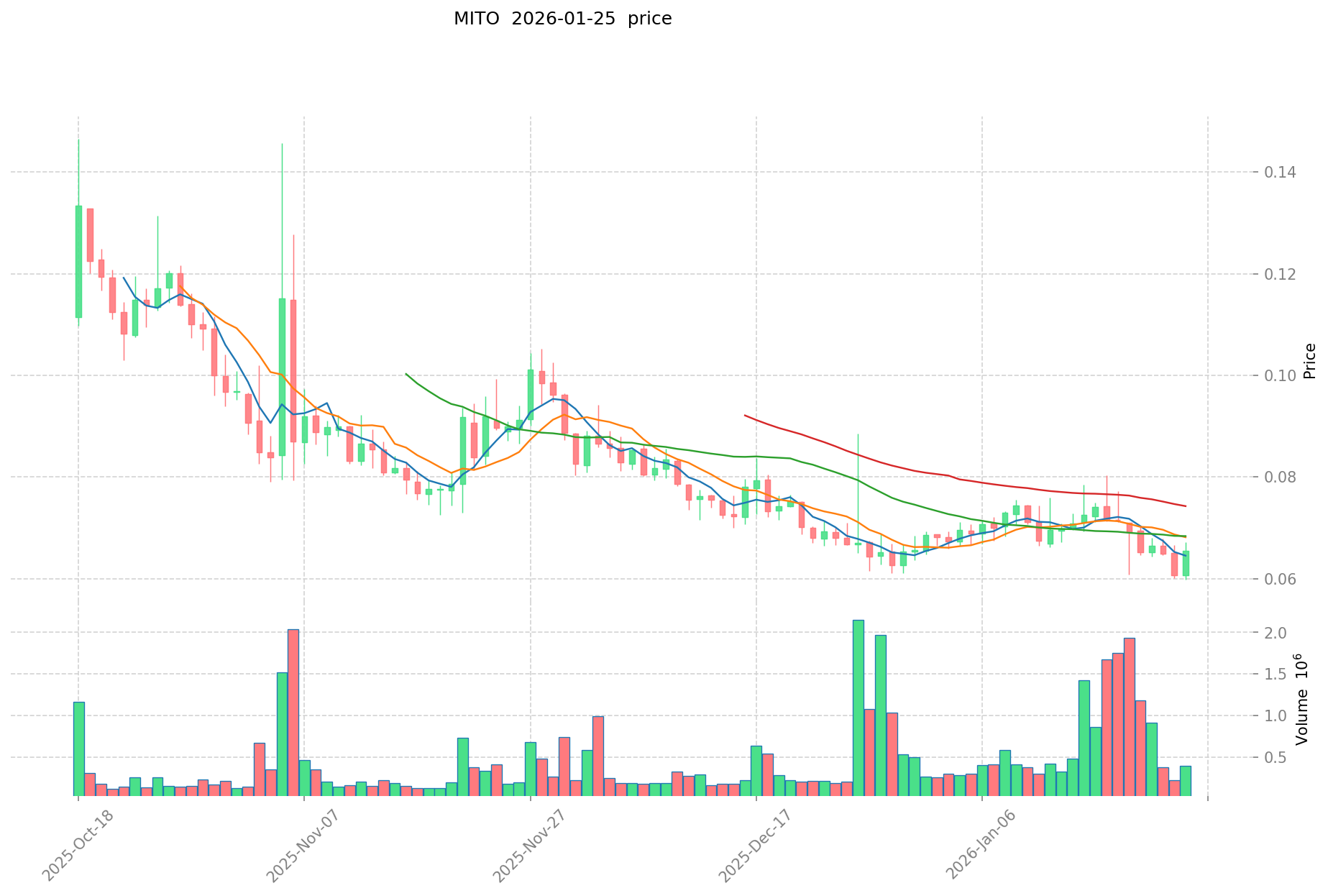
Current MITO Investment Market Status (January 2026)
- MITO current price: $0.06525
- Market sentiment (Fear & Greed Index): Data not available in provided materials
- 24-hour trading volume: $27,161.28
- Institutional investor holdings: Data shows 75,114 token holders
Click to view real-time MITO market price
II. Core Factors Affecting Whether MITO is a Good Investment (Is Mitosis(MITO) a Good Investment)
Supply Mechanism and Scarcity (MITO investment scarcity)
- Fixed Supply Structure → Impacts Price and Investment Value
- Mitosis (MITO) has a maximum supply of 1,000,000,000 tokens, with a current circulating supply of 196,273,082 tokens (approximately 19.63% of total supply).
- The controlled release mechanism may create scarcity dynamics as adoption increases, potentially supporting long-term value appreciation.
- With approximately 80% of tokens yet to enter circulation, future unlocks and vesting schedules could impact supply-demand dynamics.
- Historical Price Performance
- MITO reached a notable price level of $0.45 in September 2025, while experiencing a lower price point of $0.05 in October 2025, demonstrating significant volatility.
- The current price of $0.0653 (as of January 25, 2026) reflects market adjustments following initial launch dynamics.
- Investment Significance: The relationship between circulating supply (19.63%) and maximum supply suggests that scarcity may play an evolving role as the protocol matures and token distribution progresses.
Institutional Investment and Mainstream Adoption (Institutional investment in MITO)
- Holder Base Growth: Mitosis has attracted 75,114 holders, indicating growing community adoption and distribution across market participants.
- Exchange Availability: MITO is listed on 18 exchanges, providing accessibility for institutional and retail investors seeking exposure to cross-chain liquidity protocols.
- Market Positioning: The protocol's focus on cross-chain liquidity and DeFi integration positions it within the expanding modular blockchain ecosystem, potentially attracting interest from participants seeking exposure to infrastructure-layer innovations.
Macroeconomic Environment's Impact on MITO Investment
- Monetary Policy and Risk Appetite → Altering Investment Attractiveness
- Changes in global monetary policy and interest rate environments influence investor allocation to digital assets, including DeFi protocol tokens like MITO.
- Tightening monetary conditions may reduce speculative capital flows to emerging crypto protocols, while accommodative policies could support risk-on positioning.
- DeFi Market Cycles → Impact on Protocol Token Valuations
- The broader DeFi market environment affects demand for liquidity protocol tokens, as total value locked (TVL) trends and yield opportunities influence investor sentiment.
- Market cycles in cross-chain infrastructure and Layer 2 adoption may create varying conditions for MITO's investment attractiveness.
- Regulatory Developments → Influencing DeFi Investment Landscape
- Evolving regulatory frameworks for DeFi protocols and cross-chain liquidity provision may impact the operational environment and investment considerations for tokens like MITO.
Technology and Ecosystem Development (Technology & Ecosystem for MITO investment)
- Cross-Chain Liquidity Innovation: Mitosis's core value proposition involves enabling liquid cross-chain liquidity provision, allowing LPs to receive derivative tokens (1:1 convertible) that can be utilized across supported Ethereum L1 and L2 rollups.
- DeFi Integration Potential: The protocol's design enables liquidity providers to participate in various DeFi applications while maintaining cross-chain positions, potentially creating additional yield opportunities beyond default fee sharing.
- Modular Blockchain Ecosystem Positioning: As a liquidity protocol designed for the modular era, MITO's long-term investment value may be supported by the growth of modular blockchain architectures and the expansion of cross-chain DeFi applications.
- Technical Infrastructure: Built on BEP-20 standard (BSC chain), the protocol operates within an established ecosystem with existing DeFi infrastructure and user base.
III. MITO Future Investment Forecast and Price Outlook (Is Mitosis(MITO) worth investing in 2026-2031)
Short-term Investment Forecast (2026, short-term MITO investment outlook)
- Conservative forecast: $0.0599 - $0.0652
- Neutral forecast: $0.0652 - $0.0691
- Optimistic forecast: $0.0652 - $0.0691
Mid-term Investment Outlook (2027-2029, mid-term Mitosis(MITO) investment forecast)
- Market stage expectation: The mid-term outlook suggests potential moderate growth as the protocol may develop its cross-chain liquidity infrastructure. Price movements are anticipated to vary with broader DeFi market conditions and adoption rates.
- Investment return forecast:
- 2027: $0.0376 - $0.0799
- 2028: $0.0448 - $0.0801
- 2029: $0.0668 - $0.0906
- Key catalysts: Cross-chain liquidity adoption, DeFi ecosystem integration, derivative token utility expansion, and partnership developments with L1 and L2 networks.
Long-term Investment Outlook (Is MITO a good long-term investment?)
- Base scenario: $0.0554 - $0.0866 (assuming steady protocol development and moderate market growth)
- Optimistic scenario: $0.0712 - $0.0953 (assuming accelerated adoption of cross-chain liquidity solutions and favorable market conditions)
- Risk scenario: Below $0.0376 (under adverse market conditions or limited protocol adoption)
View MITO long-term investment and price forecast: Price Prediction
2026-2031 Long-term Outlook
- Base scenario: $0.0554 - $0.0866 (corresponding to steady progress and gradual mainstream application growth)
- Optimistic scenario: $0.0712 - $0.0953 (corresponding to large-scale adoption and favorable market environment)
- Transformative scenario: Above $0.0953 (such as breakthrough ecosystem developments and mainstream popularization)
- 2031-12-31 forecast high: $0.0953 (based on optimistic development assumptions)
Disclaimer: This forecast is for reference purposes only and does not constitute investment advice. Cryptocurrency markets are highly volatile and subject to numerous unpredictable factors.
| Year |
Predicted High Price |
Predicted Average Price |
Predicted Low Price |
Price Change |
| 2026 |
0.0690696 |
0.06516 |
0.0599472 |
0 |
| 2027 |
0.079866612 |
0.0671148 |
0.037584288 |
2 |
| 2028 |
0.08010486954 |
0.073490706 |
0.04482933066 |
12 |
| 2029 |
0.0906213895686 |
0.07679778777 |
0.0668140753599 |
17 |
| 2030 |
0.089569259876151 |
0.0837095886693 |
0.071153150368905 |
28 |
| 2031 |
0.095303366699998 |
0.086639424272725 |
0.055449231534544 |
32 |
IV. Mitosis Investment Strategy and Risk Management (How to invest in Mitosis)
Investment Methodology (Mitosis investment strategy)
Long-term Holding (HODL Mitosis): Suitable for Conservative Investors
For investors seeking steady exposure to cross-chain liquidity protocols, a long-term holding strategy may be considered. This approach involves purchasing MITO tokens and maintaining positions through market cycles, allowing investors to potentially benefit from the protocol's development and adoption over time. Given Mitosis's focus on redefining cross-chain liquidity through liquid staking derivatives, long-term holders may position themselves to capture value as the protocol expands its supported chains and DeFi integrations.
Active Trading: Technical Analysis and Swing Trading
Active traders may approach MITO through technical analysis frameworks, utilizing price action patterns, volume indicators, and support/resistance levels. With 24-hour trading volume of approximately $27,161 and recent price fluctuations showing -3.85% (1H), +6.28% (24H), and -13.48% (7D), swing trading opportunities may exist for experienced traders. The token's 24-hour range between $0.06094 and $0.0691 provides reference points for entry and exit strategies. However, traders should note the token's historical volatility, with a one-year decline of -67.73%.
Risk Management (Risk management for Mitosis investment)
Asset Allocation Ratios: Conservative / Aggressive / Professional Investors
- Conservative Investors: May consider allocating 1-3% of crypto portfolio to MITO, prioritizing established assets for core holdings
- Aggressive Investors: Could allocate 5-10% to protocol tokens like MITO as part of a growth-oriented DeFi strategy
- Professional Investors: May implement dynamic allocation based on protocol metrics, market conditions, and cross-chain liquidity trends, ranging from 3-15% depending on risk tolerance and investment thesis
Risk Hedging Solutions: Multi-asset Portfolio + Hedging Tools
Investors may consider diversifying across multiple blockchain ecosystems and DeFi protocols to mitigate concentration risk. Since MITO operates within the cross-chain liquidity sector, complementary positions in established Layer 1 and Layer 2 ecosystems may provide portfolio balance. For sophisticated investors, options strategies or stable asset allocation can serve as hedging mechanisms during periods of elevated volatility.
Secure Storage: Hot/Cold Wallets + Hardware Wallet Recommendations
MITO is deployed on BSC (BEP-20 standard, contract address: 0x8e1e6bf7e13c400269987b65ab2b5724b016caef). Investors should implement appropriate security measures:
- Cold Storage: Hardware wallets such as Ledger or Trezor for long-term holdings
- Hot Wallets: MetaMask or Trust Wallet for active trading, with limited amounts
- Security Practices: Enable two-factor authentication, verify contract addresses before transactions, and maintain separate wallets for different security tiers
V. Mitosis Investment Risks and Challenges (Risks of investing in Mitosis)
Market Risk: High Volatility and Price Dynamics
MITO exhibits notable price volatility, with the token trading at $0.06525 as of January 25, 2026, representing a significant decline from its historical range. The token has experienced a -67.73% change over one year, reflecting broader market conditions and protocol-specific factors. With a relatively modest 24-hour trading volume of $27,161 across 18 exchanges, liquidity considerations may impact execution during periods of market stress. The current circulating supply of 196,273,082 tokens (19.63% of maximum supply) suggests potential supply dynamics as additional tokens enter circulation.
Regulatory Risk: Policy Uncertainty Across Jurisdictions
Cross-chain liquidity protocols operate in an evolving regulatory landscape. Different jurisdictions maintain varying approaches to DeFi protocols, liquid staking derivatives, and cross-chain asset transfers. Investors should monitor regulatory developments that may impact:
- Classification of liquid staking derivatives
- Cross-border digital asset transfer regulations
- Securities law implications for protocol tokens
- Compliance requirements for DeFi protocols
Regulatory changes in key markets could affect protocol operations, token utility, or market access.
Technical Risk: Network Security and Protocol Development
As a cross-chain liquidity protocol, Mitosis faces inherent technical challenges:
- Smart Contract Risk: Vulnerabilities in protocol contracts could impact user funds or protocol functionality
- Integration Risk: Dependencies on multiple blockchain networks and rollups introduce complexity
- Bridge Security: Cross-chain operations carry inherent risks associated with asset bridging mechanisms
- Protocol Upgrades: Development roadmap execution and potential technical complications during network updates
Investors should consider that the protocol's architecture, while designed to enable liquid cross-chain LPing, requires ongoing technical maintenance and security audits.
VI. Conclusion: Is Mitosis a Good Investment?
Investment Value Summary
Mitosis presents a specialized approach to cross-chain liquidity through its liquid staking derivative model, operating within the growing modular blockchain ecosystem. The protocol's positioning in cross-chain DeFi infrastructure may offer exposure to sector development. However, current market metrics, including limited trading volume, significant price decline over the past year, and relatively low market capitalization of approximately $12.8 million, indicate that MITO carries elevated risk characteristics. The token's circulating supply represents 19.63% of maximum supply, with potential dilution considerations as additional tokens enter circulation.
Investor Recommendations
✅ Beginners: Consider dollar-cost averaging with minimal allocation + secure hardware wallet storage. Prioritize education about cross-chain protocols and DeFi mechanics before investment.
✅ Experienced Investors: May explore swing trading opportunities with strict position sizing + diversified DeFi portfolio allocation. Monitor protocol development milestones and cross-chain liquidity trends.
✅ Institutional Investors: Conduct thorough due diligence on protocol architecture, team background, and competitive positioning before strategic allocation. Consider liquidity constraints and market depth.
⚠️ Disclaimer: Cryptocurrency investments carry substantial risk. This content is provided for informational purposes only and does not constitute investment advice, financial advice, trading advice, or any other type of advice. Investors should conduct independent research and consult with qualified financial advisors before making investment decisions.
VII. FAQ
Q1: What is the current market capitalization and token supply structure of Mitosis (MITO)?
As of January 2026, Mitosis has a market capitalization of approximately $12.81 million, with a circulating supply of around 196.27 million tokens (approximately 19.63% of the maximum supply of 1 billion tokens). The current price stands at approximately $0.06525. This relatively low circulating percentage means that approximately 80% of tokens have yet to enter circulation, which could significantly impact future supply-demand dynamics. The controlled release mechanism may create scarcity dynamics as adoption increases, though future unlocks and vesting schedules represent important considerations for investors evaluating dilution risk.
Q2: How volatile has MITO's price been since its launch in 2025?
MITO has demonstrated significant price volatility since its launch on January 27, 2025. The token experienced substantial fluctuations throughout 2025, ranging from approximately $0.05 to $0.45. A notable high of $0.45 was reached on September 14, 2025, followed by a market correction phase that brought the price down to approximately $0.05 by October 10, 2025. Over the one-year period, MITO has declined by -67.73%, reflecting both broader market conditions and protocol-specific factors. Recent short-term movements show -3.85% (1H), +6.28% (24H), and -13.48% (7D) changes, indicating continued volatility.
Q3: What is the core value proposition of the Mitosis protocol?
Mitosis is positioned as a liquidity protocol for the modular blockchain era that redefines cross-chain liquidity provision. The protocol's core innovation involves enabling liquid cross-chain liquidity provision by issuing derivative tokens that are 1:1 convertible to locked assets. This allows liquidity providers to maintain their positions while simultaneously participating in various DeFi applications across supported Ethereum L1 chains and L2 rollups. By making cross-chain liquidity provision more flexible and capital-efficient, Mitosis aims to address fragmentation in the modular blockchain ecosystem and create additional yield opportunities for liquidity providers beyond traditional fee sharing mechanisms.
Q4: What are the primary risks associated with investing in MITO?
MITO carries several significant investment risks: (1) Market Risk – The token exhibits high volatility with a -67.73% decline over one year and relatively low 24-hour trading volume of approximately $27,161, which may impact liquidity during market stress; (2) Technical Risk – As a cross-chain protocol, MITO faces smart contract vulnerabilities, bridge security concerns, and integration complexities across multiple blockchain networks; (3) Regulatory Risk – Evolving DeFi regulations could impact protocol operations, particularly concerning liquid staking derivatives and cross-chain asset transfers; (4) Supply Risk – With only 19.63% of tokens currently circulating, future token unlocks could create selling pressure and affect price dynamics.
Q5: What are the price forecasts for MITO through 2031?
Price forecasts for MITO vary considerably based on adoption scenarios. For 2026, conservative forecasts range from $0.0599 to $0.0652, while optimistic scenarios reach up to $0.0691. Mid-term projections (2027-2029) suggest potential ranges of $0.0376 to $0.0799 (2027), $0.0448 to $0.0801 (2028), and $0.0668 to $0.0906 (2029). Long-term forecasts through 2031 present a base scenario of $0.0554 to $0.0866 and an optimistic scenario of $0.0712 to $0.0953. These projections depend heavily on cross-chain liquidity adoption, DeFi ecosystem integration, and broader market conditions. However, investors should note that cryptocurrency forecasts are highly speculative and subject to numerous unpredictable factors.
Q6: Which types of investors is MITO most suitable for?
MITO may appeal to different investor profiles with varying strategies: Conservative investors might consider minimal allocation (1-3% of crypto portfolio) as part of a diversified approach with long-term holding strategies, prioritizing hardware wallet security. Aggressive investors seeking growth exposure to DeFi infrastructure could allocate 5-10% while actively monitoring protocol development and cross-chain liquidity trends. Professional investors may implement dynamic allocation (3-15%) based on technical analysis, protocol metrics, and market conditions, potentially utilizing swing trading strategies. However, all investor categories should recognize MITO's elevated risk profile due to limited trading volume, significant historical volatility, and relatively low market capitalization. Beginners should prioritize education about cross-chain protocols before investment.
Q7: What security measures should investors implement when holding MITO?
Since MITO is deployed on BSC (BEP-20 standard, contract address: 0x8e1e6bf7e13c400269987b65ab2b5724b016caef), investors should implement comprehensive security protocols. For long-term holdings, cold storage solutions using hardware wallets such as Ledger or Trezor are recommended to minimize exposure to online threats. For active trading, hot wallets like MetaMask or Trust Wallet can be used, but should contain only limited amounts for immediate trading needs. Essential security practices include enabling two-factor authentication on all accounts, carefully verifying contract addresses before executing transactions, maintaining separate wallets for different security tiers, and never sharing private keys or seed phrases. Investors should also regularly update wallet firmware and software to protect against emerging security vulnerabilities.
Q8: How does Mitosis fit within the broader DeFi and modular blockchain ecosystem?
Mitosis occupies a specialized position within the emerging modular blockchain infrastructure sector, specifically targeting cross-chain liquidity challenges. The protocol is designed to address liquidity fragmentation that occurs as the blockchain ecosystem expands across multiple Layer 1 networks and Layer 2 rollups. By enabling liquid staking derivatives that work across supported chains, Mitosis aims to create more capital-efficient liquidity provision. The protocol's long-term investment value may be supported by the growth of modular blockchain architectures and the expansion of cross-chain DeFi applications. With 75,114 token holders and listings on 18 exchanges, the protocol has achieved initial distribution, though adoption metrics and total value locked (TVL) data would provide additional context for assessing its competitive positioning within the cross-chain liquidity sector.
* The information is not intended to be and does not constitute financial advice or any other recommendation of any sort offered or endorsed by Gate.