This comprehensive analysis examines whether Monad (MON) represents a sound investment opportunity within the Layer 1 blockchain sector. MON currently trades at $0.02313 with a market capitalization of $250.5 million, featuring a relatively low 10.83% circulation ratio against 100 billion total supply. The article evaluates MON's technological differentiation—including parallel transaction processing achieving 5,000+ TPS versus Ethereum's 15-30 TPS—alongside market performance metrics and institutional backing. Price forecasts range from $0.0138-$0.10 (2026) to $0.040-$0.072 (long-term optimistic scenarios). Key investment considerations include significant future dilution potential, ecosystem development risks, and price volatility (-15.53% 7-day decline). The analysis provides asset allocation strategies for different investor profiles, risk management approaches including cold wallet storage via Gate and other security practices, and acknowledgment of regulatory and technical execution risks. Suitable for
Introduction: Monad (MON) Investment Status and Market Outlook
MON is an important asset in the cryptocurrency field. As of 2026-01-15, Monad has a market capitalization of approximately $250.50 million, with a circulating supply of around 10.83 billion tokens, and the current price is maintained at approximately $0.02313. With a fully diluted market cap of $2.31 billion and a market dominance of 0.067%, MON is gradually becoming a focal point when investors discuss "Is Monad (MON) a good investment?" Monad is building a high-performance Layer 1 blockchain designed for the next generation of decentralized applications, aiming to accelerate decentralization by creating a blockchain that could be substantially faster than its nearest competitors. This positioning has attracted attention within the blockchain infrastructure sector. This article will comprehensively analyze the investment value, historical trends, future price predictions, and investment risks of MON, providing reference for investors.
I. Cryptocurrency (MON) Historical Price Review and Current Investment Value
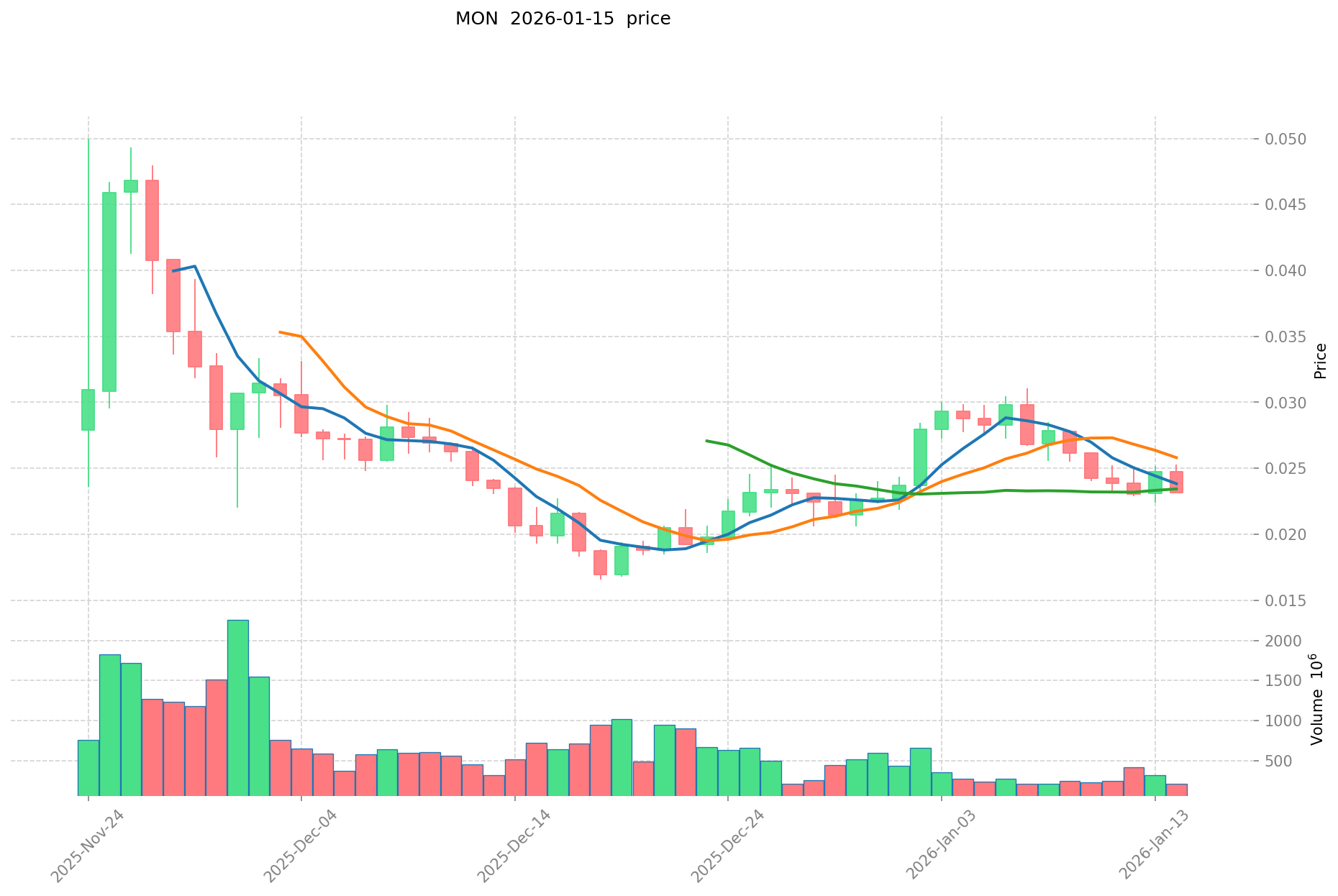
- November 2025: MON reached a notable price level of $0.05 on November 24, 2025 → representing a significant point in its early trading history
- December 2025: Market correction phase → MON experienced downward price movement to $0.01655 on December 18, 2025
- January 2026: Recovery period → Price fluctuated between $0.02223 and $0.02465 within a 24-hour trading cycle
Current MON Investment Market Status (January 2026)
- MON current price: $0.02313
- 24-hour trading volume: $5,017,323.58
- Market capitalization: $250,497,900
- Circulating supply: 10.83 billion MON (10.83% of total supply)
- Fully diluted market cap: $2,313,000,000
- Recent price changes: +0.16% (1H), -4.02% (24H), -15.53% (7D), +16.07% (30D)
- Trading platforms: Listed on 23 cryptocurrency exchanges
Click to view real-time MON market price
II. Core Factors Influencing Whether MON is a Good Investment
Supply Mechanism and Scarcity (MON Investment Scarcity)
- Total Supply Structure: MON has a maximum supply of 100 billion tokens, with approximately 10.83 billion tokens (10.83%) currently in circulation as of January 15, 2026. The fully diluted market capitalization stands at $2.313 billion, while the circulating market cap is approximately $250.5 million.
- Circulating Supply Ratio: With only 10.83% of tokens in circulation, MON maintains a relatively low circulating supply ratio. This creates potential price sensitivity to future token releases and unlock schedules, which may influence investment considerations.
- Investment Consideration: The significant gap between circulating and total supply indicates substantial future dilution potential. Investors should monitor token distribution schedules and vesting timelines, as these factors may impact supply-side dynamics and long-term price behavior.
Institutional Investment and Mainstream Adoption
- Funding Background: Monad has secured substantial venture capital backing, with key support from high-frequency trading professionals who have joined the project team, according to market analysis reports.
- Adoption Strategy: The project targets DeFi, NFT, and on-chain gaming sectors. However, Monad's success depends on mainnet performance, ecosystem incentive programs, and token listing on additional exchanges.
- Market Positioning: As of January 15, 2026, MON ranks #208 by market capitalization with a market dominance of 0.067%. The project aims to establish itself as a competitive Layer-1 blockchain alternative.
Macroeconomic Environment Impact on MON Investment
- Risk Asset Positioning: As an emerging Layer-1 blockchain token launched in late 2025, MON functions as a speculative technology asset. Its performance may correlate with broader cryptocurrency market sentiment and risk appetite trends.
- Market Context: The broader cryptocurrency market conditions, regulatory developments, and investor risk tolerance levels may influence MON's price behavior and investment attractiveness.
Technology and Ecosystem Development (Technology & Ecosystem for MON Investment)
- Parallel Processing Architecture: Monad implements parallel transaction processing technology, which reportedly achieved over 5,000 transactions per second (TPS) during testnet phases. The project aims to scale beyond 10,000 TPS, compared to Ethereum's 15-30 TPS.
- EVM Compatibility: Full Ethereum Virtual Machine (EVM) compatibility is designed to facilitate developer migration from Ethereum-based projects while maintaining performance improvements.
- Ecosystem Development Stage: As a recently launched mainnet project, Monad's ecosystem remains in early development. The platform's ability to attract developers familiar with Ethereum tooling and build functional decentralized applications will be important factors for long-term investment value assessment.
- Application Scenarios: Target use cases include DeFi protocols, NFT platforms, and gaming applications that may benefit from higher throughput capabilities compared to existing Layer-1 solutions.
III. MON Future Investment Forecast and Price Outlook (Is Monad(MON) worth investing in 2026-2030)
Short-term MON Investment Outlook (2026)
- Conservative Forecast: $0.0138 - $0.0230
- Neutral Forecast: $0.0230 - $0.0295
- Optimistic Forecast: $0.0295 - $0.10
Mid-term Monad(MON) Investment Forecast (2027-2028)
-
Market Stage Expectation: MON may experience gradual growth as the project continues to develop its Layer 1 blockchain infrastructure. The period from 2027 to 2028 could see increased adoption if the platform successfully demonstrates its performance capabilities.
-
Investment Return Forecast:
- 2027: $0.0229 - $0.0318
- 2028: $0.0212 - $0.0424
-
Key Catalysts: Technical development milestones, ecosystem expansion, potential partnerships, and overall market conditions for Layer 1 blockchain solutions.
Long-term Investment Outlook (Is MON a good long-term investment?)
- Base Scenario: $0.0196 - $0.0532 (assuming steady development and moderate market conditions through 2029)
- Optimistic Scenario: $0.040 - $0.072 (assuming strong adoption, favorable market environment, and successful ecosystem growth through 2031)
- Risk Scenario: Below $0.0138 (in case of significant market downturn or project execution challenges)
For detailed MON long-term investment and price predictions, visit: Price Prediction
2026-2031 Long-term Outlook
- Base Scenario: $0.0138 - $0.0532 (corresponding to steady progress and gradual mainstream application growth)
- Optimistic Scenario: $0.040 - $0.072 (corresponding to large-scale adoption and favorable market environment)
- Transformative Scenario: Above $0.10 (if the ecosystem achieves breakthrough developments and mainstream adoption)
- December 31, 2031 Predicted High: $0.072 (based on optimistic development assumptions)
Disclaimer: Price predictions are based on available market data and analysis models. Cryptocurrency investments carry significant risks, and actual prices may vary substantially from forecasts. This information does not constitute investment advice, and investors should conduct their own research and risk assessment before making investment decisions.
| Year |
Predicted High Price |
Predicted Average Price |
Predicted Low Price |
Price Change |
| 2026 |
0.0295296 |
0.02307 |
0.013842 |
0 |
| 2027 |
0.031822758 |
0.0262998 |
0.022880826 |
13 |
| 2028 |
0.04242946734 |
0.029061279 |
0.02121473367 |
25 |
| 2029 |
0.0532606060233 |
0.03574537317 |
0.0196599552435 |
54 |
| 2030 |
0.051623467932114 |
0.04450298959665 |
0.040052690636985 |
92 |
| 2031 |
0.071614210858929 |
0.048063228764382 |
0.041815009025012 |
107 |
IV. Monad Investment Strategy and Risk Management (How to invest in Layer 1 Blockchain)
Investment Methodology (Monad investment strategy)
Long-term Holding (HODL Monad)
For conservative investors seeking exposure to high-performance Layer 1 blockchain infrastructure, a long-term holding strategy may be considered. This approach focuses on Monad's technological positioning as a platform designed to be significantly faster than competing blockchains, potentially supporting more complex decentralized applications over time. Investors adopting this strategy typically allocate a predetermined percentage of their portfolio and maintain positions through market cycles, reducing the impact of short-term price fluctuations.
Active Trading
Active traders may utilize technical analysis and swing trading strategies when engaging with MON. Given the token's price volatility—with 24-hour fluctuations of -4.02% and 7-day changes of -15.53%—experienced traders might identify entry and exit points based on support and resistance levels. The 24-hour trading volume of approximately $5.02 million suggests moderate liquidity for tactical positioning. Traders should monitor price ranges between recent lows of $0.02223 and highs of $0.02465 to inform short-term decisions.
Risk Management (Risk management for Monad investment)
Asset Allocation Ratios
- Conservative Investors: May consider allocating 1-3% of their cryptocurrency portfolio to MON, emphasizing capital preservation while gaining limited exposure to Layer 1 blockchain opportunities.
- Aggressive Investors: Could allocate 5-10% of their crypto holdings to MON, accepting higher volatility in exchange for potential growth aligned with the project's performance objectives.
- Professional Investors: Might implement dynamic allocation strategies ranging from 3-15%, adjusting positions based on technical indicators, market conditions, and fundamental developments in Monad's ecosystem.
Risk Hedging Strategies
Investors may consider diversifying across multiple asset classes and blockchain protocols to mitigate concentration risk. A balanced portfolio might include:
- Established Layer 1 protocols alongside emerging platforms like Monad
- Stablecoins for liquidity management
- Traditional hedging instruments where available
This multi-asset approach can help reduce exposure to single-protocol risks while maintaining participation in the broader blockchain infrastructure sector.
Secure Storage Solutions
- Cold Wallets: For long-term holdings, hardware wallets such as Ledger or Trezor provide offline storage, minimizing exposure to online security threats.
- Hot Wallets: For active traders requiring frequent access, reputable exchange wallets or software wallets with multi-factor authentication may be utilized, though these carry higher security risks.
- Best Practices: Implement proper backup procedures, never share private keys, and regularly verify wallet addresses before transactions.
V. Monad Investment Risks and Challenges (Risks of investing in Layer 1 Blockchain)
Market Risks
Monad exhibits significant price volatility, with a 7-day decline of -15.53% and 30-day increase of 16.07%, illustrating the substantial price swings common in the cryptocurrency market. With a circulating supply of 10.83 billion tokens out of a maximum supply of 100 billion (10.83% circulation ratio), future token releases could impact supply dynamics. The relatively modest market capitalization of approximately $250.5 million and 24-hour trading volume of $5.02 million suggest limited liquidity compared to established cryptocurrencies, potentially resulting in price slippage during large transactions.
Regulatory Risks
Cryptocurrency regulations vary significantly across jurisdictions and remain in flux. Changes in regulatory frameworks—including securities classification, taxation policies, or trading restrictions—could materially affect MON's accessibility, liquidity, and valuation. Investors should monitor regulatory developments in their jurisdictions and assess compliance requirements before participating in the Monad ecosystem.
Technical Risks
As a blockchain platform emphasizing performance optimization, Monad faces technical challenges including:
- Network Security: Potential vulnerabilities in smart contract execution, consensus mechanisms, or protocol upgrades could compromise network integrity.
- Development Execution: The project's ability to deliver on its performance objectives requires sustained technical innovation and successful implementation of complex architectural improvements.
- Adoption Uncertainty: The platform's value proposition depends on attracting developers and users to build and utilize decentralized applications on its infrastructure, which remains uncertain in a competitive Layer 1 landscape.
VI. Conclusion: Is Layer 1 Blockchain a Good Investment?
Investment Value Summary
Monad represents a Layer 1 blockchain project focused on performance optimization for decentralized applications. While the project's technical ambitions regarding transaction speed and scalability may offer long-term potential, investors should recognize the substantial price volatility and early-stage risks inherent in the token. The current circulation ratio of 10.83% indicates significant future supply expansion, which warrants consideration in valuation assessments.
Investor Recommendations
✅ Beginners: Consider dollar-cost averaging strategies to mitigate entry timing risks, combined with secure cold wallet storage for any holdings. Prioritize understanding blockchain fundamentals and the specific value proposition of Layer 1 protocols before allocating capital.
✅ Experienced Investors: May employ swing trading strategies based on technical analysis, while maintaining diversified exposure across multiple blockchain protocols. Position sizing should reflect individual risk tolerance and overall portfolio construction.
✅ Institutional Investors: Could evaluate strategic allocation to Layer 1 infrastructure as part of broader blockchain sector exposure, conducting thorough due diligence on technical architecture, team credentials, and competitive positioning.
⚠️ Disclaimer: Cryptocurrency investments carry substantial risks, including potential complete loss of capital. This content is provided for informational purposes only and does not constitute investment advice. Investors should conduct independent research and consult qualified financial advisors before making investment decisions.
VII. FAQ
Q1: What is the current supply structure of MON and how does it affect investment value?
MON has a maximum supply of 100 billion tokens, with only 10.83 billion tokens (10.83%) currently in circulation as of January 15, 2026. This low circulation ratio creates significant dilution potential, as approximately 89.17% of total supply remains locked or unvested. The substantial gap between the circulating market cap ($250.5 million) and fully diluted market cap ($2.31 billion) indicates that future token releases could impact supply-side dynamics and price behavior. Investors should monitor token unlock schedules and vesting timelines, as these scheduled releases may create selling pressure that could affect short to medium-term price movements. This supply structure is particularly important for long-term investment planning and risk assessment.
Q2: How does Monad's technology differentiate it from other Layer 1 blockchain platforms?
Monad implements parallel transaction processing architecture that reportedly achieved over 5,000 transactions per second (TPS) during testnet phases, with goals to scale beyond 10,000 TPS. This represents a significant performance improvement compared to Ethereum's 15-30 TPS. The platform maintains full Ethereum Virtual Machine (EVM) compatibility, designed to facilitate developer migration from Ethereum-based projects while delivering enhanced throughput capabilities. However, as a recently launched mainnet project, the ecosystem remains in early development stages. The platform's actual investment value will ultimately depend on its ability to attract developers, demonstrate sustained performance under real-world conditions, and build functional decentralized applications across target sectors including DeFi, NFTs, and gaming.
Q3: What are the realistic price predictions for MON through 2031?
Based on current market analysis, MON price forecasts vary significantly by timeframe. For 2026, conservative estimates range from $0.0138 to $0.0295, with optimistic scenarios reaching up to $0.10. Mid-term forecasts for 2027-2028 project ranges of $0.0229-$0.0318 (2027) and $0.0212-$0.0424 (2028), assuming continued development and moderate market conditions. Long-term projections through 2031 suggest a base scenario range of $0.0196-$0.0532, with optimistic scenarios reaching $0.040-$0.072 if the platform achieves strong adoption and favorable market conditions. The predicted high for December 31, 2031 stands at $0.072 under optimistic assumptions. However, these predictions carry substantial uncertainty and do not account for market downturns, execution challenges, or competitive pressures that could significantly impact actual prices.
Q4: What is an appropriate asset allocation strategy for MON investment?
Asset allocation should correspond directly with investor risk tolerance and experience levels. Conservative investors may consider allocating 1-3% of their cryptocurrency portfolio to MON, emphasizing capital preservation while gaining limited exposure to Layer 1 blockchain opportunities. Aggressive investors could allocate 5-10% of crypto holdings, accepting higher volatility for potential growth aligned with the project's performance objectives. Professional investors might implement dynamic allocation strategies ranging from 3-15%, adjusting positions based on technical indicators and fundamental developments. Regardless of allocation size, diversification across multiple blockchain protocols, asset classes, and hedging instruments is recommended to mitigate concentration risk. All investors should ensure allocations remain within their overall risk capacity and do not exceed capital they can afford to lose entirely.
Q5: What are the primary risks associated with investing in MON?
MON investment carries multiple significant risk categories. Market risks include substantial price volatility (7-day decline of -15.53%), limited liquidity with $5.02 million daily trading volume, and future supply expansion from the current 10.83% circulation ratio. Regulatory risks involve evolving cryptocurrency frameworks that could affect accessibility, taxation, or trading restrictions across different jurisdictions. Technical risks encompass potential smart contract vulnerabilities, network security challenges, and uncertainty regarding development execution of the platform's ambitious performance objectives. Additionally, adoption uncertainty represents a critical risk—the platform's value depends on successfully attracting developers and users in a highly competitive Layer 1 landscape. The modest market capitalization of $250.5 million and early-stage ecosystem development further amplify these risks, particularly for investors with limited cryptocurrency experience.
Q6: How does MON compare to established Layer 1 blockchain platforms?
MON currently ranks #208 by market capitalization with a market dominance of 0.067%, positioning it as an emerging competitor rather than an established Layer 1 platform. While Monad's technological focus on parallel processing and high transaction throughput (targeting 10,000+ TPS) presents differentiation from Ethereum's 15-30 TPS, the platform lacks the extensive ecosystem, developer community, and battle-tested infrastructure of established networks. The platform's EVM compatibility provides a potential migration path for Ethereum developers, but actual adoption remains to be proven. Compared to mature Layer 1 protocols, MON offers higher performance potential but carries significantly greater execution risk, ecosystem uncertainty, and price volatility. Investors evaluating MON should weigh these technological promises against the platform's early-stage development status and limited track record.
Q7: What storage solutions are recommended for MON holders?
Storage solution selection depends on investment timeframe and trading frequency. Long-term holders should prioritize cold wallet solutions such as hardware wallets (Ledger or Trezor), which provide offline storage and minimize exposure to online security threats. These devices offer the highest security level for assets not requiring frequent access. Active traders requiring regular transactions may utilize hot wallets, including reputable exchange wallets or software wallets with multi-factor authentication enabled, though these carry higher security risks due to internet connectivity. Regardless of chosen solution, essential best practices include implementing proper backup procedures, never sharing private keys, regularly verifying wallet addresses before transactions, and storing recovery phrases in secure physical locations separate from devices. Diversifying storage across multiple wallet types can also reduce single-point-of-failure risks.
Q8: Is MON suitable for beginners in cryptocurrency investment?
MON presents significant challenges for cryptocurrency beginners due to multiple complexity factors. The token exhibits substantial volatility (24-hour changes of -4.02%, 7-day changes of -15.53%), requiring emotional discipline and risk tolerance that newer investors may lack. The early-stage ecosystem, complex supply dynamics with only 10.83% circulation, and technical nature of Layer 1 blockchain infrastructure create additional barriers to informed decision-making. Beginners considering MON exposure should first establish foundational understanding of blockchain technology, cryptocurrency market dynamics, and risk management principles. If proceeding, dollar-cost averaging strategies can mitigate entry timing risks, combined with strict position sizing (maximum 1-3% of total portfolio) and secure cold wallet storage. However, beginners may find greater learning value and risk-adjusted returns by first gaining experience with established cryptocurrencies before exploring early-stage Layer 1 projects like Monad.
* The information is not intended to be and does not constitute financial advice or any other recommendation of any sort offered or endorsed by Gate.