This comprehensive analysis examines Moonwell (WELL) as an investment opportunity within the Polkadot DeFi ecosystem. Trading at $0.006375 with a $28.88 million market cap, WELL operates as a decentralized lending protocol on Moonbeam and Moonriver networks, supporting multiple assets including DOT, GLMR, and USDC. The article evaluates critical investment factors including token supply mechanisms, historical price performance (down 87.11% over one year from its $0.298797 peak), and security measures through ImmuneFi audits. Price forecasts range from $0.0055-$0.0075 (neutral 2026) to $0.0080-$0.014 (optimistic long-term scenarios), addressing both bullish and risk scenarios. The analysis provides actionable investment strategies for beginners, experienced traders, and institutional investors, while emphasizing substantial risks including high volatility, regulatory uncertainty, and liquidity constraints inherent to mid-cap DeFi tokens on Gate exchange and other platforms.
Introduction: Moonwell (WELL) Investment Position and Market Outlook
Moonwell (WELL) represents a notable asset in the decentralized finance sector, operating as an open lending protocol on the Moonbeam and Moonriver networks. As of January 21, 2026, WELL maintains a market capitalization of approximately $28.88 million with a circulating supply of 4.53 billion tokens, currently trading at around $0.006375. The protocol has established itself within the Polkadot ecosystem's DeFi landscape, with deployments including Moonwell Apollo on Moonriver and Moonwell Artemis on Moonbeam, supporting assets such as DOT, GLMR, wBTC, ETH, USDC, and FRAX. With a market dominance of 0.0010% and ranking at position 734, WELL has experienced significant price fluctuations since its historical high of $0.298797 recorded in June 2022. The protocol's focus on security, demonstrated through multiple audits and collaboration with ImmuneFi for bug bounty programs, contributes to discussions around "Is Moonwell (WELL) a good investment?" This analysis examines WELL's investment characteristics, historical performance patterns, future price considerations, and associated risks to provide reference information for market participants.
I. Token (WELL) Price History Review and Investment Value Status
- 2022: June marked a significant price level at $0.298797, followed by a downward trend through the year → Price experienced substantial volatility, declining to $0.00298508 by December
- 2023-2025: Market conditions led to continued price adjustments → WELL price fluctuated within a range, reflecting broader market dynamics
- Recent Period: From early 2025 levels to current trading range → Price movement shows decline from higher price points to the $0.006-0.007 range
Current WELL Investment Market Status (January 2026)
- WELL current price: $0.006375
- 24-hour trading volume: $23,887.29
- Market capitalization: $28,877,971.31
- Circulating supply: 4,529,877,852 WELL (90.6% of total supply)
- Price changes: -0.29% (1H), -4.19% (24H), -19.07% (7D), -19.35% (30D)
Click to view real-time WELL market price
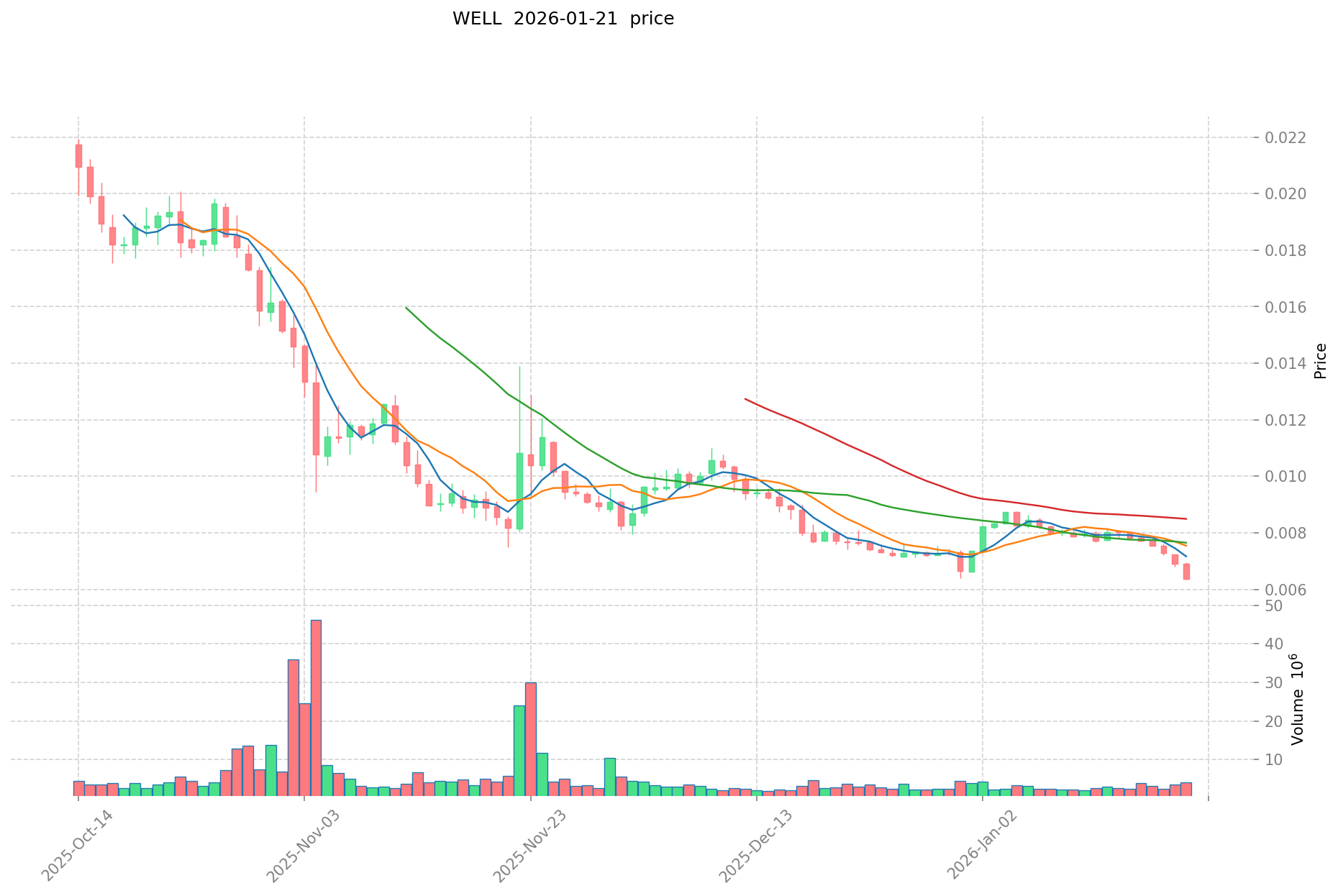
II. Core Factors Affecting Whether WELL is a Good Investment (Is Moonwell(WELL) a Good Investment)
Supply Mechanism and Scarcity (WELL investment scarcity)
- Fixed Supply Cap → Influences Price and Investment Value
- WELL has a maximum supply of 5,000,000,000 tokens, with approximately 4,529,877,852 tokens currently in circulation, representing a circulating ratio of 90.6%.
- The defined supply cap creates a scarcity mechanism that may support long-term value preservation as demand dynamics evolve.
- Historical Price Performance
- WELL reached a notable price level of $0.298797 on June 23, 2022, while experiencing a lower price point of $0.00298508 on December 21, 2022.
- As of January 21, 2026, the token trades at $0.006375, reflecting significant volatility over its trading history.
- Investment Significance: The controlled supply structure serves as one element supporting potential long-term investment consideration, though market dynamics and adoption rates remain key determinants.
Institutional Investment and Mainstream Adoption (Institutional investment in WELL)
- Platform Integration
- WELL is listed on 9 exchanges, providing accessibility for various investor segments.
- The token operates within the Moonbeam (GLMR) ecosystem, with its smart contract deployed at 0x511aB53F793683763E5a8829738301368a2411E3.
- Ecosystem Positioning
- Moonwell functions as an open lending DeFi protocol on Moonbeam and Moonriver networks, supporting assets including DOT, GLMR, wBTC, ETH, USDC, and FRAX.
- The protocol has collaborated with ImmuneFi for security audits and bug bounty programs, emphasizing user fund protection.
- Moonwell Apollo on Moonriver previously became one of the larger DeFi protocols within the Polkadot ecosystem.
Macroeconomic Environment's Impact on WELL Investment
- Market Context
- DeFi protocols like Moonwell may experience varying levels of demand based on broader monetary policy shifts, interest rate environments, and liquidity conditions in cryptocurrency markets.
- During periods of economic uncertainty or inflation concerns, decentralized lending platforms could see shifts in user activity as investors seek alternative yield opportunities.
- Regulatory and Geopolitical Factors
- Evolving regulatory frameworks for DeFi and lending protocols across jurisdictions may influence investor sentiment and operational dynamics for platforms like Moonwell.
Technology and Ecosystem Development (Technology & Ecosystem for WELL investment)
- Protocol Functionality
- Moonwell Artemis operates as an open lending protocol on the Moonbeam network, enabling users to engage in lending and borrowing activities within a decentralized framework.
- The protocol's integration with multiple asset types (DOT, GLMR, wBTC, ETH, USDC, FRAX) provides diversified collateral options for participants.
- Security and Audit Measures
- The project has undergone multiple security audits in partnership with ImmuneFi and maintains an active bug bounty program, addressing risk management considerations for protocol users.
- Ecosystem Applications
- As part of the broader DeFi landscape, Moonwell's lending infrastructure contributes to liquidity provision and capital efficiency within the Moonbeam and Moonriver networks.
- The protocol's positioning within the Polkadot ecosystem provides potential connectivity with cross-chain applications and interoperability features.
III. WELL Future Investment Predictions and Price Outlook (Is Moonwell(WELL) worth investing in 2026-2031)
Short-term Investment Prediction (2026, short-term WELL investment outlook)
- Conservative forecast: $0.0037 - $0.0064
- Neutral forecast: $0.0055 - $0.0075
- Optimistic forecast: $0.0070 - $0.0087
Mid-term Investment Outlook (2027-2029, mid-term Moonwell(WELL) investment forecast)
-
Market stage expectation: The protocol may experience gradual development within the DeFi lending sector on Moonbeam and Moonriver networks, with potential growth tied to broader adoption of cross-chain lending solutions and ecosystem expansion.
-
Investment return prediction:
- 2027: $0.0042 - $0.0079
- 2028: $0.0043 - $0.0086
- 2029: $0.0052 - $0.010
-
Key catalysts: Protocol upgrades, expansion of supported assets, growth in total value locked (TVL), increased adoption within the Polkadot ecosystem, partnerships within the DeFi space, and broader market sentiment toward decentralized lending platforms.
Long-term Investment Outlook (Is WELL a good long-term investment?)
- Base scenario: $0.0052 - $0.012 (assuming steady protocol development and moderate ecosystem growth)
- Optimistic scenario: $0.0080 - $0.014 (assuming enhanced adoption, significant TVL growth, and favorable market conditions)
- Risk scenario: $0.0030 - $0.0065 (under adverse market conditions, reduced DeFi activity, or competitive pressures)
Click to view WELL long-term investment and price prediction: Price Prediction
2026-01-21 - 2031 Long-term Outlook
- Base scenario: $0.0052 - $0.010 (corresponding to steady progress and gradual mainstream application enhancement)
- Optimistic scenario: $0.0067 - $0.014 (corresponding to large-scale adoption and favorable market environment)
- Transformative scenario: Above $0.014 (if the ecosystem achieves breakthrough developments and mainstream adoption)
- 2031-12-31 predicted high: $0.014 (based on optimistic development assumptions)
Disclaimer: These predictions are for informational purposes only and do not constitute investment advice. Cryptocurrency markets are highly volatile and subject to various risks. Investors should conduct their own research and consider their risk tolerance before making investment decisions.
| Year |
Predicted High Price |
Predicted Average Price |
Predicted Low Price |
Price Change |
| 2026 |
0.00867 |
0.006375 |
0.0036975 |
0 |
| 2027 |
0.007898625 |
0.0075225 |
0.0042126 |
18 |
| 2028 |
0.008558724375 |
0.0077105625 |
0.004317915 |
20 |
| 2029 |
0.010005611428125 |
0.0081346434375 |
0.0052061718 |
27 |
| 2030 |
0.011519061839671 |
0.009070127432812 |
0.005169972636703 |
42 |
| 2031 |
0.013897702758926 |
0.010294594636242 |
0.006691486513557 |
61 |
IV. WELL Investment Strategy and Risk Management (How to invest in DeFi lending tokens)
Investment Strategy (WELL investment strategy)
-
Long-term holding (HODL WELL): This approach may suit investors who believe in the long-term potential of decentralized lending protocols within the Polkadot ecosystem. Given Moonwell's positioning as an open lending protocol on Moonbeam and Moonriver networks, long-term holders would be betting on the growth of DeFi adoption across these platforms. However, investors should note WELL has experienced significant volatility, with a 1-year price decline of 87.11%, indicating substantial risk exposure.
-
Active trading: Traders utilizing technical analysis and swing trading methods might capitalize on WELL's price volatility. With 24-hour trading volume of approximately $23,887 and notable price swings (24-hour range: $0.006338 - $0.006668), active traders may find opportunities in short-term price movements. This approach requires continuous market monitoring and understanding of DeFi market dynamics.
Risk Management (Risk management for WELL investment)
-
Asset allocation ratios: Conservative investors might limit WELL exposure to 1-3% of their crypto portfolio, given its mid-cap status (market cap: ~$28.88 million) and recent negative performance trends. Aggressive investors comfortable with higher risk could allocate 5-10%, while professional investors with deep DeFi knowledge might consider larger positions based on fundamental protocol analysis.
-
Risk hedging strategies: Diversification across multiple DeFi protocols and layer-1 blockchain ecosystems can help mitigate protocol-specific risks. Investors might consider pairing WELL with stablecoin positions or other blue-chip crypto assets to balance portfolio volatility. Given WELL's correlation with the Polkadot ecosystem, monitoring DOT and GLMR performance provides additional risk context.
-
Secure storage: WELL tokens, deployed on the Moonbeam network (contract address: 0x511aB53F793683763E5a8829738301368a2411E3), should be stored in compatible wallets. For long-term holdings, hardware wallets supporting Moonbeam/Polkadot networks offer enhanced security. For active traders, reputable exchanges with strong security protocols may provide sufficient protection, though users should avoid keeping large amounts on exchanges long-term.
V. WELL Investment Risks and Challenges (Risks of investing in DeFi lending tokens)
-
Market risks: WELL demonstrates high volatility characteristics typical of mid-cap DeFi tokens. The token has declined 19.07% over 7 days and 19.35% over 30 days, illustrating significant short-term price fluctuations. With a circulating supply of 4.53 billion tokens (90.6% of max supply) and relatively low daily trading volume, the token may be susceptible to price manipulation or sudden liquidity shifts. The market cap to fully diluted valuation ratio of 90.6% suggests limited additional token inflation risk, though market sentiment remains a primary price driver.
-
Regulatory risks: As a DeFi lending protocol, Moonwell operates in a regulatory environment that varies significantly across jurisdictions. Lending protocols face ongoing scrutiny from financial regulators worldwide, with potential future regulations possibly impacting protocol operations, token utility, or accessibility in certain regions. Investors should monitor regulatory developments affecting DeFi platforms, particularly in major markets.
-
Technical risks: DeFi protocols face inherent smart contract vulnerabilities and network security concerns. While Moonwell has conducted multiple security audits through partnerships and implemented bug bounty programs via ImmuneFi, no protocol can guarantee absolute security. Network upgrades on Moonbeam or Moonriver could potentially impact protocol functionality. Additionally, as Moonwell's success depends on the broader health of the Polkadot ecosystem and connected networks, any technical issues affecting these underlying platforms could adversely impact WELL token value.
VI. Conclusion: Is DeFi lending token a Good Investment?
-
Investment value summary: WELL represents exposure to decentralized lending within the Polkadot ecosystem through the Moonbeam and Moonriver networks. While the protocol achieved notable early success with over $300 million TVL on Moonriver, the token has experienced substantial price depreciation (87.11% decline over one year). The project demonstrates operational functionality and security focus, but faces challenges common to mid-cap DeFi tokens including volatility, liquidity constraints, and ecosystem dependency.
-
Investor recommendations:
✅ Beginners: Consider dollar-cost averaging with small amounts only after understanding DeFi lending mechanics and Polkadot ecosystem basics. Prioritize secure wallet storage and never invest more than you can afford to lose.
✅ Experienced investors: May explore swing trading opportunities based on technical analysis, while maintaining strict position sizing and stop-loss disciplines. Consider WELL as a satellite position within a broader DeFi portfolio rather than a core holding.
✅ Institutional investors: Could evaluate Moonwell protocol fundamentals, total value locked trends, and competitive positioning within Polkadot DeFi before considering strategic allocation. Due diligence should include smart contract audits, team background, and governance structure assessment.
⚠️ Disclaimer: Cryptocurrency investments carry substantial risk, including potential total loss of capital. This analysis is provided for informational purposes only and does not constitute investment, financial, or legal advice. Conduct thorough independent research and consult qualified financial advisors before making investment decisions.
VII. FAQ
Q1: What is Moonwell (WELL) and how does its lending protocol work?
Moonwell (WELL) is an open lending DeFi protocol operating on the Moonbeam and Moonriver networks within the Polkadot ecosystem. The protocol enables users to lend and borrow various crypto assets including DOT, GLMR, wBTC, ETH, USDC, and FRAX. It functions as a decentralized lending platform where lenders supply assets to earn interest while borrowers can access liquidity by providing collateral. The protocol operates through two main deployments: Moonwell Apollo on Moonriver and Moonwell Artemis on Moonbeam, with smart contracts deployed at address 0x511aB53F793683763E5a8829738301368a2411E3 on the Moonbeam network.
Q2: Why has WELL's price declined significantly from its historical high?
WELL has experienced an 87.11% decline over one year, trading at approximately $0.006375 as of January 2026 compared to its historical peak of $0.298797 in June 2022. This significant price depreciation reflects multiple factors: broader cryptocurrency market downturns affecting DeFi protocols, reduced total value locked (TVL) in lending platforms, competitive pressures within the Polkadot DeFi ecosystem, and general market volatility characteristic of mid-cap tokens. Additionally, the shift in investor sentiment away from DeFi protocols during certain market cycles has contributed to sustained selling pressure on governance and utility tokens like WELL.
Q3: Is WELL suitable for long-term investment?
Long-term investment suitability depends on individual risk tolerance and conviction in DeFi lending growth within the Polkadot ecosystem. WELL demonstrates high volatility with substantial downside risk, as evidenced by recent price declines of 19.07% over 7 days and 19.35% over 30 days. While the protocol maintains operational functionality with security audits and a fixed supply cap of 5 billion tokens (90.6% circulating), it faces challenges including limited liquidity ($23,887 daily trading volume) and dependency on Moonbeam/Moonriver ecosystem health. Conservative long-term holders should limit exposure to 1-3% of portfolio allocation, understanding that mid-cap DeFi tokens carry elevated risk compared to established cryptocurrencies.
Q4: What are the main security features protecting WELL protocol users?
Moonwell prioritizes security through multiple protective measures: the protocol has undergone several security audits conducted in partnership with specialized blockchain security firms, maintaining an active bug bounty program through ImmuneFi to incentivize vulnerability discovery by white-hat hackers. These measures aim to identify and address potential smart contract vulnerabilities before exploitation. However, investors should recognize that no DeFi protocol can guarantee absolute security—smart contract risks remain inherent, and protocol upgrades on underlying networks (Moonbeam or Moonriver) could potentially introduce unforeseen technical challenges affecting WELL token holders and protocol participants.
Q5: How does WELL compare to other DeFi lending protocols?
WELL operates within a specialized niche as a lending protocol focused on the Polkadot ecosystem via Moonbeam and Moonriver networks, differentiating it from larger multi-chain lending platforms like Aave or Compound. With a market capitalization of approximately $28.88 million and ranking at position 734, WELL represents a smaller-scale protocol compared to industry leaders. Its competitive advantages include integration within the Polkadot ecosystem and support for DOT and GLMR alongside mainstream assets. However, it faces disadvantages including lower liquidity, limited exchange listings (9 exchanges), and reduced brand recognition compared to established lending protocols, which may impact its ability to attract significant total value locked growth.
Q6: What factors could drive WELL's price growth in 2026-2027?
Several catalysts could support WELL price appreciation in the near to mid-term: protocol upgrades enhancing functionality or user experience, expansion of supported collateral assets attracting broader user participation, significant growth in total value locked (TVL) demonstrating increased protocol adoption, successful partnerships within the Polkadot or broader DeFi ecosystems, favorable regulatory developments for decentralized lending platforms, and improved overall market sentiment toward mid-cap DeFi tokens. Additionally, any breakthrough developments in cross-chain interoperability within the Polkadot ecosystem could benefit Moonwell's positioning. However, price predictions ranging from $0.0055-$0.0075 (neutral forecast) to $0.0070-$0.0087 (optimistic forecast) for 2026 suggest modest growth expectations rather than dramatic appreciation.
Q7: What wallet options are available for storing WELL tokens safely?
WELL tokens, deployed on the Moonbeam network, require wallets compatible with the Polkadot ecosystem and EVM-compatible chains. For long-term holders prioritizing security, hardware wallets supporting Moonbeam/Polkadot networks such as Ledger or Trezor (with appropriate firmware) provide cold storage protection against online threats. Software wallet options include MetaMask configured for the Moonbeam network, Trust Wallet, or Moonbeam-specific wallets like Talisman or SubWallet. Active traders may choose to maintain positions on reputable exchanges offering WELL trading pairs, though this approach carries counterparty risk. Regardless of storage method, users should implement security best practices including strong passwords, two-factor authentication, and careful management of seed phrases.
Q8: What are the key risks investors should understand before investing in WELL?
Investors face multiple risk categories when considering WELL investment: Market risks include high volatility (19.07% weekly decline), low liquidity that may hinder large position exits, and susceptibility to broader crypto market downturns. Regulatory risks encompass evolving global frameworks for DeFi lending protocols that could impact operations or accessibility. Technical risks involve potential smart contract vulnerabilities despite security audits, network upgrade complications on Moonbeam or Moonriver, and dependency on underlying Polkadot ecosystem health. Additionally, competitive risks from established lending protocols and newer entrants could limit WELL's market share growth. The token's 87.11% one-year decline underscores the substantial risk of capital loss, emphasizing the importance of position sizing appropriate to individual risk tolerance.
* The information is not intended to be and does not constitute financial advice or any other recommendation of any sort offered or endorsed by Gate.












