This comprehensive analysis evaluates whether MultiversX (EGLD) represents a sound investment opportunity in 2026. Currently trading at $5.98 with a $174.28 million market cap, EGLD functions as the native token for MultiversX Network, leveraging adaptive sharding and Secure Proof-of-Stake consensus for scalability. The article examines EGLD's historical performance from its $542 peak in 2021 to current levels, analyzing supply scarcity (92.72% circulation ratio) and ecosystem fundamentals supporting long-term value. Short-term 2026 forecasts range from $4.67-$7.36, while long-term projections through 2031 suggest $6.42-$13.52 depending on adoption scenarios. Investment strategies span conservative dollar-cost averaging to active trading approaches, with comprehensive risk management guidance covering market volatility, regulatory uncertainty, and technical vulnerabilities. Real-time market data and price tracking available on Gate exchange facilitate informed decision-making for diverse investor profiles.
Introduction: MultiversX (EGLD) Investment Position and Market Outlook
MultiversX (EGLD) represents a notable asset in the cryptocurrency space, having evolved from its predecessor ERD in 2019 through a token upgrade at a 1000:1 ratio. As of January 16, 2026, EGLD maintains a market capitalization of approximately $174.28 million, with a circulating supply of 29.13 million tokens and a current price around $5.98. The token serves as the native unit of value for the MultiversX Network, functioning as a medium of exchange between network users, developers, and validators. With its positioning as a high-throughput blockchain platform focused on adaptive sharding technology and a secure proof-of-stake consensus mechanism, EGLD has become a subject of interest when investors evaluate "Is MultiversX (EGLD) a good investment?" This article provides a comprehensive analysis of EGLD's investment characteristics, historical price movements, future price outlook, and associated risks to assist investors in their decision-making process.
I. MultiversX (EGLD) Price History Review and Current Investment Status
- 2021: EGLD reached a price level around $542, representing a significant appreciation phase for early investors during the broader crypto market expansion.
- 2023: Following market corrections, EGLD price declined to approximately $22 in September, reflecting the broader crypto asset volatility during this period.
- 2024: Price showed recovery momentum, moving above the $50 level and reaching approximately $75 in mid-March, indicating renewed market interest.
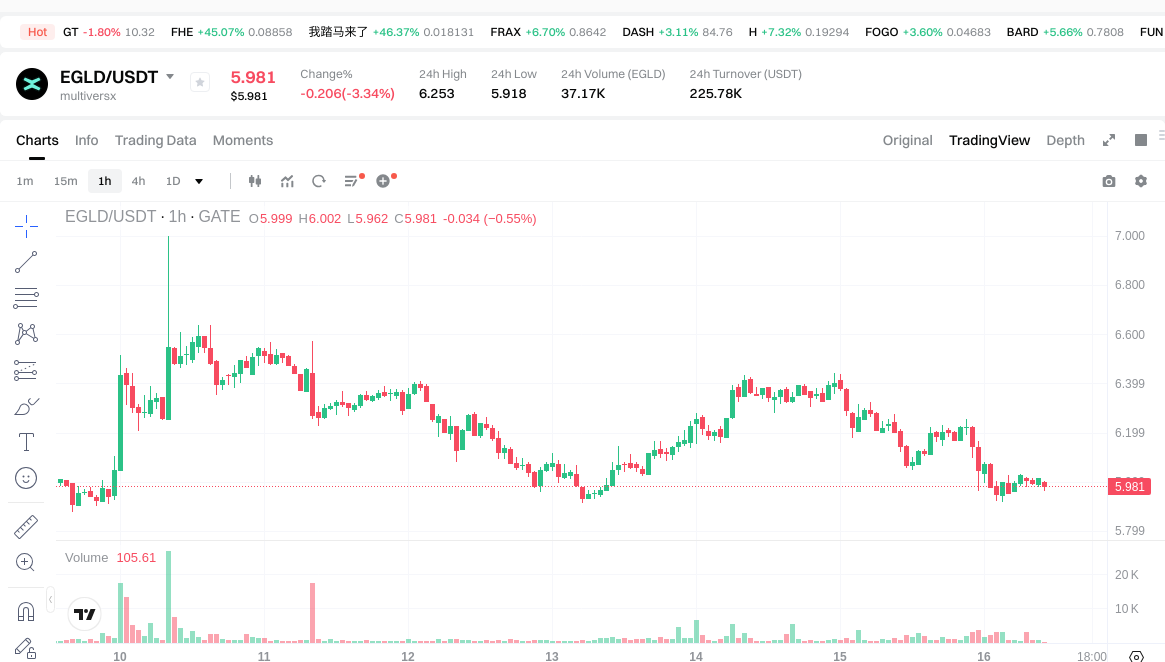
- Recent Period: As of January 2026, EGLD trades at $5.983, with circulating supply of 29,129,434 tokens.
Current EGLD Investment Market Status (January 2026)
- Current Price: $5.983 USD
- 24-Hour Price Change: -3.59%
- 24-Hour Trading Volume: $226,541.62
- Market Capitalization: $174,281,403.62
- Circulating Supply Ratio: 92.72% of total supply
- Price Range (24H): High $6.253 / Low $5.918
View real-time EGLD market price
II. Core Factors Influencing Whether EGLD is a Good Investment
Supply Mechanism and Scarcity (EGLD Investment Scarcity)
- Supply Structure: MultiversX (EGLD) operates with a circulating supply of 29,129,434 tokens and a maximum supply of 31,415,926 tokens, representing a circulation ratio of approximately 92.72%. This limited supply cap creates inherent scarcity that may support long-term value considerations.
- Economic Model Evolution: The project has introduced a general annual emission rate mechanism designed to balance staking rewards, network security, yield incentives, and ecosystem growth. This supply framework aims to create programmatic demand for EGLD while maintaining a structured token distribution approach.
- Investment Consideration: The relatively high circulation ratio and defined maximum supply indicate limited future dilution, which may be relevant for investors evaluating long-term scarcity dynamics.
Institutional Investment and Mainstream Adoption
- Network Usage Metrics: As of current data, the network records 9,153,257 holders, indicating a substantial user base across the MultiversX ecosystem.
- Strategic Economic Initiatives: The project has outlined plans to attract new liquidity, increase network usage, and generate protocol-level revenue through its Economic Evolution framework. These initiatives target the creation of sustained demand mechanisms for EGLD within decentralized finance applications.
- Adoption Framework: The Growth Dividend Fund initiative aims to convert the network's staked supply into deployable capital, potentially expanding EGLD's utility across various decentralized applications.
Macroeconomic Environment Impact on EGLD Investment
- Market Volatility Context: Price predictions for 2025 suggest potential fluctuations influenced by Bitcoin price action, broader cryptocurrency market sentiment, and global economic conditions. Forecasts indicate ranges from $13.20 to $91.71, reflecting significant uncertainty in macroeconomic factors.
- Market Positioning: With a market capitalization of approximately $174 million and a market dominance of 0.0051%, EGLD operates within a competitive landscape where broader market trends may substantially influence its performance.
- Economic Sensitivity: Analysis indicates that EGLD's short-term price movements are expected to correlate with investor sentiment and general economic conditions, suggesting sensitivity to macroeconomic factors.
Technology and Ecosystem Development (Technology & Ecosystem for EGLD Investment)
- Adaptive Sharding Technology: MultiversX employs adaptive sharding techniques combined with a secure Proof-of-Stake consensus mechanism, designed to provide scalability, efficiency, and interoperability for high-throughput blockchain operations.
- Developer Ecosystem: The project maintains an active developer community focused on blockchain innovation and real-world applications, which may contribute to long-term ecosystem expansion.
- DeFi Integration Strategy: The Economic Evolution blueprint explicitly targets DeFi applications through mechanisms that create active liquidity from staked supply. The Growth Dividend Fund is structured to programmatically drive EGLD demand within decentralized finance protocols, potentially expanding utility beyond basic network operations.
- Long-term Technical Positioning: Technical fundamentals emphasize scalability and interoperability as core value propositions, with ecosystem development aimed at sustained network utility and application diversity.
III. EGLD Future Investment Forecast and Price Outlook (Is MultiversX (EGLD) worth investing in 2026-2031)
Short-term Investment Forecast (2026, short-term EGLD investment outlook)
- Conservative forecast: $4.67 - $5.98
- Neutral forecast: $5.98 - $6.67
- Optimistic forecast: $6.67 - $7.36
Mid-term Investment Outlook (2027-2029, mid-term MultiversX (EGLD) investment forecast)
-
Market phase expectations: According to technical analysis projections, EGLD may experience gradual recovery momentum during the mid-term period, with market attention potentially increasing as the MultiversX ecosystem develops and technological advantages become more apparent.
-
Investment return forecast:
- 2027: $3.93 - $9.74
- 2028: $6.81 - $9.35
- 2029: $5.53 - $9.57
-
Key catalysts: Network scalability improvements, ecosystem expansion in metaverse and NFT infrastructure, adoption of sharding technology and Secure Proof of Stake consensus mechanism.
Long-term Investment Outlook (Is EGLD a good long-term investment?)
- Base scenario: $6.42 - $11.01 (assuming steady network development and moderate ecosystem growth through 2030)
- Optimistic scenario: $10.09 - $13.52 (assuming accelerated adoption and favorable market conditions through 2031)
- Risk scenario: Below $5.53 (in cases of severe market downturn or significant technological challenges)
Click to view EGLD long-term investment and price forecast: Price Prediction
2026-2031 Long-term Outlook
- Base scenario: $6.42 - $11.01 (corresponding to steady progress and gradual mainstream application enhancement)
- Optimistic scenario: $10.09 - $13.52 (corresponding to large-scale adoption and favorable market environment)
- Transformative scenario: Above $13.52 (if ecosystem achieves breakthrough progress and mainstream penetration)
- 2031-12-31 projected high: $13.52 (based on optimistic development assumptions)
Disclaimer: The above forecasts are based on technical analysis and historical data modeling. Cryptocurrency markets are highly volatile and influenced by multiple unpredictable factors. These projections should not be construed as investment advice, and investors should conduct thorough research and risk assessment before making any investment decisions.
| Year |
Predicted High Price |
Predicted Average Price |
Predicted Low Price |
Price Change |
| 2026 |
7.35663 |
5.981 |
4.66518 |
0 |
| 2027 |
9.7364699 |
6.668815 |
3.93460085 |
11 |
| 2028 |
9.351012393 |
8.20264245 |
6.8081932335 |
37 |
| 2029 |
9.566741889435 |
8.7768274215 |
5.529401275545 |
46 |
| 2030 |
11.006141586561 |
9.1717846554675 |
6.42024925882725 |
53 |
| 2031 |
13.519210582159095 |
10.08896312101425 |
6.86049492228969 |
68 |
IV. MultiversX (EGLD) Investment Strategy and Risk Management (How to invest in cryptocurrency)
Investment Methodology (MultiversX investment strategy)
Long-term Holding (HODL MultiversX)
Long-term holding represents a strategy suitable for conservative investors who believe in the fundamental value proposition of MultiversX's sharding technology and Secure Proof of Stake consensus mechanism. This approach involves acquiring EGLD tokens and maintaining positions through market cycles, focusing on the network's technological development and adoption metrics rather than short-term price movements.
Given MultiversX's position as a high-throughput blockchain platform, long-term holders typically evaluate factors such as network upgrades, developer activity, and ecosystem expansion when making holding decisions. The strategy requires patience and conviction in the project's ability to deliver on its scalability and interoperability objectives.
Active Trading
Active trading strategies rely on technical analysis and swing trading techniques to capitalize on EGLD's price volatility. Traders monitor price trends across multiple timeframes, utilizing indicators and chart patterns to identify entry and exit points.
With EGLD experiencing a 24-hour price range between 5.918 and 6.253, active traders may find opportunities in intraday and short-term movements. This approach demands continuous market monitoring, risk management discipline, and the ability to respond quickly to market sentiment shifts.
Risk Management (Risk management for MultiversX investment)
Asset Allocation Ratios
Conservative Investors: May consider allocating 1-3% of their cryptocurrency portfolio to EGLD, maintaining a diversified approach across multiple established digital assets and traditional investments.
Aggressive Investors: Could allocate 5-10% of their cryptocurrency holdings to EGLD, accepting higher volatility in exchange for potential growth opportunities from the platform's technological innovations.
Professional Investors: Might deploy 10-15% or more based on thorough due diligence, active monitoring capabilities, and sophisticated risk management frameworks.
Risk Hedging Solutions
A multi-asset portfolio approach helps mitigate concentration risk. Investors may consider combining EGLD holdings with:
- Established cryptocurrencies with different use cases
- Stablecoins for liquidity management
- Other blockchain platforms with complementary technologies
Hedging tools such as stop-loss orders, position sizing strategies, and periodic rebalancing can help manage downside exposure while maintaining upside participation.
Secure Storage
Cold and Hot Wallet Solutions:
- Cold wallets (offline storage) are recommended for long-term holdings, providing enhanced security against online threats
- Hot wallets (online storage) offer convenience for active trading and frequent transactions
Hardware Wallet Recommendations:
Hardware wallets provide a balance between security and accessibility, storing private keys offline while enabling transaction signing when needed. Investors should research compatible hardware wallet options that support EGLD and follow best practices for backup and recovery phrase storage.
V. MultiversX (EGLD) Investment Risks and Challenges (Risks of investing in cryptocurrency)
Market Risk
High Volatility: EGLD has demonstrated significant price fluctuations, with a 24-hour change of -3.59% and a 30-day movement of -13.66%. The token's price has ranged from a low of 5.39 to a high of 545.64 throughout its trading history, illustrating the substantial volatility characteristic of cryptocurrency markets.
Price Manipulation Concerns: Lower market capitalization cryptocurrencies may be more susceptible to price manipulation through coordinated trading activities. With a circulating market cap of approximately 174.28 million and trading across 39 exchanges, investors should remain aware of potential market inefficiencies and unusual trading patterns.
Regulatory Risk
Policy Uncertainty Across Jurisdictions: Cryptocurrency regulations vary significantly across different countries and continue to evolve. Changes in regulatory frameworks can impact:
- Token classification and legal status
- Exchange listing requirements and accessibility
- Taxation treatment for holders and traders
- Cross-border transaction capabilities
Investors should monitor regulatory developments in their jurisdictions and consider how policy changes might affect EGLD's accessibility, utility, and market dynamics.
Technical Risk
Network Security Vulnerabilities: As with any blockchain platform, potential security vulnerabilities in smart contracts, consensus mechanisms, or network infrastructure could pose risks to token holders and network participants. While MultiversX employs a Secure Proof of Stake consensus mechanism, ongoing security audits and monitoring remain important.
Upgrade Implementation Challenges: Network upgrades and protocol changes carry inherent risks, including potential bugs, temporary network disruptions, or community disagreements regarding development direction. The successful execution of technical roadmap items requires careful coordination and testing.
VI. Conclusion: Is Cryptocurrency a Good Investment?
Investment Value Summary
MultiversX (EGLD) presents a technological proposition focused on scalability, security, and interoperability through adaptive sharding and Secure Proof of Stake consensus. The platform's high-throughput capabilities position it within the competitive landscape of blockchain infrastructure projects.
Long-term investment potential depends on the project's ability to execute its technical roadmap, attract developers and users, and differentiate itself in an evolving ecosystem. Short-term price movements reflect broader cryptocurrency market dynamics, with EGLD experiencing volatility consistent with mid-cap digital assets.
With 92.72% of maximum supply in circulation and a market cap of approximately 174.28 million, EGLD represents a mid-tier cryptocurrency investment opportunity with corresponding risk-reward characteristics.
Investor Recommendations
✅ Beginners: Consider dollar-cost averaging strategies combined with secure wallet storage practices. Focus on understanding the project's fundamentals and blockchain technology basics before making allocation decisions.
✅ Experienced Investors: Evaluate swing trading opportunities based on technical analysis while maintaining a core position. Implement diversified portfolio allocation across multiple blockchain platforms and use cases.
✅ Institutional Investors: Conduct thorough due diligence on technology architecture, team credentials, and competitive positioning. Consider strategic long-term allocation as part of a broader blockchain infrastructure investment thesis.
⚠️ Important Notice: Cryptocurrency investments involve substantial risk and high volatility. This content is provided for informational purposes only and does not constitute investment advice, financial consultation, or recommendations to buy or sell any digital assets. Investors should conduct independent research, assess their risk tolerance, and consult with qualified financial advisors before making investment decisions.
VII. FAQ
Q1: What is MultiversX (EGLD) and how does it differ from other blockchain platforms?
MultiversX (EGLD) is a high-throughput blockchain platform that utilizes adaptive sharding technology and a Secure Proof of Stake consensus mechanism to achieve scalability, security, and interoperability. The key differentiator lies in its sharding approach, which divides the network into smaller, parallel processing units to significantly increase transaction throughput compared to traditional single-chain architectures. EGLD serves as the native token for the MultiversX Network, functioning as a medium of exchange between users, developers, and validators while also playing a role in network security through staking mechanisms.
Q2: How has EGLD's price performed historically and what is its current market status?
EGLD reached its historical peak around $542 in 2021 during the broader crypto market expansion, but subsequently declined to approximately $22 in September 2023 following market corrections. The token showed recovery momentum in 2024, reaching approximately $75 in mid-March. As of January 16, 2026, EGLD trades at $5.98 with a market capitalization of approximately $174.28 million and a circulating supply of 29.13 million tokens (92.72% of maximum supply). The 24-hour trading volume stands at $226,541.62, with the token experiencing -3.59% price movement in the past day.
Q3: What are the main factors that could influence EGLD's future investment potential?
Four primary factors influence EGLD's investment outlook: (I) Supply scarcity - with 92.72% of maximum supply already in circulation, limited future dilution may support long-term value considerations; (II) Ecosystem development - the platform's adaptive sharding technology and growing developer community targeting DeFi applications and real-world use cases; (III) Market adoption metrics - currently supporting 9.15 million holders and listed on 39 exchanges; (IV) Macroeconomic conditions - broader cryptocurrency market sentiment, Bitcoin price action, and global economic factors that create volatility in mid-cap digital assets.
Q4: What investment strategies are suitable for different types of EGLD investors?
Conservative investors may consider a long-term holding (HODL) strategy with 1-3% portfolio allocation, focusing on the project's technological fundamentals and ecosystem development rather than short-term price movements. Aggressive investors could allocate 5-10% of their cryptocurrency holdings and employ active trading strategies utilizing technical analysis to capitalize on price volatility. Professional investors might deploy 10-15% or more based on thorough due diligence, implementing sophisticated risk management frameworks including stop-loss orders, position sizing, and periodic rebalancing across a diversified blockchain infrastructure portfolio.
Q5: What are the primary risks associated with investing in EGLD?
Three major risk categories affect EGLD investments: (I) Market risk - significant price volatility demonstrated by a 30-day movement of -13.66% and historical price range from $5.39 to $545.64, along with potential price manipulation concerns given its mid-cap status; (II) Regulatory risk - evolving cryptocurrency regulations across jurisdictions that may impact token classification, exchange accessibility, taxation treatment, and cross-border transactions; (III) Technical risk - potential security vulnerabilities in smart contracts or consensus mechanisms, and implementation challenges during network upgrades that could affect network stability and user confidence.
Q6: What is the price forecast for EGLD in the short to long term?
Short-term forecasts for 2026 range from $4.67 (conservative) to $7.36 (optimistic), with neutral expectations around $5.98-$6.67. Mid-term projections show potential ranges of $3.93-$9.74 for 2027, $6.81-$9.35 for 2028, and $5.53-$9.57 for 2029, contingent on ecosystem expansion and technological adoption. Long-term outlook through 2031 presents a base scenario of $6.42-$11.01 assuming steady network development, an optimistic scenario of $10.09-$13.52 with accelerated adoption, and a risk scenario below $5.53 in cases of severe market downturns. These projections are based on technical analysis and historical data modeling but should not be construed as investment advice given cryptocurrency market volatility.
Q7: How should investors securely store their EGLD tokens?
EGLD storage requires a balanced approach between security and accessibility based on investment strategy. Long-term holders should utilize cold wallet solutions (offline storage) that provide enhanced security against online threats and hacking attempts. Active traders may prefer hot wallets (online storage) for convenience during frequent transactions, though with elevated security risks. Hardware wallets offer an optimal middle ground, storing private keys offline while enabling transaction signing when needed. Regardless of storage method, investors should implement best practices including secure backup of recovery phrases, use of multi-factor authentication, and regular security audits of their storage solutions.
Q8: Is MultiversX (EGLD) suitable for beginner cryptocurrency investors?
EGLD can be suitable for beginners who approach it with appropriate risk management and education. New investors should consider dollar-cost averaging strategies to mitigate timing risk, allocate only 1-3% of their total portfolio to EGLD, and prioritize understanding blockchain technology fundamentals and the project's value proposition before investing. Beginners should establish secure wallet storage practices, avoid emotional trading decisions during price volatility, and recognize that EGLD's mid-cap status involves higher risk compared to established cryptocurrencies. Most importantly, beginners should only invest amounts they can afford to lose and conduct independent research rather than relying solely on price predictions or social media sentiment.
* The information is not intended to be and does not constitute financial advice or any other recommendation of any sort offered or endorsed by Gate.