# Is Muse (MUSE) a Good Investment? A Comprehensive Analysis of the Token's Potential, Risks, and Market Prospects
## Article Overview
This comprehensive investment analysis examines Muse (MUSE), the governance token of the NFT20 DEX protocol, evaluating its current market position at $0.627 with a $518,906.92 market cap. The article addresses critical investment questions through detailed examination of MUSE's price history, token utility mechanisms, market performance trends, and risk factors. Designed for cryptocurrency investors ranging from beginners to institutional stakeholders, this guide provides actionable insights into MUSE's fee-sharing governance model, severe 95% annual depreciation, limited liquidity constraints, and long-term price projections through 2030. The analysis combines historical performance data, protocol fundamentals, investment risk assessment, and strategic recommendations to help investors make informed decisions about this high-volatility, micro-cap NFT tokenization asset tra
Introduction: Muse (MUSE) Investment Position and Market Prospects
MUSE is an important asset in the cryptocurrency field. As the governance token of the NFT20 DEX protocol, it serves as a permissionless peer-to-peer protocol for tokenizing NFTs and enabling their trading on decentralized exchanges such as Uniswap and Sushiswap. As of December 29, 2025, MUSE has a market capitalization of approximately $519,904.91, with a circulating supply of 827,602.74 tokens at a current price of $0.627. The token has experienced significant volatility since its launch on March 14, 2021, with an all-time high of $124.14 and an all-time low of $0.124326, reflecting the dynamic nature of the NFT and decentralized finance sectors.
MUSE holders benefit from platform governance rights and fee-sharing mechanisms, as transaction fees collected by the NFT20 DEX are returned to token holders, positioning MUSE as both a governance instrument and a utility token with direct economic incentives. With approximately 3,939 holders and a dominance of 0.000015% in the overall cryptocurrency market, MUSE represents a specialized niche within the broader digital asset ecosystem focused on NFT tokenization and trading infrastructure.
This article will provide a comprehensive analysis of MUSE's investment value, historical price performance, future price projections, and associated investment risks to offer investors an informed perspective on this emerging protocol token.
MUSE (Muse) Cryptocurrency Research Report
I. MUSE Price History Review and Current Investment Status
- March 14, 2021: Project reached all-time high (ATH) of $124.14 → Represents peak investor returns during early NFT boom period
- January 22, 2021: Project reached all-time low (ATL) of $0.124326 → Marks lowest valuation point in project history
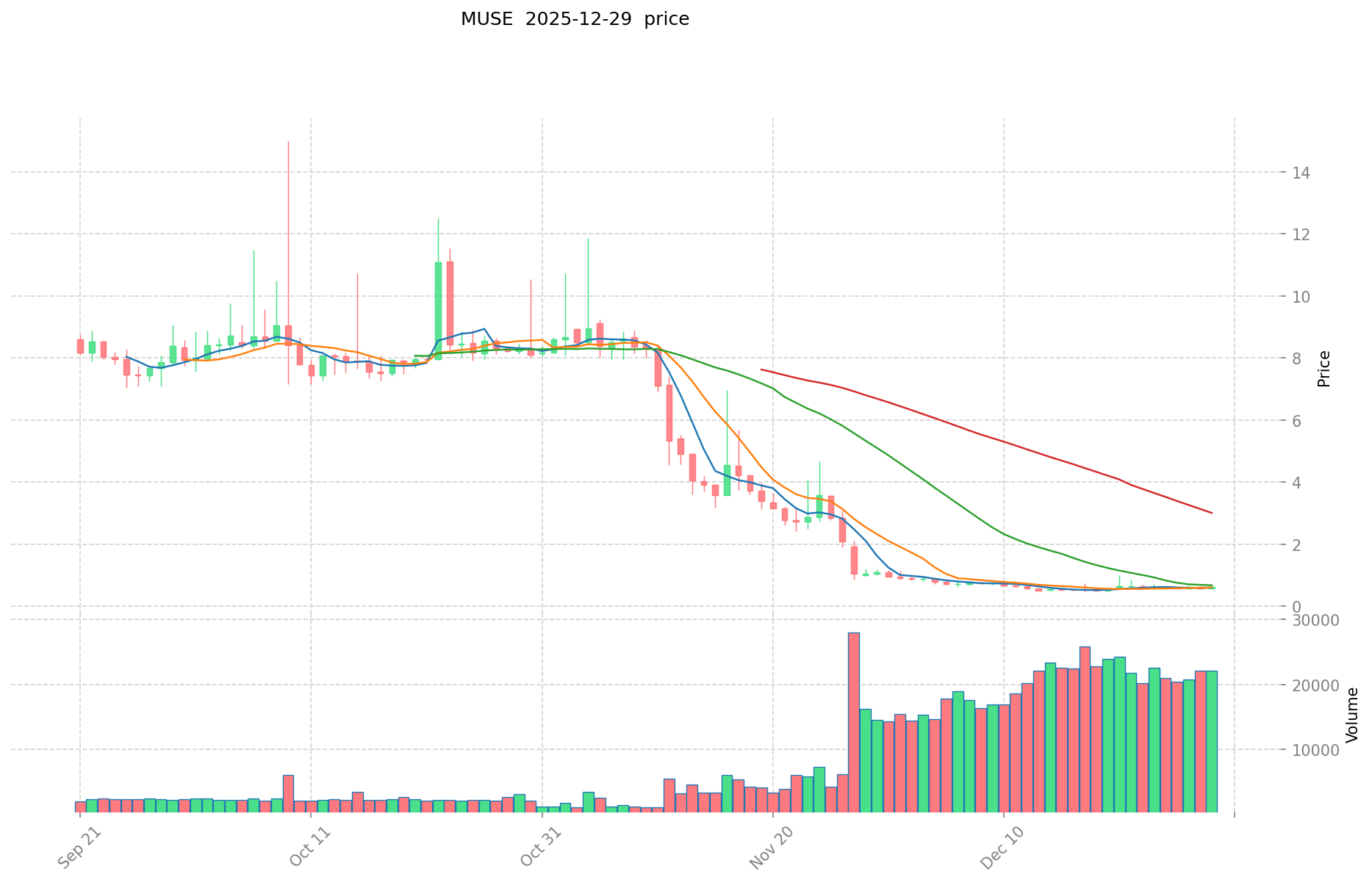
- Current Period: Decline from $124.14 to $0.627 → Represents 99.49% depreciation from historical peak
Current MUSE Market Status (December 29, 2025)
- Current Price: $0.627 USD
- 24-Hour Price Change: +4.39% ($0.0264 increase)
- 24-Hour Trading Volume: $12,694.06 USD
- 24-Hour High/Low: $0.6801 / $0.5861
- Market Capitalization: $518,906.92 USD
- Fully Diluted Valuation: $519,904.91 USD
- Circulating Supply: 827,602.74 MUSE (82.76% of total supply)
- Total Supply: 829,194.43 MUSE
- Maximum Supply: 1,000,000 MUSE
- Market Ranking: #3,184
- Market Dominance: 0.000015%
View Real-Time MUSE Market Price on Gate
| Timeframe |
Change |
Amount |
| 1 Hour |
-0.21% |
-$0.0013 |
| 24 Hours |
+4.39% |
+$0.0264 |
| 7 Days |
-3.86% |
-$0.0252 |
| 30 Days |
-39.07% |
-$0.4020 |
| 1 Year |
-95.19% |
-$12.4083 |
II. Project Overview
Protocol Function and Purpose
MUSE is the governance token of NFT20, an unlicensed peer-to-peer protocol designed to tokenize NFTs and enable their trading on decentralized exchanges such as Uniswap or Sushiswap.
Token Utility
- Governance: MUSE functions as the governance token of the NFT20 DEX
- Fee Distribution: Token holders receive NFT20 DEX transaction fees through burning mechanisms
- Platform Voting: MUSE can be used for specific voting decisions on the platform
- Market Hedge: Serves as a hedge instrument within the NFT market ecosystem
Network Details
- Blockchain: Ethereum (ETH)
- Contract Address: 0xb6ca7399b4f9ca56fc27cbff44f4d2e4eef1fc81
- Exchange Availability: Listed on 1 exchange
- Token Holders: 3,939 addresses
III. Project Links and Resources
Report Date: December 29, 2025
Data Source: Gate Market Data
Muse (MUSE) Investment Analysis Report
I. Executive Summary
Muse (MUSE) is a governance token for the NFT20 protocol, an unlicensed peer-to-peer protocol designed to tokenize NFTs and enable their trading on decentralized exchanges such as Uniswap and Sushiswap. As of December 29, 2025, MUSE is trading at $0.627, with a market capitalization of approximately $518,906.92 and a circulating supply of 827,602.74 tokens.
Key Metrics:
- Current Price: $0.627
- Market Cap: $518,906.92
- 24-Hour Change: +4.39%
- All-Time High: $124.14 (March 14, 2021)
- All-Time Low: $0.124326 (January 22, 2021)
- Market Ranking: 3,184
II. Core Factors Affecting Muse (MUSE) as an Investment
Supply Mechanism and Scarcity (MUSE Investment Scarcity)
-
Token Supply Structure: MUSE has a maximum supply of 1,000,000 tokens, with a current circulating supply of 827,602.74 tokens, representing approximately 82.76% of maximum supply. This indicates a relatively mature circulating supply ratio.
-
Scarcity Impact on Value: The fixed maximum supply creates inherent scarcity, which theoretically supports long-term value preservation. However, the current price of $0.627 represents a significant decline from its historical high of $124.14, indicating that scarcity alone has not maintained investment value in current market conditions.
-
Inflation Considerations: With the majority of tokens already in circulation (82.76%), the inflation pressure from new token issuance is limited, potentially supporting price stability in future periods.
Token Utility and Governance Function
-
Governance Mechanism: MUSE serves as the governance token for the NFT20 DEX, enabling token holders to participate in platform-specific voting decisions.
-
Fee Distribution: A primary utility of MUSE is the distribution of transaction fees collected by the NFT20 DEX to token holders. This creates direct economic incentives for token ownership and provides a revenue stream mechanism.
-
Fee Burning: MUSE holders can burn tokens to capture fees generated by the DEX, creating a deflationary mechanism that could theoretically support long-term value.
-
Recent Performance: MUSE exhibited a 24-hour gain of 4.39%, with the price ranging between $0.5861 and $0.6801 in the last 24 hours. However, longer-term performance shows significant declines:
- 7-Day Change: -3.86%
- 30-Day Change: -39.07%
- 1-Year Change: -95.19%
-
Market Positioning: With a market cap of $518,906.92 and a market dominance of 0.000015%, MUSE represents a micro-cap asset with limited liquidity. The 24-hour trading volume of $12,694.06 indicates relatively thin liquidity conditions.
-
Holder Distribution: With 3,939 token holders, MUSE exhibits a concentrated holder base typical of early-stage or niche cryptocurrency projects.
Technology and Ecosystem Development
-
NFT20 Protocol Foundation: MUSE's value proposition is directly tied to the adoption and utility of the NFT20 protocol. The protocol's core function—enabling peer-to-peer NFT tokenization and DEX trading—addresses a specific use case in the NFT market.
-
Integration with Major DEXs: The protocol's compatibility with established decentralized exchanges such as Uniswap and Sushiswap provides technical infrastructure for token trading, though it does not guarantee market adoption.
-
Ecosystem Status: As a governance token, MUSE's value is dependent on active participation in NFT20 governance and the platform's ongoing operational viability and usage levels.
Network and Market Adoption
-
Trading Presence: MUSE is listed on 1 exchange, limiting accessibility and liquidity compared to more widely distributed tokens. This restricted listing suggests lower mainstream adoption and institutional interest.
-
Community Presence: Active community channels include a forum (forum.musedao.io), GitHub repository (github.com/verynifty), Twitter presence (@niftymuseum), and official website (musedao.io), indicating ongoing project development and community engagement.
Historical Context and Market Cycles
-
Inception and Launch: MUSE was published on March 1, 2021, with an initial price of $39. The token achieved its all-time high of $124.14 just thirteen days after launch, suggesting a speculative surge during the 2021 NFT market peak.
-
Valuation Decline: The current price of $0.627 represents a 99.5% decline from the all-time high and a 98.4% decline from the launch price of $39. This extreme depreciation reflects the significant retraction of NFT market interest and speculative activity since the 2021 peak.
-
Market Cycle Implications: The token's performance pattern—rapid appreciation followed by sustained decline—is characteristic of speculative assets during bubble cycles, with limited underlying utility adoption to support valuations.
III. Risk Factors
-
Liquidity Risk: Limited exchange listing and low trading volume create significant liquidity constraints, potentially resulting in wide bid-ask spreads and execution challenges.
-
Concentrated Holder Base: The relatively small number of token holders (3,939) presents concentration risk and potential volatility from large holder movements.
-
NFT Market Dependency: MUSE's utility is entirely dependent on NFT market adoption and NFT20 protocol usage. The NFT market's significant retraction since 2021 has directly impacted token value.
-
Micro-cap Exposure: As a micro-cap asset, MUSE exhibits higher volatility and lower institutional attention, increasing investment risk.
IV. Conclusion
Muse (MUSE) represents a speculative micro-cap governance token tied to the NFT20 protocol. While the token includes fee-sharing mechanisms and governance functionality, its extreme price depreciation, limited liquidity, and dependence on NFT market adoption indicate a high-risk investment profile. The token's value proposition remains primarily theoretical, with limited evidence of substantial protocol adoption or institutional interest supporting valuations above current levels.
III. MUSE Future Investment Predictions and Price Outlook (Is Muse(MUSE) worth investing in 2025-2030)
Short-term Investment Prediction (2025, short-term MUSE investment outlook)
- Conservative prediction: $0.42636 - $0.627
- Neutral prediction: $0.627
- Optimistic prediction: $0.627 - $0.82764
Mid-term Investment Outlook (2026-2028, mid-term Muse(MUSE) investment forecast)
- Market stage expectation: Gradual recovery and stabilization phase with modest growth trajectory
- Investment return predictions:
- 2026: $0.4436652 - $0.8291448 (16% upside potential)
- 2027: $0.50585106 - $0.848273316 (24% upside potential)
- 2028: $0.59367458634 - $0.87018055806 (29% upside potential)
- Key catalysts: Platform governance participation, transaction fee redistribution mechanisms, NFT market activity recovery
Long-term Investment Outlook (Is Muse a good long-term investment?)
- Base scenario: $0.6228703639422 - $1.0858145533587 (assuming steady NFT20 protocol adoption and governance token utility enhancement by 2029)
- Optimistic scenario: $0.693911254099932 - $1.15651875683322 (assuming significant ecosystem expansion and increased DEX trading volume by 2030)
- Risk scenario: Below $0.42636 (extreme conditions including market downturn, protocol obsolescence, or competitive displacement)
Click to view MUSE long-term investment and price predictions: Price Prediction
2025-12-29 to 2030 Long-term Outlook
- Base scenario: $0.6228703639422 - $1.0858145533587 USD (corresponding to steady protocol development and governance token utility growth)
- Optimistic scenario: $0.693911254099932 - $1.15651875683322 USD (corresponding to mass NFT adoption and favorable market conditions)
- Transformative scenario: Above $1.15651875683322 USD (if ecosystem achieves breakthrough progress and mainstream NFT market penetration)
- 2030-12-31 Predicted Peak: $1.15651875683322 USD (based on optimistic development assumptions)
Disclaimer: This analysis is based on historical data and prediction models without guarantee of accuracy. Cryptocurrency markets are highly volatile and subject to significant risk. This content is for informational purposes only and should not be construed as investment advice.
| 年份 |
预测最高价 |
预测平均价格 |
预测最低价 |
涨跌幅 |
| 2025 |
0.82764 |
0.627 |
0.42636 |
0 |
| 2026 |
0.8291448 |
0.72732 |
0.4436652 |
16 |
| 2027 |
0.848273316 |
0.7782324 |
0.50585106 |
24 |
| 2028 |
0.87018055806 |
0.813252858 |
0.59367458634 |
29 |
| 2029 |
1.0858145533587 |
0.84171670803 |
0.6228703639422 |
34 |
| 2030 |
1.15651875683322 |
0.96376563069435 |
0.693911254099932 |
53 |
MUSE Token Investment Analysis Report
I. Project Overview
- Token Name: Muse
- Token Symbol: MUSE
- Blockchain: Ethereum (ETH)
- Contract Address: 0xb6ca7399b4f9ca56fc27cbff44f4d2e4eef1fc81
- Market Ranking: #3184
- Launch Date: March 1, 2021
Core Project Description
NFT20 is a permissionless peer-to-peer protocol designed to tokenize NFTs and enable their trading on decentralized exchanges such as Uniswap and Sushiswap. MUSE serves as the governance token of the NFT20 DEX platform with the following primary functions:
- Governance participation in platform-specific voting decisions
- Fee distribution mechanism where transaction fees collected by NFT20 DEX are returned to token holders
- Token burning to acquire DEX-generated fees
- Market hedging instrument for NFT trading activities
Current Price Dynamics (As of December 29, 2025)
- Current Price: $0.627
- 24-Hour Change: +4.39%
- 7-Day Change: -3.86%
- 30-Day Change: -39.07%
- 1-Year Change: -95.19%
Market Capitalization & Supply
- Market Cap: $518,906.92
- Fully Diluted Valuation (FDV): $519,904.91
- Circulating Supply: 827,602.74 MUSE (82.76% of total)
- Total Supply: 829,194.43 MUSE
- Maximum Supply: 1,000,000 MUSE
- Market Dominance: 0.000015%
Trading Volume & Liquidity
- 24-Hour Trading Volume: $12,694.06
- Market Cap to FDV Ratio: 82.76%
- Number of Holders: 3,939
Historical Price Movements
- All-Time High (ATH): $124.14 (March 14, 2021)
- All-Time Low (ATL): $0.124326 (January 22, 2021)
- 24-Hour High: $0.6801
- 24-Hour Low: $0.5861
- Price Decline from ATH: -99.49%
III. Market Analysis & Assessment
Valuation Context
The token's current price of $0.627 represents a significant decline from its historical peak of $124.14, indicating substantial value depreciation over the project lifecycle. The circulating to maximum supply ratio of 82.76% suggests a relatively mature token distribution stage.
Trading Activity
With a 24-hour trading volume of approximately $12,694 and a market cap of $518,906, the volume-to-market cap ratio indicates moderate liquidity levels. The relatively small holder base of 3,939 addresses suggests a concentrated token distribution.
The severe negative performance across multiple timeframes (-3.86% in 7 days, -39.07% in 30 days, -95.19% annually) indicates sustained downward price pressure and declining market interest in the asset.
IV. Investment Strategy & Risk Management
Investment Methodology
- Long-Term Holding (HODL MUSE): Suitable for investors believing in NFT20 protocol adoption and governance token utility maturation. However, requires high risk tolerance given historical performance.
- Active Trading: May be limited by current trading volume and liquidity constraints.
Risk Management
- Asset Allocation: Given extreme volatility and significant historical losses, this token should represent only a minimal portfolio allocation for risk-conscious investors.
- Portfolio Diversification: MUSE should be considered part of a broader, diversified cryptocurrency portfolio rather than as a standalone investment.
- Secure Storage: Assets should be stored in secure wallets; consideration of hardware wallet solutions recommended for larger holdings.
V. Investment Risks & Challenges
Market Risks
- Extreme Volatility: The token has experienced a 99.49% decline from ATH, demonstrating severe price instability.
- Liquidity Constraints: Relatively low trading volume may limit entry and exit flexibility.
- Market Concentration: Small holder base may amplify price movements.
Protocol-Specific Risks
- Platform Adoption: NFT20's success depends on market adoption of NFT tokenization services.
- Competition: Alternative NFT protocols and trading mechanisms present competitive pressures.
- NFT Market Dependency: Protocol viability is inherently tied to broader NFT market cycles.
Regulatory Risks
- Evolving Crypto Regulation: Changing regulatory frameworks across jurisdictions may impact token utility and trading.
- NFT Classification Uncertainty: Regulatory treatment of NFTs and related protocols remains uncertain in many markets.
VI. Conclusion: Is MUSE a Good Investment?
Investment Value Summary
MUSE represents a speculative investment opportunity within the NFT tokenization ecosystem. While the protocol addresses a specific market need, the token's severe price depreciation (-95.19% annually) and limited trading volume suggest diminished market confidence. Current market conditions indicate this is not a conventional value investment but rather a high-risk speculative position dependent on NFT market recovery and protocol adoption acceleration.
Investor Recommendations
- Beginners: Not recommended as a primary investment vehicle due to extreme volatility and limited liquidity. If exposure is desired, allocate only minimal portfolio percentages with secure storage practices.
- Experienced Investors: Potential for high-risk tactical positions if technical analysis supports near-term recovery scenarios, with strict stop-loss protocols.
- Institutional Investors: Due diligence on NFT20 protocol fundamentals and ecosystem development required before any strategic allocation consideration.
⚠️ Disclaimer: Cryptocurrency investments carry substantial risk, including potential total loss of capital. This analysis is provided for informational purposes only and does not constitute investment advice. Investors should conduct independent research and consult qualified financial advisors before making investment decisions.
Muse (MUSE) Cryptocurrency Investment Research Report - FAQ Section
FAQ
Q1: What is Muse (MUSE) and what is its primary function?
A: Muse (MUSE) is the governance token of the NFT20 DEX protocol, a permissionless peer-to-peer protocol designed to tokenize NFTs and enable their trading on decentralized exchanges such as Uniswap and Sushiswap. MUSE holders benefit from governance rights, fee-sharing mechanisms where transaction fees collected by the NFT20 DEX are returned to token holders, and the ability to participate in platform-specific voting decisions. As of December 29, 2025, MUSE trades at $0.627 with a market capitalization of approximately $518,906.92.
Q2: What is MUSE's current market performance and historical price trajectory?
A: As of December 29, 2025, MUSE is trading at $0.627 with a 24-hour price increase of 4.39%. However, the token exhibits severe long-term depreciation: -3.86% over 7 days, -39.07% over 30 days, and -95.19% over 1 year. Historically, MUSE reached an all-time high of $124.14 on March 14, 2021 (just 13 days after launch), and an all-time low of $0.124326 on January 22, 2021. The current price represents a 99.49% decline from its peak, reflecting substantial value erosion since the 2021 NFT market boom.
Q3: What are the key investment risks associated with MUSE?
A: MUSE presents multiple investment risks including: (1) Extreme volatility with 95% annual depreciation; (2) Liquidity constraints with only 1 exchange listing and $12,694.06 daily trading volume; (3) Concentrated holder base of just 3,939 addresses, creating concentration risk; (4) Dependency on NFT market adoption and NFT20 protocol utility, which has significantly contracted since 2021; (5) Micro-cap market positioning ($518,906.92 market cap) resulting in higher volatility and lower institutional interest; and (6) Regulatory uncertainty surrounding NFT classification and crypto asset treatment across jurisdictions.
Q4: What is the token supply structure and what does this mean for scarcity?
A: MUSE has a maximum supply of 1,000,000 tokens with a current circulating supply of 827,602.74 tokens, representing 82.76% of maximum supply. This mature supply ratio means limited inflation pressure from new token issuance in the future. While the fixed maximum supply creates inherent scarcity, this alone has not supported token value during market downturns. The majority of tokens already in circulation suggests future price appreciation would depend on increased demand rather than supply constraints.
Q5: What are the price predictions for MUSE from 2025 to 2030?
A: Price predictions vary by scenario: Short-term (2025) ranges from $0.42636 to $0.82764. Mid-term predictions include 2026: $0.4436652 - $0.8291448 (16% upside), 2027: $0.50585106 - $0.848273316 (24% upside), and 2028: $0.59367458634 - $0.87018055806 (29% upside). Long-term base scenario for 2029-2030 projects $0.6228703639422 - $1.0858145533587, while optimistic scenario predicts $0.693911254099932 - $1.15651875683322, assuming steady NFT20 protocol adoption and governance token utility enhancement. These predictions assume market recovery and increased protocol adoption; however, they carry no accuracy guarantees.
Q6: Is MUSE a suitable investment for beginners or institutional investors?
A: MUSE is generally not recommended for beginner investors due to extreme volatility (-95.19% annually), limited trading liquidity, and the speculative nature of the asset. If beginners pursue exposure, allocations should be minimal with secure storage practices and high risk tolerance. Experienced traders may consider tactical positions if technical analysis supports recovery scenarios with strict stop-loss protocols. Institutional investors should conduct thorough due diligence on NFT20 protocol fundamentals and ecosystem development before any strategic allocation consideration. This token is best suited for risk-tolerant investors with deep understanding of NFT market dynamics and DeFi protocols.
Q7: How does MUSE's fee-sharing mechanism work and what value does it provide to holders?
A: MUSE holders receive direct economic benefits through a fee-distribution mechanism where transaction fees collected by the NFT20 DEX are returned to token holders. Token holders can burn MUSE to acquire DEX-generated fees, creating a deflationary mechanism that theoretically supports long-term value preservation. This fee-sharing structure positions MUSE as both a governance instrument and a utility token with direct economic incentives. However, the mechanism's actual value depends on NFT20 DEX transaction volume and adoption levels, which have declined significantly since the 2021 peak.
Q8: What factors should investors consider before purchasing MUSE?
A: Investors should carefully evaluate: (1) Personal risk tolerance, as MUSE exhibits extreme volatility; (2) Understanding of NFT market cycles and current market sentiment; (3) Technical analysis of support and resistance levels given limited liquidity; (4) Portfolio diversification impact—MUSE should represent minimal allocation only; (5) Secure storage solutions for asset protection; (6) Independent research on NFT20 protocol adoption trends and competitive positioning; (7) Regulatory developments affecting cryptocurrency and NFT markets; and (8) A clear exit strategy given the token's severe historical depreciation. This investment is speculative and suitable only for investors who can afford potential total loss of capital.
Disclaimer: This analysis is provided for informational purposes only and does not constitute investment advice. Cryptocurrency investments carry substantial risk, including potential total loss of capital. Investors should conduct independent research and consult qualified financial advisors before making investment decisions.
* The information is not intended to be and does not constitute financial advice or any other recommendation of any sort offered or endorsed by Gate.