This comprehensive analysis evaluates whether Myria (MYRIA) represents a viable investment opportunity in 2026. MYRIA, an Ethereum Layer 2 scaling solution for blockchain gaming developed with StarkWare, operates at approximately $0.00007045 with a market cap of $1.99 million. The article examines MYRIA's investment fundamentals including price history trends, token supply mechanics, ecosystem partnerships, and technological capabilities supporting up to 9,000 transactions per block. Price forecasts range from conservative estimates of $0.000058-$0.000103 (2026) to optimistic long-term projections reaching $0.000172 by 2030, contingent upon gaming adoption acceleration. The analysis addresses critical investment risks including extreme volatility, regulatory uncertainty, technical dependencies on Ethereum, and market liquidity constraints. Investors receive tailored strategies spanning conservative dollar-cost averaging approaches to active trading methodologies, emphasizing portfolio diversification and secu
Introduction: Myria (MYRIA) Investment Position and Market Outlook
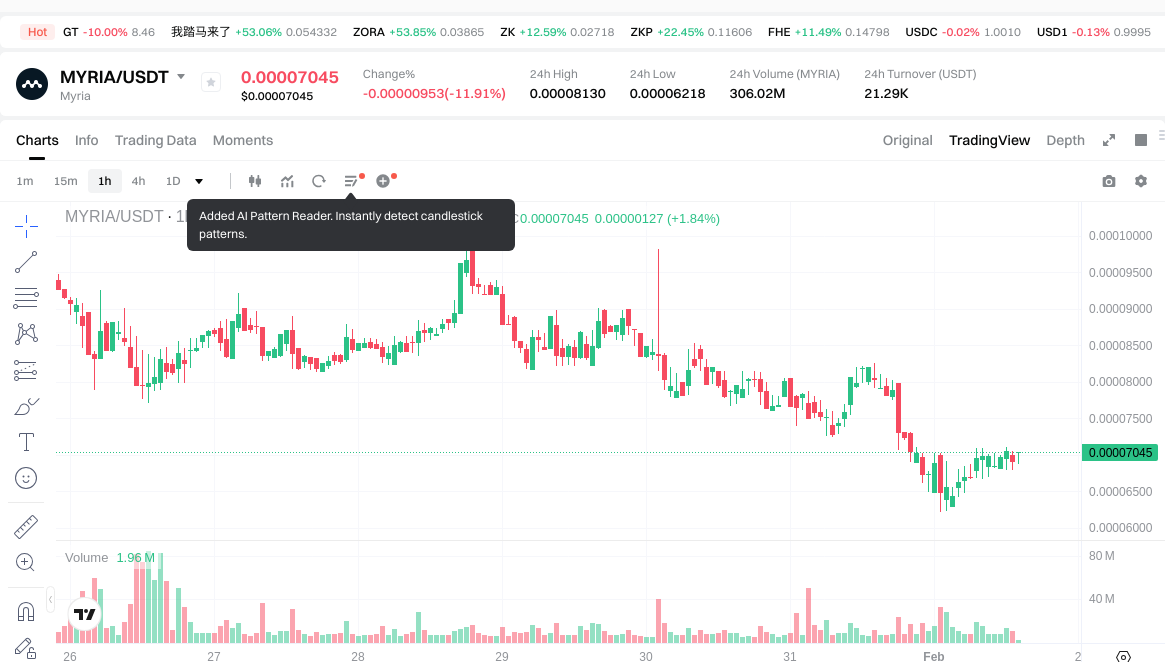
MYRIA is a functional token within the cryptocurrency sector, launched in April 2023 as part of the Myria ecosystem. As of February 2026, MYRIA has a market capitalization of approximately $1.99 million, with a circulating supply of around 28.29 billion tokens, and the current price stands at approximately $0.00007045. Positioned as an Ethereum Layer2 expansion solution specifically developed for gaming, Myria collaborates with StarkWare to deploy blockchain games and develop NFTs. The platform utilizes ZK-Rollup technology to support up to 9,000 transactions per block, offering instant transaction confirmation without gas fees. With over 36,104 token holders and availability on 6 exchanges, MYRIA has gradually become a focal point when investors discuss "Is Myria (MYRIA) a good investment?" This article provides a comprehensive analysis of MYRIA's investment value, historical trends, future price predictions, and investment risks to serve as a reference for investors.
I. Myria (MYRIA) Price History Review and Investment Value Status
- 2023: MYRIA recorded a notable price level of $0.01667821 in December → The token demonstrated significant volatility during this period, with price movements reflecting broader market dynamics in the blockchain gaming sector.
- 2026: Market adjustments continued → MYRIA traded at $0.00007045, showing downward pressure from previous levels.
- Recent cycles: Price fluctuated between $0.00008252 and $0.00006218 within a 24-hour trading window → The token experienced compression in trading range amid evolving market conditions.
Current MYRIA Investment Market Status (February 2026)
- MYRIA current price: $0.00007045
- 24-hour trading volume: $21,302.11
- Circulating supply: 28,293,011,843 MYRIA (approximately 56.59% of total supply)
- Market capitalization: $1,993,242.68
- Fully diluted valuation: $3,522,500.00
- Price changes: +2.29% (1H), -14.62% (24H), -29.03% (7D), -9.2% (30D)
- Token holders: 36,104 addresses
Click to view real-time MYRIA market price
II. Core Factors Affecting Whether MYRIA is a Good Investment (Is Myria(MYRIA) a Good Investment)
Supply Mechanism and Scarcity (MYRIA investment scarcity)
- Total supply mechanism: MYRIA has a maximum supply of 50,000,000,000 tokens, with approximately 28,293,011,843 tokens currently in circulation, representing a circulating ratio of 56.59%
- Supply structure impact: The defined maximum supply may contribute to establishing a foundation for potential long-term value appreciation
- Investment consideration: Token supply dynamics and circulation patterns represent factors that market participants consider when evaluating investment positioning
Institutional Investment and Mainstream Adoption (Institutional investment in MYRIA)
- Network participation: As of February 2026, the token has approximately 36,104 holders across its network
- Exchange presence: MYRIA is listed on 6 exchanges, providing various access points for market participants
- Market positioning: The project focuses on blockchain gaming and NFT development, sectors that have attracted attention from institutional participants interested in Web3 infrastructure
Macroeconomic Environment's Impact on MYRIA Investment
- Market context: As of February 2026, Bitcoin dominance stands at approximately 58%, which historically has influenced altcoin market dynamics and investment flow patterns
- Broader market conditions: Cryptocurrency markets continue to be influenced by monetary policy developments, regulatory frameworks, and evolving institutional participation across various jurisdictions
- Risk considerations: Digital asset investments remain subject to various macroeconomic factors including interest rate environments, inflation dynamics, and geopolitical developments
Technology and Ecosystem Development (Technology & Ecosystem for MYRIA investment)
- Layer 2 infrastructure: Myria operates as an Ethereum Layer 2 scaling solution developed in collaboration with StarkWare, utilizing ZK-Rollup technology
- Technical capabilities: The platform is designed to support up to 9,000 transactions per block while offering instant transaction confirmation and reduced transaction costs
- Application focus: The ecosystem centers on blockchain gaming deployment and NFT development, with MYRIA serving as the functional token within this infrastructure
- Development partnerships: The collaboration with StarkWare provides access to STARK proof technology for zero-knowledge scaling implementation
III. MYRIA Future Investment Prediction and Price Outlook (Is Myria(MYRIA) worth investing in 2026-2030)
Short-term Investment Prediction (2026, short-term MYRIA investment outlook)
- Conservative forecast: $0.000057769 - $0.00007045
- Neutral forecast: $0.00007045 - $0.000089
- Optimistic forecast: $0.000089 - $0.000102857
Mid-term Investment Outlook (2027-2028, mid-term Myria(MYRIA) investment forecast)
- Market stage expectation: The mid-term period may witness gradual growth as Layer2 gaming solutions gain traction in the blockchain ecosystem, with potential adoption expansion in the NFT and gaming sectors.
- Investment return prediction:
- 2027: $0.00007105587 - $0.00011611569
- 2028: $0.0000547476813 - $0.00012470305185
- Key catalysts: technological development in ZK-Rollup infrastructure, gaming industry adoption rates, and broader Layer2 ecosystem evolution.
Long-term Investment Outlook (Is Myria a good long-term investment?)
- Base scenario: $0.000082177207438 - $0.000122652548416 (assuming steady ecosystem development and maintained market presence through 2030)
- Optimistic scenario: $0.000122161938222 - $0.000171713567782 (contingent upon accelerated gaming sector integration and enhanced platform utility)
- Risk scenario: Below $0.00006436 (under conditions of prolonged market downturns or significant competitive pressure)
Click to view MYRIA long-term investment and price prediction: Price Prediction
2026-02-01 - 2030 Long-term Outlook
- Base scenario: $0.000082 - $0.000123 (corresponding to steady progress and gradual mainstream application advancement)
- Optimistic scenario: $0.000122 - $0.000172 (corresponding to large-scale adoption and favorable market conditions)
- Transformative scenario: Above $0.000172 (contingent upon breakthrough ecosystem developments and mainstream proliferation)
- 2030-12-31 predicted high: $0.000171713567782 (based on optimistic development assumptions)
Disclaimer: Price predictions are based on historical data analysis and market trends. Cryptocurrency markets are highly volatile and subject to numerous unpredictable factors. These forecasts should not be considered as investment advice, and investors should conduct independent research and risk assessment before making any investment decisions.
| Year |
Predicted High Price |
Predicted Average Price |
Predicted Low Price |
Price Change |
| 2026 |
0.000102857 |
0.00007045 |
0.000057769 |
0 |
| 2027 |
0.00011611569 |
0.0000866535 |
0.00007105587 |
23 |
| 2028 |
0.00012470305185 |
0.000101384595 |
0.0000547476813 |
43 |
| 2029 |
0.000132261273407 |
0.000113043823425 |
0.000108522070488 |
60 |
| 2030 |
0.000171713567782 |
0.000122652548416 |
0.000082177207438 |
74 |
| 2031 |
0.000164845025071 |
0.000147183058099 |
0.000122161938222 |
108 |
IV. Myria Investment Strategy and Risk Management (How to invest in Gaming Layer 2 Tokens)
Investment Methodology (Myria investment strategy)
Long-term Holding (HODL Myria)
For conservative investors considering long-term exposure to gaming-focused Layer 2 infrastructure, a buy-and-hold approach may align with the development timeline of blockchain gaming ecosystems. This strategy assumes confidence in the protocol's technical roadmap and partnerships.
Active Trading
Traders utilizing technical analysis may monitor price movements within observed ranges. As of February 1, 2026, MYRIA exhibits notable volatility, with 24-hour fluctuations between $0.00006218 and $0.00008252, and hourly changes reaching 2.29%. Short-term position management requires attention to liquidity conditions, as 24-hour trading volume stands at approximately $21,302.
Risk Management (Risk management for Myria investment)
Asset Allocation Ratio
- Conservative investors: Limited allocation (1-3% of crypto portfolio) due to market cap ranking (#2064) and price volatility
- Aggressive investors: Moderate allocation (5-10%) with acceptance of higher risk tolerance
- Professional investors: Strategic position sizing based on portfolio strategy and risk assessment frameworks
Risk Hedging Solutions
- Multi-asset portfolio: Diversification across established cryptocurrencies, stablecoins, and traditional assets
- Hedging tools: Consideration of portfolio balancing mechanisms when available for lower market cap tokens
Secure Storage
- Hot wallets: For active trading positions requiring frequent access
- Cold wallets: Recommended for long-term holdings to minimize online exposure
- Hardware wallets: Ledger, Trezor, and similar devices support ERC-20 tokens (MYRIA contract: 0xA0Ef786Bf476fE0810408CaBA05E536aC800ff86 on Ethereum)
V. Myria Investment Risks and Challenges (Risks of investing in Gaming Layer 2 Tokens)
Market Risk
High Volatility: MYRIA has demonstrated significant price fluctuations, with a 29.03% decline over 7 days and a 96.66% decrease over one year as of February 1, 2026. The token's 24-hour price range shows continued volatility. Current price stands at $0.00007045, approaching the historical low of $0.00006436 recorded on February 1, 2026.
Market Manipulation Potential: With a market capitalization of approximately $1.99 million and relatively modest daily trading volume, smaller market cap tokens may face liquidity constraints and potential susceptibility to larger order impacts.
Regulatory Risk
Policy Uncertainty: Gaming tokens and Layer 2 solutions face evolving regulatory frameworks across jurisdictions. Changes in cryptocurrency classification, securities regulations, or gaming-related digital asset policies could impact token utility and market accessibility.
Compliance Requirements: As blockchain gaming infrastructure develops, regulatory expectations regarding user protection, anti-money laundering measures, and licensing requirements may introduce operational constraints.
Technical Risk
Network Security: While Myria utilizes ZK-Rollup technology developed in collaboration with StarkWare, Layer 2 solutions involve technical complexity. Smart contract vulnerabilities, bridge security, or proof generation issues represent potential technical exposure points.
Upgrade Execution: Protocol upgrades and technical improvements carry implementation risks. The development and deployment of blockchain gaming infrastructure requires successful coordination across multiple technical components.
Dependency on Ethereum: As an Ethereum Layer 2 solution, Myria's performance correlates with Ethereum network conditions, including base layer congestion, gas fee dynamics, and protocol updates.
VI. Conclusion: Is Gaming Layer 2 Infrastructure a Good Investment?
Investment Value Summary
Myria represents exposure to blockchain gaming infrastructure, combining Layer 2 scaling technology with gaming and NFT deployment capabilities. The token serves as the functional utility token within the Myria ecosystem. However, significant price volatility and market cap positioning suggest heightened risk characteristics.
Investor Recommendations
✅ Beginners: Dollar-cost averaging with small position sizes + secure hardware wallet storage for ERC-20 tokens. Thorough research into gaming blockchain fundamentals recommended before investment.
✅ Experienced Investors: Technical analysis-based position management + diversified portfolio allocation across multiple blockchain gaming and Layer 2 projects. Risk-adjusted sizing based on volatility metrics.
✅ Institutional Investors: Strategic evaluation within gaming blockchain infrastructure thesis. Due diligence on partnership ecosystem, technical roadmap, and competitive positioning within Layer 2 landscape.
⚠️ Disclaimer: Cryptocurrency investments carry substantial risk, including potential loss of capital. This content is provided for informational purposes only and does not constitute investment advice, financial advice, trading advice, or recommendations. Investment decisions should be made based on individual circumstances, risk tolerance, and independent research. Past performance does not indicate future results.
VII. FAQ
Q1: Is Myria (MYRIA) a good investment for beginners in 2026?
Myria presents significant risks for beginners due to its high volatility and relatively small market capitalization of approximately $1.99 million. The token has experienced a 96.66% price decline over the past year and demonstrates substantial short-term fluctuations, with a 29.03% drop over 7 days as of February 1, 2026. For investors new to cryptocurrency, MYRIA should only be considered as a minor portfolio allocation (1-3%) using a dollar-cost averaging strategy combined with secure hardware wallet storage. Beginners are advised to thoroughly research blockchain gaming fundamentals and Layer 2 technology before considering any investment, and should prioritize more established cryptocurrencies while building foundational knowledge.
Q2: What makes Myria different from other Layer 2 gaming solutions?
Myria distinguishes itself through its collaboration with StarkWare, utilizing ZK-Rollup technology specifically optimized for blockchain gaming applications. The platform is designed to process up to 9,000 transactions per block while offering instant transaction confirmation without gas fees, addressing key friction points in gaming experiences. Unlike general-purpose Layer 2 solutions, Myria focuses exclusively on gaming and NFT deployment, with MYRIA serving as the functional utility token within this specialized ecosystem. However, this niche positioning also means the token's success is directly tied to blockchain gaming adoption rates and the platform's ability to attract game developers and users to its infrastructure.
Q3: What are the primary risks when investing in MYRIA?
MYRIA investment carries three major risk categories. First, market risk manifests through extreme volatility, with the current price of $0.00007045 approaching its historical low of $0.00006436, and the relatively small market cap making it susceptible to liquidity constraints and potential order impact from large transactions. Second, regulatory risk stems from evolving frameworks governing gaming tokens, Layer 2 solutions, and digital asset classification across different jurisdictions, which could affect token utility and market accessibility. Third, technical risk includes smart contract vulnerabilities, Layer 2 bridge security considerations, and dependency on Ethereum base layer performance. Additionally, as an ERC-20 token on Ethereum, MYRIA's operational efficiency correlates with Ethereum network conditions, including gas fees and congestion periods.
Q4: How should investors approach MYRIA price predictions and future outlook?
MYRIA price predictions should be viewed with significant caution given the token's volatility and market positioning. Short-term forecasts for 2026 range from $0.000057769 to $0.000102857, while long-term projections through 2030 suggest a base scenario of $0.000082 to $0.000123, with optimistic scenarios reaching $0.000172. However, these predictions assume steady ecosystem development, successful gaming adoption, and favorable market conditions—all uncertain variables. Investors should recognize that cryptocurrency markets are highly unpredictable, and smaller market cap tokens like MYRIA face additional uncertainty. These forecasts should not substitute for independent research, risk assessment, and evaluation of personal investment objectives. Past performance, including MYRIA's significant price decline from its December 2023 level of $0.01667821, demonstrates that price trajectories can deviate substantially from projections.
Q5: What investment strategy is most appropriate for MYRIA?
The appropriate MYRIA investment strategy depends on risk tolerance and investment timeframe. Conservative investors should limit allocation to 1-3% of their cryptocurrency portfolio using a long-term holding (HODL) approach aligned with blockchain gaming development timelines, combined with hardware wallet storage for security. Active traders may consider short-term position management based on technical analysis, though they should note the modest 24-hour trading volume of approximately $21,302 and price volatility between $0.00006218 and $0.00008252. Aggressive investors might allocate 5-10% with acceptance of higher risk, while professional investors should conduct strategic evaluation within broader gaming blockchain infrastructure theses. Regardless of strategy, diversification across multiple assets, including established cryptocurrencies and stablecoins, remains essential for risk management. Dollar-cost averaging can help mitigate timing risk for those building positions.
Q6: What factors should investors monitor when holding MYRIA?
Investors holding MYRIA should actively monitor several critical factors. Technical development milestones include ZK-Rollup infrastructure improvements, gaming platform launches, and partnership announcements with game developers. Market metrics require attention, including holder count (currently 36,104), exchange listings (currently 6 exchanges), trading volume trends, and market capitalization changes relative to the broader Layer 2 and gaming token sectors. Ecosystem growth indicators such as transaction volume, active gaming applications, NFT deployment activity, and developer engagement provide insight into platform adoption. Additionally, monitoring Ethereum base layer conditions, including gas fees and network upgrades, is important given MYRIA's dependency as a Layer 2 solution. Regulatory developments affecting gaming tokens, NFTs, and Layer 2 solutions across major jurisdictions should also be tracked, as policy changes could impact token utility and market accessibility.
Q7: How does MYRIA's token supply structure affect its investment potential?
MYRIA's token supply structure presents both opportunities and considerations for investors. With a maximum supply of 50 billion tokens and approximately 28.29 billion currently in circulation (56.59% circulating ratio), significant token supply remains unlocked. This defined maximum supply could theoretically provide a foundation for scarcity-driven value appreciation over time, unlike tokens with infinite supply mechanisms. However, the substantial unlocked supply (approximately 21.71 billion tokens) represents potential future selling pressure as tokens enter circulation through vesting schedules, team allocations, or ecosystem development programs. Investors should research the token release schedule and vesting mechanisms to understand future supply dynamics. The relationship between circulating supply expansion and ecosystem growth will be a key factor in determining whether increased supply is absorbed by genuine utility demand or creates downward price pressure.
Q8: Is MYRIA suitable for long-term investment through 2030?
MYRIA as a long-term investment through 2030 carries substantial uncertainty and requires careful consideration. The optimistic scenario projects potential prices reaching $0.000122 to $0.000172 by 2030, contingent upon accelerated gaming sector integration, enhanced platform utility, and favorable market conditions. However, this represents a speculative scenario dependent on multiple uncertain variables including blockchain gaming adoption rates, competitive positioning within the crowded Layer 2 landscape, successful technical development, and overall cryptocurrency market conditions. The project's current market cap ranking of #2064 and significant historical price decline suggest it remains an early-stage, high-risk proposition. Long-term investors should only allocate capital they can afford to lose entirely, maintain diversification across multiple assets, and regularly reassess the investment thesis based on ecosystem development milestones, competitive dynamics, and changing market conditions. The gaming blockchain sector itself remains nascent, adding another layer of uncertainty to multi-year projections.
* The information is not intended to be and does not constitute financial advice or any other recommendation of any sort offered or endorsed by Gate.