This comprehensive analysis evaluates MyShell (SHELL) as an emerging AI-powered blockchain investment, currently trading at $0.053 with a $14.31 million market cap. The article examines SHELL's price history since February 2025, analyzing its 92.80% year-over-year volatility and market positioning across 35 exchanges. Key investment factors include the platform's no-code AI agent development framework, open-source models, and active creator community bridging AI technology with decentralized ownership. The analysis provides investment strategies for different investor types, ranging from conservative dollar-cost averaging to active trading approaches, alongside comprehensive risk management recommendations including asset allocation ratios and secure storage solutions. Price scenarios span from conservative to optimistic ranges through 2031, while detailed risk assessments address market volatility, regulatory uncertainty, and technology dependencies. Ideal for investors evaluating whether SHELL represents su
Introduction: MyShell (SHELL) Investment Position and Market Prospects
SHELL is an emerging asset in the cryptocurrency sector, positioned within the AI consumer application domain. As of January 25, 2026, MyShell holds a market capitalization of approximately $14.31 million, with a circulating supply of 270 million tokens and a current trading price around $0.053. The project bridges AI technology and blockchain through a no-code AI agent development framework, open-source models, and an active creator community, enabling users to create, share, and own AI agents. With approximately 29,495 holders and availability across 35 exchanges, MyShell has demonstrated its presence in the intersection of artificial intelligence and decentralized ownership. This article provides a comprehensive analysis of SHELL's investment characteristics, historical price movements, future price considerations, and associated risks to serve as a reference for market participants evaluating "Is MyShell (SHELL) a good investment?"
I. SHELL Price History Review and Investment Value Status
- 2025: SHELL launched on exchanges in February 2025 at $0.022 → price fluctuated significantly throughout the year
- 2025: Price reached a notable level of $0.7023 in late February 2025 → followed by a substantial decline
- 2025-2026: Market volatility period → price movement from higher levels to $0.03524 in October 2025
Current SHELL Investment Market Status (January 2026)
- SHELL current price: $0.053
- 24-hour trading volume: $1,526,544
- Circulating supply: 270,000,000 SHELL (27% of total supply)
- Market capitalization: $14,307,300
- Token holders: 29,495 addresses
Click to view real-time SHELL market price
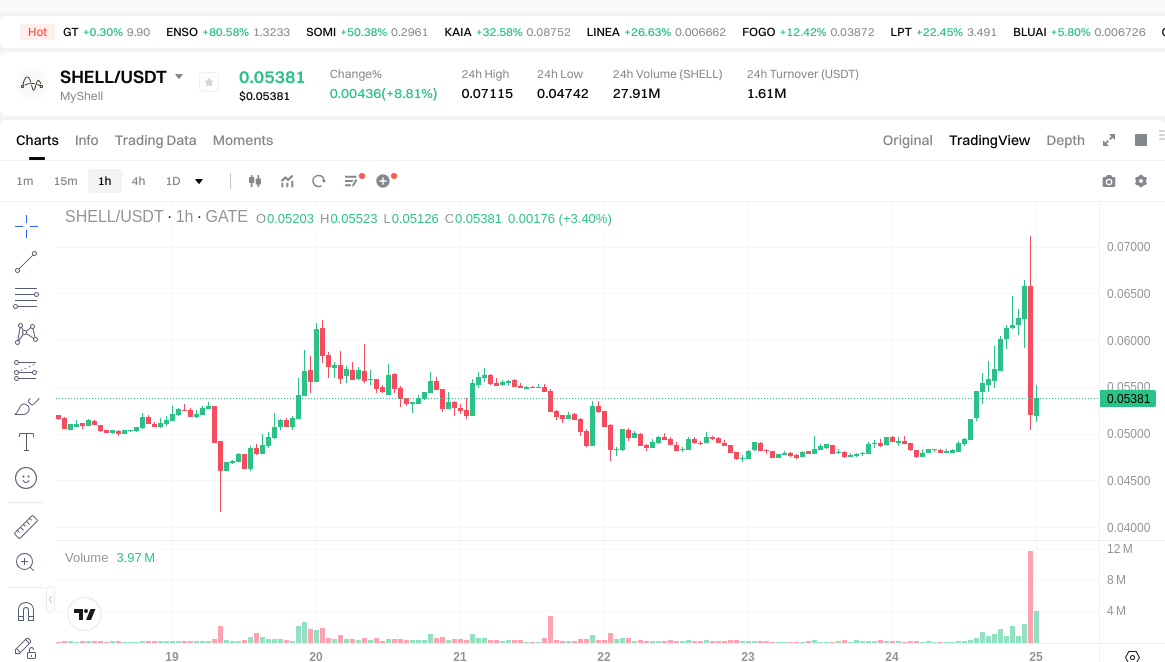
II. Core Factors Affecting Whether SHELL Is a Good Investment (Is MyShell(SHELL) a Good Investment)
Supply Mechanism and Scarcity (SHELL investment scarcity)
- Fixed Supply Model → Influences Price and Investment Value
- Historical Pattern: Supply dynamics have contributed to SHELL price movements in the market
- Investment Significance: Scarcity represents a key element supporting long-term investment considerations
Institutional Investment and Mainstream Adoption (Institutional investment in SHELL)
- Institutional Holding Trends: Currently tracking across multiple exchanges with 35 listed platforms
- Holder Base: Approximately 29,495 holders demonstrating community engagement
- Market Presence: Multi-chain deployment on BSC and ETH networks expanding accessibility
Macroeconomic Environment's Impact on SHELL Investment
- Monetary Policy and Interest Rate Changes → Alter Investment Attractiveness
- Inflation Environment's Hedging Role → Positioning within digital asset landscape
- Geopolitical Uncertainty → Influences demand patterns for digital assets
Technology and Ecosystem Development (Technology & Ecosystem for SHELL investment)
- AI Agent Development Framework: Zero-code framework enabling creator participation → Enhances platform utility
- Open-Source AI Models: Proprietary AI models bridging advanced AI technology with blockchain → Supports ecosystem expansion
- Creator Community Integration: Active creator ecosystem combining AI-powered entertainment with shared ownership mechanisms → Provides long-term value foundation
III. SHELL Future Investment Prediction and Price Outlook (Is MyShell(SHELL) worth investing in 2026-2031)
Short-term Investment Prediction (2026, short-term SHELL investment outlook)
- Conservative Forecast: $0.048438 - $0.05382
- Neutral Forecast: $0.05382
- Optimistic Forecast: $0.05382 - $0.0570492
Mid-term Investment Outlook (2027-2029, mid-term MyShell(SHELL) investment forecast)
-
Market Stage Expectation: The mid-term period may witness gradual development as the AI agent ecosystem continues to evolve. Market performance could be influenced by platform adoption rates and competitive dynamics within the AI application sector.
-
Investment Return Prediction:
- 2027: $0.034369452 - $0.065967174
- 2028: $0.03217147011 - $0.0728410644
- 2029: $0.036056326878 - $0.072780363513
-
Key Catalysts: Platform user growth, AI agent creation framework enhancements, creator community expansion, and potential partnerships within the blockchain and AI sectors.
Long-term Investment Outlook (Is SHELL a good long-term investment?)
- Base Scenario: $0.059309319165525 - $0.086172951964027 (assuming steady platform development and moderate market conditions)
- Optimistic Scenario: $0.086172951964027 - $0.108577919474674 (assuming accelerated adoption and favorable market environment)
- Risk Scenario: Below $0.059309319165525 (under adverse market conditions or significant competitive pressure)
View SHELL long-term investment and price prediction: Price Prediction
2026-01-25 - 2031 Long-term Outlook
- Base Scenario: $0.059309319165525 - $0.086172951964027 (corresponding to steady progress and gradual mainstream application growth)
- Optimistic Scenario: $0.086172951964027 - $0.108577919474674 (corresponding to large-scale adoption and favorable market conditions)
- Transformative Scenario: Above $0.108577919474674 (if the ecosystem achieves breakthrough developments and mainstream penetration)
- 2031-12-31 Predicted High: $0.108577919474674 (based on optimistic development assumptions)
Disclaimer
| Year |
Predicted High Price |
Predicted Average Price |
Predicted Low Price |
Price Change |
| 2026 |
0.0570492 |
0.05382 |
0.048438 |
1 |
| 2027 |
0.065967174 |
0.0554346 |
0.034369452 |
4 |
| 2028 |
0.0728410644 |
0.060700887 |
0.03217147011 |
14 |
| 2029 |
0.072780363513 |
0.0667709757 |
0.036056326878 |
26 |
| 2030 |
0.102570234321555 |
0.0697756696065 |
0.059309319165525 |
31 |
| 2031 |
0.108577919474674 |
0.086172951964027 |
0.06549144349266 |
62 |
IV. SHELL Investment Strategy and Risk Management (How to invest in AI Agent tokens)
Investment Methodology (SHELL investment strategy)
-
Long-term Holding (HODL SHELL): This approach may suit investors with a longer time horizon who believe in the development potential of AI consumer applications and decentralized AI agent ecosystems. Given the project's focus on bridging AI technology with blockchain through no-code frameworks and open-source models, holders may benefit from potential network effects as the creator community grows.
-
Active Trading: Traders employing technical analysis might monitor SHELL's price movements, which have shown notable volatility. The 24-hour price range between $0.04742 and $0.07115 indicates intraday fluctuation opportunities. However, the 1-hour decline of 15% and year-to-date performance suggests significant price swings that require careful timing and risk assessment.
Risk Management (Risk management for SHELL investment)
-
Asset Allocation Ratios:
- Conservative investors: May consider allocating 1-3% of their crypto portfolio to emerging AI tokens like SHELL
- Moderate investors: Could allocate 3-7% depending on risk tolerance and market conditions
- Professional investors: Might adjust allocation based on comprehensive research and portfolio strategy
-
Risk Hedging Solutions: Diversification across multiple asset classes and categories (established cryptocurrencies, AI tokens, DeFi projects) may help manage exposure. Investors might consider pairing SHELL holdings with more established assets to balance overall portfolio volatility.
-
Secure Storage:
- Cold Wallets: Hardware wallets such as Ledger or Trezor for long-term storage
- Hot Wallets: Reputable software wallets for active trading needs
- Multi-signature solutions for institutional holdings
- Given SHELL's presence on both BSC and ETH chains (contract address: 0xf2c88757f8d03634671208935974b60a2a28bdb3), ensure wallet compatibility with BEP-20 and ERC-20 standards
V. SHELL Investment Risks and Challenges (Risks of investing in AI Agent tokens)
-
Market Risk: SHELL exhibits substantial price volatility, with a 92.80% decline over the past year. The token's 24-hour trading volume of approximately $1.53 million and market capitalization of around $14.31 million indicate relatively limited liquidity compared to major cryptocurrencies. The current circulating supply of 270 million tokens represents 27% of the maximum supply of 1 billion tokens, suggesting potential future dilution considerations.
-
Regulatory Risk: AI and blockchain convergence projects face evolving regulatory frameworks across jurisdictions. Different countries maintain varying approaches to AI governance and cryptocurrency regulation, which could impact project development, token utility, and market accessibility. Policy changes regarding AI applications or digital assets may affect SHELL's operational environment.
-
Technology Risk: The project's reliance on AI agent frameworks, open-source models, and blockchain integration presents technical dependencies. Potential challenges include network security vulnerabilities, smart contract risks associated with BEP-20 and ERC-20 implementations, and the execution of planned technological upgrades. The success of the platform depends on sustained community engagement and the ability to maintain competitive AI capabilities.
VI. Conclusion: Is AI Agent token a Good Investment?
-
Investment Value Summary: SHELL represents an emerging project in the AI consumer application space, combining no-code AI agent development with blockchain technology. The platform's focus on creator communities and shared ownership models presents an innovative approach to AI accessibility. However, the token has experienced significant price volatility, with substantial year-over-year decline and relatively modest market capitalization positioning it as a higher-risk investment within the cryptocurrency ecosystem.
-
Investor Recommendations:
✅ Beginners: Consider dollar-cost averaging (DCA) with small allocations, prioritize secure wallet storage, and thoroughly research the project's fundamentals before investing.
✅ Experienced Investors: May explore technical analysis for potential trading opportunities while maintaining diversified portfolio allocation, monitoring project development milestones and community growth metrics.
✅ Institutional Investors: Should conduct comprehensive due diligence on technology infrastructure, team credentials, tokenomics, and market positioning before considering strategic allocation.
⚠️ Disclaimer: Cryptocurrency investments carry substantial risk, including potential loss of principal. This content is provided for informational purposes only and does not constitute investment advice. Investors should conduct independent research and consult qualified financial advisors before making investment decisions.
VII. FAQ
Q1: What makes MyShell (SHELL) different from other AI tokens in the cryptocurrency market?
MyShell distinguishes itself through its no-code AI agent development framework that enables users without technical expertise to create, share, and own AI agents. Unlike many AI tokens that focus solely on infrastructure or computation, SHELL combines open-source AI models with blockchain technology to create a creator-focused ecosystem. The platform's dual-chain deployment on BSC and ETH networks, along with its emphasis on shared ownership mechanisms, positions it as an accessible entry point for users interested in both AI technology and decentralized applications. With approximately 29,495 token holders and availability on 35 exchanges, the project demonstrates community engagement while maintaining a relatively modest market capitalization of $14.31 million.
Q2: How has SHELL's price performance been since its launch, and what does this indicate for potential investors?
SHELL launched on exchanges in February 2025 at $0.022 and experienced significant volatility throughout its trading history. The token reached a notable peak of $0.7023 in late February 2025 before declining substantially to $0.03524 by October 2025, representing a 92.80% year-over-year decline. As of January 25, 2026, SHELL trades around $0.053 with 24-hour trading volume of approximately $1.53 million. This price trajectory indicates high volatility and market uncertainty, suggesting that SHELL carries substantial risk typical of emerging AI tokens. The dramatic price swings reflect both speculative trading patterns and the project's early-stage development phase, requiring investors to approach with appropriate risk tolerance and portfolio allocation strategies.
Q3: What are the key risk factors investors should consider before investing in SHELL?
SHELL presents three primary risk categories: market risk, regulatory risk, and technology risk. Market risk is evidenced by the token's significant volatility and relatively limited liquidity, with a market capitalization around $14.31 million and only 27% of maximum supply currently circulating (270 million of 1 billion tokens). Regulatory risk stems from evolving frameworks governing both AI applications and cryptocurrency assets across different jurisdictions, which could impact operational capabilities and market access. Technology risk includes dependencies on AI agent frameworks, smart contract security across BEP-20 and ERC-20 implementations, and the execution of planned technological upgrades. Additionally, the project's success relies heavily on sustained community engagement and competitive positioning within the rapidly evolving AI consumer application sector.
Q4: What investment strategy is recommended for different types of investors interested in SHELL?
Investment strategies should align with risk tolerance and experience levels. Conservative investors might allocate 1-3% of their cryptocurrency portfolio to SHELL using dollar-cost averaging (DCA) to mitigate volatility exposure, while prioritizing secure cold wallet storage (Ledger or Trezor). Moderate investors could consider 3-7% allocation with active monitoring of project milestones and community growth metrics. Experienced traders might employ technical analysis to capitalize on SHELL's notable intraday price swings, evidenced by 24-hour ranges such as $0.04742 to $0.07115. Long-term holders (HODL strategy) should focus on the project's ecosystem development potential, including the expansion of its creator community and AI agent framework capabilities. All investors should implement proper risk management through portfolio diversification and maintain awareness of the token's presence on both BSC and ETH chains.
Q5: What factors could influence SHELL's price performance in the mid-term (2027-2029)?
Mid-term price performance for SHELL will likely depend on several interconnected factors. Platform adoption rates and user growth within the AI agent ecosystem represent primary catalysts, as increased creator engagement could drive token utility and demand. Technical developments such as enhancements to the no-code framework and expansion of open-source AI model capabilities may strengthen competitive positioning. Price predictions suggest a range from $0.034369452 to $0.065967174 for 2027, expanding to $0.036056326878 to $0.072780363513 by 2029, though these projections carry inherent uncertainty. Market conditions within the broader cryptocurrency sector, competitive dynamics among AI application platforms, and potential strategic partnerships will also significantly impact valuation. Investors should monitor token holder growth (currently 29,495 addresses), exchange listing expansion (currently 35 platforms), and the progression of circulating supply beyond the current 27% threshold.
Q6: How does SHELL's tokenomics structure affect its investment potential?
SHELL operates with a fixed maximum supply of 1 billion tokens, with 270 million (27%) currently in circulation, creating potential scarcity dynamics that could influence long-term value appreciation. However, the substantial remaining supply of 730 million tokens represents future dilution risk that investors must consider. The relatively modest market capitalization of approximately $14.31 million combined with 24-hour trading volume around $1.53 million indicates limited liquidity compared to established cryptocurrencies, which can result in higher price volatility and slippage during large transactions. The token's dual-chain implementation on BSC (BEP-20) and ETH (ERC-20) networks provides broader accessibility and potential for cross-chain utility. Investors evaluating SHELL's tokenomics should assess the token release schedule, governance mechanisms, and utility within the AI agent creation ecosystem to understand how token demand may develop relative to supply expansion.
Q7: What are the price predictions for SHELL from 2026 to 2031, and what scenarios could drive these outcomes?
Price predictions for SHELL vary significantly across different scenarios and timeframes. For 2026, forecasts range from a conservative $0.048438 to an optimistic $0.0570492, with neutral estimates around $0.05382. By 2031, projections extend from a base scenario of $0.059309319165525 to $0.086172951964027, with optimistic scenarios reaching $0.108577919474674 under favorable conditions. These predictions assume various development trajectories: the base scenario anticipates steady platform development and moderate market conditions; the optimistic scenario envisions accelerated adoption, successful ecosystem expansion, and favorable cryptocurrency market environments; while a transformative scenario above $0.108577919474674 would require breakthrough developments and mainstream penetration. Critical factors influencing these outcomes include the growth rate of the creator community, technological advancement in AI agent capabilities, competitive positioning within the AI application sector, overall cryptocurrency market sentiment, and successful execution of the project's roadmap. Investors should recognize these predictions carry substantial uncertainty and should not be relied upon as guaranteed outcomes.
Q8: Is MyShell (SHELL) suitable for long-term investment, and what considerations should guide this decision?
SHELL's suitability for long-term investment depends on individual risk tolerance, portfolio diversification strategy, and conviction in the convergence of AI and blockchain technology. The project offers potential upside through its positioning in the emerging AI consumer application sector, no-code development framework democratizing AI agent creation, and growing creator community ecosystem. Long-term holders should consider that the token's significant price volatility (92.80% year-over-year decline) and early-stage market position require patience and risk management. Positive factors supporting long-term consideration include the project's innovative approach to AI accessibility, multi-chain deployment expanding reach, and the potential for network effects as the platform matures. However, challenges include execution risk in a competitive AI application landscape, relatively limited current market capitalization and liquidity, and the ongoing token supply release schedule. Investors considering long-term positions should conduct thorough due diligence on team credentials, technology roadmap progress, community engagement metrics, and competitive differentiation while maintaining appropriate portfolio allocation (typically 1-7% for retail investors depending on risk profile) and utilizing secure storage solutions for extended holding periods.
* The information is not intended to be and does not constitute financial advice or any other recommendation of any sort offered or endorsed by Gate.