This comprehensive analysis examines whether Nano (NANO) represents a sound investment opportunity in the current cryptocurrency market. As a decentralized, fee-free digital currency trading at $0.7424 with a market capitalization of $98.92 million, Nano addresses inefficiencies in traditional financial systems through its innovative block-lattice technology and sustainable consensus mechanism. The article evaluates Nano's investment merit by analyzing its historical price performance (ranging from $0.026179 to $33.69), current market position ranking #360, and technical advantages including instant transactions and zero fees. Additionally, it presents price predictions through 2031, outlines investment strategies for different investor profiles, and identifies critical risks including market volatility (-46.81% annual decline), regulatory uncertainty, and limited liquidity across 6 exchanges on platforms like Gate. For beginners, experienced traders, and institutional investors, this guide provides actionabl
Introduction: Nano (NANO) Investment Position and Market Outlook
Nano (NANO) is a decentralized, sustainable and secure digital currency that has been designed to address inefficiency issues in existing financial systems since its launch in 2018. As of January 2026, Nano maintains a market capitalization of approximately $98.92 million with a circulating supply of 133.25 million tokens, and its current price stands around $0.74. With its positioning focused on providing simple peer-to-peer value transmission and connecting individuals to the global economy at minimal cost, Nano has gradually become a subject of discussion among investors exploring "Is Nano (NANO) a good investment?" This article will comprehensively analyze Nano's investment value, historical trends, future price predictions and investment risks to provide reference for investors.
Nano's unique design enables efficient and accessible digital currency usage, distinguishing itself in the cryptocurrency landscape. The project has achieved full circulation with a 100% circulating ratio, and its fully diluted market cap matches its current market capitalization at $98.92 million. Recent market data shows mixed performance, with a 3.36% gain over the past week and an 11.62% increase over the past month, though the asset experienced a decline of 46.81% over the past year. The current trading price represents a substantial distance from its historical peak of $33.69 recorded in January 2018, while remaining well above its historical low of $0.026179 from July 2017. These dynamics reflect the evolving market perception and adoption trajectory of this digital currency project.
I. Nano (NANO) Historical Price Review and Current Investment Value
- 2017: Nano (formerly RaiBlocks) entered the market with a publishing price of $0.009104 in January 2017 → Early investors experienced substantial volatility as the token traded near its lowest recorded level of $0.026179 in July 2017
- 2018: Market enthusiasm during the cryptocurrency boom drove significant price appreciation → NANO reached $33.69 in January 2018, representing considerable gains from its initial trading levels before experiencing a market correction
- 2025: Recent market cycles have shown mixed performance → The token has declined approximately 46.81% over the past year, with current trading activity reflecting ongoing market adjustment periods
Current NANO Investment Market Status (January 2026)
- Current Price: $0.7424 (as of January 17, 2026)
- 24-Hour Trading Volume: $12,233,646.03
- Market Capitalization: $98,923,535.69, ranking #360 among digital assets
- Circulating Supply: 133,248,297 NANO (100% of maximum supply)
- Recent Price Trends:
- 1-Hour: +0.69%
- 24-Hour: -0.68%
- 7-Day: +3.36%
- 30-Day: +11.62%
- 1-Year: -46.81%
- Trading Range (24H): High $0.7542 / Low $0.7185
- Market Cap to Fully Diluted Valuation: 100%
- Available Trading Platforms: Listed on 6 exchanges
Click to view real-time NANO market price
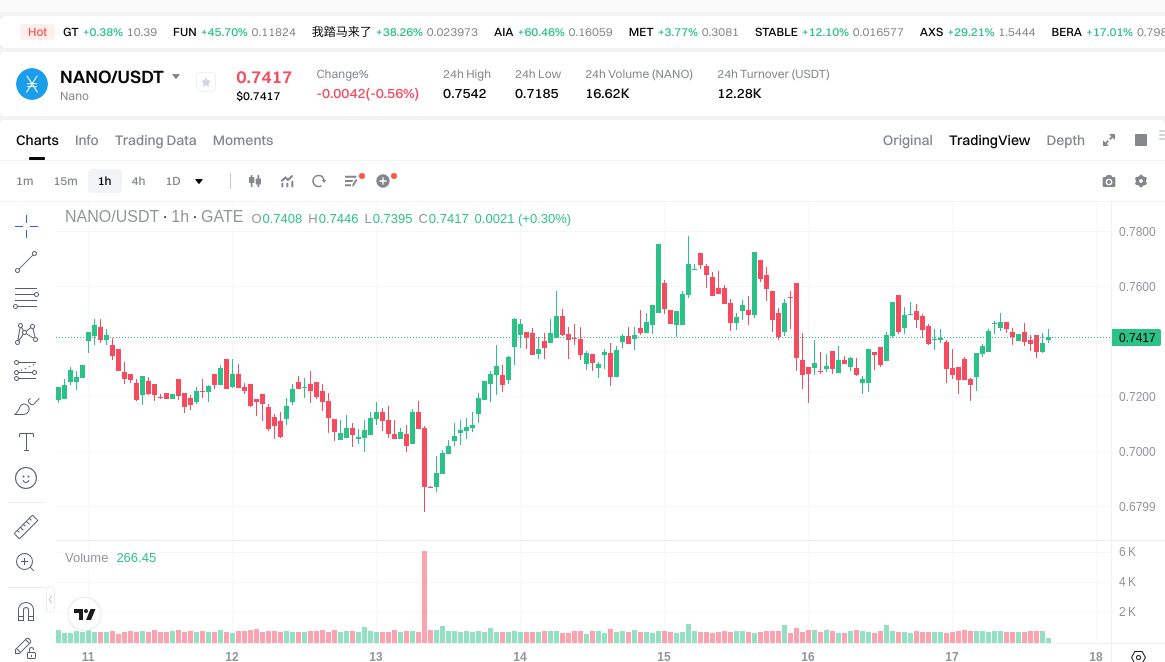
II. Core Factors Affecting Whether NANO is a Good Investment
Supply Mechanism and Scarcity (NANO Investment Scarcity)
- Fixed supply mechanism → influences price and investment value
- Total supply capped at 133,248,297 NANO tokens with 100% already in circulation, creating a deflationary characteristic
- Historical pattern: Price experienced significant appreciation from its all-time low of $0.026179 (July 2017) to notable valuation levels, though current price of $0.7424 remains below previous peaks
- Investment significance: The fixed maximum supply with full circulation establishes scarcity as a foundational element for long-term investment consideration
Institutional Investment and Mainstream Adoption (Institutional Investment in NANO)
- Current market data shows NANO ranked 360th by market capitalization at approximately $98.92 million
- Trading availability across 6 exchanges indicates established market presence
- Market dominance stands at 0.0029%, reflecting niche positioning within the broader cryptocurrency ecosystem
- The project's focus on efficient point-to-point value transmission positions it as a utility-oriented digital currency rather than primarily an institutional investment vehicle
Macroeconomic Environment's Impact on NANO Investment
- Recent performance shows mixed signals: 1-hour (+0.69%), 7-day (+3.36%), and 30-day (+11.62%) gains contrast with 1-year decline (-46.81%)
- Price volatility reflects broader cryptocurrency market dynamics and macroeconomic uncertainties
- 24-hour trading volume of $12,233.65 indicates moderate liquidity levels
- Nano's positioning as a sustainable and efficient digital currency may align with evolving preferences during periods of economic uncertainty
Technology and Ecosystem Development (Technology & Ecosystem for NANO Investment)
- Decentralized architecture: Nano operates on a unique block-lattice structure designed to address inefficiencies in traditional financial systems
- Zero-fee transactions: The protocol enables fee-free value transfer, distinguishing it from many blockchain networks
- Sustainability focus: Energy-efficient consensus mechanism positions Nano favorably amid growing environmental considerations
- Ecosystem applications: Active development community with established wallet solutions (Natrium) and block explorers supporting network transparency
- The project maintains active development presence through GitHub repositories and community engagement channels including Twitter, Reddit, and Facebook
III. NANO Future Investment Prediction and Price Outlook (Is Nano(NANO) worth investing in 2026-2031)
Short-term Investment Prediction (2026, short-term NANO investment outlook)
- Conservative Prediction: $0.64 - $0.74
- Neutral Prediction: $0.74 - $0.80
- Optimistic Prediction: $0.80 - $0.85
Mid-term Investment Outlook (2027-2028, mid-term Nano(NANO) investment forecast)
- Market Stage Expectation: Based on reference materials, the mid-term period may show gradual upward momentum with potential volatility influenced by broader market dynamics and adoption patterns.
- Investment Return Prediction:
- 2027: $0.75 - $0.86
- 2028: $0.60 - $1.14
- Key Catalysts: Market sentiment shifts, technological adoption rates, and competitive positioning within the digital currency ecosystem.
Long-term Investment Outlook (Is NANO a good long-term investment?)
- Baseline Scenario: $0.56 - $1.22 (assuming steady development and moderate market conditions through 2030)
- Optimistic Scenario: $0.93 - $1.52 (assuming favorable regulatory environment and increased mainstream adoption)
- Risk Scenario: Below $0.56 (under adverse market conditions or prolonged bearish trends)
Click to view NANO long-term investment and price prediction: Price Prediction
2026-01-17 - 2031 Long-term Outlook
- Base Scenario: $0.56 - $1.22 (corresponding to steady progress and gradual mainstream application enhancement)
- Optimistic Scenario: $0.93 - $1.52 (corresponding to large-scale adoption and favorable market environment)
- Transformative Scenario: Above $1.52 (if the ecosystem achieves breakthrough progress and mainstream popularization)
- 2031-12-31 Predicted High: $1.52 (based on optimistic development assumptions)
Disclaimer: The predictions and analyses provided are for informational purposes only and should not be construed as financial advice. Cryptocurrency markets are highly volatile and subject to various risks. Historical data and predictive models cannot guarantee future performance. Investors should conduct their own research and consider their risk tolerance before making investment decisions.
| Year |
Predicted High Price |
Predicted Average Price |
Predicted Low Price |
Price Change |
| 2026 |
0.801036 |
0.7417 |
0.637862 |
0 |
| 2027 |
0.85621848 |
0.771368 |
0.74822696 |
3 |
| 2028 |
1.139310536 |
0.81379324 |
0.6022069976 |
9 |
| 2029 |
1.22068986 |
0.976551888 |
0.60546217056 |
31 |
| 2030 |
1.21946917014 |
1.098620874 |
0.56029664574 |
47 |
| 2031 |
1.5183489789117 |
1.15904502207 |
0.927236017656 |
56 |
IV. Nano Investment Strategy and Risk Management (How to invest in Nano)
Investment Methodology (Nano investment strategy)
Long-term Holding (HODL Nano)
For conservative investors seeking exposure to instant, feeless digital currency technology, long-term holding of Nano may align with beliefs in the fundamental value of efficient peer-to-peer payment systems. This approach involves acquiring Nano and maintaining positions through market cycles, based on confidence in the project's sustainable and decentralized architecture.
Active Trading
Active traders may engage with Nano through technical analysis and swing trading strategies. Given the observed price movements (24-hour range: $0.7185-$0.7542), short-term traders could identify entry and exit points based on support and resistance levels, volume patterns, and momentum indicators. This approach requires continuous market monitoring and understanding of cryptocurrency market dynamics.
Risk Management (Risk management for Nano investment)
Asset Allocation Ratios
- Conservative Investors: May consider allocating 1-3% of their cryptocurrency portfolio to Nano, maintaining majority positions in more established digital assets.
- Aggressive Investors: Could allocate 5-10% to Nano as part of a diversified altcoin strategy, accepting higher risk for potential returns.
- Professional Investors: Might implement dynamic allocation models based on technical indicators, market conditions, and correlation analysis with broader crypto markets.
Risk Hedging Approaches
Investors may consider multi-asset portfolio construction that includes various cryptocurrency categories alongside traditional assets. Diversification across different blockchain architectures and use cases can help mitigate concentration risk. Some investors employ stablecoin reserves to capitalize on volatility opportunities.
Secure Storage
Cold Wallet Solutions: For long-term holdings, hardware wallets supporting Nano provide offline storage with enhanced security against online threats.
Hot Wallet Options: The Natrium wallet (https://natrium.io/) offers convenient access for active transactions while maintaining reasonable security standards.
Security Best Practices: Implement multi-signature solutions where applicable, maintain backup seed phrases in secure physical locations, and regularly update wallet software.
V. Nano Investment Risks and Challenges (Risks of investing in Nano)
Market Risks
High Volatility: Nano has demonstrated significant price fluctuations, with a 1-year change of -46.81% and historical price range from $0.026179 to $33.69. This volatility presents both opportunities and substantial downside risk.
Liquidity Considerations: With a 24-hour trading volume of approximately $12,233.65 and market capitalization of roughly $98.92 million (ranking #360), Nano has relatively limited liquidity compared to major cryptocurrencies. This may result in wider bid-ask spreads and increased slippage during larger transactions.
Market Share: Representing approximately 0.0029% of the total cryptocurrency market, Nano's smaller market presence may expose it to greater price sensitivity from large trades or shifts in investor sentiment.
Regulatory Risks
Jurisdictional Uncertainty: Different countries maintain varying regulatory frameworks for digital currencies. Changes in cryptocurrency regulations, taxation policies, or legal classification could impact Nano's accessibility, trading venues, and adoption prospects.
Compliance Evolution: As regulatory oversight of digital assets continues to develop globally, projects may face requirements for enhanced compliance measures, which could affect operational flexibility or market access.
Technical Risks
Network Security: While Nano employs a block-lattice architecture designed for efficiency, any cryptocurrency network faces ongoing security considerations. Investors should monitor community discussions and development updates regarding network stability.
Technology Development: The success of Nano's vision for instant, feeless transactions depends on continued technical development, network adoption, and competitive positioning against evolving payment solutions in the blockchain space.
Adoption Challenges: Achieving widespread usage as a medium of exchange requires overcoming network effects, merchant integration barriers, and competition from established payment systems and other cryptocurrencies.
VI. Conclusion: Is Nano a Good Investment?
Investment Value Summary
Nano presents a unique value proposition focused on efficient, feeless peer-to-peer transactions within a sustainable framework. The project's technical approach addresses specific inefficiencies in traditional financial systems and some cryptocurrency networks. However, the asset has experienced significant price volatility, including a 46.81% decline over the past year, while showing recent 30-day strength with an 11.62% increase.
The fully circulating supply of 133,248,297 NANO (100% of max supply) eliminates future inflation concerns but also means no supply-driven scarcity dynamics remain. With a current market capitalization around $98.92 million and limited exchange availability (6 exchanges), Nano operates in a niche position within the cryptocurrency ecosystem.
Investor Recommendations
✅ Beginners: Consider dollar-cost averaging with small allocations as part of a diversified learning portfolio. Prioritize secure storage through recommended wallet solutions like Natrium or hardware wallets. Focus on understanding the technology and market dynamics before increasing exposure.
✅ Experienced Investors: May explore swing trading opportunities based on technical analysis of the observed volatility patterns. Implement position sizing that accounts for Nano's market cap and liquidity constraints. Consider Nano as a portfolio satellite position within a broader altcoin allocation strategy.
✅ Institutional Investors: Could evaluate Nano for strategic exposure to instant payment cryptocurrency technology as a minor component of diversified digital asset portfolios. Assess liquidity requirements carefully given the current trading volume and exchange availability.
⚠️ Disclaimer: Cryptocurrency investments carry substantial risk due to price volatility, regulatory uncertainty, technological challenges, and market dynamics. This content is provided for informational purposes only and does not constitute investment advice, financial guidance, or a recommendation to buy, sell, or hold any digital asset. Conduct thorough independent research and consult qualified financial advisors before making investment decisions.
VII. FAQ
Q1: What makes Nano different from other cryptocurrencies in terms of transaction efficiency?
Nano distinguishes itself through zero-fee transactions and instant settlement times, utilizing a unique block-lattice architecture rather than traditional blockchain structures. Unlike Bitcoin or Ethereum, which charge network fees and require block confirmations, Nano's design allows each account to maintain its own blockchain, enabling parallel transaction processing without mining or fees. This architecture addresses inefficiencies in both traditional financial systems and conventional cryptocurrencies, making it particularly suitable for micro-transactions and peer-to-peer payments where transaction costs would otherwise be prohibitive.
Q2: Is Nano suitable for long-term investment given its 46.81% decline over the past year?
The decision depends on individual risk tolerance and investment objectives. Nano's 46.81% annual decline reflects broader market volatility and its niche positioning, with a market cap ranking of #360. However, recent 30-day performance showing +11.62% suggests potential stabilization. Conservative long-term investors might allocate 1-3% of their cryptocurrency portfolio to Nano, viewing it as exposure to instant payment technology with a fully circulated supply (133.25 million tokens). The fixed supply creates scarcity dynamics, but past performance doesn't guarantee future returns. Investors should evaluate whether Nano's technological advantages align with their portfolio strategy and accept that smaller market cap assets carry higher volatility risks.
Q3: What are the main risks associated with investing in Nano?
Three primary risk categories affect Nano investments: (1) Market Risks - significant price volatility (historical range $0.026179 to $33.69), limited liquidity with $12.23 million 24-hour volume, and small 0.0029% market share creating susceptibility to large trades; (2) Regulatory Risks - evolving cryptocurrency regulations across jurisdictions could impact accessibility and adoption; (3) Technical Risks - network security considerations, dependency on continued development, and adoption challenges competing against established payment systems. Additionally, availability on only 6 exchanges limits trading options and may affect liquidity during market stress periods.
Q4: How should beginners approach Nano investment?
Beginners should start with dollar-cost averaging (DCA) strategy, allocating small amounts regularly rather than lump-sum purchases to mitigate timing risk. Limit Nano allocation to 1-3% of total cryptocurrency holdings as part of a diversified portfolio including established assets like Bitcoin or Ethereum. Prioritize security by using recommended wallets such as Natrium for hot storage or hardware wallets for long-term holdings. Before investing, understand Nano's technology, monitor community development through GitHub and social channels (Twitter, Reddit), and recognize that the asset's volatility requires emotional discipline. Never invest more than you can afford to lose, and conduct thorough research beyond any single information source.
Q5: What price levels should investors watch for Nano in 2026?
Key technical levels for 2026 include: Support Zone - $0.64 represents the conservative prediction floor; breaking below this could signal bearish continuation. Current Trading Range - $0.74 (current price) to $0.80 represents neutral scenario territory. Resistance Levels - $0.85 marks the optimistic prediction ceiling for 2026; sustained movement above this could indicate bullish momentum. The recent 24-hour range of $0.7185-$0.7542 provides short-term trading boundaries. Investors should note that these levels are predictions based on technical analysis and market assumptions, not guarantees. Volume confirmation at these levels helps validate breakouts or breakdowns.
Q6: Can Nano reach its previous all-time high of $33.69 again?
Reaching the January 2018 all-time high of $33.69 from the current $0.7424 would require approximately 4,440% appreciation. While technically possible, several factors make this challenging: (1) the 2018 peak occurred during unprecedented cryptocurrency market euphoria unlikely to repeat identically; (2) Nano's current market position (#360 ranking, 0.0029% market share) would require massive capital inflow or adoption breakthrough; (3) competitive landscape has intensified with newer payment-focused projects. Long-term predictions through 2031 suggest more conservative targets of $0.93-$1.52 in optimistic scenarios. Investors should focus on realistic growth expectations rather than historical peaks when evaluating potential returns.
Q7: What are the best storage options for securing Nano holdings?
Storage choice depends on investment timeframe and security needs: Hardware Wallets (Cold Storage) - optimal for long-term holdings, providing offline security against hacking; requires initial purchase but offers maximum protection. Natrium Wallet (Hot Storage) - official mobile wallet at https://natrium.io/ offering convenient access for active transactions with reasonable security; suitable for amounts you might spend or trade. Security Best Practices - implement backup seed phrases stored in secure physical locations (fireproof safe, safety deposit box), never share private keys, enable all available security features, and regularly update wallet software. For substantial holdings, consider splitting between cold storage (majority) and hot wallet (spending money) to balance security with accessibility.
Q8: How does Nano's environmental sustainability compare to other cryptocurrencies?
Nano positions itself as an environmentally sustainable digital currency through its energy-efficient consensus mechanism, which eliminates energy-intensive proof-of-work mining required by Bitcoin and many other cryptocurrencies. The block-lattice architecture enables transaction validation without competing miners solving complex mathematical problems, dramatically reducing energy consumption per transaction. This sustainability focus aligns with growing environmental considerations in cryptocurrency adoption, potentially attracting environmentally conscious investors and institutions. However, investors should recognize that environmental advantages alone don't guarantee investment success - adoption rates, market demand, and competitive positioning remain crucial factors. Nano's sustainability credentials may provide long-term strategic advantages as regulatory scrutiny of cryptocurrency energy consumption increases globally.
* The information is not intended to be and does not constitute financial advice or any other recommendation of any sort offered or endorsed by Gate.