This comprehensive analysis evaluates whether Naoris Protocol (NAORIS) represents a viable cryptocurrency investment in 2024-2026. NAORIS operates as a decentralized post-quantum infrastructure positioned at the Sub-Zero Layer, securing both Web3 and Web2 systems. Trading at $0.05138 with a market cap of $30.79 million and ranking 707 globally, the token demonstrates significant volatility but institutional backing from Tim Draper and seasoned advisors. The article examines NAORIS's technological differentiation, including quantum-resistant cryptography and cross-platform EVM integration, alongside market dynamics and supply mechanics. Price forecasts range from $0.0399-$0.0971 through 2031 across conservative, neutral, and optimistic scenarios. Investment recommendations stratify by experience level, emphasizing risk management given early-stage status, limited liquidity across 10 exchanges, and 85% unreleased token supply. Comprehensive risk analysis addresses market volatility, regulatory uncertainty, tech
Introduction: Naoris Protocol (NAORIS) Investment Position and Market Prospects
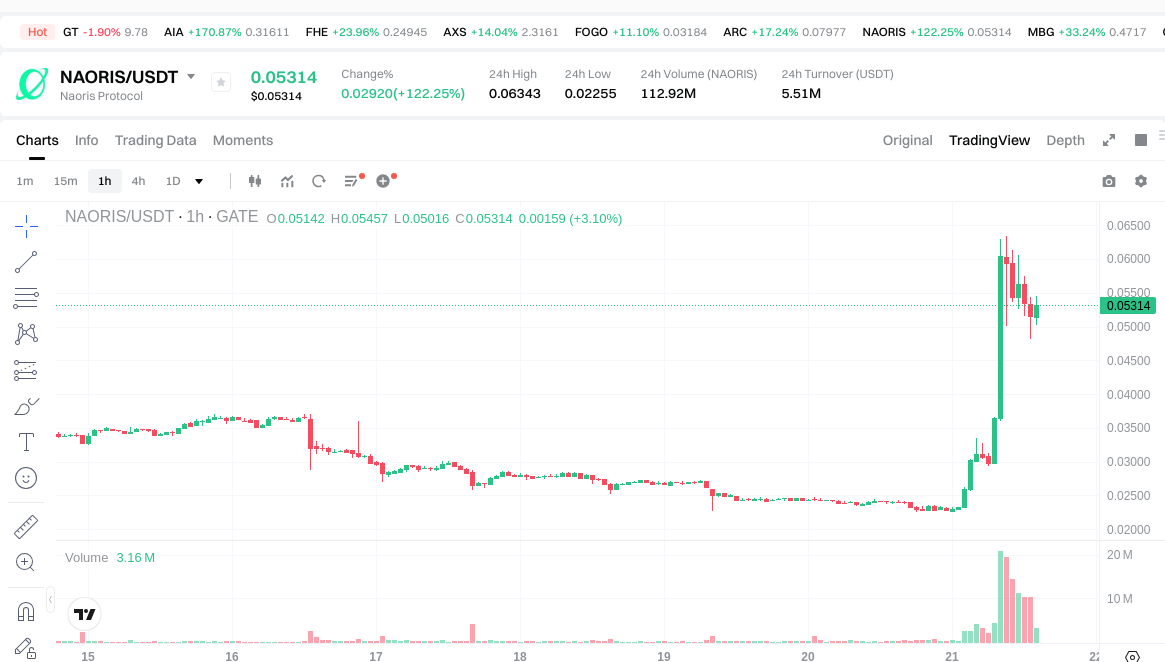
Naoris Protocol (NAORIS) represents a notable asset in the cryptocurrency sector, operating as a decentralized post-quantum infrastructure at the Sub-Zero Layer beneath L0 to L3 blockchain layers. As of January 21, 2026, NAORIS holds a market ranking of 707 with a market capitalization of approximately $30.79 million and a circulating supply of 599.26 million tokens. The current trading price stands at around $0.05138, with 24-hour trading volume reaching $5.43 million across 10 exchanges.
The project has attracted institutional backing from notable investors including Tim Draper and Holdun Family Office, alongside an advisory board featuring industry figures such as Michael Terpin, David Holtzman (DNS architect), former White House Chief of Staff Mick Mulvaney, and Ahmed Chami (former CEO of Microsoft South East Asia). With a total supply capped at 4 billion tokens and a current circulation ratio of 14.98%, NAORIS demonstrates a particular tokenomics structure that warrants examination.
Recent price movements show notable volatility, with a 114.14% increase over 24 hours and 44.15% gain over 7 days, though the asset has experienced a decline of 66.30% over the past year. The token's historical price range spans from a recorded low of $0.00613 (October 10, 2025) to a peak of $0.2238 (July 31, 2025). As investors evaluate "Is Naoris Protocol (NAORIS) a good investment?", this article provides a comprehensive analysis of NAORIS's investment characteristics, historical performance, future price considerations, and associated risks to support informed decision-making.
I. NAORIS Token Price History Review and Current Investment Value
- 2025: Token Launch and Initial Trading → NAORIS began trading with initial price volatility
- July 2025: Price Peak Period → NAORIS reached $0.2238 during this phase
- October 2025: Market Correction Phase → Price declined to $0.00613
- January 2026: Recovery Momentum → Price rebounded to current levels with increased trading activity
Current NAORIS Investment Market Status (January 2026)
- NAORIS current price: $0.05138
- 24-hour trading volume: $5,426,283.15
- Market capitalization: $30,789,978.80
- Circulating supply: 599,260,000 NAORIS (14.98% of total supply)
- Total supply: 4,000,000,000 NAORIS
- Available on 10 exchanges
- Token holders: 1,872
Click to view real-time NAORIS market price
II. Core Factors Affecting Whether NAORIS is a Good Investment (Is Naoris Protocol(NAORIS) a Good Investment)
Supply Mechanism and Scarcity (NAORIS investment scarcity)
- Maximum Supply and Circulation: Naoris Protocol has a maximum supply of 4,000,000,000 NAORIS tokens, with a current circulating supply of 599,260,000 tokens, representing approximately 14.98% of the total supply → the gradual release of tokens may influence price dynamics and investment considerations
- Historical Price Range: NAORIS has experienced price fluctuations, with historical data showing variations between different price levels → supply-demand dynamics have contributed to price movements
- Investment Significance: The controlled token release schedule and capped maximum supply may provide a framework for evaluating long-term scarcity considerations
Institutional Investment and Mainstream Adoption (Institutional investment in NAORIS)
- Institutional Backing: Naoris Protocol is backed by investors including Tim Draper and Holdun Family Office → institutional participation may contribute to project credibility
- Advisory Team: The project features advisors such as Michael Terpin (referred to by CNBC as "the godfather of crypto"), David Holtzman (Architect of DNS), Mick Mulvaney (former White House Chief of Staff), and Ahmed Chami (former CEO of Microsoft South East Asia), as well as former NATO Generals → experienced advisory input may support strategic development
- Integration Potential: The protocol's ability to integrate with existing EVM blockchains without requiring hard forks, as well as compatibility with Web3 infrastructure (nodes, validators, bridges, DEXs, dApps) and Web2 systems (enterprise systems, cloud platforms, IoT devices) → may facilitate broader adoption across different technological environments
Macroeconomic Environment's Impact on NAORIS Investment
- Market Position: As of the current period, NAORIS holds a market ranking of 707 with a market dominance of 0.0064% → macroeconomic factors affecting the broader cryptocurrency market may influence NAORIS investment dynamics
- Volatility Considerations: The token has shown price volatility, with 24-hour price changes and fluctuations over different time periods → macroeconomic uncertainty and market sentiment may contribute to price movements
Technology and Ecosystem Development (Technology & Ecosystem for NAORIS investment)
- Sub-Zero Layer Architecture: Naoris Protocol operates at the Sub-Zero Layer, positioned beneath L0 to L3 blockchain layers, functioning as a trust and security framework for Web3 and modern internet infrastructure → this architectural approach may provide differentiation in the decentralized infrastructure space
- Post-Quantum Infrastructure: Described as a decentralized post-quantum infrastructure currently in production → the focus on post-quantum security features may address emerging technological considerations
- Cross-Platform Integration: The protocol's design allows seamless integration with existing EVM blockchains and various physical infrastructure types across both Web3 and Web2 environments → ecosystem compatibility may support broader utility and application development
- Holder Base and Exchange Availability: Currently held by 1,872 addresses and listed on 10 exchanges → the developing holder base and exchange presence may reflect ongoing ecosystem growth
III. NAORIS Future Investment Forecast and Price Outlook (Is Naoris Protocol(NAORIS) worth investing in 2026-2031)
Short-term Investment Forecast (2026, short-term NAORIS investment outlook)
- Conservative forecast: $0.0399 - $0.0519
- Neutral forecast: $0.0519 - $0.0612
- Optimistic forecast: $0.0612 and above
Mid-term Investment Outlook (2027-2029, mid-term Naoris Protocol(NAORIS) investment forecast)
-
Market stage expectation: The mid-term period may witness gradual adoption of decentralized post-quantum infrastructure solutions across Web3 and enterprise environments, potentially supporting price stability with moderate growth trajectories.
-
Investment return forecast:
- 2027: $0.0322 - $0.0593
- 2028: $0.0336 - $0.0753
- 2029: $0.0553 - $0.0852
-
Key catalysts: Integration progress with EVM blockchains, strategic partnerships with enterprise systems and IoT platforms, expansion of node validator networks, and broader market acceptance of post-quantum security solutions.
Long-term Investment Outlook (Is NAORIS a good long-term investment?)
- Base scenario: $0.0486 - $0.0971 (assuming steady infrastructure adoption and maintained market positioning)
- Optimistic scenario: $0.0736 - $0.1108 (assuming accelerated Web3 integration and enhanced institutional adoption)
- Risk scenario: Below $0.0486 (under adverse market conditions or significant competitive pressures)
View NAORIS long-term investment and price forecast: Price Prediction
2026-01-21 - 2031 Long-term Outlook
- Base scenario: $0.0486 - $0.0971 (corresponding to steady progress and gradual mainstream application growth)
- Optimistic scenario: $0.0736 - $0.1108 (corresponding to large-scale adoption and favorable market environment)
- Transformative scenario: Above $0.1108 (in case of breakthrough ecosystem developments and mainstream popularization)
- 2031-12-31 forecast high: $0.1108 (based on optimistic development assumptions)
Disclaimer: The above forecasts are for reference purposes only and do not constitute investment advice. Cryptocurrency markets involve substantial risk, and actual prices may differ significantly from projections due to market volatility, technological developments, regulatory changes, and other unforeseen factors. Investors should conduct independent research and assess their risk tolerance before making investment decisions.
| Year |
Predicted High Price |
Predicted Average Price |
Predicted Low Price |
Price Change |
| 2026 |
0.0611594 |
0.05183 |
0.0399091 |
0 |
| 2027 |
0.059319435 |
0.0564947 |
0.032201979 |
9 |
| 2028 |
0.07527918775 |
0.0579070675 |
0.03358609915 |
12 |
| 2029 |
0.08523920336 |
0.066593127625 |
0.05527229592875 |
28 |
| 2030 |
0.11083760161905 |
0.0759161654925 |
0.073638680527725 |
47 |
| 2031 |
0.097111958898006 |
0.093376883555775 |
0.048555979449003 |
80 |
IV. NAORIS Investment Strategy and Risk Management (How to invest in Naoris Protocol)
Investment Methodology (NAORIS investment strategy)
Long-term Holding (HODL NAORIS)
For conservative investors seeking exposure to decentralized cybersecurity infrastructure, a long-term holding strategy may align with the project's development trajectory. Given NAORIS's positioning as a post-quantum security layer integrating with both Web3 and Web2 infrastructures, investors with extended time horizons could consider accumulation during periods of reduced volatility. This approach requires patience through market cycles and focus on fundamental technological adoption rather than short-term price movements.
Active Trading
Traders employing technical analysis may find opportunities in NAORIS's price dynamics. The token has exhibited notable volatility, with 24-hour price fluctuations reaching significant levels. Active traders should monitor support and resistance levels, volume patterns, and correlation with broader market trends. Given the token's relatively lower liquidity compared to major cryptocurrencies, position sizing becomes particularly important to manage execution risks.
Risk Management (Risk management for NAORIS investment)
Asset Allocation Proportions
- Conservative investors: May consider limiting NAORIS exposure to 1-3% of their cryptocurrency portfolio, given the project's early stage and market capitalization positioning
- Moderate investors: Could allocate 3-7% depending on conviction in decentralized security infrastructure thesis
- Experienced investors: May adjust allocation based on technical developments, partnership announcements, and integration progress with existing blockchain networks
Risk Hedging Approaches
Investors should consider diversification across multiple asset classes and cryptocurrency sectors. A balanced portfolio might include:
- Established layer-1 protocols alongside infrastructure tokens like NAORIS
- Stablecoin reserves for opportunistic rebalancing
- Hedging instruments available on supporting exchanges, where applicable
Secure Storage Solutions
Given NAORIS operates as an ERC-20 token on the Ethereum network (contract address: 0x1b379a79c91a540b2bcd612b4d713f31de1b80cc), investors have multiple storage options:
- Cold storage: Hardware wallets supporting Ethereum-based tokens provide optimal security for long-term holdings
- Hot wallets: For active traders, reputable software wallets with multi-signature capabilities offer balance between accessibility and security
- Exchange custody: While convenient for trading, extended storage on exchanges carries counterparty risk
V. NAORIS Investment Risks and Challenges (Risks of investing in Naoris Protocol)
Market Risk
NAORIS demonstrates substantial price volatility characteristic of mid-cap cryptocurrency assets. The 24-hour trading range and historical price movement from its all-time high to current levels illustrate the potential for significant value fluctuations. With a market capitalization representing a small fraction of total cryptocurrency market value, the token remains susceptible to broader market sentiment shifts and liquidity constraints that can amplify price swings in both directions.
Regulatory Risk
As a cybersecurity infrastructure project operating across Web3 and traditional internet environments, NAORIS faces regulatory considerations across multiple jurisdictions. The evolving landscape of cryptocurrency regulation, particularly regarding infrastructure protocols and their classification, introduces uncertainty. Changes in regulatory frameworks concerning data security, cross-border operations, or token utility could impact the project's operational scope and token economics.
Technical Risk
Several technical considerations warrant attention:
- Integration complexity: The protocol's claimed seamless integration with existing EVM blockchains and physical infrastructure presents execution challenges that could affect adoption timelines
- Network security: While positioned as a security solution, the protocol itself must maintain robust defenses against potential vulnerabilities
- Post-quantum cryptography implementation: The effectiveness of post-quantum security features remains subject to ongoing cryptographic research and potential discovery of new attack vectors
- Smart contract risk: As an ERC-20 token, NAORIS inherits the security considerations associated with Ethereum smart contracts
Project-Specific Risks
- Adoption uncertainty: The protocol's value proposition depends on achieving meaningful integration with both blockchain networks and traditional infrastructure
- Competition: Other cybersecurity and infrastructure projects compete for similar use cases and market positioning
- Token distribution: With circulating supply representing approximately 14.98% of maximum supply, future token releases could influence price dynamics
VI. Conclusion: Is Naoris Protocol a Good Investment?
Investment Value Summary
NAORIS presents a specialized investment proposition within the cryptocurrency cybersecurity infrastructure sector. The project's positioning at the intersection of Web3 security and traditional internet infrastructure addresses an emerging need as blockchain adoption expands. However, the token's price history and volatility characteristics reflect the uncertainties inherent in early-stage infrastructure projects.
The backing from notable investors and advisors with backgrounds in technology and policy provides certain credibility indicators, though this does not guarantee technical or commercial success. The project's focus on post-quantum security addresses a forward-looking concern, though practical implementation and market demand remain to be demonstrated at scale.
Investor Recommendations
✅ Beginners: Consider dollar-cost averaging with small allocations while learning about decentralized security infrastructure. Prioritize secure storage using hardware wallets compatible with ERC-20 tokens. Limit exposure to amounts comfortable with potential loss.
✅ Experienced investors: May explore tactical allocation strategies based on technical analysis and project milestone monitoring. Portfolio positioning should account for the token's volatility profile and liquidity characteristics. Consider correlation with broader infrastructure and security-focused cryptocurrency sectors.
✅ Institutional investors: Could evaluate NAORIS within thematic allocations to blockchain infrastructure and cybersecurity segments. Due diligence should encompass technical architecture review, competitive landscape analysis, and assessment of integration roadmap feasibility.
⚠️ Disclaimer: Cryptocurrency investments carry substantial risk, including potential complete loss of capital. This analysis provides informational context only and does not constitute financial advice, investment recommendation, or solicitation. Market conditions, project developments, and regulatory environments can change rapidly. Investors should conduct independent research and consult qualified financial advisors before making investment decisions.
VII. FAQ
Q1: What is Naoris Protocol and how does it differ from other blockchain security projects?
Naoris Protocol is a decentralized post-quantum infrastructure operating at the Sub-Zero Layer beneath L0 to L3 blockchain layers, serving as a trust and security framework for both Web3 and modern internet infrastructure. Unlike conventional blockchain security solutions that operate at specific layer levels, NAORIS positions itself as a foundational security layer that can integrate with existing EVM blockchains without requiring hard forks. The protocol's distinguishing feature is its focus on post-quantum cryptography, addressing potential future threats from quantum computing, while maintaining compatibility across Web3 infrastructure (nodes, validators, bridges, DEXs, dApps) and Web2 systems (enterprise systems, cloud platforms, IoT devices). This cross-platform approach differentiates it from security projects that focus solely on blockchain-specific vulnerabilities.
Q2: What are the primary risks associated with investing in NAORIS tokens?
NAORIS investment carries multiple risk dimensions that investors should carefully consider. Market risk is significant, as demonstrated by the token's historical volatility—ranging from a low of $0.00613 (October 2025) to a high of $0.2238 (July 2025), with current annual decline of 66.30%. Liquidity constraints pose challenges, with relatively limited trading volume across 10 exchanges and a market cap of approximately $30.79 million. Technical risks include the complexity of implementing post-quantum cryptography and achieving seamless integration with diverse blockchain and traditional infrastructure systems. Additionally, with only 14.98% of total supply currently circulating (599.26 million of 4 billion tokens), future token releases could create downward price pressure. Regulatory uncertainty surrounding cybersecurity infrastructure protocols and the project's early-stage nature further compound investment risks.
Q3: How should different types of investors approach NAORIS allocation in their portfolios?
Portfolio allocation strategies should align with investor experience and risk tolerance. Conservative investors may limit NAORIS exposure to 1-3% of their cryptocurrency portfolio, given the project's early-stage status and mid-cap positioning (rank 707). This conservative approach allows participation in the decentralized security infrastructure thesis while limiting downside exposure. Moderate investors with higher risk tolerance could allocate 3-7% based on conviction in post-quantum security adoption and integration progress with blockchain networks. Experienced investors may adjust allocations dynamically based on technical developments, partnership announcements, and milestone achievements. Regardless of allocation size, diversification across multiple cryptocurrency sectors and asset classes remains essential. Investors should also maintain stablecoin reserves for opportunistic rebalancing during periods of heightened volatility.
Q4: What factors could drive NAORIS price appreciation in the medium to long term?
Several catalysts could potentially support NAORIS value appreciation over extended timeframes. Integration progress with EVM blockchains and successful deployment across Web3 infrastructure (nodes, validators, decentralized applications) would demonstrate practical utility and adoption. Strategic partnerships with enterprise systems, cloud platforms, and IoT device manufacturers could expand the protocol's addressable market beyond cryptocurrency-native applications. Growing awareness of post-quantum security threats and increasing demand for quantum-resistant cryptographic solutions may drive institutional interest. Expansion of the node validator network and increased token holder base (currently 1,872 addresses) would contribute to network effects. Favorable regulatory developments regarding blockchain security infrastructure and broader cryptocurrency market recovery could provide tailwind support. However, investors should note that price forecasts range from $0.0486 - $0.0971 (base scenario) to $0.0736 - $0.1108 (optimistic scenario) by 2031, reflecting significant uncertainty.
Q5: Is NAORIS suitable for long-term holding (HODL) strategy?
NAORIS may align with long-term holding strategies for investors with specific conviction in decentralized cybersecurity infrastructure and extended time horizons. The project's focus on post-quantum security addresses a forward-looking concern as quantum computing advances, potentially creating sustained demand for quantum-resistant solutions. Institutional backing from Tim Draper and Holdun Family Office, combined with an advisory board including technology and policy veterans, provides certain credibility indicators for long-term viability. The protocol's positioning at the Sub-Zero Layer with cross-platform compatibility suggests potential for broad application beyond current use cases. However, long-term holders must accept substantial interim volatility, early-stage execution risks, and uncertainty regarding adoption timelines. The current circulating supply of only 14.98% means token release schedules will influence price dynamics over years. Conservative long-term investors should employ dollar-cost averaging to mitigate timing risk and utilize secure cold storage solutions (hardware wallets) given the multi-year holding horizon.
Q6: How does NAORIS's token distribution and supply schedule impact investment considerations?
NAORIS's tokenomics structure presents both opportunities and concerns for investors. With a maximum supply capped at 4 billion tokens and current circulation of 599.26 million (14.98%), approximately 85% of total supply remains locked or unvested. This controlled release schedule theoretically supports scarcity considerations, as gradual token distribution may prevent sudden supply shocks. However, the significant overhang of unreleased tokens introduces uncertainty regarding future dilution and its impact on token value. Investors lack transparent information about vesting schedules, team allocations, and community distribution plans from the provided data. The relatively small holder base of 1,872 addresses suggests concentrated ownership, which could contribute to price volatility as large holders adjust positions. For investment evaluation, the low float relative to total supply means current market capitalization ($30.79 million) doesn't reflect fully-diluted valuation, which would approach $205 million at current prices if all tokens circulated.
Q7: What technical factors should investors monitor to assess NAORIS's development progress?
Investors tracking NAORIS development should monitor several technical indicators beyond price movements. Integration milestones with EVM blockchains serve as concrete evidence of protocol adoption—successful deployments without requiring hard forks would validate the project's technical claims. Growth in validator nodes and network participants provides quantifiable metrics of infrastructure expansion. Smart contract security audits and formal verification of post-quantum cryptographic implementations offer assurance regarding technical robustness. Partnership announcements with Web2 enterprises, cloud platforms, or IoT manufacturers signal real-world application progress. On-chain metrics including active addresses, transaction volume, and token holder distribution reveal actual usage patterns versus speculative trading. Exchange listing expansion beyond the current 10 platforms would improve liquidity and accessibility. Development activity visibility through open-source code repositories (if available) demonstrates ongoing technical work. Investors should also monitor competitive developments in the post-quantum cryptography and blockchain security sectors to assess NAORIS's relative positioning.
Q8: What are the immediate-term price outlook and trading considerations for NAORIS?
NAORIS exhibits characteristics typical of mid-cap, high-volatility cryptocurrency assets. Recent price action shows significant swings—a 114.14% increase over 24 hours and 44.15% gain over 7 days, contrasted with a 66.30% decline over the past year. For 2026, price forecasts range from $0.0399 - $0.0519 (conservative) to $0.0612 and above (optimistic), with neutral expectations at $0.0519 - $0.0612. Active traders should note the relatively limited liquidity, with 24-hour trading volume of $5.43 million across exchanges, which may result in wider bid-ask spreads and slippage on larger orders. Technical analysis should incorporate support levels near historical lows around $0.0061 and resistance near previous highs around $0.2238. Given the volatility profile, position sizing becomes critical—traders should use stop-loss orders and avoid overleveraging. The token's correlation with broader cryptocurrency market trends means macro sentiment shifts significantly impact short-term price movements. Investors should approach near-term trading with disciplined risk management and recognition of execution challenges in lower-liquidity environments.
* The information is not intended to be and does not constitute financial advice or any other recommendation of any sort offered or endorsed by Gate.