This comprehensive analysis examines whether Naoris Protocol (NAORIS) represents a viable investment opportunity in 2024-2026. The article evaluates NAORIS, a decentralized post-quantum infrastructure token operating at the Sub-Zero Layer with institutional backing from Tim Draper and prominent advisors. It provides detailed price history analysis from launch through January 2026, reviewing the token's $0.02642 current valuation against historical performance and market dynamics. The analysis covers critical investment factors including tokenomics with a 4 billion maximum supply and 14.98% circulation ratio, technological positioning for Web3/Web2 integration, and institutional credibility. Price forecasts range from conservative to optimistic scenarios through 2031, alongside comprehensive risk assessment addressing market volatility, regulatory uncertainty, and technology execution challenges. Investment strategies for different investor profiles, risk management approaches, and secure storage recommendatio
Introduction: Naoris Protocol (NAORIS) Investment Position and Market Outlook
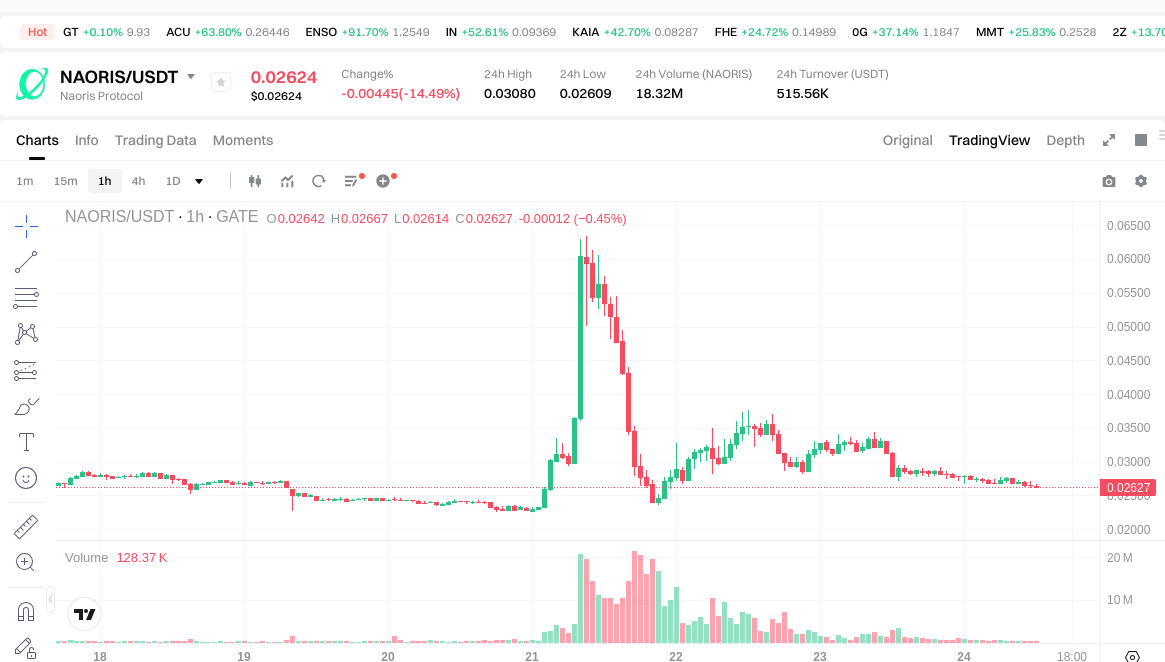
Naoris Protocol (NAORIS) represents a notable digital asset in the cryptocurrency sector, positioning itself as a decentralized post-quantum infrastructure operating at the Sub-Zero Layer beneath L0 to L3 blockchain layers. As of January 24, 2026, NAORIS maintains a market capitalization of approximately $15.83 million, with a circulating supply of 599.26 million tokens and a current price around $0.02642. The project integrates with existing EVM blockchains and various physical infrastructure components across Web3 and Web2 ecosystems, including nodes, validators, bridges, decentralized exchanges, enterprise systems, and IoT devices.
With backing from investors such as Tim Draper and the Holdun Family Office, along with advisory support from individuals including Michael Terpin, David Holtzman, former White House Chief of Staff Mick Mulvaney, and Ahmed Chami, the project has established a network of 1,927 token holders across 10 exchanges. The token has experienced notable price fluctuations, with recent period showing declines of 2.27% over 1 hour, 15.25% over 24 hours, and 82.68% over the past year from its previous levels.
This article examines NAORIS's investment characteristics, historical price movements, market dynamics, and associated considerations for those evaluating "Is Naoris Protocol (NAORIS) a good investment?" through analysis of available market data and project fundamentals.
I. NAORIS Token Price History Review and Current Investment Value Status
- 2025: Token launch and initial trading → Price volatility observed during early market phase
- July 2025: Price reached $0.2238 during initial market period → NAORIS experienced significant fluctuation
- October 2025: Market correction phase → Price adjusted from elevated levels to $0.00613
- 2025-2026: Market consolidation period → Price stabilized around current trading range
Current NAORIS Investment Market Status (January 2026)
- NAORIS current price: $0.02642
- 24-hour trading volume: $521,989.66
- Token holders: 1,927 addresses
- Trading availability: Listed on 10 exchanges
Click to view real-time NAORIS market price
II. Core Factors Affecting Whether NAORIS is a Good Investment (Is Naoris Protocol(NAORIS) a Good Investment)
Supply Mechanism and Scarcity (NAORIS investment scarcity)
- Maximum Supply: 4,000,000,000 NAORIS tokens, with current circulating supply of 599,260,000 tokens (approximately 14.98% of maximum supply) → affects long-term price dynamics and investment considerations
- Circulating Supply Ratio: Only 14.98% of tokens currently in circulation suggests potential supply expansion over time, which may influence future price behavior
- Investment Implication: The tokenomics structure with a capped maximum supply provides a defined scarcity framework, though the low circulation ratio indicates significant future token releases may occur
Institutional Investment and Mainstream Adoption (Institutional investment in NAORIS)
- Venture Capital Backing: Supported by Tim Draper and Holdun Family Office, providing institutional credibility
- Advisory Network: Guided by industry figures including Michael Terpin, David Holtzman (DNS Architect), former White House Chief of Staff Mick Mulvaney, and former Microsoft Southeast Asia CEO Ahmed Chami
- Integration Capability: Designed to integrate with existing EVM blockchains without hard forks, and compatible with Web3 infrastructure (nodes, validators, bridges, DEXs, dApps) as well as Web2 systems (enterprise systems, cloud platforms, IoT devices)
Technology and Ecosystem Development (Technology & Ecosystem for NAORIS investment)
- Technical Positioning: Operates at the Sub-Zero Layer, beneath L0 to L3 blockchain layers, functioning as trust and security infrastructure for Web3 and modern internet
- Post-Quantum Infrastructure: Positioned as a decentralized post-quantum infrastructure solution in production
- Integration Scope: Seamless compatibility with various physical infrastructure types across both Web3 and Web2 environments may support long-term ecosystem expansion
- Token Standard: Deployed as ERC-20 token on Ethereum network
Market Performance Context
- Current Holder Base: 1,927 token holders as of the reference date
- Exchange Availability: Listed on 10 exchanges
- Price Performance: The token has experienced fluctuations since launch, with price changes of -2.27% (1H), -15.25% (24H), -11.37% (7D), -32.92% (30D), and -82.68% (1Y)
III. NAORIS Future Investment Forecast and Price Outlook (Is Naoris Protocol (NAORIS) worth investing in 2026-2031)
Short-term Investment Forecast (2026, short-term NAORIS investment outlook)
- Conservative forecast: 0.0189 - 0.02625 USD
- Neutral forecast: 0.02625 - 0.03115 USD
- Optimistic forecast: 0.03115 - 0.036225 USD
Mid-term Investment Outlook (2027-2029, mid-term Naoris Protocol (NAORIS) investment forecast)
-
Market stage expectations: The project may experience gradual development as its post-quantum infrastructure continues integration with Web3 and Web2 systems. Market performance could be influenced by broader adoption of its Sub-Zero Layer technology and partnerships within decentralized infrastructure.
-
Investment return forecast:
- 2027: 0.01811775 - 0.046543875 USD
- 2028: 0.031501456875 - 0.047057731875 USD
- 2029: 0.030511688878125 - 0.062312604046875 USD
-
Key catalysts: Integration progress with EVM blockchains, expansion of enterprise and IoT infrastructure partnerships, developments in post-quantum security solutions, and potential network effect from validator and node adoption.
Long-term Investment Outlook (Is NAORIS a good long-term investment?)
- Base scenario: 0.045599719028357 - 0.064224956377968 USD (assuming steady infrastructure adoption and maintained market position)
- Optimistic scenario: 0.064224956377968 - 0.077069947653562 USD (assuming accelerated Web3 integration and expanded institutional adoption)
- Risk scenario: Below 0.03 USD (under conditions of delayed technology adoption, intensified competition, or adverse regulatory developments)
View NAORIS long-term investment and price forecast: Price Prediction
2026-2031 Long-term Outlook
- Base scenario: 0.045599719028357 - 0.064224956377968 USD (corresponding to steady progress and gradual mainstream application improvement)
- Optimistic scenario: 0.064224956377968 - 0.077069947653562 USD (corresponding to large-scale adoption and favorable market conditions)
- Transformative scenario: Above 0.077069947653562 USD (in case of breakthrough ecosystem developments and mainstream popularization)
- 2031-12-31 forecast high: 0.077069947653562 USD (based on optimistic development assumptions)
Disclaimer: The above forecasts are based on historical data and market analysis models. Cryptocurrency investments involve substantial risks, and actual prices may differ significantly from predictions due to market volatility, regulatory changes, technological developments, and other unpredictable factors. This content does not constitute investment advice, and investors should conduct independent research and risk assessment.
| Year |
Predicted High Price |
Predicted Average Price |
Predicted Low Price |
Price Change |
| 2026 |
0.036225 |
0.02625 |
0.0189 |
0 |
| 2027 |
0.046543875 |
0.0312375 |
0.01811775 |
18 |
| 2028 |
0.047057731875 |
0.0388906875 |
0.031501456875 |
47 |
| 2029 |
0.062312604046875 |
0.0429742096875 |
0.030511688878125 |
62 |
| 2030 |
0.07580650588875 |
0.052643406867187 |
0.045273329905781 |
99 |
| 2031 |
0.077069947653562 |
0.064224956377968 |
0.045599719028357 |
143 |
IV. Naoris Protocol (NAORIS) Investment Strategy and Risk Management (How to invest in Naoris Protocol)
Investment Methodology (Naoris Protocol investment strategy)
Long-term Holding (HODL NAORIS): Suitable for conservative investors who believe in the protocol's vision of decentralized post-quantum infrastructure. This approach focuses on accumulating tokens during price dips and holding through market cycles, betting on the gradual adoption of Naoris Protocol's Sub-Zero Layer technology across Web3 and Web2 infrastructure.
Active Trading: Relies on technical analysis and swing trading opportunities. Given NAORIS's price volatility (24-hour range: $0.02609 - $0.03113), experienced traders may capitalize on short-term price movements. This strategy requires continuous monitoring of support and resistance levels, volume patterns, and broader market sentiment.
Risk Management (Risk management for NAORIS investment)
Asset Allocation Ratios:
- Conservative Investors: Allocate 1-3% of crypto portfolio to NAORIS, maintaining majority holdings in established assets
- Aggressive Investors: May allocate 5-10% to NAORIS, accepting higher volatility for potential growth
- Professional Investors: Could consider 3-7% allocation with active rebalancing strategies
Risk Hedging Solutions: Diversify across multiple blockchain infrastructure projects and established cryptocurrencies. Consider hedging strategies during periods of heightened volatility. Maintain exposure to both high-market-cap assets and emerging protocols to balance risk-reward profiles.
Secure Storage: For long-term holdings, hardware wallets (such as Ledger or Trezor) are recommended for maximum security. Hot wallets may be used for smaller amounts designated for active trading. Always verify the contract address (0x1b379a79c91a540b2bcd612b4d713f31de1b80cc on Ethereum) before any transaction.
V. Naoris Protocol (NAORIS) Investment Risks and Challenges (Risks of investing in Naoris Protocol)
Market Risk: NAORIS demonstrates substantial price volatility, with a 24-hour change of -15.25% and a 30-day decline of -32.92%. The token has experienced significant drawdowns from its price levels earlier in its trading history. The relatively modest trading volume ($521,989.66) and market capitalization ($15.83 million) indicate limited liquidity, which can amplify price swings during periods of buying or selling pressure.
Regulatory Risk: As a blockchain infrastructure protocol operating across multiple jurisdictions, Naoris Protocol faces evolving regulatory frameworks. Different countries maintain varying approaches to blockchain technology and cryptocurrency classification. Changes in regulatory stances, particularly regarding post-quantum cryptography standards or decentralized infrastructure, could impact the protocol's operations and token valuation.
Technology Risk: The protocol's ambitious goal of providing post-quantum security infrastructure introduces technical complexity. Potential risks include:
- Integration challenges with existing EVM blockchains and traditional infrastructure
- Competition from alternative security solutions or quantum-resistant protocols
- Technical vulnerabilities in the Sub-Zero Layer implementation
- Dependencies on continued development and maintenance of the protocol
The token's circulating supply represents only 14.98% of the maximum supply (599.26 million of 4 billion tokens), indicating potential future supply increases that could affect token economics.
VI. Conclusion: Is Naoris Protocol a Good Investment?
Investment Value Summary: Naoris Protocol presents an interesting proposition in the blockchain infrastructure space, particularly in addressing post-quantum security concerns. The protocol's backing by notable investors and advisors, along with its unique positioning at the Sub-Zero Layer, offers potential long-term value. However, the token has experienced considerable price volatility, with notable declines across various timeframes.
Investor Recommendations:
✅ Beginners: Consider dollar-cost averaging (DCA) to enter positions gradually, reducing exposure to short-term volatility. Store tokens in secure hardware wallets and focus on understanding the protocol's technology and roadmap before making significant allocations.
✅ Experienced Investors: May employ swing trading strategies to capitalize on price fluctuations while maintaining a core long-term position. Combine technical analysis with fundamental evaluation of protocol development milestones and partnership announcements. Maintain disciplined position sizing within a diversified portfolio.
✅ Institutional Investors: Could consider strategic long-term allocation as part of a blockchain infrastructure thesis, particularly focused on quantum-resistant security solutions. Conduct thorough due diligence on the protocol's technology implementation, team capabilities, and competitive positioning.
⚠️ Disclaimer: Cryptocurrency investments carry substantial risk, including the potential for complete loss of capital. This analysis is provided for informational purposes only and does not constitute investment advice. Conduct independent research and consider your financial situation, risk tolerance, and investment objectives before making any investment decisions.
VII. FAQ
Q1: What is Naoris Protocol and how does it differ from other blockchain security solutions?
Naoris Protocol is a decentralized post-quantum infrastructure operating at the Sub-Zero Layer, positioned beneath L0 to L3 blockchain layers. Unlike conventional blockchain security solutions that operate at application or consensus layers, Naoris functions as foundational trust and security infrastructure for both Web3 and Web2 ecosystems. The protocol integrates seamlessly with existing EVM blockchains without requiring hard forks, and extends compatibility to nodes, validators, bridges, DEXs, dApps, enterprise systems, cloud platforms, and IoT devices. This unique architectural positioning addresses quantum computing threats while maintaining interoperability across diverse infrastructure components.
Q2: Why has NAORIS experienced significant price volatility since launch?
NAORIS has demonstrated substantial price fluctuations, including declines of -15.25% over 24 hours and -82.68% over the past year. This volatility stems from several factors: the token's relatively modest market capitalization of $15.83 million and trading volume of $521,989.66 indicate limited liquidity, which amplifies price movements during buying or selling pressure. Additionally, only 14.98% of the maximum supply (599.26 million of 4 billion tokens) currently circulates, creating uncertainty about future token releases. As an emerging infrastructure protocol, NAORIS also experiences price sensitivity to broader market sentiment, development milestones, and competition within the blockchain security sector.
Q3: What are the tokenomics and supply dynamics of NAORIS?
NAORIS operates with a maximum supply of 4 billion tokens, with a current circulating supply of 599.26 million tokens (approximately 14.98% of maximum supply). The token is deployed as an ERC-20 standard on the Ethereum network, with the contract address 0x1b379a79c91a540b2bcd612b4d713f31de1b80cc. The low circulation ratio indicates significant future token releases may occur, which could influence price dynamics and dilution concerns. Investors should monitor the token release schedule and vesting mechanisms to understand potential supply-side pressure on the market price over time.
Q4: What is the recommended investment allocation for NAORIS?
Investment allocation depends on risk tolerance and portfolio strategy. Conservative investors should consider allocating 1-3% of their cryptocurrency portfolio to NAORIS, maintaining majority holdings in established assets like Bitcoin or Ethereum. Aggressive investors with higher risk appetite may allocate 5-10% to NAORIS, accepting greater volatility for potential growth. Professional investors could consider 3-7% allocation with active rebalancing strategies. Regardless of allocation size, diversification across multiple blockchain infrastructure projects and established cryptocurrencies is essential to manage risk. Always conduct independent research and consider your financial situation before making investment decisions.
Q5: What are the primary risks associated with investing in NAORIS?
NAORIS presents several key risk categories: Market Risk includes substantial price volatility with notable declines across multiple timeframes and limited liquidity that amplifies price swings. Regulatory Risk involves evolving frameworks across jurisdictions regarding blockchain technology and post-quantum cryptography standards. Technology Risk encompasses integration challenges with existing infrastructure, competition from alternative security solutions, potential technical vulnerabilities in the Sub-Zero Layer implementation, and dependencies on continued protocol development. Additionally, the token's low circulating supply percentage (14.98%) indicates potential future supply increases that could affect token economics and create dilution pressure.
Q6: How does institutional backing affect NAORIS's investment potential?
NAORIS benefits from notable institutional support, including backing from Tim Draper and the Holdun Family Office, providing credibility and potential strategic resources. The advisory network includes industry figures such as Michael Terpin, DNS Architect David Holtzman, former White House Chief of Staff Mick Mulvaney, and former Microsoft Southeast Asia CEO Ahmed Chami. This institutional involvement may facilitate strategic partnerships, enterprise adoption, and technological development. However, institutional backing does not guarantee investment success, and the protocol must still demonstrate technical execution, market adoption, and competitive differentiation to validate its long-term value proposition.
Q7: What trading strategies are suitable for NAORIS investment?
Two primary strategies suit different investor profiles: Long-term Holding (HODL) is appropriate for conservative investors who believe in the protocol's post-quantum infrastructure vision, focusing on accumulating tokens during price dips and holding through market cycles. This approach bets on gradual adoption of Naoris Protocol's Sub-Zero Layer technology. Active Trading suits experienced traders who can capitalize on short-term price movements, given NAORIS's volatility (24-hour range: $0.02609 - $0.03113). This strategy requires continuous monitoring of support and resistance levels, volume patterns, and broader market sentiment. Beginners should consider dollar-cost averaging (DCA) to reduce exposure to short-term volatility.
Q8: What are the long-term price forecasts for NAORIS through 2031?
Price forecasts for NAORIS through 2031 vary across scenarios: Base scenario projects $0.045599719028357 - $0.064224956377968, assuming steady infrastructure adoption and maintained market position. Optimistic scenario forecasts $0.064224956377968 - $0.077069947653562, contingent on accelerated Web3 integration and expanded institutional adoption. Risk scenario indicates potential decline below $0.03 under conditions of delayed technology adoption, intensified competition, or adverse regulatory developments. The 2031 forecast high reaches $0.077069947653562 based on optimistic development assumptions. These projections carry substantial uncertainty and depend on unpredictable factors including market conditions, technological developments, regulatory changes, and competitive dynamics.
* The information is not intended to be and does not constitute financial advice or any other recommendation of any sort offered or endorsed by Gate.