This comprehensive guide evaluates whether NAVI Protocol (NAVX) represents a viable investment opportunity in 2024-2026. The article analyzes NAVX's position as Sui's first native liquidity protocol, examining its price trajectory from $0.428 (March 2024) to current levels of $0.01261, alongside tokenomics with 816.17 million circulating tokens of 1 billion total supply. Core investment factors include technological innovation through Automatic Leverage Vaults and Isolation Mode, the 95,973 holder base, and availability across 15 exchanges including Gate. Price forecasts range from conservative ($0.0110-$0.0126) to optimistic ($0.0150-$0.0180) for 2026, with long-term projections reaching $0.0269 by 2031 under favorable conditions. The analysis addresses critical risks including market volatility, regulatory uncertainty, smart contract vulnerabilities, and ecosystem dependence, alongside tailored investment strategies for beginners, traders, and institutions.
Introduction: NAVI Protocol (NAVX) Investment Position and Market Outlook
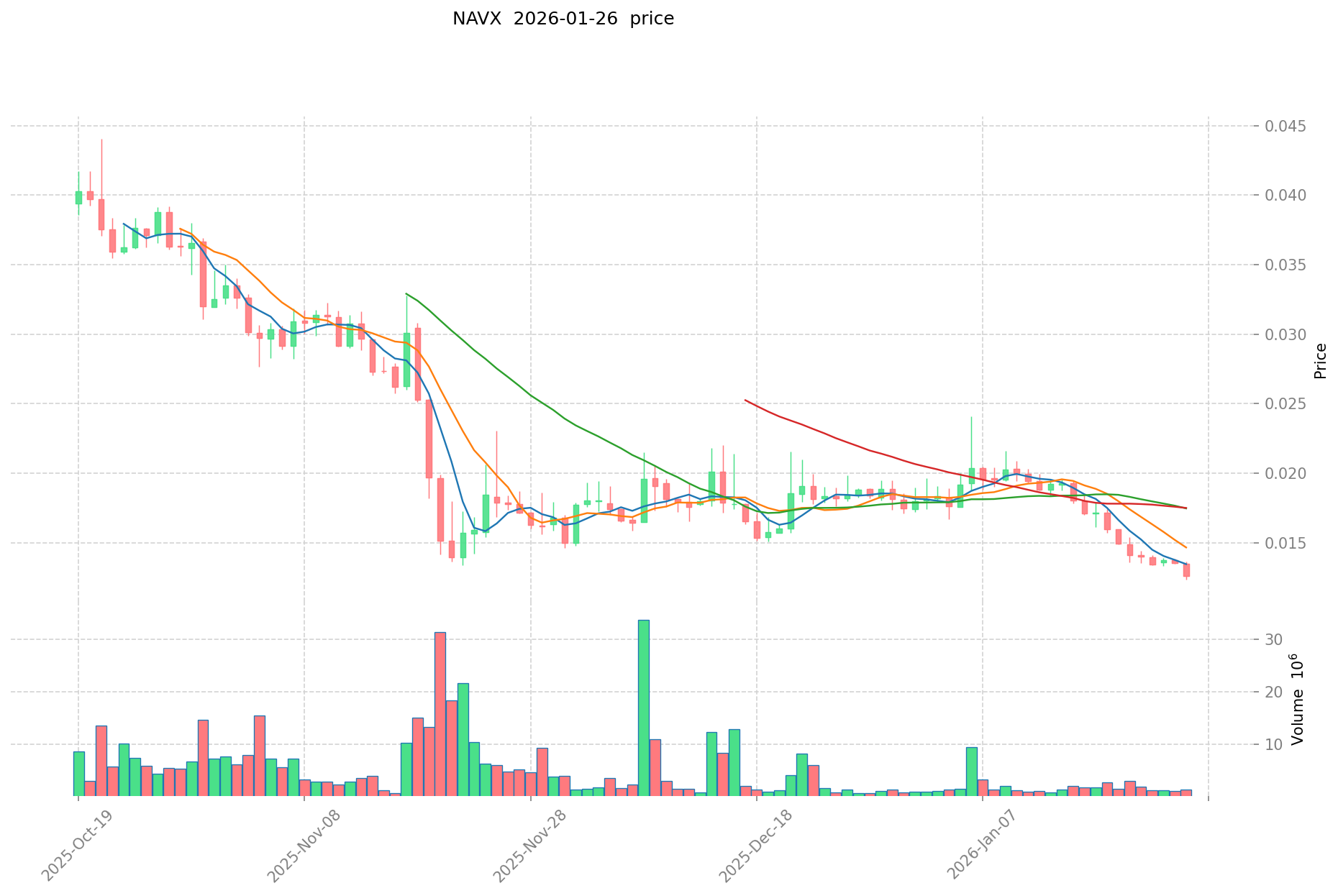
NAVI Protocol (NAVX) represents a notable asset in the cryptocurrency sector, having launched in February 2024 as the first native one-stop liquidity protocol on the Sui blockchain. As of January 26, 2026, NAVX maintains a market capitalization of approximately $10.29 million, with a circulating supply of 816.17 million tokens and a current trading price around $0.01261. Positioned as a liquidity protocol featuring innovative mechanisms such as Automatic Leverage Vaults and Isolation Mode, NAVX has attracted attention from participants considering "Is NAVI Protocol (NAVX) a good investment?" This article provides a comprehensive analysis of NAVX's investment characteristics, historical price movements, future price projections, and associated risks to offer reference information for market participants.
The protocol operates within the Sui ecosystem, enabling users to participate as liquidity providers or borrowers while supporting digital assets across different risk levels. With 95,973 token holders and availability on 15 exchanges, NAVX has established a presence in the decentralized finance space. The token experienced price fluctuations ranging from $0.01 to $0.428 since its launch, with the current price showing a decline of 6.37% over 24 hours and 88.64% over the past year. This introduction sets the foundation for examining NAVX's market dynamics, technical factors, and considerations relevant to evaluating its position in the cryptocurrency landscape.
I. NAVX Price History Review and Current Investment Value
- 2024: NAVX reached a notable price level of $0.428 on March 29, 2024 → Subsequently experienced significant volatility
- 2024: Price declined to $0.01 by June 19, 2024 → Representing substantial correction from earlier levels
- 2024-2026: Market adjustment period → Price moved from higher levels toward current trading range of approximately $0.01261
Current NAVX Investment Market Status (January 2026)
- NAVX Current Price: $0.01261
- 24-Hour Trading Volume: $18,966.42
- Circulating Supply: 816,167,495.24 NAVX (81.62% of total supply)
- Market Capitalization: $10,291,872.11
- Fully Diluted Valuation: $12,610,000
Click to view real-time NAVX market price
II. Core Factors Affecting Whether NAVX is a Good Investment (Is NAVI Protocol(NAVX) a Good Investment)
Supply Mechanism and Scarcity (NAVX investment scarcity)
-
Fixed Maximum Supply of 1 Billion Tokens → Impacts Price and Investment Value
NAVI Protocol has established a maximum supply cap of 1,000,000,000 NAVX tokens, with a current circulating supply of approximately 816.17 million tokens (representing 81.62% of the total supply). This predetermined supply ceiling creates a theoretical scarcity framework that may influence long-term valuation dynamics.
-
Investment Significance: Scarcity as a Key Factor Supporting Long-term Investment
The fixed supply mechanism, combined with the current market capitalization to fully diluted valuation ratio of 81.62%, suggests that the majority of planned tokens are already in circulation. This supply structure may serve as one element investors consider when evaluating the asset's long-term positioning, though actual investment value depends on multiple factors including adoption, utility, and market conditions.
Institutional Investment and Mainstream Adoption (Institutional investment in NAVX)
- Holder Base: Approximately 95,973 Addresses
The protocol has attracted a holder base of nearly 96,000 addresses, indicating a degree of community participation. The token is currently listed on 15 exchanges, providing various access points for market participants.
Macroeconomic Environment's Impact on NAVX Investment
-
Monetary Policy and Interest Rate Changes → Altering Investment Attractiveness
As with other digital assets, NAVX may be influenced by broader macroeconomic conditions, including monetary policy shifts and interest rate adjustments. Changes in liquidity conditions and risk appetite in traditional financial markets can affect capital flows into alternative asset classes.
-
Geopolitical Uncertainty → Enhanced NAVX Investment Demand
Periods of geopolitical instability may drive investors toward decentralized financial protocols as alternative financial infrastructure, potentially affecting demand for protocol tokens like NAVX.
Technology and Ecosystem Development (Technology & Ecosystem for NAVX investment)
-
Native One-Stop Liquidity Protocol on Sui → Enhanced Investment Appeal
NAVI Protocol operates as the first native one-stop liquidity protocol on the Sui blockchain, enabling users to participate as liquidity providers or borrowers within the Sui ecosystem. The protocol's positioning within the Sui network infrastructure may contribute to its functional utility.
-
Innovative Features: Automatic Leverage Vaults and Isolation Mode → Long-term Value Support
The protocol incorporates advanced features including Automatic Leverage Vaults and Isolation Mode, designed to enable users to leverage assets and access trading opportunities with risk management mechanisms. These technical capabilities are intended to support digital assets at different risk levels while providing security features for user fund protection.
-
DeFi Application Driving Investment Value
As a liquidity protocol within the decentralized finance sector, NAVI Protocol's core functionality centers on lending and borrowing services. The protocol's design supports various digital asset risk levels, and its integration within the Sui ecosystem may contribute to its operational scope. The expansion of DeFi applications and protocol adoption could potentially influence the utility and demand dynamics for NAVX tokens.
III. NAVX Future Investment Forecast and Price Outlook (Is NAVI Protocol (NAVX) worth investing in 2026-2031)
Short-term Investment Forecast (2026, short-term NAVX investment outlook)
- Conservative forecast: $0.0110 - $0.0126
- Neutral forecast: $0.0126 - $0.0150
- Optimistic forecast: $0.0150 - $0.0180
Mid-term Investment Outlook (2027-2028, mid-term NAVI Protocol (NAVX) investment forecast)
-
Market stage expectation: NAVX may experience a recovery phase following the current price decline, with potential stabilization as the protocol continues to develop its liquidity features and expand its user base within the Sui ecosystem.
-
Investment return forecast:
- 2027: $0.0089 - $0.0202
- 2028: $0.0149 - $0.0199
-
Key catalysts: Protocol adoption within the Sui ecosystem, development of innovative features such as Automatic Leverage Vaults and Isolation Mode, expansion of supported digital assets, and overall growth in decentralized finance activity.
Long-term Investment Outlook (Is NAVX a good long-term investment?)
- Base scenario: $0.0133 - $0.0214 (assuming steady protocol development and moderate ecosystem growth)
- Optimistic scenario: $0.0217 - $0.0269 (assuming increased adoption of liquidity protocols and favorable DeFi market conditions)
- Risk scenario: $0.0089 - $0.0110 (under conditions of reduced market activity or increased competition)
View NAVX long-term investment and price forecast: Price Prediction
2026-01-26 - 2031 Long-term Outlook
- Base scenario: $0.0133 - $0.0214 (corresponding to steady progress and gradual mainstream application improvement)
- Optimistic scenario: $0.0217 - $0.0269 (corresponding to large-scale adoption and favorable market environment)
- Transformative scenario: Above $0.0269 (if the ecosystem achieves breakthrough progress and mainstream popularization)
- 2031-12-31 forecast high: $0.0269 (based on optimistic development assumptions)
Disclaimer: This analysis is for informational purposes only and should not be considered as investment advice. Cryptocurrency investments carry substantial risks, and past performance does not guarantee future results. Investors should conduct their own research and consult with financial advisors before making investment decisions.
| Year |
Predicted High Price |
Predicted Average Price |
Predicted Low Price |
Price Change |
| 2026 |
0.0180323 |
0.01261 |
0.0109707 |
0 |
| 2027 |
0.020223918 |
0.01532115 |
0.008886267 |
21 |
| 2028 |
0.01990523808 |
0.017772534 |
0.01492892856 |
40 |
| 2029 |
0.0239253852708 |
0.01883888604 |
0.0167666085756 |
49 |
| 2030 |
0.022023599725062 |
0.0213821356554 |
0.016678065811212 |
69 |
| 2031 |
0.026911555935886 |
0.021702867690231 |
0.01323874929104 |
72 |
IV. NAVI Protocol Investment Strategy and Risk Management (How to invest in DeFi Tokens)
Investment Methodology (NAVI Protocol investment strategy)
-
Long-term Holding (HODL NAVX): Suitable for Conservative Investors
For investors seeking to participate in the Sui ecosystem's DeFi infrastructure development, NAVX may serve as a long-term holding option. The protocol's position as Sui's first native one-stop liquidity protocol could provide exposure to the network's growth trajectory. However, investors should note the token's circulating supply represents approximately 81.62% of total supply, with a current market capitalization of around $10.29 million.
-
Active Trading: Relying on Technical Analysis and Swing Operations
Given NAVX's price volatility (24-hour range between $0.01234-$0.01363), active traders may identify opportunities through technical analysis. The token's 24-hour trading volume of approximately $18,966 suggests moderate liquidity for trading activities. Traders should monitor key support and resistance levels while considering the token's correlation with broader Sui ecosystem performance.
Risk Management (Risk management for NAVX investment)
-
Asset Allocation Ratio: Conservative / Aggressive / Professional Investors
- Conservative investors: Allocate no more than 1-3% of crypto portfolio to NAVX, considering its relatively small market cap and high volatility
- Aggressive investors: May allocate 5-10% while maintaining close monitoring of protocol developments and market conditions
- Professional investors: Can structure position sizing based on risk-adjusted return models and correlation analysis with other DeFi assets
-
Risk Hedging Solutions: Multi-asset Portfolio + Risk Management Tools
Investors should diversify across multiple DeFi protocols and blockchain ecosystems rather than concentrating exposure in a single protocol token. Consider pairing NAVX positions with established DeFi blue-chips or stablecoins to reduce portfolio volatility. Implementing stop-loss orders may help limit downside risk during periods of heightened market uncertainty.
-
Secure Storage: Hot/Cold Wallets + Hardware Wallet Recommendations
Given NAVX's deployment on the Sui blockchain, investors should utilize Sui-compatible wallets. For long-term holdings, hardware wallets supporting Sui assets provide enhanced security. For active trading, maintain only necessary amounts in exchange hot wallets while storing the majority in self-custody cold storage solutions. Regular security audits of wallet addresses and private key management practices are essential.
V. NAVX Investment Risks and Challenges (Risks of investing in DeFi Tokens)
-
Market Risk: High Volatility and Price Manipulation Concerns
NAVX has demonstrated significant price volatility, with a 7-day decline of approximately 19.82% and a 30-day decline of around 31.38%. The token's all-time high of $0.428 (recorded on March 29, 2024) contrasts sharply with its current price of approximately $0.01261, representing a substantial decline. The relatively modest 24-hour trading volume may expose the token to price manipulation risks in periods of low liquidity.
-
Regulatory Risk: Policy Uncertainty Across Different Jurisdictions
As a DeFi protocol token, NAVX operates in an evolving regulatory landscape. Different jurisdictions maintain varying approaches to DeFi protocol governance tokens, which could impact the token's accessibility and utility. Investors should stay informed about regulatory developments in their local jurisdictions and how they may affect DeFi token holdings and trading activities.
-
Technical Risk: Network Security Vulnerabilities and Upgrade Failures
While NAVI Protocol emphasizes advanced security features for protecting user funds and mitigating systemic risks, DeFi protocols inherently carry smart contract risks. The protocol's innovative features such as Automatic Leverage Vaults and Isolation Mode introduce complex mechanisms that require thorough testing and auditing. Additionally, as the protocol operates on the Sui blockchain, any network-level issues or upgrade complications could affect NAVX functionality and value.
VI. Conclusion: Is DeFi Protocol Token a Good Investment?
-
Investment Value Summary: NAVX represents exposure to Sui's DeFi infrastructure, but faces significant volatility and market challenges. The protocol's position as Sui's first native liquidity protocol provides potential for growth alongside the ecosystem's development, though current price trends indicate substantial downward pressure.
-
Investor Recommendations:
✅ Beginners: Consider dollar-cost averaging with small allocations + secure wallet storage practices
✅ Experienced Investors: Evaluate swing trading opportunities while maintaining diversified DeFi portfolio exposure
✅ Institutional Investors: Assess strategic allocation based on comprehensive due diligence and risk modeling
⚠️ Disclaimer: Cryptocurrency investment carries high risks. This content is for informational purposes only and does not constitute investment advice. Investors should conduct their own research and consult with qualified financial advisors before making investment decisions.
VII. FAQ
Q1: Is NAVI Protocol (NAVX) a good investment for beginners in 2026?
NAVX presents high-risk characteristics that require careful consideration for beginners. The token has experienced substantial volatility, declining approximately 88.64% from its all-time high of $0.428 to the current price of around $0.01261. For newcomers to cryptocurrency investing, NAVX should only represent 1-3% of a diversified crypto portfolio if considered at all. Beginners should prioritize understanding the Sui ecosystem, DeFi protocol mechanics, and secure wallet storage practices before investing. Dollar-cost averaging strategies may help mitigate timing risks, though the token's modest 24-hour trading volume of approximately $18,966 suggests limited liquidity that could impact entry and exit prices.
Q2: What are the main factors that could drive NAVX price recovery?
Key catalysts for potential NAVX price recovery include increased adoption of NAVI Protocol within the Sui ecosystem, successful implementation and utilization of innovative features such as Automatic Leverage Vaults and Isolation Mode, expansion of supported digital assets across different risk levels, and overall growth in decentralized finance activity on the Sui network. Additionally, broader market conditions such as favorable DeFi sector sentiment, increased liquidity flows into alternative blockchain ecosystems, and positive developments in the Sui network infrastructure could support price stabilization and potential appreciation.
Q3: How does NAVX's tokenomics affect its long-term investment potential?
NAVX has established a maximum supply of 1 billion tokens, with approximately 816.17 million tokens (81.62%) already in circulation as of January 2026. This high circulating supply percentage indicates that most planned tokens have been released to the market, reducing future supply-driven dilution risks. However, the current market capitalization of approximately $10.29 million remains relatively modest compared to established DeFi protocols. The fixed supply mechanism provides a theoretical scarcity framework, though actual investment value depends on adoption rates, protocol utility, sustained transaction volumes, and the ability to attract and retain liquidity providers and borrowers within the NAVI Protocol ecosystem.
Q4: What are the primary risks associated with investing in NAVX?
NAVX investment carries multiple risk categories including market risk (high price volatility with 7-day declines of 19.82% and 30-day declines of 31.38%), liquidity risk (modest trading volumes may affect price execution), smart contract risk (DeFi protocols face technical vulnerabilities despite security measures), regulatory risk (evolving policies across jurisdictions regarding DeFi governance tokens), and ecosystem dependence (NAVX's value is closely tied to Sui blockchain development and adoption). The token's significant decline from its all-time high demonstrates substantial downside potential. Investors should implement appropriate risk management strategies including portfolio diversification, position sizing based on risk tolerance, and secure storage solutions.
Q5: How does NAVI Protocol compare to other DeFi lending protocols?
NAVI Protocol positions itself as the first native one-stop liquidity protocol on the Sui blockchain, differentiating through features such as Automatic Leverage Vaults and Isolation Mode designed for risk-adjusted lending and borrowing. While established protocols like Aave and Compound operate on more mature networks with deeper liquidity, NAVI's integration within the Sui ecosystem provides exposure to a newer blockchain infrastructure with different technical characteristics. The protocol's relatively small market capitalization of $10.29 million and holder base of approximately 95,973 addresses indicate an earlier development stage compared to established DeFi lending platforms. Investors should evaluate NAVI's competitive positioning within both the Sui ecosystem specifically and the broader DeFi lending sector.
Q6: What investment strategy is recommended for NAVX based on different timeframes?
For short-term trading (2026), technical analysis suggests potential ranges between $0.0110-$0.0180 depending on market conditions, making swing trading strategies viable for experienced traders. Mid-term investors (2027-2028) might consider dollar-cost averaging during price consolidation phases, with projected ranges of $0.0089-$0.0202 for 2027. Long-term holders (2029-2031) should view NAVX as a speculative position within a broader DeFi portfolio, with optimistic scenarios projecting prices up to $0.0269 by 2031, though base case scenarios suggest $0.0133-$0.0214. All strategies should incorporate strict risk management, with position sizing appropriate to individual risk tolerance and regular portfolio rebalancing based on performance and changing market conditions.
Q7: What security measures should NAVX investors implement?
NAVX investors should prioritize secure storage through Sui-compatible wallet solutions, utilizing hardware wallets for long-term holdings while maintaining minimal amounts in exchange hot wallets for active trading. Given the token's deployment on the Sui blockchain, investors must ensure wallet compatibility and maintain secure backup procedures for private keys and recovery phrases. Regular security audits of wallet addresses, implementation of two-factor authentication on exchange accounts, and vigilance against phishing attempts targeting DeFi protocol users are essential. Investors should also monitor NAVI Protocol's official communication channels for security updates and never share private keys or seed phrases with any third parties.
Q8: How do macroeconomic factors affect NAVX investment potential?
NAVX, like other DeFi protocol tokens, experiences influence from broader macroeconomic conditions including monetary policy shifts, interest rate adjustments, and overall risk appetite in financial markets. Tightening monetary conditions may reduce liquidity flows into speculative crypto assets, potentially pressuring NAVX prices. Conversely, periods of monetary expansion or geopolitical uncertainty driving interest in decentralized financial infrastructure could support demand for DeFi protocol tokens. The correlation between traditional financial markets and cryptocurrency assets should be monitored, as systemic risk events can trigger correlated selloffs across digital asset classes. Investors should consider macroeconomic outlook as one component of comprehensive investment analysis alongside protocol-specific fundamentals and technical factors.
* The information is not intended to be and does not constitute financial advice or any other recommendation of any sort offered or endorsed by Gate.