This comprehensive guide evaluates NEAR Protocol's investment potential in 2026 and beyond. NEAR currently trades at $1.85 with a $2.38 billion market cap, featuring Nightshade sharding technology for scalability and mobile device support. The article reviews price history from its $0.0375 launch price to January 2022's $20.44 peak, analyzing current market performance with 15.92% 30-day gains against 62.83% annual decline. Key investment factors examined include unlimited token supply, institutional adoption, ecosystem development, and AI-native protocol positioning. Price forecasts range from $1.53-$3.08 (2026 conservative to optimistic scenarios) to $3.17-$4.18 (2031 long-term outlook). Investment strategies encompass long-term holding for conservative investors and active trading for experienced traders, with essential risk management through portfolio diversification, secure wallet storage, and position sizing. The analysis identifies critical risks including market volatility, regulatory uncertainty, an
Introduction: Near (NEAR)'s Investment Position and Market Outlook
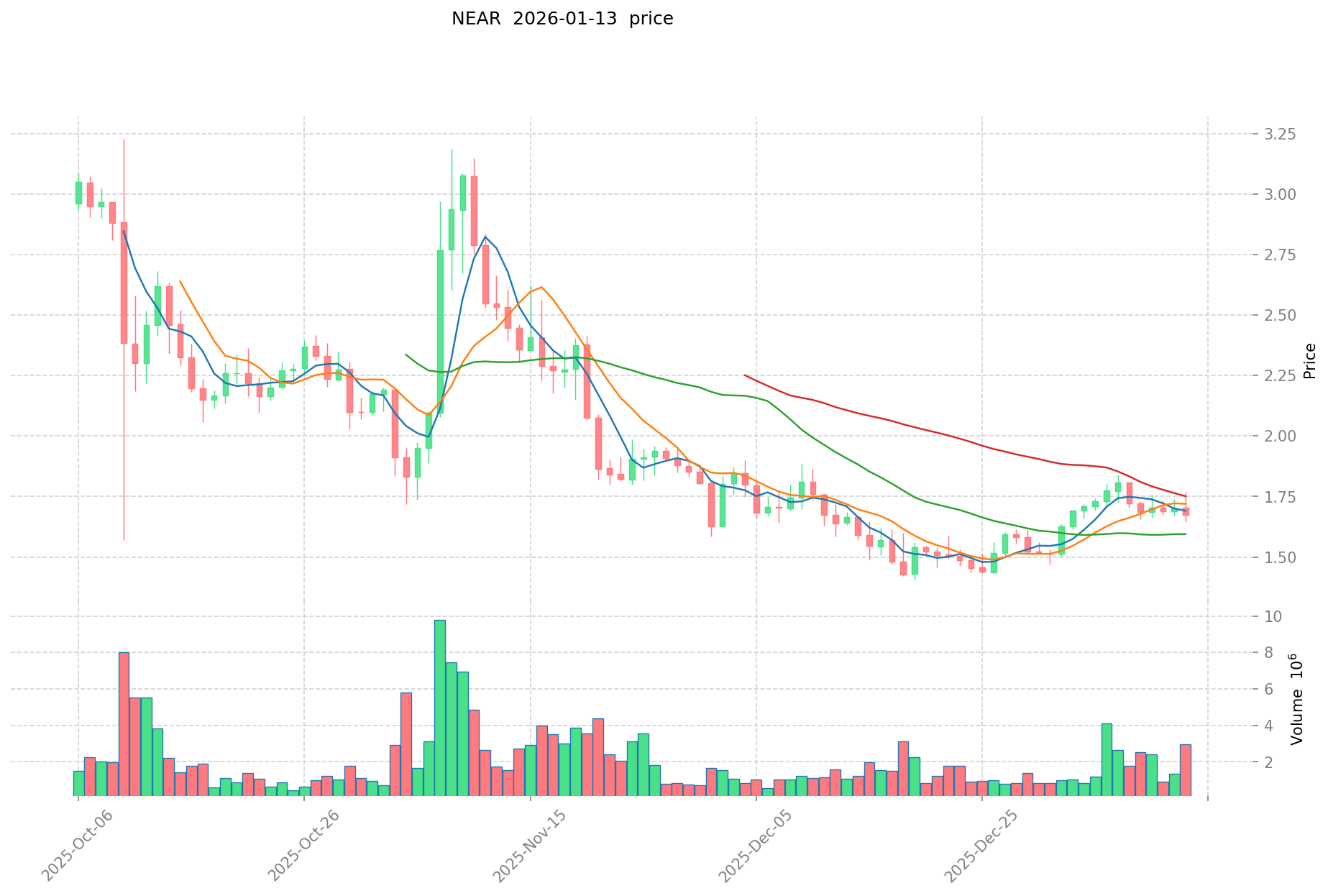
NEAR is a notable asset in the cryptocurrency sector. As of January 14, 2026, NEAR holds a market capitalization of approximately $2.38 billion with a circulating supply of around 1.285 billion tokens, and the current price maintains around $1.85. The protocol's focus on scalability and mobile device support through state sharding technology positions it as a subject of interest when investors discuss "Is Near (NEAR) a good investment?" This article will comprehensively analyze NEAR's investment value, historical trends, future price forecasts, and investment risks to provide reference for investors.
I. Near (NEAR) Price History Review and Investment Value Status
- 2020: NEAR Protocol launched in October 2020 with an initial offering price of $0.0375 → Early investors experienced substantial growth as the protocol gained traction in the decentralized application space
- 2022: January market peak → NEAR price reached $20.44, representing a significant milestone during the broader cryptocurrency bull market cycle
- 2022-2024: Market correction phase → Price declined from elevated levels to approximately $0.53 range, reflecting broader market volatility and sector-wide adjustments
- 2025: Recovery momentum → Price demonstrated positive movement, with recent data showing increases of 8.44% over 24 hours and 15.92% over 30 days
Current NEAR Investment Market Status (January 2026)
- NEAR current price: $1.85
- 24-hour trading volume: Approximately $730 million
- Market capitalization: $2.38 billion
- Circulating supply: 1.285 billion NEAR tokens
- Trading activity: NEAR is listed on 56 exchanges with an active holder base of 43,961 addresses
- Market rank: #47 among cryptocurrencies
- Recent price performance: 1-hour change +1.83%, 7-day change +6.68%, 30-day change +15.92%
Click to view real-time NEAR market price
II. Core Factors Influencing Whether NEAR is a Good Investment
Supply Mechanism and Scarcity (NEAR Investment Scarcity)
- Supply structure → influences price and investment value
- Investment significance: scarcity serves as a key foundation for long-term investment consideration
According to market data as of January 14, 2026, NEAR Protocol has a circulating supply of 1,285,035,653 tokens with a total supply of 1,285,035,671 tokens. The maximum supply is listed as infinite (∞), indicating an uncapped token generation model. The current circulating supply represents approximately 100% of the total supply, suggesting full circulation in the market.
The unlimited maximum supply structure differs from assets with fixed caps, which may influence scarcity considerations for investors evaluating NEAR Protocol's long-term value proposition. This supply mechanism requires investors to consider factors beyond pure scarcity when assessing NEAR's investment potential, including network utility, adoption rates, and ecosystem development.
Institutional Investment and Mainstream Adoption (Institutional Investment in NEAR)
- Institutional holding trends: evaluation of market positioning
- Policy environment's influence on NEAR investment outlook
As of January 14, 2026, NEAR Protocol maintains a market ranking of 47 with a total market capitalization of approximately $2.38 billion. The token is listed on 56 exchanges, indicating broad market accessibility. The protocol has attracted approximately 43,961 token holders, representing a substantial user base within the blockchain ecosystem.
NEAR Protocol's technology has been positioned as an AI-native protocol designed for intelligent agents, with capabilities extending to cross-chain interoperability through features such as Chain Signatures. This technical positioning may influence institutional interest in the protocol's infrastructure capabilities. The project's Web3 AI agent ecosystem represents a specialized focus area that could affect adoption patterns among technology-focused entities.
Macroeconomic Environment's Impact on NEAR Investment
- Monetary policy and interest rate changes → alter investment attractiveness
- Geopolitical uncertainty → influences crypto asset investment demand
The broader cryptocurrency market environment continues to impact altcoin performance, including NEAR Protocol. Market data shows NEAR's price experienced volatility with a 24-hour change of +8.44%, a 7-day change of +6.68%, and a 30-day change of +15.92%. However, the 1-year performance reflects a decline of -62.83%, indicating significant sensitivity to market cycles.
The token's current price of $1.8502 (as of January 14, 2026) represents a considerable distance from its previous peak, which occurred in January 2022. Macroeconomic factors, including monetary policy adjustments and risk sentiment in traditional markets, continue to influence cryptocurrency valuations, affecting NEAR's investment dynamics.
Technology and Ecosystem Development (Technology & Ecosystem for NEAR Investment)
- Sharding technology: enhances network performance → increases technical appeal
- Cross-chain capabilities: expands ecosystem applications → supports long-term value consideration
- DeFi, AI integration, and application diversity's impact on investment value
NEAR Protocol employs Nightshade sharding technology designed to enable parallel transaction processing, addressing scalability challenges faced by earlier blockchain networks. The protocol targets high throughput capabilities, with specifications designed to support decentralized application (DApp) operations efficiently.
The platform allows developers to build blockchain applications while providing native support for mobile devices. NEAR's architecture incorporates state sharding mechanisms that enable linear scaling with network node expansion. The protocol's design aims to facilitate DApp development with reduced complexity compared to some competing platforms.
Recent developments emphasize NEAR's positioning as an AI-native protocol with infrastructure supporting autonomous agent operations. The protocol's Chain Signatures feature enables AI agents to interact with multiple blockchain networks, including Bitcoin, Ethereum, and others, potentially expanding use case scenarios beyond single-chain limitations.
The ecosystem's focus on Web3 AI agent capabilities represents a specialized development path, with applications spanning yield optimization, asset management, and cross-chain transaction execution. This technical direction differentiates NEAR from purely transaction-focused blockchain platforms, though actual adoption rates and practical utility remain subject to market validation.
III. NEAR Future Investment Forecast & Price Outlook (Is Near (NEAR) worth investing in 2026-2030)
Short-term Investment Forecast (2026, short-term NEAR investment outlook)
- Conservative forecast: $1.53 - $1.84
- Neutral forecast: $1.84 - $2.29
- Optimistic forecast: $2.29 - $3.08
Mid-term Investment Outlook (2027-2029, mid-term Near (NEAR) investment forecast)
- Market stage expectation: NEAR is anticipated to enter a phase of gradual expansion driven by ecosystem development, DeFi integration, and Web3 adoption. Price stability and moderate growth are expected during this period.
- Investment return forecast:
- 2027: $1.69 - $2.52
- 2028: $1.31 - $2.55
- 2029: $1.77 - $2.69
- Key catalysts: DeFi platform adoption, Web3 ecosystem integration, sharding technology improvements, and strategic partnerships within the blockchain space.
Long-term Investment Outlook (Is NEAR a good long-term investment?)
- Base scenario: $1.86 - $3.78 (assuming steady ecosystem growth and sustained developer engagement)
- Optimistic scenario: $3.17 - $4.18 (assuming increased mainstream adoption and favorable regulatory environment)
- Risk scenario: $1.61 - $2.55 (under conditions of heightened market volatility or reduced adoption rates)
For detailed NEAR long-term investment analysis and price forecast, visit: Price Prediction
Long-term Outlook for 2026-01-14 to 2031
- Base scenario: $1.86 - $3.78 (corresponding to steady progress and gradual mainstream application expansion)
- Optimistic scenario: $3.17 - $4.18 (corresponding to large-scale adoption and favorable market conditions)
- Transformative scenario: Above $4.18 (if the ecosystem achieves breakthrough progress and widespread mainstream adoption)
- Predicted high for 2031-12-31: $4.18 (based on optimistic development assumptions)
Disclaimer: The forecasts presented are based on historical data analysis, market trends, and technical indicators. Cryptocurrency markets are highly volatile and unpredictable. These projections should not be considered financial advice, and investors should conduct their own research and assess their risk tolerance before making investment decisions.
| Year |
Predicted High Price |
Predicted Average Price |
Predicted Low Price |
Price Change |
| 2026 |
2.287304 |
1.8446 |
1.531018 |
0 |
| 2027 |
2.52046144 |
2.065952 |
1.69408064 |
11 |
| 2028 |
2.5454594592 |
2.29320672 |
1.3071278304 |
23 |
| 2029 |
2.685459729456 |
2.4193330896 |
1.766113155408 |
30 |
| 2030 |
3.77754668610144 |
2.552396409528 |
1.86324937895544 |
37 |
| 2031 |
4.17776244311543 |
3.16497154781472 |
1.614135489385507 |
71 |
IV. NEAR Investment Strategy and Risk Management (How to invest in NEAR Protocol)
Investment Methodology (NEAR investment strategy)
Long-term Holding (HODL NEAR): Suitable for conservative investors
Long-term holding represents a fundamental approach for investors who believe in NEAR Protocol's technological foundation and ecosystem development potential. This strategy involves acquiring NEAR tokens and maintaining positions through market cycles, focusing on the protocol's long-term value proposition rather than short-term price movements. Investors adopting this approach typically emphasize the project's scalability features, including its sharding technology designed to support high transaction throughput, and the ongoing development of decentralized applications within the NEAR ecosystem.
Active Trading: Relies on technical analysis and swing trading operations
Active trading strategies for NEAR involve utilizing technical analysis tools to identify entry and exit points based on price patterns, trading volume, and market momentum indicators. Traders may leverage the token's price volatility, which has demonstrated significant fluctuations with a 24-hour change of 8.44% and a 30-day change of 15.92%. This approach requires continuous market monitoring and understanding of support and resistance levels, with recent data showing a 24-hour trading range between $1.6632 and $1.8526.
Risk Management (Risk management for NEAR investment)
Asset Allocation Ratio: Conservative / Aggressive / Professional investors
- Conservative investors: May allocate 2-5% of their crypto portfolio to NEAR, prioritizing capital preservation while gaining exposure to the protocol's potential
- Aggressive investors: Could allocate 10-20% to NEAR, accepting higher volatility in pursuit of greater returns
- Professional investors: May implement dynamic allocation strategies ranging from 5-15%, adjusting positions based on market conditions and technical indicators
Risk Hedging Solutions: Multi-asset portfolio + hedging instruments
Diversification remains essential for managing NEAR investment risks. Investors may consider combining NEAR holdings with other blockchain protocols, stablecoins, and traditional assets to reduce portfolio volatility. Risk management strategies could include setting stop-loss orders, taking partial profits during price rallies, and maintaining cash reserves for opportunistic purchases during market corrections. Given NEAR's market capitalization of approximately $2.38 billion and its ranking at position 47, position sizing should reflect both the token's established presence and its potential for volatility.
Secure Storage: Hot and cold wallets + hardware wallet recommendations
Secure storage of NEAR tokens requires understanding different wallet solutions:
- Cold wallets (hardware wallets): Recommended for long-term holdings, providing offline storage and enhanced security against online threats
- Hot wallets: Suitable for smaller amounts intended for trading or immediate use, offering convenience with connectivity to exchanges and DApps
- Hardware wallet recommendations: Industry-standard devices supporting NEAR Protocol provide robust security features including private key generation and transaction signing in isolated environments
Investors should implement multi-signature solutions where applicable and maintain backup recovery phrases in secure, separate locations.
V. NEAR Investment Risks and Challenges (Risks of investing in NEAR Protocol)
Market Risks: High volatility and price manipulation concerns
NEAR demonstrates significant price volatility, with historical data showing a decline of 62.83% over one year, reflecting broader market dynamics and token-specific factors. The current price of $1.8502 represents approximately 9.05% of its historical high of $20.44 recorded in January 2022. Trading volume of approximately $7.3 million over 24 hours indicates active market participation, though liquidity conditions may vary across different exchanges. Market manipulation risks exist in cryptocurrency markets generally, requiring investors to maintain vigilance regarding unusual trading patterns or sudden price movements.
Regulatory Risks: Policy uncertainty across different jurisdictions
Cryptocurrency regulatory frameworks continue evolving globally, creating uncertainty for blockchain protocols including NEAR. Different jurisdictions maintain varying approaches to digital asset classification, taxation, and operational requirements. Regulatory developments may impact NEAR's utility, trading availability, and institutional adoption. Investors should monitor regulatory announcements in their jurisdictions and consider how potential policy changes might affect their holdings.
Technical Risks: Network security vulnerabilities and upgrade failures
As a blockchain protocol emphasizing scalability through sharding technology, NEAR faces technical risks inherent to complex distributed systems. Potential concerns include:
- Network security vulnerabilities that could compromise user assets or transaction integrity
- Smart contract bugs affecting decentralized applications built on NEAR
- Protocol upgrade complications that might temporarily affect network performance
- Validator-related risks, as NEAR relies on validators to provide computational and storage resources for network operations
The protocol's technical architecture, while designed for high throughput targeting significant transaction capacity, requires ongoing development and security auditing to maintain operational integrity.
VI. Conclusion: Is NEAR Protocol a Good Investment?
Investment Value Summary: NEAR demonstrates notable long-term investment potential through its scalable infrastructure and developer-focused ecosystem, though short-term price movements remain volatile.
NEAR Protocol presents a value proposition centered on technological scalability and mobile device accessibility for decentralized applications. The protocol's sharding approach and focus on developer experience contribute to its potential for ecosystem growth. However, the significant price decline over the past year and ongoing market volatility underscore the speculative nature of the investment.
Investor Recommendations:
✅ Beginners: Implement dollar-cost averaging strategies combined with secure wallet storage practices. Focus on understanding NEAR's fundamental technology and ecosystem development before committing substantial capital.
✅ Experienced Investors: Consider swing trading strategies leveraging technical analysis while maintaining core positions for longer-term appreciation. Implement portfolio allocation strategies that balance NEAR exposure with other assets.
✅ Institutional Investors: Evaluate strategic long-term allocation opportunities, conducting thorough due diligence on protocol development, validator economics, and competitive positioning within the Layer 1 blockchain landscape.
⚠️ Notice: Cryptocurrency investments carry substantial risks, including potential total loss of capital. This content serves informational purposes only and does not constitute investment advice. Investors should conduct independent research and consider their financial situation, risk tolerance, and investment objectives before making investment decisions regarding NEAR or any cryptocurrency.
VII. FAQ
Q1: What makes NEAR Protocol different from other Layer 1 blockchains?
NEAR Protocol distinguishes itself through Nightshade sharding technology that enables parallel transaction processing and linear scalability as network nodes expand. Unlike many competing platforms, NEAR provides native mobile device support and focuses on developer-friendly infrastructure with reduced complexity for decentralized application development. Additionally, NEAR positions itself as an AI-native protocol with Chain Signatures functionality, allowing autonomous agents to interact across multiple blockchain networks including Bitcoin and Ethereum, extending its utility beyond single-chain limitations.
Q2: Is NEAR a good short-term investment in 2026?
Short-term NEAR investment carries significant volatility risk. Conservative forecasts range from $1.53 to $1.84, while optimistic scenarios suggest potential reaching $2.29 to $3.08 by end of 2026. Recent data shows positive momentum with 30-day gains of 15.92%, yet the token remains down 62.83% over one year. Short-term investors should employ active trading strategies with technical analysis, implement strict risk management including stop-loss orders, and recognize that cryptocurrency markets remain highly unpredictable with potential for sudden price swings.
Q3: How does NEAR's unlimited token supply affect its investment value?
NEAR Protocol's infinite maximum supply structure differs fundamentally from fixed-cap cryptocurrencies like Bitcoin. With circulating supply of 1.285 billion tokens representing approximately 100% of total supply, the unlimited supply model means scarcity alone cannot drive value appreciation. Instead, NEAR's investment value depends primarily on network utility, adoption rates, ecosystem development, and demand for protocol services. Investors must evaluate technological adoption and real-world usage rather than relying on supply constraints as a primary value driver.
Q4: What are the main risks of investing in NEAR Protocol?
NEAR investment carries three primary risk categories: Market risks include extreme volatility, with historical declines of 62.83% over one year and current price representing only 9.05% of its $20.44 peak. Regulatory risks stem from evolving global cryptocurrency policies that may impact trading availability and institutional adoption. Technical risks involve potential network security vulnerabilities, smart contract bugs, protocol upgrade complications, and validator-related issues inherent to complex distributed systems. Additionally, market manipulation concerns exist given relatively modest trading volumes compared to larger cryptocurrencies.
Q5: What investment strategy suits conservative investors interested in NEAR?
Conservative investors should allocate only 2-5% of their cryptocurrency portfolio to NEAR, prioritizing capital preservation over aggressive returns. Implement dollar-cost averaging (DCA) by purchasing fixed amounts at regular intervals to reduce timing risk and volatility impact. Utilize hardware wallets for secure cold storage of tokens intended for long-term holding. Combine NEAR holdings with stablecoins and established cryptocurrencies for diversification. Avoid leveraged trading and maintain realistic expectations, recognizing that NEAR's long-term value depends on ecosystem development, which requires patience through market cycles.
Q6: How does NEAR's technology support its long-term investment potential?
NEAR's technological foundation includes Nightshade sharding enabling parallel processing and linear scalability, addressing performance bottlenecks that limit earlier blockchains. The protocol's state sharding mechanism allows network capacity to expand proportionally with validator additions. NEAR's positioning as an AI-native protocol with infrastructure supporting autonomous agents represents differentiated functionality, particularly through Chain Signatures enabling cross-chain interoperability. However, long-term investment potential ultimately depends on converting technical capabilities into practical adoption—actual developer engagement, DApp usage, and real-world utility remain critical factors requiring ongoing market validation.
Q7: What price targets are realistic for NEAR by 2030?
Based on analytical models, NEAR's 2030 base scenario forecasts range from $1.86 to $3.78, assuming steady ecosystem growth and sustained developer engagement. Optimistic scenarios suggest $3.77 average with potential highs reaching $3.78, contingent on increased mainstream adoption and favorable regulatory environments. However, risk scenarios indicate potential lows of $1.86 under heightened volatility or reduced adoption. These projections assume continuous protocol development, DeFi integration expansion, and Web3 ecosystem growth—factors subject to significant uncertainty given cryptocurrency market unpredictability and technological competition.
Q8: Should institutional investors consider NEAR Protocol for strategic allocation?
Institutional investors may evaluate NEAR for strategic long-term allocation based on its Layer 1 blockchain positioning, scalability technology, and differentiated AI-native protocol features. With market capitalization of $2.38 billion and ranking at position 47, NEAR maintains established market presence while offering growth potential. Institutions should conduct comprehensive due diligence examining validator economics, competitive analysis against other Layer 1 platforms, protocol governance structures, and ecosystem development metrics. Recommended allocation ranges from 5-15% of crypto portfolios with dynamic adjustments based on market conditions, though individual circumstances and risk parameters should guide final allocation decisions.
* The information is not intended to be and does not constitute financial advice or any other recommendation of any sort offered or endorsed by Gate.