This comprehensive analysis examines whether NEON EVM (NEON) represents a viable investment opportunity, evaluating the token's market position, historical performance, and growth potential through 2031. Currently trading at $0.05215 with a market capitalization of $12.49 million, NEON functions as a compatibility layer enabling Ethereum dApps to operate on Solana, bridging two major blockchain ecosystems. The article reviews NEON's price history from its $0.15 launch price to current levels, analyzes core investment factors including token supply dynamics, institutional adoption across nine exchanges, and macroeconomic influences. Detailed price forecasts range from $0.0476-$0.0631 for 2026 to $0.0439-$0.1229 for long-term projections, while addressing significant risks including market volatility, limited liquidity, and regulatory uncertainty. Investor strategies accommodate different risk profiles—from conservative dollar-cost averaging to active trading—with emphasis on portfolio diversification and secur
Introduction: NEON EVM (NEON) Investment Position and Market Outlook
NEON EVM (NEON) represents a notable asset in the cryptocurrency sector, launched in July 2023 as a low-friction solution enabling Ethereum dApps to operate within the Solana ecosystem. As of January 25, 2026, NEON holds a market capitalization of approximately $12.49 million with a circulating supply of around 239.47 million tokens, currently trading at $0.05215. The project addresses interoperability challenges between Ethereum and Solana networks, allowing Ethereum developers to leverage Solana's characteristics including transaction speed and parallel execution capabilities. With a market ranking of 1101 and a market dominance of 0.0016%, NEON has experienced notable price fluctuations since its initial offering at $0.15. The token is traded on 9 exchanges and maintains a holder base of 16,227 addresses. This article provides a comprehensive analysis of NEON's investment characteristics, historical price movements, future price considerations, and associated risks to serve as a reference for investors evaluating "Is NEON EVM (NEON) a good investment?"
I. NEON Token Price History Review and Current Investment Value
- 2024: NEON reached a notable price level of $3.98 on January 2, 2024 → Price subsequently declined
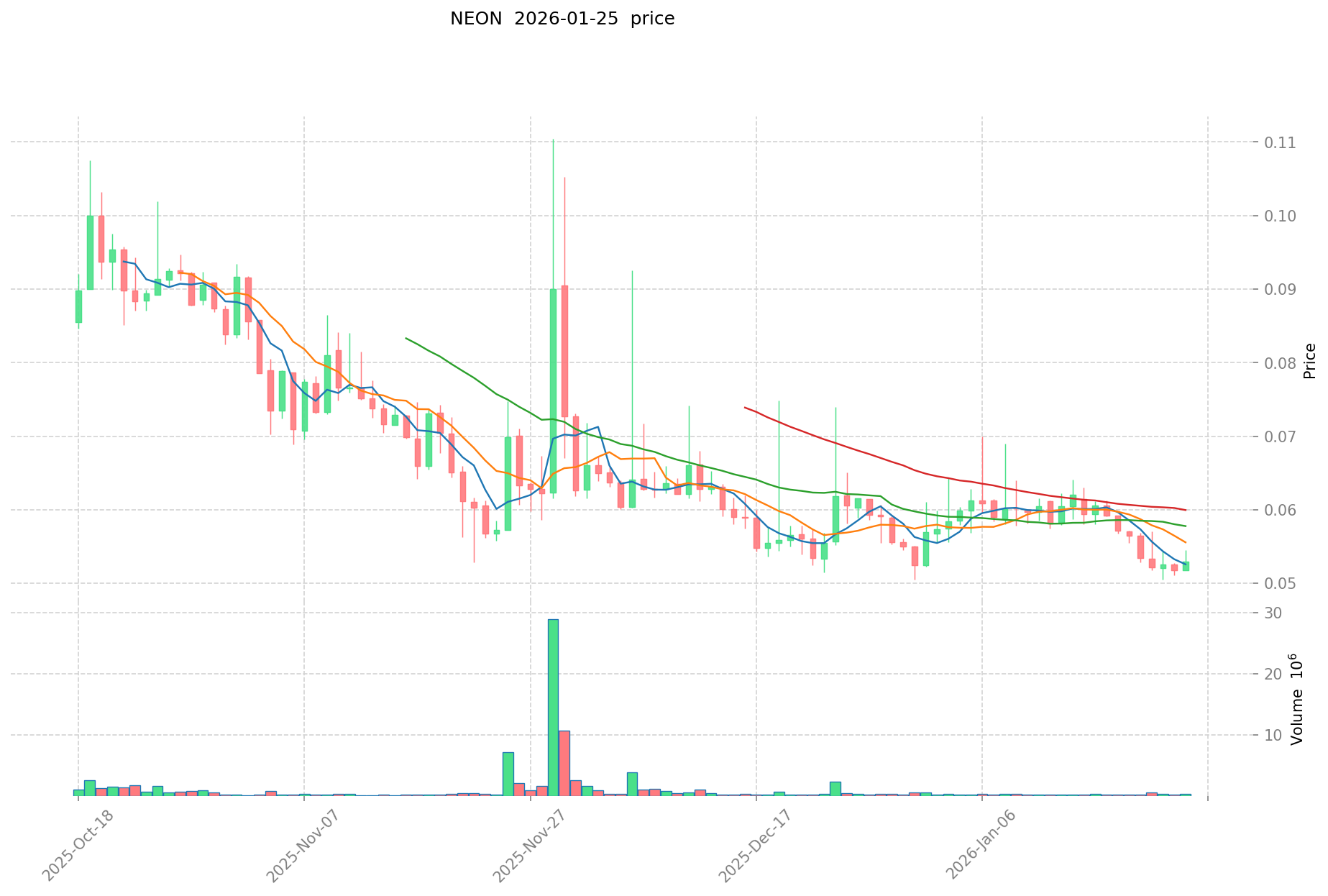
- 2025: Market correction phase → Price dropped to $0.0505 on December 31, 2025
- Launch to Present: From initial offering price of $0.15 in July 2023 → Current price shows -65.23% change from launch
Current NEON Investment Market Status (January 2026)
- NEON current price: $0.05215
- Market sentiment (Fear & Greed Index): Data not available in provided materials
- 24-hour trading volume: $18,355.98
- Institutional investor holdings: Data not available in provided materials
Click to view real-time NEON market price
II. Core Factors Affecting Whether NEON is a Good Investment
Supply Mechanism and Scarcity (NEON Investment Scarcity)
- Maximum supply capped at 1,000,000,000 NEON tokens → influences price dynamics and investment considerations
- Current circulating supply represents approximately 23.95% of total supply, with 239,465,430.68 tokens in circulation
- The controlled release of remaining supply may present considerations for long-term investment evaluation
- Investment perspective: supply distribution patterns represent one factor among many in assessing potential investment characteristics
Institutional Investment and Mainstream Adoption (Institutional Investment in NEON)
- NEON is currently listed on 9 cryptocurrency exchanges, providing accessibility for various market participants
- The token maintains an active holder base of 16,227 addresses as of the latest data
- Market capitalization stands at approximately $12.49 million, with a fully diluted valuation of approximately $52.15 million
- The project's integration bridging Ethereum dApps with Solana infrastructure represents a technical positioning within the multi-chain ecosystem
Macroeconomic Environment's Impact on NEON Investment
- As a utility token within the blockchain infrastructure sector, NEON's investment characteristics may be influenced by broader cryptocurrency market conditions
- Changes in monetary policy and interest rate environments can affect capital flows into cryptocurrency assets, including infrastructure-focused tokens
- Market sentiment toward cross-chain solutions and Ethereum Virtual Machine (EVM) compatibility projects may influence NEON's investment profile
- Regulatory developments affecting both Ethereum and Solana ecosystems could present considerations for NEON's operational environment
Technology and Ecosystem Development (Technology & Ecosystem for NEON Investment)
- Core functionality: Neon EVM provides infrastructure enabling Ethereum decentralized applications to operate within the Solana network environment
- Technical positioning: offers Ethereum developers access to Solana's network characteristics, including transaction processing capabilities and fee structures
- The project's value proposition centers on reducing friction for cross-chain application deployment between Ethereum and Solana ecosystems
- Ecosystem considerations: the adoption rate of Neon EVM by Ethereum developers and the expansion of applications utilizing the infrastructure represent factors in evaluating long-term utility and investment characteristics
III. NEON Future Investment Forecast and Price Outlook (Is NEON EVM(NEON) worth investing in 2026-2031)
Short-term Investment Forecast (2026, short-term NEON investment outlook)
- Conservative forecast: $0.0476 - $0.0517
- Neutral forecast: $0.0517 - $0.0563
- Optimistic forecast: $0.0563 - $0.0631
Mid-term Investment Outlook (2027-2029, mid-term NEON EVM(NEON) investment forecast)
-
Market stage expectation: The project may continue developing its Ethereum-Solana bridging solutions while facing competition in the cross-chain infrastructure space. Market adoption could be influenced by the broader performance of both Ethereum and Solana ecosystems.
-
Investment return forecast:
- 2027: $0.0298 - $0.0809
- 2028: $0.0602 - $0.0996
- 2029: $0.0793 - $0.0877
-
Key catalysts: Development progress of cross-chain functionality, adoption rates of dApps utilizing the Neon EVM infrastructure, performance improvements in transaction processing, and partnership developments within both Ethereum and Solana communities.
Long-term Investment Outlook (Is NEON a good long-term investment?)
- Baseline scenario: $0.0439 - $0.0921 (assuming steady development and moderate ecosystem growth)
- Optimistic scenario: $0.0686 - $0.1229 (assuming increased cross-chain adoption and favorable market conditions)
- Risk scenario: Below $0.0439 (in cases of reduced market interest in cross-chain solutions or competitive disadvantages)
Check NEON long-term investment and price forecast: Price Prediction
2026-01-25 - 2031 Long-term Outlook
- Baseline scenario: $0.0439 - $0.0921 (corresponding to steady progress and gradual mainstream application improvement)
- Optimistic scenario: $0.0686 - $0.1229 (corresponding to large-scale adoption and favorable market environment)
- Transformative scenario: Above $0.1229 (in cases of breakthrough ecosystem developments and mainstream adoption)
- 2031-12-31 predicted high: $0.1229 (based on optimistic development assumptions)
Disclaimer: This analysis is for informational purposes only and does not constitute investment advice. Cryptocurrency investments carry substantial risks, and past performance does not guarantee future results.
| Year |
Predicted High Price |
Predicted Average Price |
Predicted Low Price |
Price Change |
| 2026 |
0.0630618 |
0.05169 |
0.0475548 |
0 |
| 2027 |
0.080900019 |
0.0573759 |
0.029835468 |
10 |
| 2028 |
0.09955866168 |
0.0691379595 |
0.060150024765 |
32 |
| 2029 |
0.0877222430136 |
0.08434831059 |
0.0792874119546 |
61 |
| 2030 |
0.092057746177926 |
0.0860352768018 |
0.043877991168918 |
64 |
| 2031 |
0.12288418585601 |
0.089046511489863 |
0.068565813847194 |
70 |
IV. NEON Investment Strategy and Risk Management (How to invest in NEON EVM)
Investment Methodology (NEON investment strategy)
Long-term Holding (HODL NEON)
Long-term holding represents a conservative approach for steady investors. This strategy involves acquiring NEON tokens and maintaining positions through market cycles, focusing on the project's fundamental development rather than short-term price movements. Investors employing this method typically rely on the project's core value proposition of enabling Ethereum dApps to operate within the Solana ecosystem.
Active Trading
Active trading strategies depend on technical analysis and swing trading operations. Traders utilizing this approach analyze price patterns, volume indicators, and market momentum to identify entry and exit points. Given NEON's price volatility, with recent fluctuations showing a 1-hour change of -0.12% and 24-hour movement of -1.02%, this method requires careful monitoring and risk assessment.
Risk Management (Risk management for NEON investment)
Asset Allocation Ratio
- Conservative Investors: May consider allocating 1-3% of their crypto portfolio to NEON, balancing exposure with established digital assets
- Aggressive Investors: Could allocate 5-10% depending on risk tolerance and market conditions
- Professional Investors: May employ dynamic allocation strategies based on technical indicators and market analysis
Risk Hedging Solutions
Diversification across multiple assets remains essential for risk management. Investors may consider:
- Multi-asset portfolio construction combining established cryptocurrencies with emerging projects
- Position sizing relative to overall portfolio value
- Stop-loss mechanisms for active trading strategies
Secure Storage
Secure storage practices include:
- Cold Wallets: Offline storage solutions for long-term holdings
- Hot Wallets: For active trading and regular transactions
- Hardware Wallet Recommendations: Physical devices offering enhanced security for private key management
Given that NEON operates on the Solana blockchain (contract address: NeonTjSjsuo3rexg9o6vHuMXw62f9V7zvmu8M8Zut44), users should ensure wallet compatibility with Solana-based tokens.
V. NEON Investment Risks and Challenges (Risks of investing in NEON EVM)
Market Risk
NEON demonstrates considerable price volatility, with recent data showing varied performance across different timeframes: -1.02% over 24 hours, -11.62% over 7 days, and -13.8% over 30 days. The current trading price of $0.05215 represents a significant decline from the previous peak, with the token trading near its range. The 24-hour trading volume of approximately $18,356 suggests relatively limited liquidity compared to major cryptocurrencies, which may contribute to price instability.
Regulatory Risk
Regulatory uncertainty varies across jurisdictions. The crypto asset sector faces evolving regulatory frameworks in different countries, which may impact token accessibility, trading availability, and project operations. Policy changes in key markets could affect NEON's adoption and market dynamics.
Technical Risk
As a project enabling Ethereum dApps to operate within Solana, NEON faces technical challenges including:
- Network security considerations inherent to blockchain infrastructure
- Potential vulnerabilities in cross-chain compatibility mechanisms
- Risks associated with protocol upgrades and maintenance
- Dependencies on both Ethereum and Solana network stability
VI. Conclusion: Is NEON EVM a Good Investment?
Investment Value Summary
NEON presents as a technical solution bridging Ethereum and Solana ecosystems, offering developers access to Solana's performance characteristics while maintaining Ethereum compatibility. The project's value proposition centers on reducing friction for dApp deployment across chains. However, the token has experienced substantial price movements, with current market capitalization of approximately $12.49 million and a circulating supply representing about 23.95% of maximum supply.
Investor Recommendations
✅ Beginners: Consider dollar-cost averaging (DCA) strategies combined with secure wallet storage practices. Familiarize yourself with Solana-compatible wallets before acquiring NEON tokens.
✅ Experienced Investors: May explore swing trading opportunities while maintaining disciplined position sizing and portfolio diversification. Technical analysis and market monitoring become essential for this approach.
✅ Institutional Investors: Could evaluate strategic long-term positioning based on fundamental analysis of cross-chain infrastructure development and adoption metrics.
⚠️ Disclaimer: Cryptocurrency investment carries substantial risk. This content serves informational purposes only and does not constitute investment advice. Conduct thorough research and consider your financial situation before making investment decisions.
VII. FAQ
Q1: What is NEON EVM and how does it work?
NEON EVM is a compatibility layer that enables Ethereum decentralized applications (dApps) to run on the Solana blockchain without requiring code modifications. It acts as a bridge between the Ethereum Virtual Machine (EVM) and Solana's infrastructure, allowing developers to deploy their Ethereum-based smart contracts directly onto Solana while benefiting from Solana's high-speed transaction processing and parallel execution capabilities. The protocol essentially translates Ethereum transactions into Solana-compatible operations, maintaining full EVM compatibility while leveraging Solana's performance characteristics.
Q2: What are the main risks associated with investing in NEON?
The primary risks include substantial market volatility, limited liquidity with 24-hour trading volume of approximately $18,356, regulatory uncertainty across different jurisdictions, and technical challenges inherent to cross-chain infrastructure. The token has experienced significant price decline from its peak, currently trading at $0.05215 compared to an all-time high of $3.98 in January 2024. Additionally, NEON faces dependency risks on both Ethereum and Solana network stability, competitive pressures from other cross-chain solutions, and potential vulnerabilities in its bridging mechanisms.
Q3: What is NEON's current market position and how does it compare to competitors?
NEON currently holds a market ranking of 1101 with a market capitalization of approximately $12.49 million and a market dominance of 0.0016%. The token maintains a holder base of 16,227 addresses and is listed on 9 cryptocurrency exchanges. With only 23.95% of its maximum supply currently in circulation (239.47 million out of 1 billion tokens), NEON represents a relatively small-cap project in the cross-chain infrastructure space. Its positioning focuses specifically on Ethereum-Solana interoperability, which differentiates it from broader multi-chain solutions but also limits its addressable market.
Q4: What factors could drive NEON's price performance in the future?
Key catalysts include adoption rates of dApps utilizing the Neon EVM infrastructure, development progress of cross-chain functionality, performance improvements in transaction processing, and partnership developments within both Ethereum and Solana communities. Broader market conditions affecting the Ethereum and Solana ecosystems will also influence NEON's performance. The controlled release of the remaining 76% of token supply represents a significant factor for price dynamics. Price forecasts range from $0.0476-$0.0631 for 2026 in various scenarios, extending to $0.0439-$0.1229 for long-term projections through 2031.
Q5: How should different types of investors approach NEON investment?
Conservative investors may consider allocating 1-3% of their crypto portfolio to NEON using dollar-cost averaging strategies combined with cold wallet storage for long-term holdings. Experienced investors could allocate 5-10% with active trading approaches based on technical analysis, given recent volatility showing -1.02% (24h), -11.62% (7d), and -13.8% (30d) movements. Professional investors may employ dynamic allocation strategies based on fundamental analysis of cross-chain adoption metrics and market conditions. All investor types should prioritize portfolio diversification, position sizing relative to overall holdings, and secure storage practices using Solana-compatible wallets.
Q6: What distinguishes NEON from other cross-chain solutions?
NEON's unique positioning lies in its specific focus on enabling Ethereum dApps to operate within the Solana ecosystem without code modifications, rather than building a generalized multi-chain bridge. This specialization allows Ethereum developers to access Solana's high-performance characteristics—including fast transaction speeds and parallel execution—while maintaining full EVM compatibility. Unlike broader interoperability protocols that connect multiple blockchains, NEON concentrates on optimizing the Ethereum-Solana pathway, potentially offering reduced friction for developers already familiar with Ethereum's development environment who want to leverage Solana's infrastructure advantages.
Q7: What are the token economics and supply dynamics for NEON?
NEON has a maximum supply capped at 1,000,000,000 tokens, with approximately 239,465,430.68 tokens (23.95%) currently in circulation. The token operates on the Solana blockchain with contract address NeonTjSjsuo3rexg9o6vHuMXw62f9V7zvmu8M8Zut44. The current market capitalization stands at approximately $12.49 million, while the fully diluted valuation reaches approximately $52.15 million. The controlled release of the remaining 76% of supply represents a significant consideration for long-term price dynamics, as future token distribution may influence market supply-demand balance and price movements over time.
Q8: What storage and security considerations apply to NEON tokens?
Since NEON operates as a Solana-based token, investors must use Solana-compatible wallets for storage. Security practices include cold wallet solutions for long-term holdings, offering offline storage and enhanced private key protection, and hot wallets for active trading requiring regular transaction access. Hardware wallets that support Solana tokens provide additional security layers for substantial holdings. Before acquiring NEON, users should verify wallet compatibility with Solana-based tokens and ensure proper backup procedures for recovery phrases. Given the relatively limited liquidity and lower market capitalization, secure storage becomes particularly important for protecting investments from potential security vulnerabilities.
* The information is not intended to be and does not constitute financial advice or any other recommendation of any sort offered or endorsed by Gate.