Newton (NEWT) is a decentralized infrastructure protocol for verifiable onchain automation and secure agent authorization, currently trading at $0.09256 with a $19.9 million market cap as of January 2026. This comprehensive analysis examines whether NEWT represents a viable investment opportunity by evaluating its historical price performance, tokenomics, and market outlook. The token has declined 81.89% over the past year from its June 2025 peak of $0.8511, currently offering positions for risk-tolerant investors. NEWT's utility as a protocol gas token across 28 exchanges with 13,156 holders provides fundamental value support. Short-term price forecasts range from $0.0714 to $0.1363, while long-term outlooks through 2031 suggest potential appreciation to $0.2109 under optimistic scenarios. Investment suitability depends on individual risk tolerance, portfolio allocation strategies, and conviction in decentralized automation infrastructure adoption. Investors should implement comprehensive risk management inc
Introduction: Newton (NEWT)'s Investment Position and Market Outlook
Newton (NEWT) represents a decentralized infrastructure designed for verifiable onchain automation and secure agent authorization within the cryptocurrency ecosystem. Since its launch in 2025, the protocol has been focusing on enabling protocols, DAOs, and users to execute complex operations through verifiable agents without relying on centralized bots. As of January 23, 2026, NEWT holds a market capitalization of approximately $19.90 million, with a circulating supply of 215 million tokens out of a maximum supply of 1 billion tokens. The current price stands at $0.09256, representing a circulating ratio of 21.5%. Trading across 28 exchanges with 13,156 holders, NEWT serves multiple functions within the Newton Protocol, including protocol security, agent registry, onchain permissions, governance, and operating as the protocol's gas token. This article provides a comprehensive analysis of NEWT's investment characteristics, historical price movements, future price projections, and associated investment risks to offer reference information for market participants evaluating whether Newton (NEWT) aligns with their research objectives.
I. Historical Price Review and Current Investment Value of NEWT
Newton (NEWT) has experienced notable price fluctuations since its market introduction. The token reached a notable price level of $0.8511 on June 24, 2025, reflecting a period of heightened market interest. Subsequently, the asset experienced a downward trajectory, reaching $0.0483 on October 10, 2025. Over the past year, NEWT has declined by approximately 81.89%, indicating significant volatility in its trading history.
Current NEWT Investment Market Status (January 2026)
- Current NEWT Price: $0.09256 (as of January 23, 2026)
- 24-Hour Trading Volume: $84,188.60
- Market Capitalization: $19,900,400
- Circulating Supply: 215,000,000 NEWT (21.5% of total supply)
- Total Supply: 1,000,000,000 NEWT
- 24-Hour Price Range: $0.09043 - $0.09454
- Recent Price Changes:
- 1 Hour: +0.22%
- 24 Hours: -1.59%
- 7 Days: -8.84%
- 30 Days: -5.4%
Click to view real-time NEWT market price
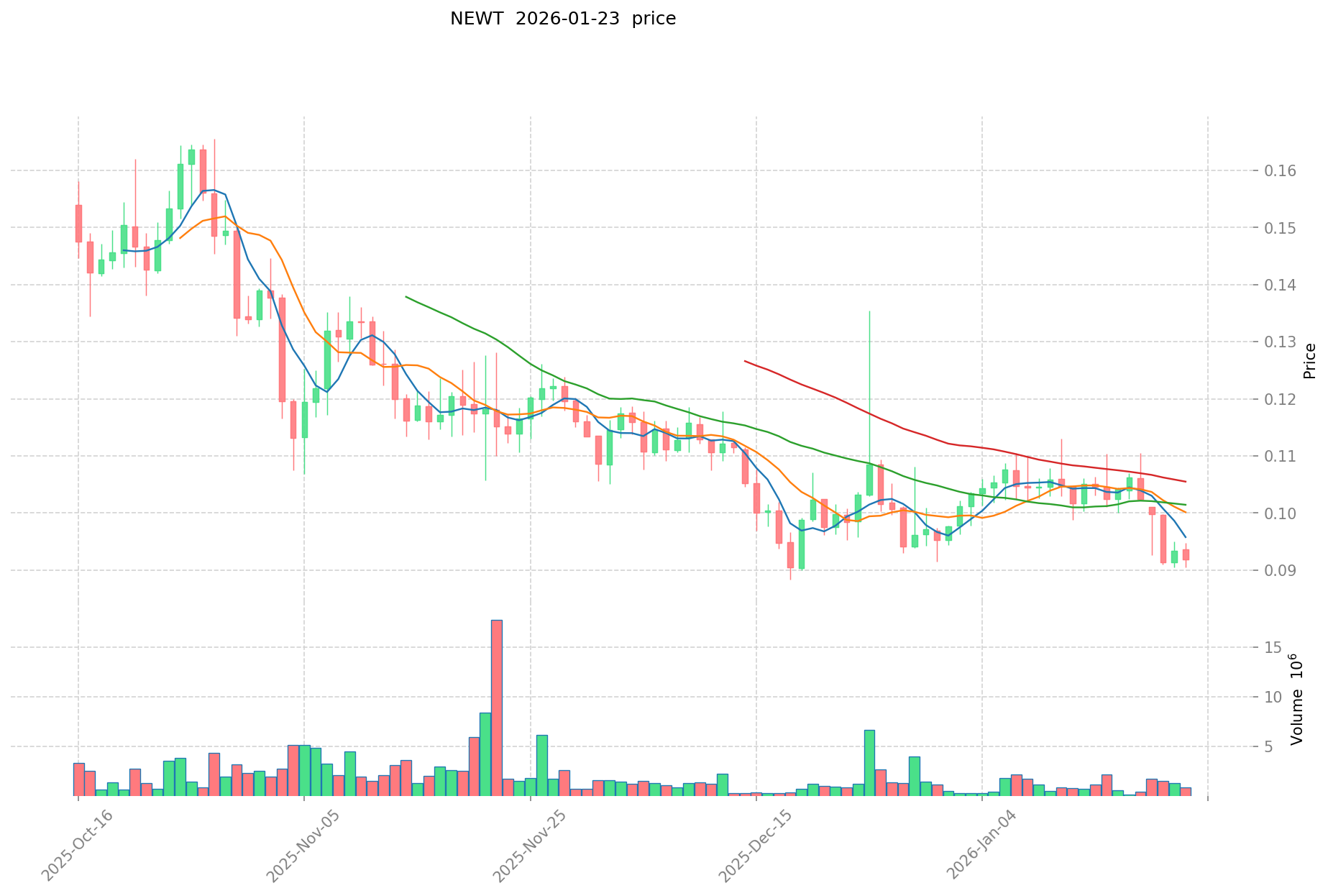
II. Core Factors Affecting Whether NEWT is a Good Investment (Is Newton(NEWT) a Good Investment)
Supply Mechanism and Scarcity (NEWT investment scarcity)
- Maximum supply capped at 1,000,000,000 NEWT → affects price and investment value
- Current circulating supply of 215,000,000 NEWT represents 21.5% of total supply → gradual token release may impact scarcity dynamics
- Investment significance: scarcity is a key factor supporting long-term investment considerations
Institutional Investment and Mainstream Adoption (Institutional investment in NEWT)
- Current holder count stands at 13,156 addresses → reflects early-stage adoption levels
- NEWT serves multiple protocol functions including security, agent registry, onchain permissions, and governance → potentially enhances utility-driven investment value
- Token available on 28 exchanges → indicates expanding accessibility for institutional and retail participation
Macroeconomic Environment's Impact on NEWT Investment
- Monetary policy and interest rate changes → alter investment attractiveness across crypto assets
- Inflation environment's hedging effects → broader crypto market positioning considerations
- Geopolitical uncertainty → may influence demand for decentralized infrastructure solutions
Technology and Ecosystem Development (Technology & Ecosystem for NEWT investment)
- Decentralized infrastructure for verifiable onchain automation → addresses market need for trustless execution without centralized bots
- Secure agent authorization framework → enables protocols, DAOs and users to execute complex actions through verifiable agents
- NEWT functions as protocol gas token → creates fundamental utility demand within Newton Protocol ecosystem
- Multi-chain deployment on Ethereum (ERC-20) and BSC (BEP-20) → expands ecosystem reach and interoperability potential
- DeFi, DAO governance applications → provide use case foundations for long-term value support
III. NEWT Future Investment Forecast and Price Outlook (Is Newton(NEWT) worth investing in 2026-2031)
Short-term Investment Forecast (2026, short-term NEWT investment outlook)
- Conservative forecast: $0.0714 - $0.0927
- Neutral forecast: $0.0927 - $0.1100
- Optimistic forecast: $0.1100 - $0.1363
Mid-term Investment Outlook (2027-2029, mid-term Newton(NEWT) investment forecast)
-
Market stage expectation: Newton Protocol may experience gradual adoption as a decentralized infrastructure for onchain automation. The protocol's utility in enabling verifiable agent operations could attract interest from DAOs and protocols seeking alternatives to centralized automation solutions.
-
Investment return forecast:
- 2027: $0.0584 - $0.1248
- 2028: $0.0814 - $0.1640
- 2029: $0.1135 - $0.1532
-
Key catalysts: Protocol security enhancements, expansion of agent registry ecosystem, governance implementation progress, and adoption by protocols and DAOs for automation purposes.
Long-term Investment Outlook (Is Newton a good long-term investment?)
- Base scenario: $0.0973 - $0.1473 (assuming steady development of decentralized automation infrastructure and moderate ecosystem growth)
- Optimistic scenario: $0.1595 - $0.2109 (assuming increased adoption by DAOs and protocols, enhanced protocol security features, and favorable market conditions for decentralized infrastructure solutions)
- Risk scenario: Below $0.0714 (under conditions of limited adoption, competition from alternative automation solutions, or adverse regulatory developments)
View NEWT long-term investment and price forecast: Price Prediction
2026-01-23 to 2031 Long-term Outlook
- Base scenario: $0.0973 - $0.1473 (corresponding to steady progress and gradual mainstream application advancement)
- Optimistic scenario: $0.1595 - $0.2109 (corresponding to large-scale adoption and favorable market environment)
- Transformative scenario: Above $0.2109 (if ecosystem achieves breakthrough progress and mainstream adoption)
- 2031-12-31 forecast high: $0.2109 (based on optimistic development assumptions)
Disclaimer: The forecast is based on historical data and current market conditions. Cryptocurrency markets are highly volatile and unpredictable. This analysis does not constitute investment advice, and investors should conduct independent research and assess their risk tolerance before making investment decisions.
| Year |
Predicted High Price |
Predicted Average Price |
Predicted Low Price |
Price Change |
| 2026 |
0.1363131 |
0.09273 |
0.0714021 |
0 |
| 2027 |
0.1248284895 |
0.11452155 |
0.0584059905 |
23 |
| 2028 |
0.1639547770575 |
0.11967501975 |
0.08137901343 |
29 |
| 2029 |
0.15316009027605 |
0.14181489840375 |
0.113451918723 |
53 |
| 2030 |
0.210907116906057 |
0.1474874943399 |
0.097341746264334 |
59 |
| 2031 |
0.186365197847897 |
0.179197305622978 |
0.15948560200445 |
93 |
IV. Newton Investment Strategy and Risk Management (How to invest in Newton)
Investment Methodology (Newton investment strategy)
-
Long-term Holding (HODL Newton): Suitable for conservative investors who believe in the long-term potential of decentralized infrastructure for verifiable onchain automation. This approach focuses on accumulating NEWT tokens during market corrections and holding through market cycles, reducing exposure to short-term volatility.
-
Active Trading: Relies on technical analysis and swing trading strategies. Traders may leverage support and resistance levels, monitoring key price points such as the 24-hour high of $0.09454 and low of $0.09043. This strategy requires continuous market monitoring and understanding of price movement patterns.
Risk Management (Risk management for Newton investment)
-
Asset Allocation Ratios:
- Conservative investors: Allocate 1-3% of crypto portfolio to NEWT
- Aggressive investors: Consider 5-10% allocation based on risk tolerance
- Professional investors: May allocate higher percentages with active hedging strategies
-
Risk Hedging Solutions: Implement multi-asset portfolio diversification by combining NEWT with established cryptocurrencies and stablecoins. Consider using derivatives or options where available to hedge against significant price swings.
-
Secure Storage: Utilize cold wallets for long-term holdings and hot wallets for active trading. Hardware wallets such as Ledger or Trezor are recommended for storing larger amounts. Always verify contract addresses (BSC: 0xb8a677e6d805c8d743e6f14c8bc9c19305b5defc, ETH: 0xd0ec028a3d21533fdd200838f39c85b03679285d) before transactions.
V. Newton Investment Risks and Challenges (Risks of investing in Newton)
-
Market Risk: NEWT has demonstrated significant price volatility, with a 24-hour change of -1.59%, 7-day change of -8.84%, and 1-year change of -81.89%. The token experienced price fluctuations between an all-time high of $0.8511 and an all-time low of $0.0483. Such volatility presents opportunities but also substantial downside risk.
-
Regulatory Risk: As a decentralized infrastructure protocol, Newton operates in an evolving regulatory environment. Different jurisdictions maintain varying approaches to crypto assets, and future regulatory changes could impact token utility, trading availability, or protocol operations. Investors should monitor regulatory developments in their respective regions.
-
Technical Risk: The protocol's security depends on its infrastructure for verifiable onchain automation. Potential risks include smart contract vulnerabilities, network security issues, or technical challenges during protocol upgrades. With 13,156 holders and listings on 28 exchanges, the project maintains a relatively modest ecosystem that may face scalability challenges.
-
Liquidity Risk: With a 24-hour trading volume of $84,188.60 and a market cap of approximately $19.9 million, NEWT presents moderate liquidity compared to major cryptocurrencies. This could result in price slippage during larger transactions.
VI. Conclusion: Is Newton a Good Investment?
-
Investment Value Summary: Newton presents potential value as decentralized infrastructure for verifiable onchain automation and secure agent authorization. The protocol's focus on enabling complex actions through verifiable agents without centralized bots addresses a specific need in the decentralized ecosystem. However, the token has experienced substantial price decline over the past year, and maintains a relatively small market capitalization with a circulating supply of 215 million tokens (21.5% of max supply).
-
Investor Recommendations:
✅ Beginners: Consider dollar-cost averaging (DCA) strategy with small allocations, store tokens in secure hardware wallets, and thoroughly research the protocol's use cases before investing.
✅ Experienced Investors: May explore swing trading opportunities during price volatility, maintain diversified portfolio allocation, and actively monitor protocol developments and market trends.
✅ Institutional Investors: Conduct comprehensive due diligence on protocol fundamentals, assess long-term viability of the decentralized automation infrastructure, and consider strategic positioning based on risk-adjusted returns.
⚠️ Disclaimer: Cryptocurrency investment carries substantial risk. This content is for informational purposes only and does not constitute investment advice. Past performance does not guarantee future results. Investors should conduct independent research and consult financial advisors before making investment decisions.
VII. FAQ
Q1: What is the current price of Newton (NEWT) and how has it performed historically?
As of January 23, 2026, Newton (NEWT) is trading at $0.09256 with a market capitalization of approximately $19.90 million. The token has experienced significant volatility since launch, reaching an all-time high of $0.8511 on June 24, 2025, before declining to an all-time low of $0.0483 on October 10, 2025. Over the past year, NEWT has declined by approximately 81.89%, reflecting substantial market volatility. Recent price movements show a 1-hour change of +0.22%, 24-hour change of -1.59%, 7-day change of -8.84%, and 30-day change of -5.4%.
Q2: What are the primary use cases and utility of the NEWT token?
NEWT serves multiple critical functions within the Newton Protocol ecosystem. It operates as the protocol's gas token for transaction processing, provides security for the decentralized infrastructure, enables agent registry management, controls onchain permissions, and facilitates governance participation. The token's core utility lies in enabling verifiable onchain automation and secure agent authorization, allowing protocols, DAOs, and users to execute complex operations through verifiable agents without relying on centralized bots. NEWT is deployed on both Ethereum (ERC-20) and BSC (BEP-20), expanding its ecosystem reach and interoperability.
Q3: What is NEWT's tokenomics and supply distribution?
Newton has a maximum supply capped at 1,000,000,000 NEWT tokens, with a current circulating supply of 215,000,000 NEWT, representing 21.5% of the total supply. This circulating ratio indicates that approximately 78.5% of tokens remain to be released, which may impact scarcity dynamics and future price movements. The token is held by 13,156 addresses and is available for trading on 28 exchanges. The gradual token release schedule suggests that investors should monitor unlock events that could potentially affect market dynamics.
Q4: What are the projected price forecasts for NEWT in the short-term and long-term?
For 2026, short-term forecasts range from conservative ($0.0714 - $0.0927), neutral ($0.0927 - $0.1100), to optimistic ($0.1100 - $0.1363). Mid-term projections for 2027-2029 suggest potential ranges of $0.0584 - $0.1248 (2027), $0.0814 - $0.1640 (2028), and $0.1135 - $0.1532 (2029). Long-term outlook for 2031 presents a base scenario of $0.0973 - $0.1473, optimistic scenario of $0.1595 - $0.2109, with a 2031 forecast high of $0.2109. These projections assume varying degrees of protocol adoption, ecosystem growth, and favorable market conditions for decentralized infrastructure solutions.
Q5: What are the main risks associated with investing in Newton (NEWT)?
The primary risks include market risk, evidenced by significant historical volatility and an 81.89% decline over the past year. Regulatory risk exists as the protocol operates in an evolving legal environment where jurisdictional approaches vary. Technical risk involves potential smart contract vulnerabilities, network security issues, or challenges during protocol upgrades. Liquidity risk is present with a 24-hour trading volume of $84,188.60 and a relatively modest market cap of $19.9 million, which could result in price slippage during larger transactions. The project's relatively small holder base of 13,156 addresses also presents adoption risk.
Q6: What investment strategies are recommended for NEWT holders?
For conservative investors, a long-term holding (HODL) strategy with 1-3% portfolio allocation and dollar-cost averaging (DCA) during market corrections is recommended. Active traders may leverage technical analysis and swing trading strategies, monitoring key support and resistance levels within the 24-hour range of $0.09043 - $0.09454. Aggressive investors might consider 5-10% allocation with active hedging strategies. Secure storage using hardware wallets (Ledger or Trezor) is essential, always verifying contract addresses (BSC: 0xb8a677e6d805c8d743e6f14c8bc9c19305b5defc, ETH: 0xd0ec028a3d21533fdd200838f39c85b03679285d) before transactions.
Q7: How does Newton Protocol differentiate itself from other automation solutions?
Newton Protocol differentiates itself by providing decentralized infrastructure for verifiable onchain automation without reliance on centralized bots. The protocol enables protocols, DAOs, and users to execute complex operations through verifiable agents with secure authorization frameworks. This addresses a specific market need for trustless execution in decentralized environments. The multi-chain deployment on Ethereum and BSC expands ecosystem reach, while NEWT's function as the protocol gas token creates fundamental utility demand. The protocol's applications in DeFi and DAO governance provide use case foundations that distinguish it from centralized automation alternatives.
Q8: What factors could drive future adoption and price appreciation for NEWT?
Key catalysts for future adoption include protocol security enhancements, expansion of the agent registry ecosystem, successful governance implementation, and increased adoption by protocols and DAOs for automation purposes. Broader factors include favorable macroeconomic conditions for cryptocurrency assets, institutional interest in decentralized infrastructure solutions, and successful technological developments within the Newton ecosystem. Enhanced interoperability features, strategic partnerships with major protocols, and increased mainstream recognition of the need for verifiable onchain automation could serve as positive drivers for token value appreciation.
* The information is not intended to be and does not constitute financial advice or any other recommendation of any sort offered or endorsed by Gate.