This comprehensive analysis examines whether NKN represents a viable investment opportunity within the blockchain infrastructure sector. The article evaluates NKN's historical performance, current market position with a $9.46 million capitalization, and technological differentiation as a decentralized network transmission infrastructure project. It presents price forecasts through 2031, ranging from conservative to optimistic scenarios, while analyzing core investment factors including token supply mechanisms, ecosystem development, and macroeconomic influences. The guide provides tailored investment strategies for conservative, moderate, and aggressive investors, emphasizing asset allocation proportions and risk management through portfolio diversification and secure storage solutions on Gate and other supported platforms. Critical examination of market risks, regulatory uncertainties, and technical challenges offers balanced perspective on NKN's viability. FAQ sections address common investor questions rega
Introduction: NKN (New Kind of Network) Investment Position and Market Outlook
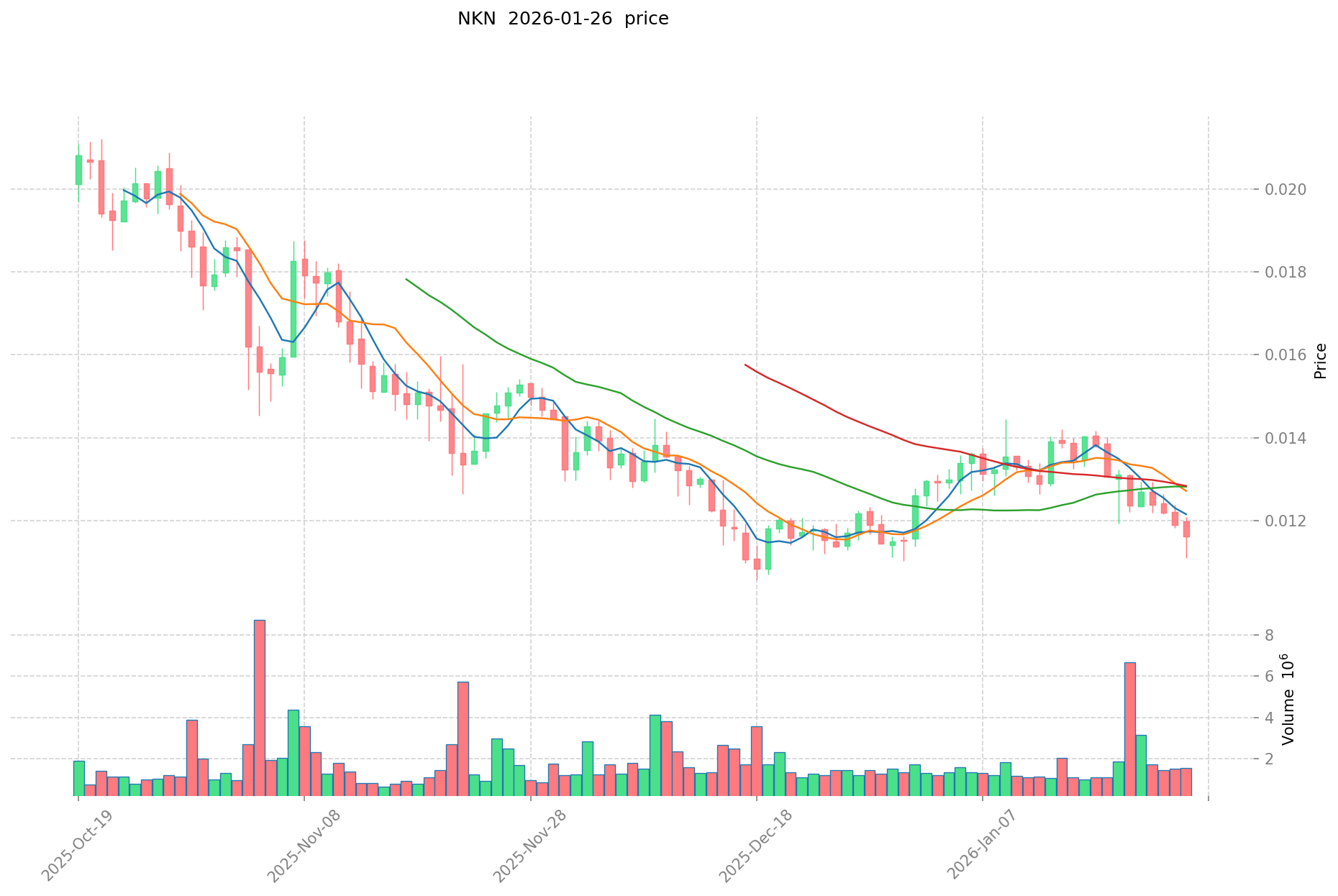
NKN is a decentralized network infrastructure project in the cryptocurrency space, launched in May 2018 with an initial offering price of $0.14. As of January 2026, NKN maintains a market capitalization of approximately $9.46 million, with a circulating supply of around 796.15 million tokens and a current price of $0.01188. Positioned as a blockchain-driven network infrastructure that incentivizes bandwidth sharing, NKN has attracted attention in discussions regarding "Is NKN a good investment?" among cryptocurrency investors. The project aims to address network resource allocation and transmission efficiency challenges through its innovative approach to decentralized networking. This article comprehensively analyzes NKN's investment value, historical price performance, future price predictions, and associated investment risks to provide reference information for potential investors.
I. Historical Price Review and Current Investment Value of NKN
- 2018: NKN launched with a publish price of $0.14, marking the beginning of its journey as a blockchain-driven network infrastructure project
- 2021: During the crypto market bull cycle, NKN experienced significant price appreciation, reaching a peak of $1.44 in April 2021
- 2020-2024: The token experienced substantial volatility, with prices fluctuating between $0.0067 (March 2020) and levels observed in subsequent market cycles
- 2025-2026: Over the past year, NKN has declined approximately 85.46%, reflecting broader market pressures and sector-specific challenges
Current NKN Investment Market Status (January 2026)
- NKN current price: $0.01188
- Market sentiment (Fear & Greed Index): Data not available in provided materials
- 24-hour trading volume: $18,222.62
- Market capitalization: $9,458,277.44
- Circulating supply: 796,151,299.71 NKN (79.62% of max supply)
- Institutional investor holdings: Data not available in provided materials
- Current market ranking: #1227
- Available on 21 exchanges with 18,257 token holders
Click to view real-time NKN market price
II. Core Factors Affecting Whether NKN is a Good Investment (Is NKN(NKN) a Good Investment)
Supply Mechanism and Scarcity (NKN investment scarcity)
- Maximum supply cap of 1,000,000,000 NKN tokens with current circulating supply of approximately 796.15 million tokens (79.62% of max supply) → influences price dynamics and investment valuation framework
- The token supply mechanism demonstrates a relatively high circulation ratio, with total supply approaching 796.48 million tokens, indicating mature distribution phase
- Investment significance: The defined maximum supply cap provides a measurable scarcity framework that may support long-term valuation considerations, though actual market adoption remains the primary value driver
Institutional Investment and Mainstream Adoption (Institutional investment in NKN)
- Current holder count stands at 18,257 addresses, reflecting the scale of network participation
- The project is listed on 21 exchanges, indicating a degree of market accessibility and liquidity infrastructure
- Token deployment on Ethereum network (contract address: 0x5Cf04716BA20127F1E2297AdDCf4B5035000c9eb) provides integration potential with DeFi ecosystem components
Macroeconomic Environment's Impact on NKN Investment
- Broader cryptocurrency market conditions and monetary policy shifts → affect overall digital asset investment attractiveness, including network infrastructure projects
- Market volatility considerations: 24-hour price range between $0.01111 and $0.01208 demonstrates typical cryptocurrency price fluctuation patterns
- Regulatory developments in blockchain infrastructure space → may influence long-term adoption trajectory and investment framework
Technology and Ecosystem Development (Technology & Ecosystem for NKN investment)
- Core technical innovations include dynamic routing mechanisms, network relay proof systems, and highly scalable consensus architecture → designed to enhance network transmission efficiency
- The project positions itself as blockchain infrastructure for network transmission resources, following computational (Ethereum) and storage (Filecoin/IPFS) blockchain implementations
- Resource sharing incentive model aims to encourage network bandwidth contribution from users and node operators → creates utility-driven token economics
- Native NKN token serves as the economic incentive mechanism within the ecosystem for network resource sharing and bandwidth utilization
III. NKN Future Investment Forecast and Price Outlook (Is NKN(NKN) worth investing in 2026-2031)
Short-term Investment Forecast (2026, short-term NKN investment outlook)
- Conservative forecast: $0.0060588 - $0.01188
- Neutral forecast: $0.01188
- Optimistic forecast: $0.01188 - $0.0174636
Mid-term Investment Outlook (2027-2029, mid-term NKN(NKN) investment forecast)
-
Market stage expectation: During this period, NKN may experience gradual growth with increasing adoption of its decentralized network infrastructure model. The project's focus on network transmission resource sharing could attract more nodes and users as blockchain-based connectivity solutions gain traction.
-
Investment return forecast:
- 2027: $0.010857132 - $0.01760616
- 2028: $0.0138795228 - $0.0200123352
- 2029: $0.014279769504 - $0.023679111456
-
Key catalysts: Network expansion with increased node deployment, technological improvements in dynamic routing and consensus mechanisms, broader adoption of decentralized bandwidth sharing solutions, and potential partnerships within the Web3 infrastructure ecosystem.
Long-term Investment Outlook (Is NKN a good long-term investment?)
- Base scenario: $0.01962474145632 - $0.02567918296944 (assuming steady network growth and moderate ecosystem development)
- Optimistic scenario: $0.02327828374872 - $0.034219077110618 (assuming accelerated adoption, significant technological advancements, and favorable market conditions)
- Risk scenario: Below $0.01 (under conditions of intensified competition, technological challenges, or prolonged adverse market sentiment)
Check NKN long-term investment and price prediction: Price Prediction
2026-01-26 - 2031 Long-term Outlook
- Base scenario: $0.01962474145632 - $0.02567918296944 (corresponding to steady progress and gradual mainstream application growth)
- Optimistic scenario: $0.02327828374872 - $0.034219077110618 (corresponding to large-scale adoption and favorable market environment)
- Transformative scenario: Above $0.034219077110618 (in case of breakthrough ecosystem developments and mainstream penetration)
- 2031-12-31 Predicted high: $0.034219077110618 (based on optimistic development assumptions)
Disclaimer: The above forecasts are based on historical data analysis and current market conditions. Cryptocurrency investments involve substantial risks, and actual prices may differ significantly from predictions due to market volatility, regulatory changes, technological developments, and other unforeseen factors. This content does not constitute investment advice, and investors should conduct thorough research and consider their risk tolerance before making investment decisions.
| Year |
Predicted High Price |
Predicted Average Price |
Predicted Low Price |
Price Change |
| 2026 |
0.0174636 |
0.01188 |
0.0060588 |
0 |
| 2027 |
0.01760616 |
0.0146718 |
0.010857132 |
23 |
| 2028 |
0.0200123352 |
0.01613898 |
0.0138795228 |
35 |
| 2029 |
0.023679111456 |
0.0180756576 |
0.014279769504 |
52 |
| 2030 |
0.02567918296944 |
0.020877384528 |
0.01962474145632 |
75 |
| 2031 |
0.034219077110618 |
0.02327828374872 |
0.020019324023899 |
95 |
IV. NKN Investment Strategy and Risk Management (How to invest in NKN)
Investment Methodology (NKN investment strategy)
Long-term Holding (HODL NKN)
Long-term holding strategies may be suitable for investors seeking relatively stable exposure to decentralized network infrastructure projects. This approach typically involves:
- Regular accumulation during market corrections
- Focus on fundamental developments in the NKN ecosystem
- Multi-year investment horizon aligned with network adoption cycles
Given NKN's position in the blockchain-based network transmission sector, investors following this strategy often monitor network growth metrics, node deployment trends, and ecosystem expansion rather than short-term price movements.
Active Trading
Active trading approaches for NKN involve:
- Technical analysis utilizing price trends and volume patterns
- Monitoring the observed 24-hour trading volume of approximately $18,222
- Swing trading based on identified support and resistance levels
- Position sizing adjusted to the token's volatility characteristics
Traders may reference historical price ranges, noting that NKN has traded between $0.00667819 and $1.44 during its market history, though past performance does not indicate future results.
Risk Management (Risk management for NKN investment)
Asset Allocation Proportions
Conservative Investors:
- Suggested allocation: 1-3% of crypto portfolio
- Emphasis on established cryptocurrencies with smaller allocations to infrastructure tokens like NKN
- Priority on capital preservation over aggressive growth
Moderate Investors:
- Suggested allocation: 3-7% of crypto portfolio
- Balanced approach incorporating both established and emerging blockchain infrastructure projects
- Tolerance for moderate volatility in exchange for potential upside
Aggressive/Professional Investors:
- Suggested allocation: 7-15% of crypto portfolio
- Higher conviction in decentralized network infrastructure thesis
- Active portfolio management with sophisticated risk controls
Risk Hedging Solutions
Multi-Asset Portfolio Construction:
- Diversification across different crypto categories (Layer 1s, DeFi, infrastructure)
- Correlation analysis to reduce concentration risk
- Periodic rebalancing based on predetermined thresholds
Defensive Tools:
- Stablecoin reserves for opportunistic rebalancing
- Setting predetermined exit points based on risk tolerance
- Gradual position building to average entry prices
Secure Storage
Cold Wallet Solutions:
- Hardware wallets providing offline storage for long-term holdings
- Multi-signature configurations for larger amounts
- Secure backup procedures for recovery phrases
Hot Wallet Management:
- Limited amounts for active trading on exchanges
- Two-factor authentication and withdrawal whitelisting
- Regular security audits of connected platforms
Hardware Wallet Recommendations:
- Research reputable hardware wallet manufacturers
- Verify device authenticity upon receipt
- Store recovery information in secure, distributed locations
Given that NKN has an ERC-20 token deployed at 0x5Cf04716BA20127F1E2297AdDCf4B5035000c9eb on the Ethereum network, Ethereum-compatible hardware wallets can be utilized for secure storage.
V. NKN Investment Risks and Challenges (Risks of investing in NKN)
Market Risk
High Volatility:
- NKN has demonstrated significant price fluctuations, with recorded changes including a 7-day movement of -7.97%
- Annual performance showing a -85.46% change reflects the substantial volatility characteristic of smaller-cap crypto assets
- The circulating supply of approximately 796 million tokens (79.62% of max supply) may contribute to liquidity-related price movements
Market Manipulation Concerns:
- Tokens with relatively smaller market capitalizations may be more susceptible to coordinated trading activities
- Trading volume concentrations across limited exchanges (21 exchanges listed) could impact price discovery
- Investors should exercise caution regarding unusual trading patterns or volume spikes
Regulatory Risk
Policy Uncertainty Across Jurisdictions:
- Regulatory frameworks for blockchain network infrastructure projects remain evolving globally
- Different jurisdictions may classify decentralized network tokens differently, affecting legal status
- Compliance requirements for network operators and token holders may vary significantly by region
Potential Regulatory Impacts:
- Changes in securities regulations could affect token classification
- Network infrastructure projects may face telecommunications or data transmission regulatory scrutiny
- Cross-border data and network transmission regulations could impact operational models
Technical Risk
Network Security Vulnerabilities:
- Decentralized network architectures face unique security considerations
- Smart contract risks associated with the ERC-20 token implementation
- Potential vulnerabilities in node software or network relay mechanisms
Upgrade and Development Risks:
- Protocol upgrades may encounter technical challenges or community disagreements
- Network scalability improvements require successful implementation and adoption
- Dependency on continued development and maintenance of open-source components
Ecosystem Risks:
- Network effects require sustained node operator participation
- Competition from alternative decentralized network solutions
- Technology obsolescence risk in a rapidly evolving blockchain landscape
VI. Conclusion: Is NKN a Good Investment?
Investment Value Summary
NKN represents an approach to decentralizing network transmission resources through blockchain technology. The project positions itself within the infrastructure layer of the blockchain ecosystem, alongside computation and storage solutions. Long-term potential depends on factors including network adoption, technological development, and the broader acceptance of decentralized network infrastructure models.
Short-term price movements have shown considerable volatility, with the token experiencing significant fluctuations. The current market capitalization of approximately $9.46 million and a market share of 0.00030% indicate a relatively smaller position within the overall cryptocurrency market.
Investor Recommendations
✅ Beginner Investors:
- Consider dollar-cost averaging approaches to mitigate timing risk
- Prioritize secure storage solutions such as hardware wallets
- Allocate only capital that can be sustained through extended market cycles
- Conduct thorough research on blockchain network infrastructure concepts before investing
✅ Experienced Investors:
- Employ tactical trading strategies based on technical and fundamental analysis
- Incorporate NKN within a diversified cryptocurrency portfolio
- Monitor network metrics and development progress alongside price action
- Implement predetermined risk management protocols
✅ Institutional Investors:
- Evaluate strategic allocation within blockchain infrastructure investment thesis
- Conduct comprehensive due diligence on technology, team, and competitive positioning
- Consider long-term exposure aligned with institutional investment horizons
- Assess regulatory compliance and custody solutions appropriate for institutional requirements
⚠️ Important Notice: Cryptocurrency investments carry substantial risk, including the potential for complete loss of capital. This content is provided for informational purposes only and does not constitute investment advice, financial advice, trading advice, or recommendations. Investors should conduct independent research and consult with qualified financial advisors before making investment decisions.
VII. FAQ
Q1: Is NKN a good investment for beginners in 2026?
NKN may present significant challenges for beginner investors due to its high volatility and relatively small market capitalization. The token has experienced an 85.46% decline over the past year and currently maintains a market cap of only $9.46 million, ranking #1227 in the cryptocurrency market. For beginners, it's crucial to understand that smaller-cap infrastructure tokens carry substantially higher risk than established cryptocurrencies. If considering NKN, beginners should limit allocation to 1-3% of their crypto portfolio, use dollar-cost averaging to mitigate timing risk, and prioritize secure storage solutions like hardware wallets. Most importantly, only invest capital you can afford to lose completely, as the project's success depends on uncertain factors including network adoption, technological development, and competition from alternative decentralized network solutions.
Q2: What is the long-term price prediction for NKN through 2031?
Based on historical data analysis and current market conditions, NKN's long-term price outlook presents a wide range of possibilities. Under a base scenario assuming steady network growth, predictions suggest prices between $0.0196 and $0.0257 by 2030, representing a potential 75% increase from current levels. An optimistic scenario, contingent on accelerated adoption and favorable market conditions, projects prices reaching $0.0342 by 2031 (approximately 95% growth). However, a risk scenario considers prices falling below $0.01 if the project faces intensified competition or technological challenges. These forecasts assume continued development of the decentralized network infrastructure, increased node deployment, and broader Web3 ecosystem integration. It's critical to note that cryptocurrency price predictions are highly speculative, and actual outcomes may differ significantly due to market volatility, regulatory changes, and unforeseen technological developments.
Q3: How does NKN's technology differentiate it from other blockchain infrastructure projects?
NKN positions itself as blockchain infrastructure specifically for network transmission resources, complementing computational infrastructure like Ethereum and storage solutions like Filecoin. The project's core technical innovations include dynamic routing mechanisms, network relay proof systems, and highly scalable consensus architecture designed to enhance network transmission efficiency. The native NKN token serves as an economic incentive mechanism for network resource sharing, encouraging users and node operators to contribute bandwidth. Unlike traditional blockchain projects focused on smart contracts or decentralized storage, NKN addresses network resource allocation and transmission efficiency challenges through a bandwidth-sharing incentive model. The token is deployed on Ethereum (contract address: 0x5Cf04716BA20127F1E2297AdDCf4B5035000c9eb), providing potential integration with DeFi ecosystem components. However, investors should note that the project faces competition from alternative decentralized network solutions and must overcome adoption challenges to achieve meaningful market penetration.
Q4: What are the main risks associated with investing in NKN?
Investing in NKN carries multiple substantial risks that potential investors must carefully consider. Market risk is significant, with the token demonstrating extreme volatility—including an 85.46% annual decline and a 7-day movement of -7.97%. The relatively small market capitalization ($9.46 million) makes NKN potentially susceptible to price manipulation and liquidity concerns across its 21 listed exchanges. Regulatory risk remains substantial as frameworks for blockchain network infrastructure projects continue evolving globally, with potential implications for token classification and operational compliance. Technical risks include network security vulnerabilities, smart contract risks associated with the ERC-20 implementation, and potential challenges in protocol upgrades. Ecosystem risks encompass the requirement for sustained node operator participation, competition from alternative solutions, and technology obsolescence in a rapidly evolving landscape. The project's success fundamentally depends on achieving sufficient network effects and mainstream adoption of decentralized network infrastructure models—outcomes that remain highly uncertain.
Q5: What investment strategy is most appropriate for NKN?
The appropriate investment strategy for NKN depends significantly on investor experience level and risk tolerance. For conservative investors, a long-term holding (HODL) approach with 1-3% portfolio allocation emphasizes fundamental ecosystem developments over short-term price movements, with regular accumulation during market corrections and a multi-year investment horizon. Moderate investors might allocate 3-7% to NKN within a balanced crypto portfolio, actively monitoring network growth metrics, node deployment trends, and ecosystem expansion. Aggressive or professional investors could consider 7-15% allocation with sophisticated risk controls and active portfolio management, potentially incorporating technical analysis and swing trading based on support/resistance levels. Regardless of strategy, comprehensive risk management is essential: implement asset diversification across different crypto categories, maintain stablecoin reserves for rebalancing opportunities, use hardware wallets for secure long-term storage, and establish predetermined exit points. Given NKN's volatile nature and small market cap, all investors should only allocate capital they can sustain through extended market cycles.
Q6: How does NKN's tokenomics affect its investment potential?
NKN's tokenomics present both opportunities and considerations for potential investors. The token has a maximum supply cap of 1 billion NKN, with approximately 796.15 million tokens currently in circulation (79.62% of max supply), indicating a mature distribution phase with limited future dilution risk. This relatively high circulation ratio provides a measurable scarcity framework that may support long-term valuation, though actual market adoption remains the primary value driver. The token serves as the economic incentive mechanism within the ecosystem, rewarding network resource sharing and bandwidth contribution from users and node operators. Current network participation includes 18,257 token holders, reflecting the scale of ecosystem engagement. However, investors should note that the daily trading volume of only $18,222 indicates limited liquidity, which can contribute to price volatility and potentially challenging entry/exit conditions for larger positions. The defined supply cap offers more predictability than unlimited-supply tokens, but the token's utility value ultimately depends on successful network growth and widespread adoption of the decentralized bandwidth-sharing model.
Q7: What milestones should investors monitor to evaluate NKN's progress?
Investors evaluating NKN should track several key indicators beyond price movements to assess the project's fundamental development. Network growth metrics are paramount—monitor increases in active nodes, network bandwidth capacity, and geographic distribution of infrastructure. Technological developments including successful implementation of protocol upgrades, improvements to dynamic routing mechanisms, and enhancements to the consensus architecture signal progress toward the project's technical objectives. Ecosystem expansion markers include new partnerships within the Web3 infrastructure space, integration with decentralized applications requiring network transmission resources, and adoption by enterprise or institutional users. Token holder growth beyond the current 18,257 addresses and increased exchange listings beyond the current 21 platforms indicate expanding accessibility and market interest. Additionally, watch for regulatory clarity regarding blockchain network infrastructure in major jurisdictions, competitive positioning relative to alternative decentralized network solutions, and development team activity including code commits, community engagement, and transparent roadmap execution. These fundamental indicators provide more reliable insight into NKN's long-term viability than short-term price speculation alone.
Q8: Can NKN recover from its 85% annual decline, and what factors would drive recovery?
While cryptocurrency markets have historically demonstrated capacity for significant recoveries, NKN's potential rebound from its 85.46% annual decline depends on multiple interconnected factors, none of which are guaranteed. Price recovery would likely require fundamental improvements rather than purely speculative interest: substantial increases in network utilization with measurable bandwidth sharing activity, successful technological implementations that demonstrate competitive advantages over alternative solutions, and clear evidence of growing mainstream adoption of decentralized network infrastructure concepts. Broader market conditions would also play a crucial role—a general cryptocurrency bull market could lift NKN along with other digital assets, while continued bear market conditions could suppress prices regardless of project-specific developments. Strategic partnerships, significant protocol upgrades, or novel use cases could serve as catalysts. However, investors should recognize that recovery is far from certain—many cryptocurrency projects experiencing similar declines never regain previous valuations. The small market cap ($9.46 million) and limited daily volume ($18,222) suggest NKN faces substantial challenges in attracting sufficient capital and liquidity for sustained recovery. Any investment decision should be based on thorough fundamental analysis rather than expectations of mean reversion or recovery from historical highs.
* The information is not intended to be and does not constitute financial advice or any other recommendation of any sort offered or endorsed by Gate.