This comprehensive analysis examines Nodecoin (NC), a real-time predictive intelligence token launched in January 2025, currently trading at $0.001158 with a market cap of $342,757 on Gate and other platforms. The article evaluates NC's investment potential by analyzing its price history (declined 98% from $0.335 high), market performance metrics, and tokenomics structure with 29.6% circulating supply. Investment value hinges on Nodepay's decentralized bandwidth-sharing network and ability to aggregate market sentiment through verified human signals. Price forecasts through 2031 range from conservative scenarios ($0.00114-$0.00172) to optimistic scenarios ($0.00172-$0.00228+), contingent on ecosystem adoption and market conditions. The guide presents risk management strategies for different investor profiles, highlighting extreme volatility, limited liquidity, regulatory uncertainty, and technical vulnerabilities. While NC offers early-stage growth potential, substantial risks warrant conservative allocation
Introduction: Nodecoin (NC) Investment Position and Market Prospects
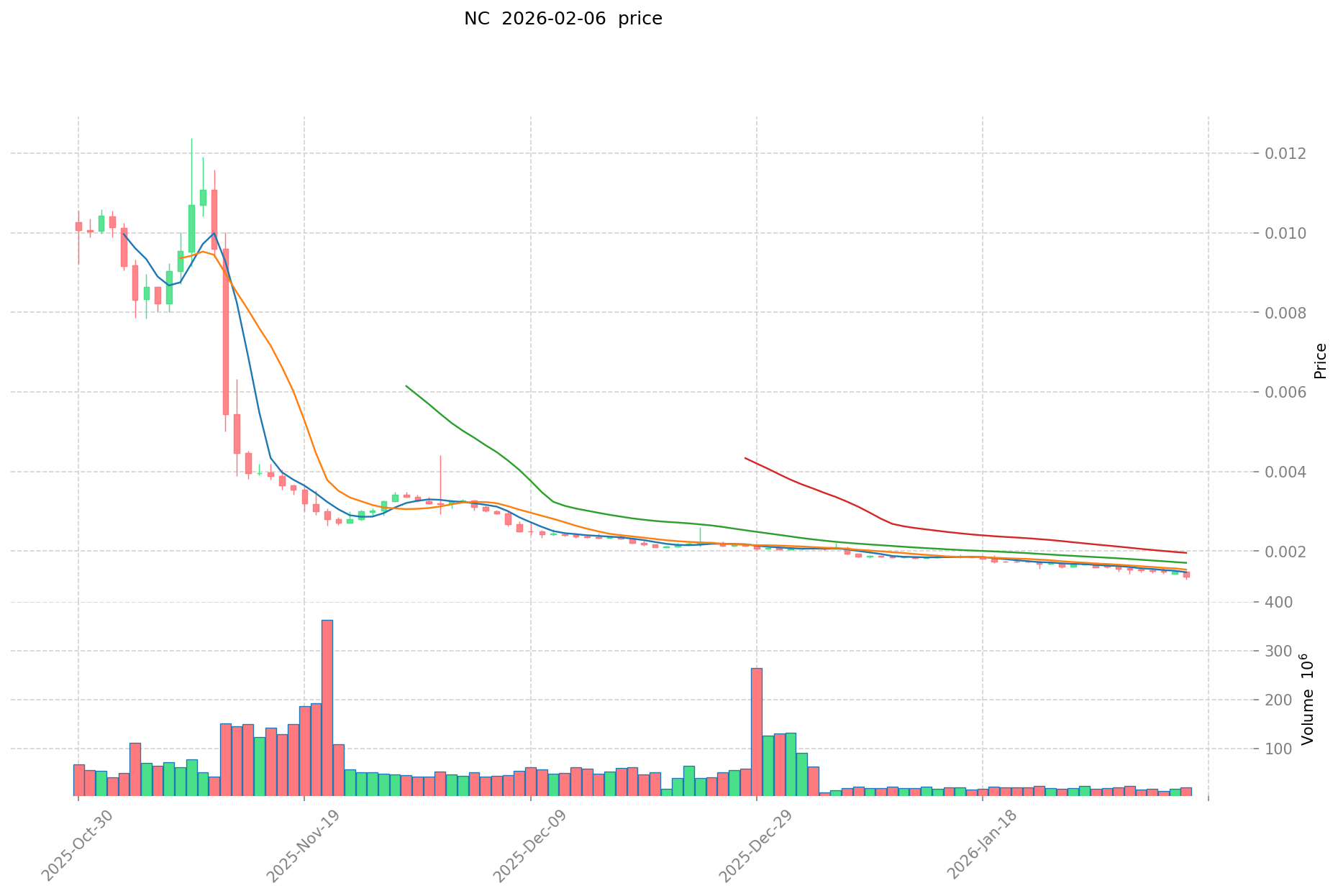
Nodecoin (NC) represents a notable asset in the cryptocurrency sector, having launched in January 2025 as a real-time predictive intelligence platform. As of February 2026, NC holds a market capitalization of approximately $342,757, with a circulating supply of about 295,990,695 tokens and a current price around $0.001158. The project has evolved from a decentralized bandwidth-sharing network into a signal and prediction engine that aggregates user inputs, social activity, and on-chain data to deliver structured market sentiment insights. With its positioning as a next-generation network driven by verified human signals and market behavior, NC has attracted attention from approximately 128,161 holders across 7 exchanges. The token has experienced notable volatility, declining 20.68% in 24 hours and showing a 7-day decrease of 26.40%, while its 30-day performance reflects a 37.69% decline. This article examines NC's investment characteristics, historical price movements, future price projections, and associated risks to provide analytical context for investors considering this asset.
I. Nodecoin (NC) Price History Review and Current Investment Value
Historical Price Trends and Investment Returns of NC
- January 2025: NC launched at an initial price of $0.1, offering early investors opportunities as the price experienced upward movement
- January 2025: The token reached a price level of $0.335 during a period of market activity
- February 2026: Market cycles led to price movements from previous levels to $0.001132
Current NC Investment Market Status (February 2026)
- Current NC price: $0.001158
- 24-hour trading volume: $26,970.97
- Market cap: $342,757.22
- Circulating supply: 295,990,695 NC
- Total supply: 999,962,813 NC
- Market share: 0.000046%
Click to view real-time NC market price
II. Core Factors Influencing Whether NC is a Good Investment
Supply Mechanism and Scarcity (NC Investment Scarcity)
- Total Supply Structure: Nodecoin has a maximum supply of 1,000,000,000 tokens, with approximately 295,990,695 tokens currently in circulation, representing a circulating ratio of 29.60%.
- Supply Distribution Impact: The relatively low circulating supply compared to maximum supply may influence price dynamics, with potential supply releases affecting future valuation.
- Investment Implications: The tokenomics structure, with less than one-third of tokens in circulation, represents a factor investors should consider when evaluating scarcity-driven investment potential.
- Current Market Position: As of February 7, 2026, NC is ranked 3,376 with a market capitalization of $342,757.22 and a fully diluted valuation of $1,157,956.94.
- Price Performance Trends: The token has experienced notable volatility, with declines of 20.68% over 24 hours, 26.40% over 7 days, and 37.69% over 30 days, indicating significant short-term market pressure.
- Historical Context: Since its listing on January 14, 2025 at $0.1, NC has seen substantial price adjustments, with current trading at $0.001158.
Technology and Ecosystem Development (Technology & Ecosystem for NC Investment)
- Platform Infrastructure: Nodepay functions as a real-time predictive intelligence platform that aggregates user signal inputs, social activity, and on-chain data to provide structured market sentiment views.
- Decentralized Bandwidth Network: Built on a bandwidth-sharing network where users contribute unused internet resources to support AI data retrieval, evolving into a signal and prediction engine.
- Ecosystem Value Proposition: The platform's infrastructure enables verifiable, reliable real-time intelligence driven by verified human signals and market behavior, representing its core technological differentiation.
Market Adoption and Community Engagement
- Holder Base: The token has approximately 128,161 holders, indicating a developing community presence.
- Exchange Listings: NC is currently listed on 7 exchanges with a 24-hour trading volume of $26,970.97.
- Market Accessibility: The presence on multiple platforms provides liquidity options for investors, though trading volumes remain relatively modest compared to major cryptocurrencies.
III. NC Future Investment Forecast and Price Outlook (Is Nodecoin(NC) worth investing in 2026-2031)
Short-term Investment Forecast (2026, short-term NC investment outlook)
- Conservative prediction: $0.00099 - $0.00115
- Neutral prediction: $0.00115 - $0.00140
- Optimistic prediction: $0.00140 - $0.00164
Based on available market data, NC's short-term trajectory reflects ongoing volatility. The token experienced a substantial decline from its early levels, and the current trading range suggests a consolidation phase. Price fluctuations in 2026 may be influenced by overall crypto market sentiment, platform adoption trends, and developments in decentralized bandwidth-sharing applications.
Mid-term Investment Outlook (2027-2029, mid-term Nodecoin(NC) investment forecast)
- Market stage expectation: Gradual recovery and potential expansion phase, contingent upon ecosystem development and broader market conditions
- Investment return forecast:
- 2027: $0.00117 - $0.00183
- 2028: $0.00082 - $0.00174
- 2029: $0.00147 - $0.00177
- Key catalysts: Enhanced platform utility, increased user engagement in bandwidth-sharing networks, strategic partnerships, and improvements in AI data retrieval infrastructure
Mid-term projections indicate potential for moderate growth, though estimates vary. Market dynamics, technological advancements, and adoption rates within the decentralized intelligence sector will likely play significant roles in shaping NC's performance during this period.
Long-term Investment Outlook (Is NC a good long-term investment?)
- Base scenario: $0.00114 - $0.00172 (assuming steady ecosystem development and stable market conditions)
- Optimistic scenario: $0.00172 - $0.00228 (assuming accelerated adoption and favorable market environment)
- Risk scenario: Below $0.00114 (under adverse market conditions or limited ecosystem progress)
For detailed NC long-term investment analysis and price predictions, visit: Price Prediction
2026-2031 Long-term Outlook
- Base scenario: $0.00099 - $0.00172 USD (corresponding to steady progress and gradual mainstream application growth)
- Optimistic scenario: $0.00172 - $0.00228 USD (corresponding to large-scale adoption and favorable market conditions)
- Transformative scenario: Above $0.00228 USD (if the ecosystem achieves breakthrough developments and mainstream penetration)
- Predicted high by December 31, 2031: $0.00228 USD (based on optimistic development assumptions)
Disclaimer: Cryptocurrency investments carry substantial risk. The above forecasts are based on historical data analysis and market trend assumptions, and do not constitute investment advice. Actual prices may differ significantly due to market volatility, regulatory changes, technological developments, and other unpredictable factors. Investors should conduct independent research (DYOR) and consult professional advisors before making any investment decisions.
| Year |
Predicted High Price |
Predicted Average Price |
Predicted Low Price |
Price Change |
| 2026 |
0.00163584 |
0.001152 |
0.00099072 |
0 |
| 2027 |
0.0018260352 |
0.00139392 |
0.0011708928 |
20 |
| 2028 |
0.001738775808 |
0.0016099776 |
0.000821088576 |
39 |
| 2029 |
0.00177483930624 |
0.001674376704 |
0.00147345149952 |
44 |
| 2030 |
0.001897068805632 |
0.00172460800512 |
0.001379686404096 |
48 |
| 2031 |
0.002281656390773 |
0.001810838405376 |
0.001140828195386 |
56 |
IV. Nodecoin (NC) Investment Strategy and Risk Management (How to invest in Nodecoin)
Investment Methodology (Nodecoin investment strategy)
Long-term Holding (HODL Nodecoin)
For conservative investors, a long-term holding strategy may be considered for Nodecoin (NC). This approach focuses on the fundamental value proposition of the Nodepay platform as a real-time predictive intelligence network. Investors adopting this strategy typically allocate a portion of their portfolio to NC and hold through market cycles, based on belief in the project's technological infrastructure and its decentralized bandwidth-sharing network model.
Given NC's relatively recent launch (January 2025) and significant price fluctuations, long-term holders should be prepared for extended periods of volatility. The token's circulating supply represents approximately 29.6% of the maximum supply, suggesting potential future supply increases that investors should factor into their holding strategy.
Active Trading Strategy
Active traders may employ technical analysis and swing trading strategies with Nodecoin. Recent price data shows substantial volatility, with 24-hour changes of -20.68% and 7-day changes of -26.40%. Such price movements create potential opportunities for traders who can identify support and resistance levels.
Key technical considerations include:
- Historical price range: NC has traded between $0.001132 (February 2026 low) and $0.335 (January 2025 high)
- 24-hour trading range: $0.001132 to $0.001461
- Volume analysis: 24-hour trading volume of approximately $26,971
Traders should monitor market sentiment indicators and on-chain metrics, given that Nodepay's platform aggregates user signals and social activity data.
Risk Management (Risk management for Nodecoin investment)
Asset Allocation Ratios
Conservative investors: Given NC's high volatility profile (down approximately 98% from its historical high), conservative portfolios should limit exposure to 1-3% of total investable assets. This allocation acknowledges the speculative nature of the token while maintaining overall portfolio stability.
Aggressive investors: Those with higher risk tolerance and experience in cryptocurrency markets may allocate 5-10% of their portfolio to NC, particularly if they believe in the long-term potential of the predictive intelligence platform model.
Professional investors: Institutional or professional investors with comprehensive risk management frameworks might consider strategic allocations within a diversified cryptocurrency portfolio, potentially 3-7%, combined with hedging strategies and strict position monitoring.
Risk Hedging Solutions
Multi-asset portfolio construction: Investors should diversify NC holdings across multiple asset classes, including established cryptocurrencies, stablecoins, and traditional assets. Given NC's correlation with broader crypto market sentiment, pairing it with non-correlated assets can help mitigate portfolio-wide drawdowns.
Hedging instruments: Advanced investors may consider:
- Position sizing based on volatility metrics
- Stop-loss orders at predetermined price levels
- Portfolio rebalancing triggers based on NC's percentage allocation
- Diversification across multiple predictive intelligence or AI-related crypto projects
Secure Storage Solutions
Nodecoin operates on the Solana blockchain (contract address: B89Hd5Juz7JP2dxCZXFJWk4tMTcbw7feDhuWGb3kq5qE). Investors should implement appropriate security measures:
Cold and hot wallet strategy:
- Hot wallets: Maintain only actively traded amounts (typically 10-20% of holdings) in exchange wallets or software wallets for liquidity
- Cold storage: Transfer the majority of NC holdings (80-90%) to cold storage solutions for long-term security
Hardware wallet recommendations:
- Solana-compatible hardware wallets provide offline private key storage
- Multi-signature wallet configurations for larger holdings
- Regular security audits of wallet access and backup procedures
Operational security:
- Verify contract addresses before transactions to prevent phishing attacks
- Use dedicated devices for cryptocurrency transactions
- Maintain secure backups of recovery phrases in multiple physical locations
V. Nodecoin (NC) Investment Risks and Challenges (Risks of investing in Nodecoin)
Market Risks
High volatility: Nodecoin has demonstrated extreme price volatility since its launch. The token has experienced a decline of approximately 98% from its high of $0.335 in January 2025 to recent trading levels around $0.001158. Short-term fluctuations include:
- 1-hour change: +0.52%
- 24-hour change: -20.68%
- 7-day change: -26.40%
- 30-day change: -37.69%
Such volatility presents substantial risk for investors, particularly those without experience managing highly volatile assets. Price swings can result in rapid capital erosion, especially for leveraged positions.
Market liquidity concerns: With a 24-hour trading volume of approximately $26,971 and a market capitalization of around $342,757, NC demonstrates relatively limited liquidity compared to major cryptocurrencies. Low liquidity can lead to:
- Wider bid-ask spreads
- Increased slippage on larger orders
- Greater susceptibility to price manipulation
- Difficulty executing exits during market stress
Price manipulation potential: Tokens with lower market capitalizations and trading volumes face higher risks of price manipulation through coordinated trading activity, wash trading, or pump-and-dump schemes. The current circulating supply represents only 29.6% of the maximum supply, with concentrated holdings potentially influencing price discovery.
Regulatory Risks
Policy uncertainty across jurisdictions: Cryptocurrency regulations vary significantly across countries and continue to evolve. Nodecoin faces potential regulatory challenges including:
- Classification uncertainty: Regulators may classify NC differently (security, utility token, or other categories), affecting its legal status and trading availability
- Geographic restrictions: Some jurisdictions may restrict or ban cryptocurrency trading, limiting market access
- Compliance requirements: Evolving regulatory frameworks may impose new compliance obligations on the project or exchanges listing NC
- Taxation policies: Different countries apply varying tax treatments to cryptocurrency holdings and transactions
Changes in regulatory approaches, particularly in major markets, could impact NC's accessibility, liquidity, and valuation. The decentralized bandwidth-sharing model underlying Nodepay may also face specific regulatory scrutiny depending on how authorities interpret such networks.
Technical Risks
Network security vulnerabilities: As a token operating on the Solana blockchain, NC inherits both the strengths and potential weaknesses of the underlying infrastructure. Technical risks include:
- Smart contract vulnerabilities: Bugs or exploits in NC's smart contract code could lead to loss of funds or unexpected token behavior
- Blockchain network issues: Solana network outages or congestion could affect NC transactions and liquidity
- Bridge and integration risks: If NC is bridged to other chains or integrated with external protocols, additional attack vectors may emerge
Upgrade and development risks: The Nodepay platform's evolution as a predictive intelligence network involves ongoing technical development. Potential risks include:
- Failed upgrades: Protocol upgrades or migrations could encounter technical difficulties, affecting token functionality
- Development delays: Slower-than-expected feature implementation may disappoint users and investors
- Technology obsolescence: Competing platforms or technologies may surpass Nodepay's capabilities
- Centralization concerns: Dependence on core development team or specific infrastructure components could create single points of failure
Data integrity and platform reliability: Given Nodepay's focus on aggregating user signals, social activity, and on-chain data, the accuracy and reliability of this data infrastructure is critical. Technical failures in data collection, processing, or delivery could undermine the platform's value proposition and, consequently, NC's utility and demand.
VI. Conclusion: Is Nodecoin a Good Investment?
Investment Value Summary
Nodecoin (NC) presents a high-risk, high-volatility investment opportunity within the predictive intelligence and decentralized network sector. The token's value proposition is tied to the Nodepay platform's ability to deliver real-time, structured market sentiment analysis through a decentralized bandwidth-sharing network.
Considerations for long-term potential:
- The platform addresses a specific market need for verifiable, real-time intelligence driven by verified human signals
- The decentralized infrastructure model aligns with broader Web3 principles
- Market capitalization of approximately $342,757 and ranking of 3376 suggest early-stage status with both growth potential and elevated risk
Short-term volatility factors:
- Recent price declines of 26.40% over 7 days and 37.69% over 30 days indicate significant downward pressure
- Limited liquidity with 24-hour volume around $26,971 may exacerbate price swings
- The token trades well below its launch price and historical high, reflecting market skepticism or broader sector challenges
Investor Recommendations
✅ For Beginners
Dollar-cost averaging approach: New cryptocurrency investors considering NC exposure should implement a disciplined accumulation strategy:
- Invest small, fixed amounts at regular intervals rather than lump-sum purchases
- Limit total NC allocation to 1-2% of overall investment portfolio
- Focus on understanding the technology and market dynamics before increasing position size
Secure wallet storage:
- Transfer NC holdings to self-custody wallets rather than keeping significant amounts on exchanges
- Use Solana-compatible wallets with proven security track records
- Maintain secure backups of wallet recovery information
- Start with small test transactions to verify wallet functionality
Education and research: Beginners should invest time in understanding:
- Basic cryptocurrency concepts and blockchain technology
- Nodepay platform functionality and value proposition
- Market dynamics affecting NC price movements
- Risk management principles specific to volatile assets
✅ For Experienced Investors
Swing trading opportunities: Traders with technical analysis experience may identify opportunities in NC's volatility:
- Monitor key support and resistance levels based on historical price data
- Implement strict risk management with stop-loss orders
- Consider position sizing based on volatility metrics (ATR, Bollinger Bands)
- Track on-chain metrics and platform adoption indicators
Portfolio composition strategies:
- Maintain NC as part of a diversified cryptocurrency portfolio (3-7% allocation)
- Balance NC exposure with established assets and stablecoins
- Regularly rebalance based on predetermined thresholds
- Consider correlation with other AI, prediction market, or Solana ecosystem tokens
Active monitoring requirements:
- Track development updates and platform metrics from official channels
- Monitor trading volume and liquidity trends
- Stay informed about regulatory developments affecting similar projects
- Assess market sentiment through social signals and community engagement
✅ For Institutional Investors
Strategic long-term allocation: Institutions with cryptocurrency investment mandates may consider NC within a thematic allocation:
- Position NC within a broader predictive intelligence or decentralized AI infrastructure thesis
- Implement professional custody solutions with institutional-grade security
- Conduct thorough due diligence on the project's team, technology, and tokenomics
- Establish clear entry and exit criteria based on fundamental and technical metrics
Risk framework integration:
- Apply institutional risk management protocols including VaR (Value at Risk) calculations
- Implement sophisticated hedging strategies if available
- Maintain detailed documentation for compliance and reporting requirements
- Regular portfolio stress testing including NC exposure scenarios
Governance and engagement:
- If applicable, participate in protocol governance processes
- Engage with the development team regarding roadmap and strategic direction
- Monitor token unlock schedules and circulating supply changes
- Assess alignment between token incentives and long-term platform success
⚠️ Important Disclaimer
Cryptocurrency investments carry substantial risk, and investors may lose their entire invested capital. Nodecoin demonstrates particularly high volatility and limited liquidity characteristics that amplify these risks. This analysis is provided for informational purposes only and does not constitute financial advice, investment recommendations, or an endorsement of Nodecoin.
Prospective investors should:
- Conduct independent research and due diligence
- Consult with qualified financial advisors familiar with cryptocurrency markets
- Only invest capital they can afford to lose completely
- Understand that past performance does not indicate future results
- Recognize that cryptocurrency regulations and market conditions can change rapidly
The cryptocurrency market operates 24/7 with minimal regulatory oversight compared to traditional financial markets, creating unique risks that require careful consideration and appropriate risk management strategies.
VII. FAQ
Q1: What is Nodecoin (NC) and what makes it different from other cryptocurrencies?
Nodecoin (NC) is a cryptocurrency launched in January 2025 that powers the Nodepay platform, a real-time predictive intelligence network. NC distinguishes itself through its decentralized bandwidth-sharing infrastructure, where users contribute unused internet resources to support AI data retrieval. The platform aggregates user signal inputs, social activity, and on-chain data to deliver structured market sentiment analysis. Unlike traditional cryptocurrencies focused solely on payments or store of value, NC's utility is tied to verifiable, real-time intelligence driven by verified human signals and market behavior, positioning it within the predictive intelligence and decentralized AI infrastructure sector.
Q2: How has Nodecoin (NC) performed since its launch, and what is its current market position?
Since launching at $0.1 in January 2025 and reaching $0.335 shortly thereafter, NC has experienced substantial price correction, currently trading around $0.001158 as of February 2026 (approximately 98% below its high). The token exhibits significant volatility with recent declines of 20.68% in 24 hours, 26.40% over 7 days, and 37.69% over 30 days. With a market capitalization of approximately $342,757, NC ranks 3,376 globally. The project has approximately 128,161 holders and is listed on 7 exchanges, though its 24-hour trading volume of around $26,971 indicates limited liquidity compared to major cryptocurrencies.
Q3: What are the key investment risks associated with Nodecoin (NC)?
NC presents several significant risks: (1) Extreme volatility with nearly 98% decline from historical highs, (2) Limited liquidity with low trading volumes increasing slippage and manipulation risk, (3) Uncertain regulatory status across jurisdictions that could affect accessibility, (4) Technical vulnerabilities related to smart contract security and Solana blockchain dependency, (5) Early-stage project risk with only 29.6% of maximum supply currently circulating, and (6) Platform adoption uncertainty as the predictive intelligence model remains unproven at scale. The combination of high volatility, low market capitalization, and limited liquidity makes NC particularly risky for inexperienced investors.
Q4: What is the price prediction for Nodecoin (NC) from 2026 to 2031?
Based on market analysis, NC price forecasts vary by scenario: Short-term 2026 predictions range from $0.00099 (conservative) to $0.00164 (optimistic). Mid-term projections suggest gradual recovery with 2027 estimates between $0.00117-$0.00183, 2028 between $0.00082-$0.00174, and 2029 between $0.00147-$0.00177. Long-term outlook by 2031 projects a base scenario of $0.00114-$0.00172, optimistic scenario of $0.00172-$0.00228, with a predicted high of $0.00228 under favorable conditions. However, these projections carry substantial uncertainty and depend on ecosystem development, adoption rates, and broader market conditions. Actual performance may differ significantly.
Q5: How should beginners approach investing in Nodecoin (NC)?
Beginners should adopt a conservative, education-first approach: (1) Limit NC allocation to 1-2% of total investment portfolio due to high volatility, (2) Use dollar-cost averaging by investing small, fixed amounts at regular intervals rather than lump-sum purchases, (3) Transfer holdings to secure, self-custody Solana-compatible wallets rather than keeping funds on exchanges, (4) Invest time understanding blockchain technology, the Nodepay platform's functionality, and cryptocurrency market dynamics before increasing position size, (5) Never invest more than you can afford to lose completely, and (6) Consult qualified financial advisors familiar with cryptocurrency markets before making investment decisions.
Q6: What investment strategies are suitable for experienced cryptocurrency traders with Nodecoin (NC)?
Experienced traders can implement several strategies: (1) Swing trading based on technical analysis of NC's high volatility, using support/resistance levels from historical data between $0.001132 and recent highs, (2) Portfolio allocation of 3-7% within a diversified cryptocurrency portfolio, balanced with established assets and stablecoins, (3) Active position management with strict stop-loss orders and volatility-based position sizing, (4) Regular rebalancing based on predetermined thresholds to maintain target allocations, (5) Monitoring on-chain metrics, platform adoption indicators, and correlation with other Solana ecosystem or AI-related tokens, and (6) Hedging strategies if available to manage downside risk during periods of heightened volatility.
Q7: What security measures should investors implement when holding Nodecoin (NC)?
NC investors should follow comprehensive security protocols: (1) Use a cold and hot wallet strategy, keeping only 10-20% of holdings in exchange or software wallets for active trading, with 80-90% in cold storage, (2) Implement Solana-compatible hardware wallets for offline private key storage, (3) Verify the official contract address (B89Hd5Juz7JP2dxCZXFJWk4tMTcbw7feDhuWGb3kq5qE) before transactions to prevent phishing attacks, (4) Maintain secure backups of recovery phrases in multiple physical locations, (5) Use dedicated devices for cryptocurrency transactions to minimize malware risk, (6) Consider multi-signature wallet configurations for larger holdings, and (7) Conduct regular security audits of wallet access and backup procedures.
Q8: What factors could influence Nodecoin's (NC) future value and adoption?
Several key factors may impact NC's trajectory: (1) Platform development and feature implementation success for the Nodepay predictive intelligence network, (2) User adoption and engagement rates with the decentralized bandwidth-sharing infrastructure, (3) Strategic partnerships that expand ecosystem utility and integration, (4) Broader cryptocurrency market sentiment and conditions affecting altcoin valuations, (5) Regulatory developments specific to predictive intelligence platforms and decentralized networks, (6) Competition from similar AI-driven intelligence or prediction market projects, (7) Token supply dynamics as additional tokens from the maximum 1 billion supply enter circulation, and (8) Technical advancements in the underlying Solana blockchain infrastructure. The relatively early stage of the project means both upside potential and downside risk remain significant.
* The information is not intended to be and does not constitute financial advice or any other recommendation of any sort offered or endorsed by Gate.