This comprehensive guide examines NodeOps (NODE), an emerging DePIN infrastructure token, to help investors evaluate its investment potential through 2031. The analysis covers NODE's current market position at $0.0138 with $1.84 million market cap, supported by institutional backing from L1D, BFF, and Finality Capital. The article examines price history, supply dynamics, ecosystem adoption metrics including 700,000+ users and $4.1 million revenue, and provides detailed price forecasts across conservative, neutral, and optimistic scenarios. It addresses investment strategies for beginners, experienced traders, and institutional investors, outlines comprehensive risk management approaches, and identifies critical risks including market volatility, regulatory uncertainty, and technical challenges. The FAQ section provides practical answers to common investment questions, making this resource essential for anyone evaluating NODE as part of a DePIN sector portfolio.
Introduction: NodeOps (NODE) Investment Position and Market Outlook
NODE is an emerging asset in the cryptocurrency space, having launched in 2025 and focused on decentralized physical infrastructure networks (DePIN) and verifiable compute services. As of February 1, 2026, NODE maintains a market capitalization of approximately $1.84 million, with a circulating supply of around 133.39 million tokens and a current price near $0.0138. Positioned as a platform enabling GPU/CPU orchestration and RPC-as-a-service across over 60 blockchains, NODE has attracted attention among investors exploring "Is NodeOps (NODE) a good investment?" The platform reports connecting over 89,000 machines and 24,000 providers, serving more than 700,000 users with assets under management exceeding $150 million. With backing from investors including L1D, BFF, Finality Capital, and notable angels such as Sandeep Nailwal and Richard Ma, NODE has generated over $4.1 million in revenue and positioned itself among actively developing DePIN projects. This article provides a comprehensive analysis of NODE's investment characteristics, historical performance, future price considerations, and associated risks to serve as a reference for investors.
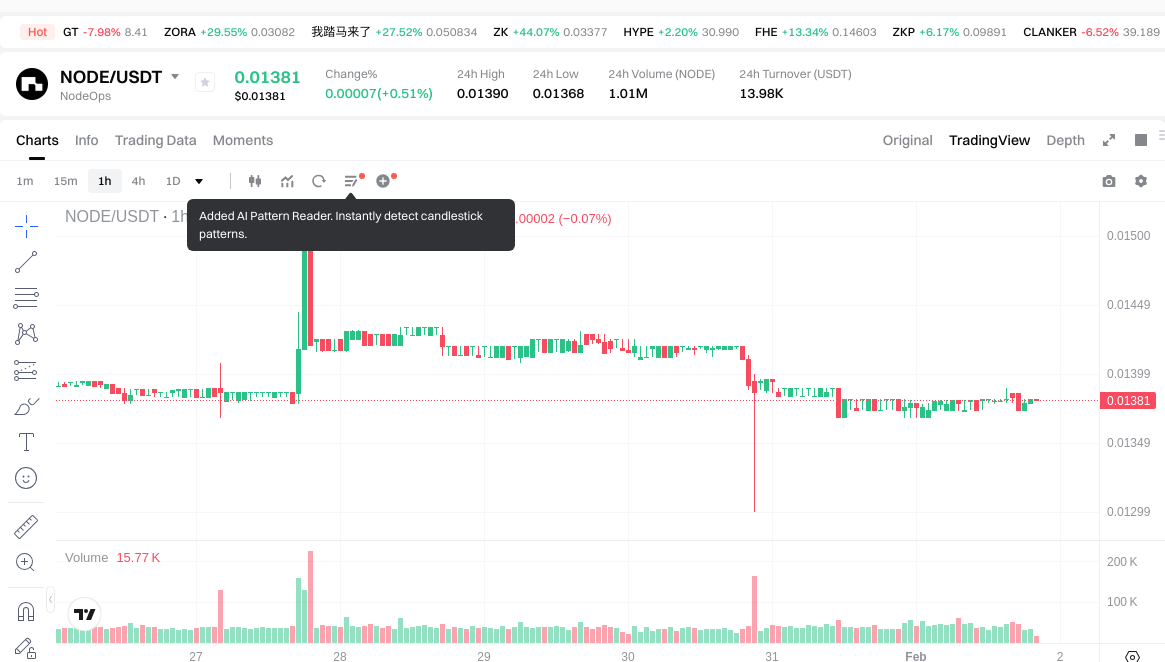
I. NodeOps (NODE) Price History and Current Investment Value
- 2025 October: According to reference data, NODE's market capitalization stood at $10.6 million with a price of $0.07964, reflecting the project's early-stage market positioning.
- 2025 October-December: The token experienced price fluctuations with a trading price around $0.0138 as of February 2026, showing volatility typical of emerging DePIN projects.
- Market Evolution: NODE demonstrated significant price movement from its historical high of $0.14897 in October 2025 to lower levels, indicating normal market adjustment patterns in the crypto sector.
Current NODE Investment Market Status (February 2026)
- NODE Current Price: $0.0138
- 24-hour Trading Volume: $13,944.42
- Market Capitalization: $1.84 million
- Circulating Supply: 133,390,828 NODE (13.34% of total supply)
- Total Supply: 1,000,000,000 NODE
- Price Change (24H): -0.14%
- Price Change (7D): -1.069%
- Price Change (30D): -24.44%
Click to view real-time NODE market price
II. Core Factors Influencing Whether NODE is a Good Investment (Is NodeOps(NODE) a Good Investment)
Supply Mechanism and Scarcity (NODE investment scarcity)
- Total supply cap of 1,000,000,000 NODE tokens with a maximum supply of 678,833,730 NODE → influences price dynamics and investment value assessment
- Current circulating supply represents 13.34% of total supply (133,390,828 NODE) → indicates controlled token distribution phase
- Investment significance: The controlled release mechanism and relatively low circulation ratio may contribute to supply-side considerations for long-term investment evaluation
Institutional Investment and Mainstream Adoption (Institutional investment in NODE)
- Institutional backing includes $5 million in funding from L1D, BFF, Finality Capital, and angel investors Sandeep Nailwal and Richard Ma → demonstrates institutional confidence in the project
- Platform has scaled to 700,000+ users and $150 million+ in assets under management (AUM) → indicates growing adoption trends
- The network connects 89,000+ machines and 24,000+ providers → reflects expanding infrastructure participation
Macroeconomic Environment Impact on NODE Investment
- As of February 1, 2026, NODE trades at $0.0138 with a market capitalization of $1,840,793.43 → represents a micro-cap asset sensitive to broader market conditions
- 30-day price change of -24.44% and 1-year decline of -85.16% → reflects exposure to market volatility and macroeconomic headwinds
- 24-hour trading volume of $13,944.42 → indicates liquidity considerations for investment positioning
Technology and Ecosystem Development (Technology & Ecosystem for NODE investment)
- Platform architecture: Enables verifiable compute at scale covering GPU/CPU orchestration and RPC-as-a-service → supports diverse use cases for infrastructure demand
- Deployment capabilities: Supports fast, transparent deployment across 60+ blockchains through a template marketplace → enhances developer accessibility and ecosystem expansion potential
- Revenue generation: The platform has generated $4.1 million+ in revenue and consistently ranks among the top 5 DePIN projects by revenue growth → demonstrates business model traction and ecosystem value creation
III. NODE Future Investment Forecast and Price Outlook (Is NodeOps(NODE) worth investing in 2026-2031)
Short-term Investment Forecast (2026, short-term NODE investment outlook)
- Conservative forecast: $0.0084 - $0.0138
- Neutral forecast: $0.0138 - $0.0145
- Optimistic forecast: $0.0145 - $0.0159
Mid-term Investment Outlook (2027-2028, mid-term NodeOps(NODE) investment forecast)
-
Market stage expectation: The platform may experience gradual growth as it continues to expand its DePIN infrastructure and provider network. With over 89,000 machines and 24,000+ providers already connected, the focus would likely shift toward increasing user adoption beyond the current 700,000+ users and enhancing revenue generation capabilities.
-
Investment return forecast:
- 2027: $0.0085 - $0.0174
- 2028: $0.0135 - $0.0198
-
Key catalysts: Expansion of RPC-as-a-service offerings across additional blockchain networks, growth in GPU/CPU orchestration demand, potential integration with emerging AI and machine learning applications, and continued revenue growth within the DePIN sector.
Long-term Investment Outlook (Is NODE a good long-term investment?)
- Base scenario: $0.014 - $0.024 (assuming steady platform development and moderate user growth)
- Optimistic scenario: $0.021 - $0.034 (assuming accelerated adoption of verifiable compute services and successful expansion across multiple blockchain ecosystems)
- Risk scenario: Below $0.010 (under conditions of intensified market competition, technical challenges, or broader cryptocurrency market downturns)
Click to view NODE long-term investment and price forecast: Price Prediction
2026-02-01 - 2031 Long-term Outlook
- Base scenario: $0.014 - $0.024 USD (corresponding to steady progress and gradual mainstream application improvement)
- Optimistic scenario: $0.021 - $0.034 USD (corresponding to large-scale adoption and favorable market conditions)
- Transformative scenario: Above $0.034 USD (if the ecosystem achieves breakthrough developments and mainstream adoption)
- 2031-12-31 forecasted high: $0.034 USD (based on optimistic development assumptions)
Disclaimer: Price forecasts are based on historical data and market analysis. Cryptocurrency investments carry substantial risks. These projections should not be considered as investment advice, and actual prices may vary significantly from forecasts due to market volatility and unforeseen developments.
| Year |
Predicted High Price |
Predicted Average Price |
Predicted Low Price |
Price Change |
| 2026 |
0.0158815 |
0.01381 |
0.0084241 |
0 |
| 2027 |
0.0173695275 |
0.01484575 |
0.0084620775 |
7 |
| 2028 |
0.0198123956625 |
0.01610763875 |
0.01353041655 |
16 |
| 2029 |
0.02083361995925 |
0.01796001720625 |
0.009518809119312 |
30 |
| 2030 |
0.027543482387505 |
0.01939681858275 |
0.014159677565407 |
40 |
| 2031 |
0.033562315193732 |
0.023470150485127 |
0.021592538446317 |
70 |
IV. NodeOps Investment Strategy and Risk Management (How to invest in DePIN)
Investment Methodology (NodeOps investment strategy)
-
Long-term Holding (HODL NODE): Suitable for conservative investors who believe in the long-term growth potential of decentralized physical infrastructure networks. Given NodeOps' position as a platform supporting verifiable compute at scale and its presence across 60+ blockchains, a buy-and-hold approach may appeal to those seeking exposure to the DePIN sector's development.
-
Active Trading: Relies on technical analysis and swing trading strategies. NODE has demonstrated notable price volatility, with a 1-year price change of -85.16% and a 30-day change of -24.44%. Traders may seek opportunities in short-term price movements, though this approach requires careful monitoring of market conditions and technical indicators.
Risk Management (Risk management for NODE investment)
-
Asset Allocation Ratio:
- Conservative investors: Consider allocating a smaller portion (1-3%) of their portfolio to NODE, balancing exposure with more established assets.
- Aggressive investors: May allocate a higher percentage (5-10%), accepting greater volatility for potential growth.
- Professional investors: Could consider strategic positions based on comprehensive research and risk tolerance, potentially incorporating NODE into a diversified DePIN portfolio.
-
Risk Hedging Solutions: Diversify across multiple asset classes and consider portfolio balancing with established cryptocurrencies. Given NODE's market cap of approximately $1.84 million and relatively small circulating supply (13.34% of total), diversification across other DePIN projects and blockchain infrastructure tokens may help mitigate concentration risk.
-
Secure Storage:
- Cold wallets: Recommended for long-term holdings to minimize exposure to online threats.
- Hot wallets: Suitable for active trading, though limited amounts should be kept.
- Hardware wallets: Consider reputable options for enhanced security of NODE tokens (ERC-20 standard on Ethereum).
V. NodeOps Investment Risks and Challenges (Risks of investing in DePIN)
-
Market Risks: NODE exhibits high volatility, with significant price fluctuations observed across different timeframes. The token experienced a decline from an all-time high of $0.14897 (October 14, 2025) to an all-time low of $0.013 (January 30, 2026). The 24-hour trading volume of approximately $13,944 suggests relatively limited liquidity, which may contribute to price volatility and potential challenges in executing large trades.
-
Regulatory Risks: As with most cryptocurrency projects, NodeOps faces uncertainty regarding regulatory frameworks across different jurisdictions. The evolving nature of DePIN regulation and policies concerning decentralized infrastructure services may impact the project's operations and token value. Investors should monitor regulatory developments in key markets.
-
Technical Risks: The platform's reliance on complex infrastructure involving GPU/CPU orchestration, RPC services, and deployment across 60+ blockchains introduces technical considerations. Network security, potential vulnerabilities in smart contracts, and the challenges of maintaining interoperability across multiple chains represent areas requiring ongoing attention. While NodeOps has connected 89,000+ machines and 24,000+ providers, the scalability and reliability of such distributed systems require continuous technical maintenance.
VI. Conclusion: Is DePIN a Good Investment?
-
Investment Value Summary: NodeOps represents a project within the emerging DePIN sector, offering exposure to decentralized infrastructure services. With backing from investors including L1D, BFF, Finality Capital, and notable angels, the project has demonstrated operational metrics including $4.1 million+ in revenue and 700,000+ users. However, the token has experienced considerable price volatility, particularly over the past year.
-
Investor Recommendations:
✅ Beginners: Consider a dollar-cost averaging approach with small, regular purchases, and prioritize secure wallet storage. Focus on understanding the DePIN sector and NodeOps' role within it before committing substantial capital.
✅ Experienced Investors: May explore swing trading opportunities while maintaining a diversified portfolio. Consider NODE as part of a broader DePIN sector allocation rather than a standalone position.
✅ Institutional Investors: Evaluate strategic long-term positioning based on comprehensive due diligence, including assessment of the project's competitive position, revenue sustainability, and growth trajectory within the decentralized infrastructure space.
⚠️ Disclaimer: Cryptocurrency investments carry high risk. This content is for informational purposes only and does not constitute investment advice. Conduct thorough research and consider your financial situation before making investment decisions.
VII. FAQ
Q1: Is NodeOps (NODE) a good investment for beginners in 2026?
NODE may be suitable for beginners seeking DePIN sector exposure, but only as a small allocation with careful risk management. As a micro-cap asset with a market capitalization of approximately $1.84 million and high volatility (85.16% decline over one year), NODE requires cautious approach. Beginners should consider dollar-cost averaging with amounts they can afford to lose, secure their tokens in cold wallets, and limit NODE to 1-3% of their overall portfolio. The project's backing from established investors like L1D and BFF, combined with operational metrics showing 700,000+ users and $4.1 million in revenue, demonstrates legitimacy, but the low trading volume ($13,944 daily) and limited circulating supply (13.34%) present liquidity challenges that beginners should understand before investing.
Q2: What is the realistic price forecast for NODE by 2030?
Based on current market analysis, NODE's 2030 price forecast ranges from $0.014 to $0.028 under base scenarios, with optimistic projections reaching $0.034. The base scenario assumes steady platform development and gradual user growth beyond the current 700,000+ users, with continued expansion of the provider network (currently 24,000+ providers and 89,000+ machines). The optimistic scenario factors in accelerated adoption of verifiable compute services, successful integration with AI/ML applications, and sustained revenue growth within the DePIN sector. However, these forecasts carry significant uncertainty given NODE's early-stage development, market volatility, and the competitive landscape of decentralized infrastructure projects.
Q3: How does NODE's supply mechanism affect its investment value?
NODE's supply structure creates potential scarcity dynamics that may influence long-term investment value. With a total supply cap of 1 billion tokens and current circulating supply of only 133.39 million (13.34%), the controlled token distribution suggests a gradual release mechanism. This relatively low circulation ratio means that future token unlocks could impact price dynamics, creating both opportunity and risk for investors. The maximum supply of 678.83 million NODE indicates that approximately 545 million tokens remain to enter circulation, which investors should consider when evaluating long-term price potential. The staged release approach may help prevent excessive supply shocks, but investors should monitor the token unlock schedule and distribution plans for potential dilution effects.
Q4: What are the main risks of investing in NodeOps?
NODE investment carries three primary risk categories. Market risks include extreme volatility, demonstrated by the 85.16% price decline from the October 2025 high of $0.14897 to the January 2026 low of $0.013, combined with limited liquidity evidenced by daily trading volume of only $13,944. Regulatory risks stem from uncertain frameworks governing DePIN projects and decentralized infrastructure services across different jurisdictions. Technical risks involve the complexity of maintaining infrastructure across 60+ blockchains, potential smart contract vulnerabilities, and the challenges of coordinating 89,000+ distributed machines. Additionally, the project's early-stage status (launched in 2025) means it lacks extensive track record, and competition within the DePIN sector from established projects poses market share challenges.
Q5: How does NodeOps compare to other DePIN investment opportunities?
NodeOps positions itself as a comprehensive infrastructure platform within the DePIN sector, differentiating through its verifiable compute services covering both GPU/CPU orchestration and RPC-as-a-service across 60+ blockchains. The platform ranks among the top 5 DePIN projects by revenue growth, having generated $4.1 million+ in revenue, which demonstrates stronger monetization than many emerging competitors. However, with a market cap of $1.84 million, NODE remains significantly smaller than established DePIN projects, presenting higher risk but potentially greater growth upside. The platform's 700,000+ user base and $150 million+ in assets under management show meaningful adoption, yet investors should compare these metrics against sector leaders and consider NODE's competitive advantages in template marketplace offerings and cross-chain deployment capabilities when evaluating its position within the broader DePIN investment landscape.
Q6: What investment strategy works best for NODE tokens?
The optimal NODE investment strategy depends on investor profile and risk tolerance. Conservative long-term holders (HODL approach) should limit NODE allocation to 1-3% of portfolio, focusing on the project's DePIN sector growth potential and gradual ecosystem expansion. This approach suits those believing in decentralized infrastructure's long-term trajectory despite near-term volatility. Active traders may exploit NODE's price swings (24.44% decline over 30 days) through technical analysis and swing trading, though the limited liquidity requires careful position sizing and stop-loss discipline. Dollar-cost averaging mitigates timing risk by spreading purchases across regular intervals, particularly valuable given NODE's volatility. Regardless of strategy, investors should prioritize secure storage through hardware or cold wallets, maintain diversification across DePIN and broader crypto assets, and regularly rebalance based on portfolio performance and risk tolerance changes.
Q7: When is the best time to invest in NodeOps?
Timing NODE investment requires balancing multiple factors rather than seeking a single "best" entry point. From a price perspective, the token trading near $0.0138 (as of February 2026) represents an 85.16% decline from its October 2025 high, potentially offering entry opportunities for risk-tolerant investors who believe in recovery potential. However, the 30-day decline of 24.44% suggests continued downward pressure, indicating that waiting for price stabilization might reduce short-term loss risk. From a fundamental perspective, investors should monitor key milestones including provider network expansion beyond 24,000 participants, user growth past 700,000, and revenue trajectory beyond $4.1 million. Market conditions also matter—broader cryptocurrency bull markets typically benefit micro-cap assets like NODE more than bear markets. Dollar-cost averaging eliminates timing concerns by spreading investments across market cycles, making it suitable for investors uncertain about optimal entry points but committed to long-term DePIN sector participation.
Q8: What could drive NODE price growth in the future?
Several catalysts could drive NODE price appreciation over the coming years. Expansion of the provider network beyond current 24,000 participants and 89,000 connected machines would demonstrate growing infrastructure adoption and network effect strengthening. User growth exceeding the current 700,000 base, particularly from enterprise clients or high-value compute customers, would validate the platform's value proposition. Revenue growth beyond $4.1 million through increased RPC service usage or GPU/CPU orchestration demand would improve fundamental metrics. Technical developments including integration with emerging AI/ML applications, expansion beyond 60+ supported blockchains, and enhanced verifiable compute capabilities could differentiate NODE from competitors. Strategic partnerships with major blockchain networks or enterprise infrastructure providers would increase visibility and adoption. Finally, broader DePIN sector growth driven by increasing demand for decentralized infrastructure alternatives to centralized cloud providers could lift all sector participants, including NODE, though investors should note these catalysts remain speculative and dependent on successful execution.
* The information is not intended to be and does not constitute financial advice or any other recommendation of any sort offered or endorsed by Gate.