Non-Playable Coin (NPC) is a hybrid memecoin-NFT token launched in August 2023, operating as an ERC-20 asset on Ethereum with a fixed supply of 8.05 billion tokens fully in circulation. As of January 2026, NPC maintains a market capitalization of $93.18 million at $0.011575 per token, representing an 84% decline from its September 2024 peak. This comprehensive analysis examines NPC's investment viability through four critical dimensions: supply mechanisms ensuring fixed tokenomics, institutional adoption metrics across 14 exchanges, technical infrastructure built on Ethereum's security model, and volatile price patterns ranging from $0.005666 to $0.07226 historically. The article provides differentiated investment strategies for conservative, aggressive, and professional investors, with allocation recommendations of 1-3%, 5-10%, and 3-7% respectively within cryptocurrency portfolios. Detailed risk management frameworks address market volatility, regulatory uncertainty, and technical vulnerabilities inherent t
Introduction: Non-Playable Coin (NPC) Investment Position and Market Outlook
Non-Playable Coin (NPC) is a distinctive asset in the cryptocurrency field. Launched in 2023, it has positioned itself as a hybrid memecoin-NFT token. As of January 17, 2026, NPC maintains a market capitalization of approximately $93.18 million, with a circulating supply of 8.05 billion tokens, and a current price around $0.011575. With its positioning as the first "meme-fungible token" (MFT), NPC has gradually become a focal point for investors discussing "Is Non-Playable Coin (NPC) a good investment?" This article will comprehensively analyze NPC's investment characteristics, historical trends, future price outlook, and investment risks to provide reference for investors.
I. Non-Playable Coin (NPC) Price History Review and Current Investment Value
- 2023: NPC launched in August, introducing the first meme-fungible token (MFT) concept → Early adopters gained exposure to an innovative hybrid asset model
- 2024: In September, NPC reached a significant price level of $0.07226 → The token demonstrated substantial upward momentum during favorable market conditions
- 2025: Market dynamics shifted, with NPC experiencing price movements from previous elevated levels to approximately $0.011575 → Reflecting broader cryptocurrency market adjustments and evolving investor sentiment
Current NPC Investment Market Status (January 2026)
- NPC current price: $0.011575
- Market sentiment (Fear & Greed Index): Data not available in provided materials
- 24-hour trading volume: $132,656.02
- Institutional investor holdings: Information not available in provided materials
- Circulating supply: 8,050,126,520 NPC
- Market capitalization: $93,180,214.47
- Fully diluted valuation: $93,180,214.47
- Market dominance: 0.0027%
Click to view real-time NPC market price
II. Core Factors Influencing Whether NPC is a Good Investment
Supply Mechanism and Scarcity (NPC Investment Scarcity)
- Fixed Supply Structure: Non-Playable Coin (NPC) has a maximum supply of 8,050,126,520 tokens, with 100% already in circulation as of January 17, 2026. This fixed supply cap eliminates future inflationary pressure from new token issuance.
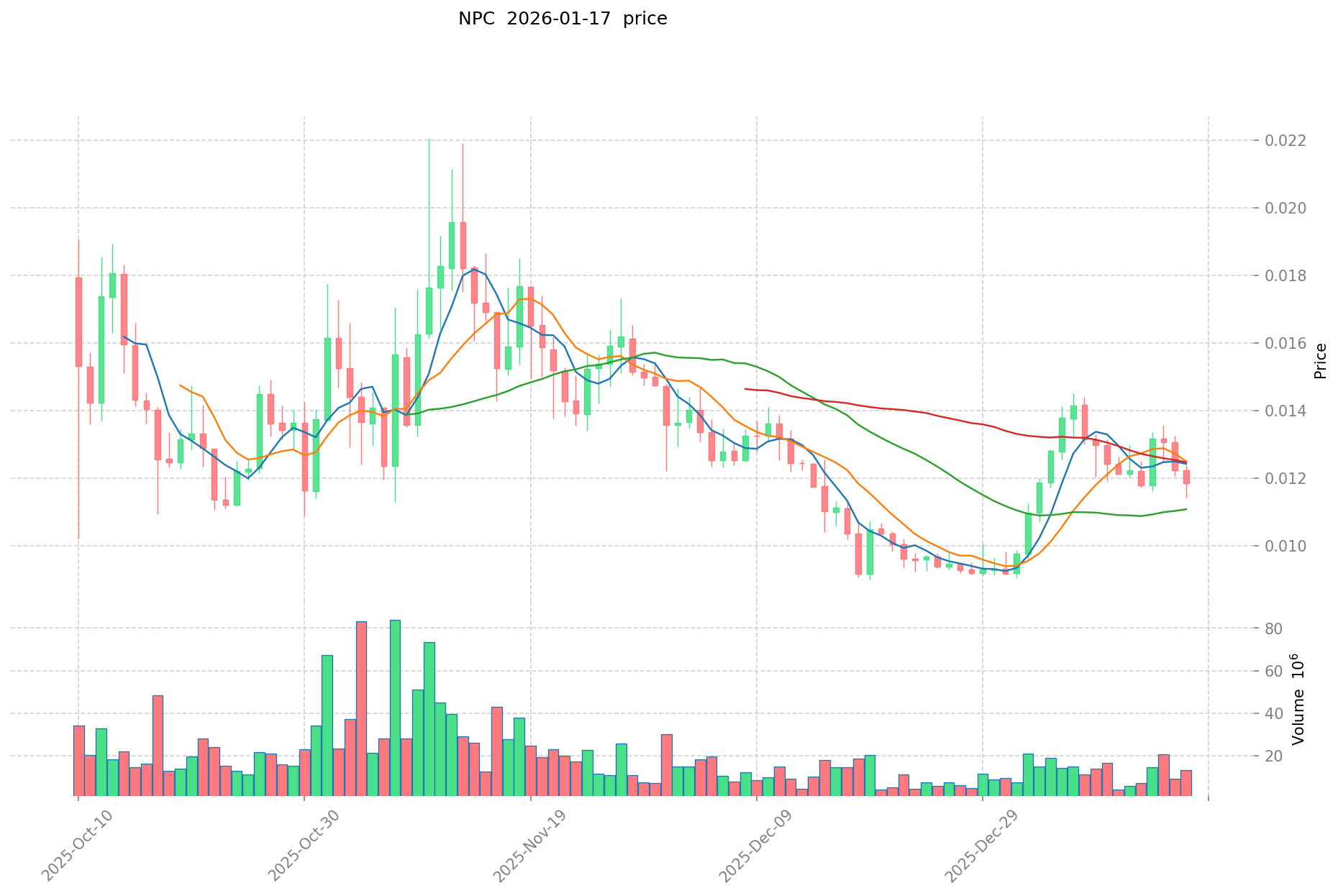
- Historical Price Context: NPC's price reached $0.07226 on September 4, 2024, and experienced a low of $0.005666 on March 11, 2025. The current price of $0.011575 (as of January 17, 2026) represents significant volatility within a relatively short timeframe.
- Investment Implication: The fully diluted market cap equals the current market cap ($93,180,214.47), indicating complete token circulation. This characteristic may influence investment considerations, as supply-side dynamics are fully transparent with no future unlocks anticipated.
Institutional Investment and Mainstream Adoption (Institutional Investment in NPC)
- Holder Distribution: As of the latest data, NPC has 18,927 token holders, suggesting a relatively modest holder base compared to major cryptocurrencies.
- Exchange Availability: NPC is listed on 14 exchanges, including Gate.com, providing multiple trading venues for potential investors.
- Adoption Status: Reference materials do not provide specific information regarding institutional investment positions or enterprise-level adoption of NPC. The token's classification as a memecoin-NFT hybrid ("meme-fungible token" or MFT) positions it within the speculative meme token category rather than institutional-grade assets.
Macroeconomic Environment's Impact on NPC Investment
- Market Performance Context: NPC demonstrated a 24-hour price decline of 2.89%, a 7-day decline of 7.66%, yet showed a 30-day gain of 13.79% as of January 17, 2026. This mixed short-term performance reflects sensitivity to broader market conditions.
- Market Capitalization Position: With a market cap of approximately $93.18 million and ranking #372, NPC represents a mid-to-small cap crypto asset, which may exhibit higher volatility during macroeconomic shifts.
- Trading Volume: The 24-hour trading volume of $132,656.02 indicates moderate liquidity levels, which may be influenced by broader market sentiment and macroeconomic factors.
Technology and Ecosystem Development (Technology & Ecosystem for NPC Investment)
- Token Standard: NPC operates as an ERC-20 token on the Ethereum blockchain (contract address: 0x8ed97a637a790be1feff5e888d43629dc05408f6), benefiting from Ethereum's established infrastructure and security model.
- Hybrid Innovation: NPC positions itself as the first memecoin-NFT hybrid, creating a unique value proposition within the meme token sector. However, reference materials do not detail specific technical upgrades or roadmap developments.
- Ecosystem Applications: Documentation is available at docs.nonplayablecoin.io, though specific details regarding DeFi integrations, NFT utilities, or payment applications are not provided in the reference materials.
- Community Presence: NPC maintains social media presence on Twitter/X (@NonPlayableCoin) and has an official website (nonplayablecoin.io), which serve as channels for community engagement and project updates.
III. NPC Future Investment Forecast and Price Outlook (Is Non-Playable Coin (NPC) worth investing in 2026-2030)
Short-term Investment Forecast (2026, short-term NPC investment outlook)
Based on available market data and technical analysis, Non-Playable Coin's short-term outlook for 2026 presents mixed signals:
- Conservative forecast: $0.0097 - $0.0106
- Neutral forecast: $0.0106 - $0.0116
- Optimistic forecast: $0.0116 - $0.0119
Technical indicators suggest moderate buying pressure, with EMA-3 at $0.012691 and EMA-5 at $0.012612 both indicating buy signals. However, the token currently trades significantly below its historical high of $0.07226 (recorded in September 2024), representing a decline of over 84% from peak levels.
Mid-term Investment Outlook (2027-2028, mid-term Non-Playable Coin (NPC) investment forecast)
- Market phase expectation: Potential recovery phase with moderate volatility, influenced by broader memecoin sector sentiment and meme-fungible token (MFT) adoption trends
- Investment return forecast:
- 2027: $0.0082 - $0.0168, representing potential annual growth rates varying between negative and positive territory
- 2028: $0.0089 - $0.0151, showing potential consolidation patterns
- Key catalysts: Community engagement strength, broader memecoin market sentiment, NFT-memecoin hybrid concept adoption, and general cryptocurrency market conditions
Long-term Investment Outlook (Is Non-Playable Coin a good long-term investment?)
- Baseline scenario: $0.0076 - $0.0194 (assuming steady memecoin sector performance and maintained community interest)
- Optimistic scenario: $0.0163 - $0.0200 (assuming increased adoption of the MFT concept and favorable market conditions)
- Risk scenario: Below $0.0076 (under conditions of declining memecoin sector interest or broader market downturns)
Click to view NPC long-term investment and price prediction: Price Prediction
2026-2030 Long-term Outlook
- Base scenario: $0.0097 - $0.0163 USD (corresponding to steady progress and gradual mainstream application improvement)
- Optimistic scenario: $0.0163 - $0.0200 USD (corresponding to large-scale adoption and favorable market environment)
- Transformative scenario: Above $0.0200 USD (in case of breakthrough progress in ecosystem and mainstream popularization)
- 2030-12-31 predicted high: $0.0194 USD (based on optimistic development assumptions)
Disclaimer
The price predictions presented above are based on historical data analysis, technical indicators, and market modeling assumptions. Cryptocurrency markets are highly volatile and influenced by numerous unpredictable factors including regulatory changes, macroeconomic trends, technological developments, and market sentiment shifts. These forecasts should not be considered as investment advice or guarantees of future performance. The memecoin sector, including meme-fungible tokens like NPC, carries substantial risks due to speculative nature and community-driven dynamics. Investors should conduct independent research, assess their risk tolerance, and consider consulting financial professionals before making investment decisions. Past performance does not indicate future results.
| Year |
Predicted High Price |
Predicted Average Price |
Predicted Low Price |
Price Change |
| 2026 |
0.0119274 |
0.01158 |
0.0097272 |
0 |
| 2027 |
0.016807791 |
0.0117537 |
0.00822759 |
1 |
| 2028 |
0.01513759023 |
0.0142807455 |
0.00885406221 |
23 |
| 2029 |
0.01926900990315 |
0.014709167865 |
0.0076487672898 |
27 |
| 2030 |
0.019367561327845 |
0.016989088884075 |
0.016309525328712 |
46 |
| 2031 |
0.019996157616556 |
0.01817832510596 |
0.011815911318874 |
57 |
IV. Non-Playable Coin Investment Strategy and Risk Management (How to invest in Meme Coins)
Investment Methodology (Non-Playable Coin investment strategy)
Long-term Holding (HODL Non-Playable Coin)
For conservative investors seeking exposure to the memecoin sector, a long-term holding strategy may be considered. Non-Playable Coin (NPC), as a meme-fungible token (MFT) hybrid combining characteristics of both memecoins and NFTs, presents a unique positioning within the digital asset landscape. The token has demonstrated significant price volatility since its launch in August 2023, with historical price movements ranging from a low of $0.005666 to a high of $0.07226.
Investors adopting a HODL strategy should recognize that memecoin valuations are primarily driven by community sentiment, cultural relevance, and social media trends rather than fundamental utility metrics. With a fully circulating supply of 8.05 billion tokens and a market capitalization of approximately $93.18 million as of January 17, 2026, NPC maintains a relatively modest position within the broader cryptocurrency market.
Active Trading
Active trading strategies for NPC rely heavily on technical analysis and identifying momentum patterns. The token has experienced notable price fluctuations, including a 52.58% decline over the one-year period, alongside a 13.79% gain over the 30-day period. Such volatility characteristics may present opportunities for traders skilled in short-term price movement analysis.
Traders should monitor 24-hour trading volumes (currently around $132,656) and price ranges to identify potential entry and exit points. The token's presence on 14 exchanges provides multiple trading venues, though liquidity considerations remain important for position sizing.
Risk Management (Risk management for Non-Playable Coin investment)
Asset Allocation Ratios
Conservative Investors: Should limit memecoin exposure to 1-3% of total crypto portfolio allocation, prioritizing established digital assets with longer track records and clearer use cases.
Aggressive Investors: May allocate 5-10% of crypto portfolio to memecoin positions, while maintaining diversification across multiple asset categories to mitigate concentration risk.
Professional Investors: Could consider 3-7% allocation to memecoins as part of a diversified alternative assets strategy, with appropriate risk monitoring frameworks in place.
Risk Hedging Solutions
A multi-asset portfolio approach helps mitigate single-token concentration risk. Investors might consider:
- Diversification across different cryptocurrency categories (large-cap, DeFi, infrastructure tokens)
- Maintaining stablecoin positions for opportunistic rebalancing
- Setting predetermined stop-loss levels to limit downside exposure
- Regular portfolio rebalancing to maintain target allocation percentages
Secure Storage
Non-Playable Coin, deployed on the Ethereum blockchain as an ERC-20 token (contract address: 0x8ed97a637a790be1feff5e888d43629dc05408f6), can be stored using various wallet solutions:
Hot Wallets: Software wallets such as MetaMask or Trust Wallet provide convenient access for active trading but carry higher security risks due to internet connectivity.
Cold Wallets: Hardware wallets including Ledger Nano X, Ledger Nano S Plus, or Trezor Model T offer enhanced security through offline private key storage, recommended for long-term holdings.
Best Practices: Investors should maintain multiple backup copies of recovery phrases, use strong authentication methods, and avoid storing large amounts on exchange platforms.
V. Non-Playable Coin Investment Risks and Challenges (Risks of investing in Meme Coins)
Market Risks
High Volatility: NPC has demonstrated substantial price fluctuations, with a historical price range from $0.005666 to $0.07226. The current price of $0.011575 represents an 83.98% decline from its historical peak recorded on September 4, 2024. Such volatility patterns are characteristic of memecoin assets and can result in rapid capital depreciation.
Price Manipulation Concerns: With a relatively modest 24-hour trading volume of approximately $132,656 and a market capitalization of $93.18 million, the token may be susceptible to coordinated trading activities that can influence price movements. Lower liquidity environments can amplify the impact of large buy or sell orders.
Regulatory Risks
Cryptocurrency regulatory frameworks vary significantly across jurisdictions and continue to evolve:
Policy Uncertainty: Different national authorities maintain divergent approaches to digital asset classification and oversight. Some jurisdictions have implemented comprehensive regulatory frameworks, while others maintain ambiguous or developing policies.
Potential Classification Changes: Regulatory authorities may reassess how memecoin projects are classified, potentially subjecting them to additional compliance requirements or trading restrictions.
Tax Treatment Variations: Capital gains taxation, reporting requirements, and other fiscal considerations differ substantially across countries, creating complexity for international investors.
Technical Risks
Network Security Vulnerabilities: As an ERC-20 token operating on the Ethereum blockchain, NPC's security depends partially on the underlying network infrastructure. Smart contract vulnerabilities or exploitation could impact token functionality.
Upgrade Implementation: Changes to the Ethereum network or updates to the token's smart contract code carry execution risks that could temporarily affect trading activity or token accessibility.
Third-Party Dependencies: Reliance on exchange platforms, wallet providers, and blockchain infrastructure creates potential points of failure outside investors' direct control.
VI. Conclusion: Is Meme Coins a Good Investment?
Investment Value Summary
Non-Playable Coin represents a distinctive approach within the memecoin category, positioning itself as the first meme-fungible token (MFT) combining NFT and memecoin characteristics. The project's foundation on recognizable internet meme culture provides cultural relevance, though this does not guarantee sustained market demand or price appreciation.
The token has experienced significant price volatility throughout its operational history, with current valuations substantially below historical peaks. Market data indicates a 100% circulation rate with a fixed maximum supply of 8.05 billion tokens, eliminating future dilution concerns but also limiting scarcity-driven price dynamics.
Investor Recommendations
✅ Beginners: Consider implementing a dollar-cost averaging approach to build positions gradually while minimizing timing risk. Priority should be placed on understanding wallet security fundamentals and utilizing hardware wallet solutions for asset protection. Educational focus on memecoin market dynamics is essential before committing capital.
✅ Experienced Investors: May explore tactical trading opportunities based on technical analysis and momentum indicators. Portfolio construction should include memecoin exposure as a minor allocation within a diversified cryptocurrency strategy. Risk management protocols including position sizing limits and stop-loss mechanisms are important.
✅ Institutional Investors: Could evaluate strategic allocation to memecoin categories as alternative assets within broader digital asset portfolios. Comprehensive due diligence, liquidity assessment, and risk monitoring frameworks should guide allocation decisions. Consideration of counterparty risks associated with custody solutions remains important.
⚠️ Disclaimer: Cryptocurrency investments carry substantial risk including potential loss of principal. Market volatility, regulatory uncertainty, and technical vulnerabilities affect all digital assets. This content provides informational analysis and does not constitute investment advice, financial guidance, or recommendations to buy or sell any cryptocurrency. Investors should conduct independent research and consult qualified financial professionals before making investment decisions.
VII. FAQ
Q1: What is Non-Playable Coin (NPC) and what makes it unique in the cryptocurrency market?
Non-Playable Coin is a hybrid memecoin-NFT token launched in August 2023, positioning itself as the first "meme-fungible token" (MFT). It operates as an ERC-20 token on the Ethereum blockchain (contract address: 0x8ed97a637a790be1feff5e888d43629dc05408f6) and combines characteristics of both memecoins and NFTs. With a fixed maximum supply of 8,050,126,520 tokens that are 100% already in circulation, NPC differentiates itself through its innovative hybrid structure that merges internet meme culture with token functionality. As of January 17, 2026, the token maintains a market capitalization of approximately $93.18 million and is listed on 14 exchanges, supported by a community of 18,927 token holders.
Q2: What is the current investment outlook for NPC in 2026?
Based on technical analysis and market data as of January 17, 2026, NPC presents mixed short-term signals with a current price of $0.011575. Conservative forecasts suggest a price range of $0.0097 - $0.0106, while neutral forecasts indicate $0.0106 - $0.0116, and optimistic scenarios project $0.0116 - $0.0119 for 2026. Technical indicators show moderate buying pressure with EMA-3 at $0.012691 and EMA-5 at $0.012612 both indicating buy signals. However, the token currently trades approximately 84% below its historical high of $0.07226 recorded in September 2024. Recent performance shows a 13.79% gain over 30 days but a 2.89% decline in the 24-hour period, reflecting the token's characteristic volatility and sensitivity to broader memecoin sector sentiment.
Q3: What are the primary risks associated with investing in Non-Playable Coin?
NPC carries several substantial risks characteristic of memecoin investments. Market volatility remains a primary concern, with the token experiencing an 83.98% decline from its September 2024 peak of $0.07226 to the current price of $0.011575. The relatively modest 24-hour trading volume of approximately $132,656 creates potential for price manipulation and lower liquidity conditions that can amplify large order impacts. Regulatory uncertainty across different jurisdictions poses policy risks, as cryptocurrency frameworks continue to evolve globally. Technical risks include potential smart contract vulnerabilities, Ethereum network dependencies, and third-party infrastructure reliance. Additionally, as a memecoin, NPC's valuation primarily depends on community sentiment and social media trends rather than fundamental utility metrics, making it susceptible to rapid sentiment shifts.
Q4: How should different investor types approach NPC investment allocation?
Investment allocation strategies vary significantly based on investor experience and risk tolerance. Conservative investors should limit memecoin exposure to 1-3% of their total cryptocurrency portfolio, prioritizing established digital assets with longer track records. Aggressive investors may allocate 5-10% of their crypto portfolio to memecoin positions while maintaining diversification across multiple asset categories. Professional investors could consider 3-7% allocation to memecoins as part of a diversified alternative assets strategy with appropriate risk monitoring frameworks. Regardless of investor type, implementing position sizing limits, stop-loss mechanisms, and regular portfolio rebalancing helps maintain target allocation percentages and mitigate concentration risk. For beginners, dollar-cost averaging provides a methodical approach to gradually building positions while minimizing timing risk.
Q5: What storage solutions are recommended for securing NPC tokens?
As an ERC-20 token on the Ethereum blockchain, NPC can be stored using various wallet solutions with different security trade-offs. Hot wallets such as MetaMask or Trust Wallet provide convenient access for active trading but carry higher security risks due to constant internet connectivity. Cold wallets including Ledger Nano X, Ledger Nano S Plus, or Trezor Model T offer enhanced security through offline private key storage and are recommended for long-term holdings. Best security practices include maintaining multiple backup copies of recovery phrases in secure physical locations, implementing strong authentication methods such as two-factor authentication, avoiding storage of large amounts on exchange platforms, and regularly updating wallet software. Investors should never share recovery phrases or private keys and should verify wallet addresses carefully before executing transactions to prevent irreversible losses.
Q6: What factors influence NPC's price movements and investment value?
NPC's price is influenced by multiple interconnected factors. The fixed supply structure of 8.05 billion fully circulated tokens eliminates future inflationary pressure from new issuance, providing transparent supply-side dynamics. Community engagement strength and social media sentiment significantly impact memecoin valuations, as these tokens derive value primarily from cultural relevance rather than fundamental utility. Broader cryptocurrency market conditions and macroeconomic trends affect NPC's performance, as evidenced by mixed recent results showing a 13.79% gain over 30 days but a 52.58% decline over one year. The token's hybrid positioning as a meme-fungible token (MFT) creates a unique value proposition that may attract investors interested in innovative tokenomics. Exchange availability across 14 platforms provides multiple trading venues, while the holder base of 18,927 participants indicates the current community scale. Technical developments within the Ethereum ecosystem and potential updates to the project roadmap also serve as potential catalysts for price movements.
Q7: What is the long-term price outlook for NPC through 2030?
Long-term price projections for NPC through 2030 present a wide range of potential outcomes based on various development scenarios. The base scenario forecasts prices ranging from $0.0097 to $0.0163, assuming steady progress and gradual mainstream application improvement. An optimistic scenario projects $0.0163 to $0.0200, contingent upon large-scale adoption of the MFT concept and favorable market conditions. The transformative scenario envisions prices above $0.0200 in case of breakthrough ecosystem progress and mainstream popularization. Specific year-end predictions include $0.0119 for 2026, $0.0168 for 2027, $0.0151 for 2028, $0.0193 for 2029, and $0.0194 for 2030 under optimistic assumptions. However, these forecasts carry substantial uncertainty due to the unpredictable nature of memecoin markets, regulatory developments, technological changes, and evolving investor sentiment. Investors should recognize that past performance does not indicate future results and that memecoin investments carry inherent speculation risks driven primarily by community dynamics rather than fundamental valuation metrics.
Q8: How can investors manage risk when trading or holding NPC?
Effective risk management for NPC investments requires implementing multiple protective strategies. Portfolio diversification across different cryptocurrency categories (large-cap, DeFi, infrastructure tokens) helps mitigate single-token concentration risk. Maintaining stablecoin positions enables opportunistic rebalancing during market volatility. Setting predetermined stop-loss levels limits downside exposure and prevents emotional decision-making during sharp price declines. Regular portfolio rebalancing maintains target allocation percentages and systematically captures gains from outperforming positions. For active traders, monitoring 24-hour trading volumes and price ranges helps identify appropriate entry and exit points. Position sizing should account for NPC's volatility characteristics, with smaller allocations appropriate for higher-risk tolerance strategies. Investors should avoid investing capital they cannot afford to lose entirely, as memecoin markets can experience rapid and substantial value declines. Maintaining detailed records of transactions supports accurate tax reporting across different jurisdictions with varying cryptocurrency taxation frameworks.
* The information is not intended to be and does not constitute financial advice or any other recommendation of any sort offered or endorsed by Gate.