This comprehensive guide evaluates Nosana (NOS), a decentralized CPU-based DevOps solution provider operating on Solana, as an investment opportunity. The article analyzes NOS's current market position with a valuation of $22.67 million and price of $0.2718 (as of January 2026), examining historical performance, supply mechanics, and ecosystem development. It outlines investment strategies for different investor profiles—from conservative dollar-cost averaging to active trading—while addressing key risks including high volatility, market manipulation susceptibility, and regulatory uncertainties. The guide provides price range projections through 2031 and details secure storage practices on Gate and other major exchanges. Essential for investors seeking balanced analysis of this infrastructure-focused token's long-term potential within the decentralized computing sector.
Introduction: Nosana (NOS) Investment Position and Market Outlook
NOS is a notable asset in the cryptocurrency space. Launched in January 2022, it has developed within the decentralized computing infrastructure sector. As of January 22, 2026, Nosana holds a market capitalization of approximately 22.67 million USD, with a circulating supply of around 83.4 million tokens, and the current price stands at approximately 0.2718 USD. Positioned as a decentralized CPU-based Dev(Ops) solution provider, Nosana aims to democratize CPU cloud computing by connecting blockchain developers and services to a global computing power pool. With approximately 47,419 holders and trading availability on 8 exchanges, NOS has attracted attention from investors exploring questions like "Is Nosana (NOS) a good investment?" This article provides a comprehensive analysis of NOS's investment value, historical trends, future price projections, and associated investment risks to serve as a reference for potential investors.
I. Historical Price Review and Current Investment Value of NOS Token
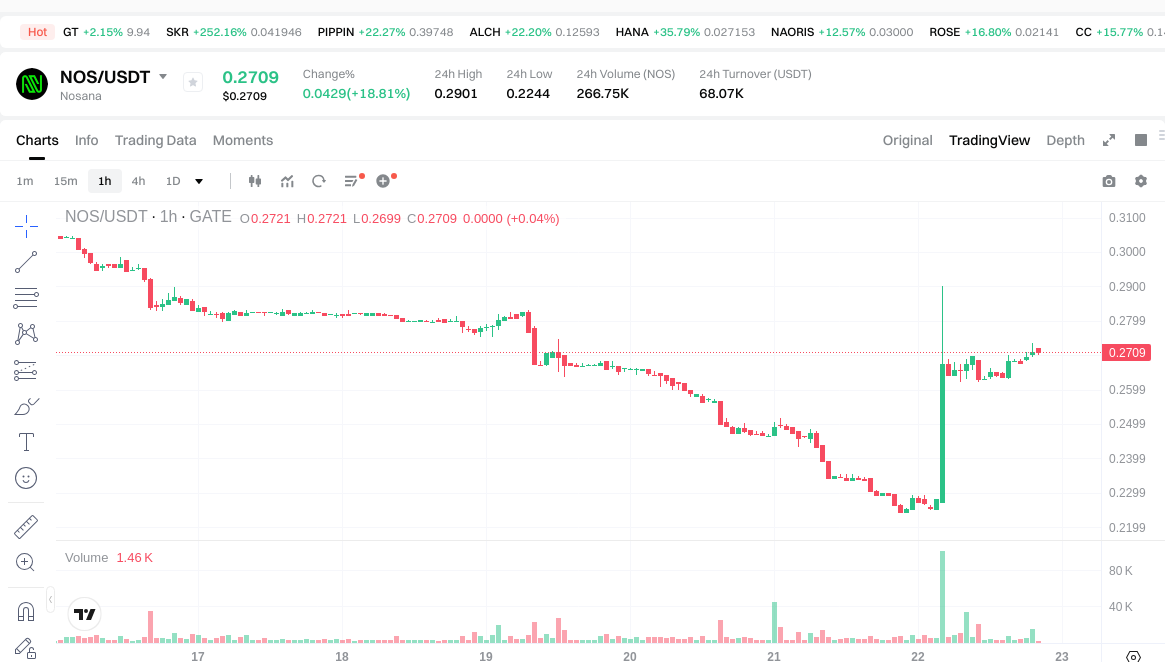
As of January 22, 2026, NOS has experienced notable price movements since its launch. The token was initially published on January 17, 2022, with a launch price of $0.03. Historical data shows the token reached a notable price level of $7.83 on March 7, 2024, while its lower price point of $0.01046656 was recorded on October 24, 2023.
Recent performance metrics indicate varied returns across different timeframes. Over the past year, the token has shown a decline of 89.91% from previous levels. However, shorter-term dynamics present a different picture, with a 28.33% increase observed over the 30-day period and an 18.53% gain within the past 24 hours.
Current NOS Investment Market Status (January 2026)
- NOS Current Price: $0.2718
- Market Sentiment (Fear & Greed Index): Data not available in provided materials
- 24-Hour Trading Volume: $68,311.72
- Token Holders: 47,419 addresses
- Circulating Supply: 83,400,000 NOS (83.4% of total supply)
- Market Capitalization: $22,668,120
- Fully Diluted Market Cap: $27,180,000
- Market Share: 0.00085%
The token is currently listed on 8 exchanges and maintains trading activity with a 24-hour price range between $0.2244 and $0.2901. Recent hourly performance shows a 0.59% change, while the 7-day trend indicates an 11.15% decrease.
Click to view real-time NOS market price
II. Core Factors Affecting Whether NOS is a Good Investment (Is Nosana(NOS) a Good Investment)
Supply Mechanism and Scarcity (NOS investment scarcity)
-
Supply Mechanism → Impacts Price and Investment Value
- Nosana (NOS) has a total supply of 100,000,000 tokens, with a circulating supply of 83,400,000 tokens, representing approximately 83.4% of the total supply in circulation.
- The token distribution indicates a relatively high circulation ratio, which may influence supply-side dynamics and liquidity in the market.
- The maximum supply is listed as infinite (∞), suggesting potential for future token emissions or minting mechanisms, which could affect long-term scarcity considerations.
-
Historical Patterns → Price Movements Related to Supply Dynamics
- Historical data shows NOS reached a price level of $7.83 on March 7, 2024, while experiencing a lower price point of $0.01046656 on October 24, 2023.
- The current price of $0.2718 (as of January 22, 2026) reflects fluctuations that may be associated with changes in market sentiment, adoption rates, and overall supply-demand dynamics.
- The token has demonstrated significant volatility, with a 1-year price change of -89.91%, indicating substantial market movement that investors should consider.
-
Investment Significance → Scarcity as a Long-term Investment Factor
- The circulating supply represents a substantial portion of the total supply, potentially limiting immediate scarcity effects compared to assets with more restrictive emission schedules.
- The infinite maximum supply designation suggests ongoing consideration of tokenomics and potential inflationary pressures that may influence long-term value retention.
- Investors evaluating scarcity should assess the project's emission schedule, burn mechanisms (if any), and utility-driven demand factors within the Nosana ecosystem.
Institutional Investment and Mainstream Adoption (Institutional investment in NOS)
Macroeconomic Environment's Impact on NOS Investment
-
Monetary Policy and Interest Rate Changes → Altering Investment Attractiveness
- Broader cryptocurrency market dynamics are often influenced by global monetary policy shifts, interest rate adjustments, and liquidity conditions in traditional financial markets.
- Changes in risk appetite among investors during periods of monetary tightening or easing may affect capital flows into digital assets, including specialized infrastructure tokens like NOS.
-
Inflation Environment and Hedging Characteristics
- While some digital assets are positioned as potential inflation hedges, infrastructure-focused tokens like NOS derive their investment value primarily from utility and adoption within their specific use cases rather than serving as "digital gold" alternatives.
- The token's value proposition centers on providing decentralized computing resources, making its performance more closely tied to ecosystem development and technological adoption trends.
-
Geopolitical Uncertainty → Influence on Investment Demand
- Periods of geopolitical instability may drive interest in decentralized infrastructure solutions as alternatives to centralized technology providers.
- Concerns about data sovereignty, censorship resistance, and infrastructure resilience could potentially enhance demand for decentralized computing platforms.
Technology and Ecosystem Development (Technology & Ecosystem for NOS investment)
-
Decentralized Computing Infrastructure → Network Performance and Investment Appeal
- Nosana's core offering involves creating a decentralized network where users can rent spare CPU capacity, addressing computing needs for blockchain developers and CI/CD pipeline operations.
- The platform's ability to provide reliable, cost-effective alternatives to centralized cloud providers represents a key value proposition that could influence adoption rates and token utility.
-
Ecosystem Applications and Long-term Value Support
- The Galactica project serves as an initial use case, focusing on providing computational power for project CI/CD infrastructure, allowing developers to reduce dependency on major technology companies.
- Community participation mechanisms enable members to earn NOS tokens by contributing computing resources or supporting projects through node verification and container image building.
- The platform's compatibility with consumer-grade hardware lowers barriers to participation, potentially expanding the network effect.
-
Integration with Broader Crypto Ecosystems
- As a Solana-based token (contract address: nosXBVoaCTtYdLvKY6Csb4AC8JCdQKKAaWYtx2ZMoo7), NOS benefits from Solana's high-throughput blockchain infrastructure and existing developer ecosystem.
- Potential synergies with DeFi protocols, NFT projects, and Web3 applications requiring decentralized computing resources could expand use cases and drive token demand.
- The open-source orientation and focus on supporting encryption projects align with broader decentralization trends in the blockchain industry.
III. NOS Future Investment Forecast and Price Outlook (Is Nosana(NOS) worth investing in 2026-2031)
Short-term NOS Investment Outlook (2026)
- Conservative forecast: $0.248584 - $0.2702
- Neutral forecast: $0.2702
- Optimistic forecast: $0.2702 - $0.281008
Mid-term Nosana(NOS) Investment Forecast (2027-2029)
- Market stage expectation: The mid-term outlook suggests a phase of potential growth accompanied by increased volatility, as the platform continues to develop its decentralized computing infrastructure and expand its user base.
- Investment return forecast:
- 2027: $0.20119092 - $0.3169446
- 2028: $0.157025379 - $0.364417389
- 2029: $0.28409742627 - $0.346863136725
- Key catalysts: Expansion of CI/CD infrastructure adoption, growth in decentralized computing demand, partnerships with metaverse and blockchain development projects, and increased utilization of the Nosana Network for computing power rental.
Long-term Investment Outlook (Is Nosana a good long-term investment?)
- Base scenario: $0.216706873992 - $0.39955329892275 (assuming steady platform development and moderate adoption of decentralized computing services)
- Optimistic scenario: $0.358006527924596 - $0.405986784244387 (assuming accelerated adoption of decentralized CPU solutions, expanded partnerships, and favorable market conditions for blockchain infrastructure)
- Risk scenario: Below $0.157025379 (under conditions of limited platform adoption, intensified competition in decentralized computing, or adverse regulatory developments)
For detailed NOS long-term investment and price prediction: Price Prediction
2026-01-22 - 2031 Long-term Outlook
- Base scenario: $0.216706873992 - $0.39955329892275 (corresponding to steady progress and gradual mainstream application adoption)
- Optimistic scenario: $0.358006527924596 - $0.405986784244387 (corresponding to large-scale adoption and favorable market environment)
- Transformative scenario: Above $0.405986784244387 (if the ecosystem achieves breakthrough progress and mainstream adoption)
- 2031-12-31 predicted high: $0.405986784244387 (based on optimistic development assumptions)
Disclaimer: This forecast is based on historical data and market analysis. Cryptocurrency investments carry significant risks, and past performance does not guarantee future results. Investors should conduct their own research and consider their risk tolerance before making investment decisions.
| Year |
Predicted High Price |
Predicted Average Price |
Predicted Low Price |
Price Change |
| 2026 |
0.281008 |
0.2702 |
0.248584 |
0 |
| 2027 |
0.3169446 |
0.275604 |
0.20119092 |
1 |
| 2028 |
0.364417389 |
0.2962743 |
0.157025379 |
9 |
| 2029 |
0.346863136725 |
0.3303458445 |
0.28409742627 |
21 |
| 2030 |
0.39955329892275 |
0.3386044906125 |
0.216706873992 |
24 |
| 2031 |
0.405986784244387 |
0.369078894767625 |
0.358006527924596 |
35 |
IV. Nosana Investment Strategy and Risk Management (How to invest in Nosana)
Investment Methodology (Nosana investment strategy)
Long-term Holding (HODL Nosana)
Long-term holding may be suitable for investors who believe in the fundamental value proposition of decentralized computing infrastructure. This approach involves acquiring NOS tokens and maintaining positions through market fluctuations, focusing on the project's long-term development trajectory rather than short-term price movements. Investors adopting this strategy typically monitor project milestones, network adoption metrics, and ecosystem growth indicators.
Active Trading
Active trading strategies for NOS tokens rely on technical analysis and market timing. Traders may utilize various technical indicators, chart patterns, and volume analysis to identify potential entry and exit points. Given the token's historical price range between $0.01046656 and $7.83, swing trading opportunities may emerge during periods of heightened volatility. However, this approach requires continuous market monitoring and risk assessment.
Risk Management (Risk management for Nosana investment)
Asset Allocation Ratios
- Conservative investors: May consider limiting exposure to NOS tokens to a small percentage (typically 1-3%) of their overall digital asset portfolio, prioritizing capital preservation
- Aggressive investors: Might allocate a moderate portion (5-10%) to capitalize on potential growth opportunities while maintaining diversification
- Professional investors: Could implement dynamic allocation strategies based on market conditions, technical indicators, and fundamental analysis
Risk Hedging Solutions
Implementing a multi-asset portfolio approach can help mitigate concentration risk. This may include diversifying across different blockchain ecosystems, combining various digital asset categories, and maintaining exposure to both established and emerging projects. Some investors may also utilize options or futures instruments where available to hedge against downside risk.
Secure Storage
Cold Wallet Solutions: For long-term holdings, cold storage solutions provide enhanced security by keeping private keys offline. Hardware wallets from reputable manufacturers offer robust protection against online threats.
Hot Wallet Considerations: For active traders requiring frequent access, hot wallets connected to exchanges or DeFi platforms may be necessary, though these carry increased security risks. Users should implement strong authentication measures and maintain only necessary trading amounts in hot wallets.
Hardware Wallet Recommendations: Industry-standard hardware wallets with multi-signature support and regular firmware updates can provide an additional layer of security for NOS token storage.
V. Nosana Investment Risks and Challenges (Risks of investing in Nosana)
Market Risks
High Volatility: NOS has demonstrated considerable price fluctuations, with 24-hour changes of 18.53% and 7-day movements of -11.15%. The token's historical performance shows a 1-year change of -89.91%, illustrating the potential for substantial downside movements. Such volatility can result in rapid portfolio value changes and may challenge investor risk tolerance.
Price Manipulation Concerns: With a market capitalization of approximately $22.67 million and a relatively modest 24-hour trading volume of $68,311.72, the token may be susceptible to price manipulation by entities with significant capital. Lower liquidity can amplify price swings and potentially create unfavorable trading conditions.
Regulatory Risks
The regulatory landscape for digital assets continues to evolve across different jurisdictions. Changes in government policies, classification of tokens, taxation frameworks, or compliance requirements could impact the accessibility, trading, and overall value proposition of NOS tokens. Investors should monitor regulatory developments in their respective jurisdictions and assess potential implications for their holdings.
Technical Risks
Network Security Vulnerabilities: As a decentralized computing platform, Nosana's infrastructure may face potential security challenges. Smart contract vulnerabilities, network attacks, or exploitation of system weaknesses could compromise user assets or platform functionality.
Upgrade Implementation: Protocol upgrades, feature implementations, or technical modifications carry inherent risks. Failed deployments, compatibility issues, or unforeseen technical complications could temporarily or permanently affect network operations and token utility.
VI. Conclusion: Is Nosana a Good Investment?
Investment Value Summary
Nosana represents a project within the decentralized computing infrastructure sector, offering exposure to the growing demand for distributed computational resources. The token's long-term potential may be influenced by the adoption of decentralized DevOps solutions and the expansion of the Nosana network. However, the token has experienced considerable price volatility, with notable short-term fluctuations and a substantial decline over the past year.
Investor Recommendations
✅ Beginners: Consider implementing a dollar-cost averaging strategy to mitigate timing risk, combined with secure wallet storage practices. Focus on understanding the project fundamentals before committing significant capital.
✅ Experienced Investors: May explore swing trading opportunities while maintaining proper position sizing and stop-loss disciplines. Diversification across multiple assets within a structured portfolio framework can help manage exposure.
✅ Institutional Investors: Could evaluate strategic long-term allocation as part of a broader digital asset investment thesis, incorporating comprehensive due diligence and risk assessment protocols.
⚠️ Disclaimer: Cryptocurrency investments carry substantial risks, including the potential for complete loss of capital. This content is provided for informational purposes only and does not constitute investment advice. Investors should conduct independent research and consult with qualified financial advisors before making investment decisions.
VII. FAQ
Q1: What is Nosana (NOS) and what makes it different from other cryptocurrency projects?
Nosana is a decentralized CPU-based DevOps solution provider that democratizes cloud computing by connecting blockchain developers to a global computing power pool. Unlike traditional centralized cloud providers, Nosana creates a peer-to-peer network where users can rent spare CPU capacity for CI/CD pipeline operations and other computational tasks. The platform operates on the Solana blockchain and enables community members to earn NOS tokens by contributing computing resources or supporting projects through node verification. Its key differentiator lies in lowering barriers to participation through compatibility with consumer-grade hardware while providing censorship-resistant, decentralized infrastructure alternatives to major technology companies.
Q2: How has NOS performed historically, and what is its current market position?
Since its launch on January 17, 2022, at $0.03, NOS has experienced significant volatility, reaching a peak of $7.83 on March 7, 2024, and a low of $0.01046656 on October 24, 2023. As of January 22, 2026, the token trades at approximately $0.2718 with a market capitalization of $22.67 million. The token has shown a 1-year decline of 89.91%, though recent short-term performance indicates a 28.33% increase over 30 days and an 18.53% gain within 24 hours. With 83.4 million tokens in circulation (83.4% of total supply), 47,419 holders, and availability on 8 exchanges, NOS maintains a modest market share of 0.00085% and a 24-hour trading volume of $68,311.72.
Q3: What are the main risks associated with investing in Nosana?
Investing in NOS carries several significant risks. Market risk is substantial, with the token demonstrating high volatility including 24-hour changes of 18.53% and a dramatic 89.91% decline over the past year. The relatively modest market capitalization of $22.67 million and low 24-hour trading volume of $68,311.72 increase susceptibility to price manipulation and liquidity concerns. Technical risks include potential network security vulnerabilities, smart contract exploits, and complications during protocol upgrades. Additionally, regulatory uncertainty surrounding digital assets could impact token accessibility and value. The infinite maximum supply designation also suggests potential inflationary pressures that may affect long-term value retention.
Q4: What is the price forecast for NOS in the coming years?
Price predictions for NOS vary by timeframe and scenario. For 2026, conservative forecasts range from $0.248584 to $0.2702, with neutral estimates at $0.2702 and optimistic projections reaching $0.281008. Mid-term forecasts show 2027 ranging from $0.20119092 to $0.3169446, 2028 between $0.157025379 and $0.364417389, and 2029 from $0.28409742627 to $0.346863136725. Long-term projections for 2030-2031 present a base scenario of $0.216706873992 to $0.39955329892275, an optimistic scenario of $0.358006527924596 to $0.405986784244387, and a risk scenario below $0.157025379. The 2031 optimistic high is projected at $0.405986784244387, though these forecasts are based on historical data and market analysis, with cryptocurrency investments carrying inherent uncertainties.
Q5: How should different types of investors approach NOS investment?
Investment strategies should align with individual risk profiles and experience levels. Beginners should consider dollar-cost averaging to mitigate timing risk, start with minimal exposure (1-3% of digital asset portfolio), and prioritize secure wallet storage while thoroughly understanding project fundamentals. Experienced investors may explore active trading strategies utilizing technical analysis and chart patterns, maintain proper position sizing with 5-10% portfolio allocation, and implement stop-loss disciplines while diversifying across multiple assets. Institutional investors could evaluate strategic long-term allocation as part of a broader digital asset thesis, incorporating comprehensive due diligence protocols and dynamic allocation strategies based on market conditions. All investors should implement appropriate risk management, including cold storage for long-term holdings and maintaining diversified portfolios across different blockchain ecosystems.
Q6: What factors could drive NOS adoption and value appreciation?
Several catalysts could potentially enhance NOS value. The primary driver is increasing adoption of decentralized computing infrastructure, particularly among blockchain developers seeking alternatives to centralized cloud providers. Expansion of the Galactica project and CI/CD infrastructure utilization could demonstrate platform utility and drive token demand. Growing concerns about data sovereignty, censorship resistance, and infrastructure resilience may favor decentralized solutions. The platform's integration with the Solana ecosystem provides access to high-throughput infrastructure and existing developer communities. Potential synergies with DeFi protocols, NFT projects, and Web3 applications requiring decentralized computing resources could expand use cases. Additionally, the lowered barriers to participation through consumer-grade hardware compatibility may accelerate network effects and ecosystem growth.
Q7: Where can investors buy and store NOS tokens securely?
NOS tokens are available for trading on 8 exchanges, with Gate.com being among the platforms supporting NOS trading. The token operates on the Solana blockchain with the contract address nosXBVoaCTtYdLvKY6Csb4AC8JCdQKKAaWYtx2ZMoo7. For secure storage, long-term holders should prioritize cold wallet solutions, particularly hardware wallets from reputable manufacturers that offer offline private key storage and robust protection against online threats. Hardware wallets with multi-signature support and regular firmware updates provide enhanced security layers. Active traders requiring frequent access may utilize hot wallets connected to exchanges or DeFi platforms, though these carry increased security risks and should only maintain necessary trading amounts. All users should implement strong authentication measures, secure backup procedures, and follow best practices for cryptocurrency asset protection.
Q8: How does NOS's tokenomics affect its investment potential?
NOS tokenomics present both opportunities and considerations for investors. The total supply is 100 million tokens, with 83.4 million currently in circulation, representing 83.4% distribution. However, the maximum supply is listed as infinite, suggesting potential for future token emissions that could create inflationary pressures affecting long-term scarcity. The relatively high circulation ratio influences supply-side dynamics and market liquidity. Token utility derives from the platform's decentralized computing services, with community members earning NOS by contributing resources or supporting projects. The distribution across 47,419 holders indicates community participation, though concentration among larger holders could impact price stability. Investors should assess the emission schedule, evaluate utility-driven demand factors, and monitor whether the project implements burn mechanisms or other deflationary measures to balance the infinite supply designation.
* The information is not intended to be and does not constitute financial advice or any other recommendation of any sort offered or endorsed by Gate.