This comprehensive analysis evaluates Oasis Network (ROSE) as an investment opportunity, examining privacy-focused blockchain technology and market potential. ROSE, priced at $0.01407 as of January 2026 with a $105.65 million market cap, offers exposure to privacy-preserving blockchain infrastructure. The article dissects key investment factors including ROSE's 10 billion token maximum supply (75.09% circulating), institutional partnerships, and scalable computing applications. Historical performance reveals significant volatility—80% decline over one year against 30% monthly gains. Price analysis through 2031 forecasts ranges from $0.0175-$0.0368 under base and optimistic scenarios. Investment strategies span conservative 1-3% allocation for beginners through aggressive 15-25% for experienced traders, emphasizing diversified portfolio management and secure storage solutions. Critical risks include market volatility, regulatory uncertainty, and competitive technical challenges requiring careful risk managemen
Introduction: Oasis Network (ROSE) Investment Position and Market Outlook
ROSE is a significant asset in the cryptocurrency field. Launched in November 2020, Oasis Network has achieved notable progress in privacy-preserving blockchain technology and decentralized cloud computing platforms. As of January 2026, ROSE holds a market capitalization of approximately $105.65 million, with a circulating supply of around 7.51 billion tokens, and the current price is maintained at approximately $0.01407. Positioned as a blockchain network that enables privacy protection, security, and performance capabilities for compute-intensive applications, ROSE has gradually become a focal point for investors discussing "Is Oasis Network (ROSE) a good investment?" This article will comprehensively analyze ROSE's investment value, historical trends, future price predictions, and investment risks to provide reference for investors.
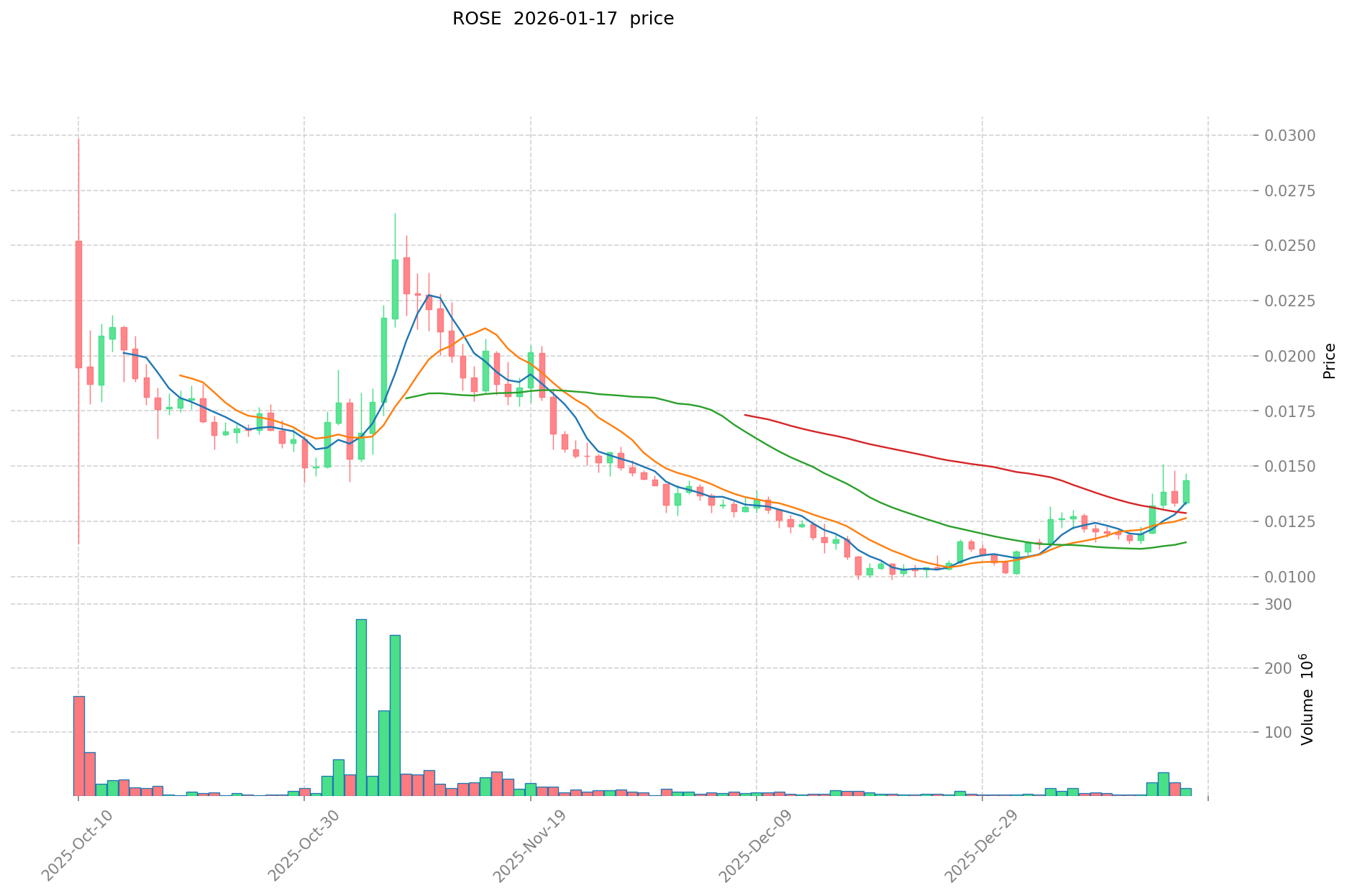
I. Oasis Network (ROSE) Price History and Current Investment Value
- 2022: ROSE experienced significant market volatility alongside broader crypto market trends → investors witnessed substantial drawdowns from earlier valuations.
- 2023: The token underwent a period of accumulation and ecosystem development → ROSE price fluctuated within a relatively narrow trading range as the project advanced its privacy-focused blockchain infrastructure.
- 2025: Market conditions presented considerable challenges for ROSE → from earlier elevated levels, the token declined to approximately $0.0141, reflecting broader headwinds in the privacy blockchain sector.
Current ROSE Investment Market Status (January 2026)
- ROSE current price: $0.01407
- Market sentiment (Fear & Greed Index): 16 (Extreme Fear)
- 24-hour trading volume: $170,172.31
- Token holders: 309,801 addresses
Click to view real-time ROSE market price
II. Core Factors Influencing Whether ROSE is a Good Investment (Is Oasis Network(ROSE) a Good Investment)
Supply Mechanism and Scarcity (ROSE investment scarcity)
- Maximum Supply Cap → Influences Price and Investment Value
Oasis Network has established a maximum supply of 10,000,000,000 ROSE tokens, with approximately 7,509,172,704 tokens currently in circulation, representing 75.09% of the total supply. This defined supply cap introduces a degree of scarcity into the token economics.
- Historical Patterns: Supply dynamics have historically influenced ROSE price movements
According to available data, ROSE reached a notable price level of $0.597347 on January 15, 2022, while experiencing lower price levels around $0.00988065 on December 19, 2025. These price fluctuations demonstrate the token's historical volatility in relation to market dynamics and supply-demand interactions.
- Investment Significance: Scarcity characteristics provide fundamental support for long-term investment consideration
With 75.09% of the maximum supply already in circulation, the remaining 24.91% represents the potential future supply expansion. This supply structure may influence long-term investment considerations as the circulating supply approaches the maximum cap.
Institutional Investment and Mainstream Adoption (Institutional investment in ROSE)
- Partnerships and Ecosystem Development
Oasis Network has been expanding its partnerships and upgrading its technology infrastructure. The network's focus on privacy-preserving technology positions it as a potential choice for projects requiring data confidentiality, which may influence adoption patterns within the DeFi and data-sharing sectors.
- Technology Applications and Use Cases
The platform's software and hardware integration technology aims to enable computing-intensive applications, including artificial intelligence implementations on blockchain infrastructure. This technological positioning may attract development activity and ecosystem growth.
Macroeconomic Environment Impact on ROSE Investment
- Market Sentiment and Broader Crypto Trends
As of January 17, 2026, ROSE is priced at $0.01407, showing a 2.4% increase over 24 hours, 19.12% gain over 7 days, and 30.61% increase over 30 days. However, the token has experienced an 82.45% decline over the one-year period, reflecting sensitivity to broader market conditions and investor sentiment shifts.
- Trading Volume and Market Activity
The 24-hour trading volume stands at $170,172.31, with a market capitalization of approximately $105,654,059.95. ROSE maintains a market dominance of 0.0041%, indicating its position as a mid-tier cryptocurrency project within the broader digital asset ecosystem.
- Price Volatility Considerations
Recent 24-hour price ranges show fluctuations between $0.0136 and $0.01469, demonstrating ongoing price volatility that investors should consider when evaluating risk tolerance and investment horizons.
Technology and Ecosystem Development (Technology & Ecosystem for ROSE investment)
- Privacy-Focused Architecture: Enhances Network Utility → Potential Investment Appeal
Oasis Network's decentralized blockchain infrastructure emphasizes privacy protection while maintaining security and performance. The platform positions itself as a "cloud computing platform" built on blockchain technology, with privacy-preserving features that may differentiate it within the competitive landscape.
- Scalability Enhancements: Expands Ecosystem Applications → Long-term Value Support
Ongoing development efforts include potential upgrades such as increased transaction speeds, enhanced privacy features, and additional ParaTime layers. These technological improvements aim to enhance scalability and attractiveness for developers building on the platform.
- DeFi and Data-Sharing Applications Driving Investment Considerations
The network's focus on DeFi and data-sharing applications represents key use cases that may influence long-term adoption. With 309,801 holders as of the current date, the platform maintains an active user base. The availability of ROSE on 20 exchanges provides accessibility for potential investors, though market depth and liquidity conditions should be evaluated individually.
III. ROSE Future Investment Forecast and Price Outlook (Is Oasis Network (ROSE) Worth Investing in 2026-2031)
Short-Term Investment Outlook (2026, Short-Term ROSE Investment Outlook)
- Conservative Forecast: $0.0087482 - $0.01411
- Neutral Forecast: $0.01411 - $0.0159443
- Optimistic Forecast: $0.0159443 - $0.0177786
Mid-Term Investment Outlook (2027-2029, Mid-Term Oasis Network (ROSE) Investment Forecast)
- Market Stage Expectation: ROSE may experience gradual growth with moderate fluctuations. The platform's adoption of privacy-preserving technologies and partnerships could drive incremental price appreciation.
- Investment Return Forecast:
- 2027: $0.008609922 - $0.018654831
- 2028: $0.012628682815 - $0.023354413425
- 2029: $0.013212543150625 - $0.027644705669
- Key Catalysts: Expansion of decentralized application (dApp) ecosystem, strategic partnerships, advancements in privacy-preserving computation technology, and broader blockchain adoption trends.
Long-Term Investment Outlook (Is ROSE a Good Long-Term Investment?)
- Base Scenario: $0.017509668722997 - $0.036770304318294 (assuming steady ecosystem development and sustained user growth)
- Optimistic Scenario: $0.025185139944037 - $0.036770304318294 (assuming significant adoption milestones, favorable regulatory developments, and enhanced market sentiment)
- Risk Scenario: Below $0.013212543150625 (in the event of prolonged market downturns, competitive pressures, or technological challenges)
Click to view ROSE long-term investment and price prediction: Price Prediction
2026-01-17 to 2031 Long-Term Outlook
- Base Scenario: $0.017509668722997 - $0.025185139944037 (steady progress with gradual mainstream application adoption)
- Optimistic Scenario: $0.025185139944037 - $0.036770304318294 (large-scale adoption and favorable market conditions)
- Transformative Scenario: Above $0.036770304318294 (breakthrough ecosystem developments and mainstream integration)
- 2031-12-31 Forecast High: $0.036770304318294 (based on optimistic development assumptions)
Disclaimer: This forecast is for informational purposes only and should not be considered investment advice. Cryptocurrency markets are highly volatile and subject to various risks. Users should conduct independent research and consult with financial professionals before making investment decisions.
| Year |
Predicted High Price |
Predicted Average Price |
Predicted Low Price |
Price Change |
| 2026 |
0.0177786 |
0.01411 |
0.0087482 |
0 |
| 2027 |
0.018654831 |
0.0159443 |
0.008609922 |
13 |
| 2028 |
0.023354413425 |
0.0172995655 |
0.012628682815 |
22 |
| 2029 |
0.027644705669 |
0.0203269894625 |
0.013212543150625 |
44 |
| 2030 |
0.026384432322325 |
0.02398584756575 |
0.017509668722997 |
70 |
| 2031 |
0.036770304318294 |
0.025185139944037 |
0.019140706357468 |
78 |
IV. ROSE Investment Strategy and Risk Management (How to invest in Oasis Network)
Investment Methodology (ROSE investment strategy)
Long-term Holding (HODL ROSE)
Long-term holding represents a suitable approach for conservative investors who believe in the fundamental value proposition of Oasis Network's privacy-focused blockchain infrastructure. This strategy involves acquiring ROSE tokens and maintaining positions through market cycles, focusing on the protocol's technological development and ecosystem expansion rather than short-term price movements. Investors adopting this methodology typically assess factors such as network adoption rates, partnership developments, and technological milestones as indicators of long-term value creation.
Active Trading
Active trading strategies for ROSE rely heavily on technical analysis and swing trading techniques. Given the token's demonstrated volatility—with 24-hour price fluctuations and a 19.12% seven-day movement—traders may identify opportunities through momentum indicators, support and resistance levels, and volume analysis. The token's trading availability across 20 exchanges provides sufficient liquidity for implementing various trading strategies, though participants should account for transaction costs and market depth when executing positions.
Risk Management (Risk management for ROSE investment)
Asset Allocation Ratios
Conservative Investors: May consider allocating 1-3% of their cryptocurrency portfolio to ROSE, maintaining majority positions in established digital assets while gaining exposure to privacy-focused blockchain infrastructure.
Moderate Investors: Could allocate 5-10% of their cryptocurrency holdings to ROSE, balancing growth potential against the inherent volatility of Layer 1 protocols in development stages.
Aggressive Investors: Might dedicate 15-25% of their crypto portfolio to ROSE, accepting higher risk exposure in exchange for potential returns tied to the protocol's technological advancement and ecosystem growth.
Risk Hedging Solutions
Implementing a diversified portfolio approach helps mitigate concentration risk. Investors may consider combining ROSE holdings with:
- Established Layer 1 protocols to balance innovation risk
- Privacy-focused assets across different technical implementations
- Stablecoin positions to manage volatility exposure
- Traditional hedging instruments where available in regulated markets
Secure Storage Solutions
Cold Wallet Storage: For long-term holdings, hardware wallets provide enhanced security by keeping private keys offline. Leading hardware wallet providers support ROSE token storage, offering protection against online threats.
Hot Wallet Management: For active trading positions, reputable exchange wallets or non-custodial mobile wallets enable quick access while implementing security features like two-factor authentication and withdrawal whitelisting.
Best Practices: Distribute holdings across multiple storage solutions based on intended use cases—cold storage for long-term positions, hot wallets for trading allocations—and maintain secure backup procedures for recovery phrases.
V. ROSE Investment Risks and Challenges (Risks of investing in Oasis Network)
Market Risk
ROSE exhibits substantial price volatility characteristic of cryptocurrency markets. The token has experienced significant price movements, with a one-year decline of 82.45% from previous levels. The 24-hour trading range between $0.0136 and $0.01469 demonstrates ongoing price fluctuations that can impact portfolio values. Market manipulation risks exist across cryptocurrency markets, particularly for assets with varying liquidity conditions across different trading platforms.
Regulatory Risk
Blockchain networks operating across multiple jurisdictions face evolving regulatory frameworks. Different countries maintain varying approaches to cryptocurrency regulation, creating uncertainty regarding:
- Classification of utility tokens and their legal status
- Compliance requirements for decentralized networks
- Cross-border transaction regulations
- Tax treatment variations across jurisdictions
Changes in regulatory positions by major economies could impact network adoption, token utility, and market accessibility for ROSE holders.
Technical Risk
As a blockchain infrastructure project, Oasis Network faces technical implementation challenges including:
Network Security: Blockchain networks require continuous security monitoring and updates to address potential vulnerabilities. Any security breaches or exploit discoveries could impact network confidence and token valuation.
Upgrade Implementation: Protocol upgrades and network improvements carry execution risks. Failed upgrades or contentious hard forks could fragment the network or disrupt operations.
Competition: The blockchain infrastructure space features numerous competing protocols, each advancing different technological approaches. Technical superiority alone does not guarantee market adoption or sustained value capture.
VI. Conclusion: Is Oasis Network a Good Investment?
Investment Value Summary
OASE presents characteristics of an infrastructure protocol with specific technological focus areas. The token has demonstrated significant price volatility, with notable movements across different timeframes—a 30.61% gain over 30 days contrasted against an 82.45% decline over one year. These fluctuations reflect both the opportunities and risks inherent in cryptocurrency investments.
The protocol's focus on privacy-preserving computation and scalable blockchain infrastructure addresses specific technical challenges in the distributed computing space. However, investment outcomes depend on multiple factors including technological adoption, competitive positioning, regulatory developments, and broader market conditions.
Investor Recommendations
✅ Novice Investors: Consider systematic investment approaches (dollar-cost averaging) to manage volatility exposure, combined with secure storage solutions. Prioritize education about blockchain technology and risk management before allocating capital.
✅ Experienced Investors: May implement position sizing based on technical analysis and fundamental assessment, integrating ROSE within diversified cryptocurrency portfolios. Monitor development milestones, network metrics, and competitive landscape developments.
✅ Institutional Investors: Evaluate strategic allocation potential within broader digital asset portfolios, considering factors such as technological differentiation, ecosystem development, and correlation characteristics with other holdings.
⚠️ Important Notice: Cryptocurrency investments carry substantial risk, including potential loss of principal. Market volatility, regulatory uncertainty, and technical challenges present ongoing considerations. This analysis provides informational content only and does not constitute investment advice. Individuals should conduct independent research and consult qualified financial advisors before making investment decisions.
VII. FAQ
Q1: Is Oasis Network (ROSE) a good investment for beginners in 2026?
ROSE may be suitable for beginners who understand cryptocurrency risks and implement proper risk management strategies. As of January 2026, ROSE trades at $0.01407 with a market capitalization of approximately $105.65 million, positioning it as a mid-tier cryptocurrency project. For novice investors, a conservative allocation of 1-3% of cryptocurrency portfolio is recommended, combined with dollar-cost averaging to manage the token's demonstrated volatility. The token has shown substantial price fluctuations—gaining 30.61% over 30 days while declining 82.45% over one year—highlighting the importance of secure storage solutions and thorough education about blockchain technology before capital allocation.
Q2: What are the main risks of investing in ROSE?
The primary risks include significant market volatility, regulatory uncertainty, and technical implementation challenges. ROSE has exhibited substantial price movements with a 24-hour trading range between $0.0136 and $0.01469, demonstrating ongoing volatility that can impact portfolio values. Regulatory frameworks for blockchain networks vary across jurisdictions, creating uncertainty regarding token classification, compliance requirements, and cross-border transaction regulations. Technical risks encompass network security vulnerabilities, protocol upgrade execution challenges, and intense competition from numerous blockchain infrastructure protocols advancing different technological approaches.
Q3: How does ROSE's supply mechanism affect its investment value?
ROSE maintains a maximum supply cap of 10 billion tokens with approximately 7.51 billion tokens currently in circulation, representing 75.09% of total supply. This defined supply cap introduces scarcity characteristics that provide fundamental support for long-term investment consideration. With only 24.91% of maximum supply remaining for future circulation, the supply structure creates potential supply-demand dynamics as the circulating supply approaches the maximum cap. Historical price data shows ROSE reached $0.597347 on January 15, 2022, demonstrating how supply dynamics have influenced price movements alongside broader market conditions.
Q4: What is the long-term price prediction for ROSE through 2031?
Long-term forecasts suggest ROSE could range between $0.017509668722997 and $0.036770304318294 by 2031 under base and optimistic scenarios. The base scenario assumes steady ecosystem development and sustained user growth, while the optimistic scenario incorporates significant adoption milestones, favorable regulatory developments, and enhanced market sentiment. Mid-term projections indicate potential prices of $0.013212543150625 to $0.027644705669 by 2029, driven by expansion of decentralized application ecosystem, strategic partnerships, and advancements in privacy-preserving computation technology. However, a risk scenario exists where prices could fall below $0.013212543150625 due to prolonged market downturns, competitive pressures, or technological challenges.
Q5: How should investors implement risk management when investing in ROSE?
Effective risk management requires appropriate asset allocation based on investor profile and diversified storage solutions. Conservative investors should limit ROSE allocation to 1-3% of cryptocurrency portfolio, moderate investors 5-10%, and aggressive investors 15-25%, balancing growth potential against inherent volatility. Implement portfolio diversification by combining ROSE with established Layer 1 protocols, privacy-focused assets across different implementations, and stablecoin positions to manage volatility exposure. For security, utilize cold wallet storage (hardware wallets) for long-term holdings and hot wallets with two-factor authentication for active trading positions, distributing holdings across multiple storage solutions based on intended use cases.
Q6: What factors could drive ROSE price appreciation in the future?
Key catalysts for potential price appreciation include expansion of the decentralized application ecosystem, strategic partnerships, technological advancements, and broader blockchain adoption. Oasis Network's focus on privacy-preserving computation positions it for potential adoption in DeFi and data-sharing applications requiring data confidentiality. The platform's ongoing development efforts include potential upgrades such as increased transaction speeds, enhanced privacy features, and additional ParaTime layers that may enhance scalability and developer attractiveness. With 309,801 current holders and availability on 20 exchanges, increased mainstream adoption and favorable regulatory developments could support long-term value creation.
Q7: How does ROSE compare to other privacy-focused blockchain investments?
ROSE distinguishes itself through its integration of privacy-preserving technology with scalable blockchain infrastructure for compute-intensive applications, including artificial intelligence implementations. As of January 2026, ROSE maintains a market dominance of 0.0041% within the broader digital asset ecosystem, positioning it as a specialized infrastructure protocol rather than a mainstream Layer 1 platform. The token's recent performance shows a 19.12% gain over 7 days with 24-hour trading volume of $170,172.31, indicating active market participation. However, the blockchain infrastructure space features numerous competing protocols, and technical superiority alone does not guarantee market adoption or sustained value capture, requiring investors to evaluate competitive positioning within their portfolio allocation decisions.
* The information is not intended to be and does not constitute financial advice or any other recommendation of any sort offered or endorsed by Gate.