Oasys (OAS) is an EVM-compatible blockchain platform specialized in gaming applications, launched in 2022 with support from gaming companies. As of January 2026, OAS trades at $0.001406 with a market cap of $8.89 million, though it has experienced significant volatility with a 95.11% annual decline. This comprehensive analysis evaluates OAS's investment potential through multiple dimensions: examining its unique Hub-Layer and Verse-Layer architecture, analyzing price history and market performance, and providing forecasts ranging from $0.001232 to $0.003459 through 2031 under various scenarios. The article addresses core investment considerations including token economics (63.21% circulating supply), institutional adoption metrics, and technological ecosystem development. Key risks include extreme market volatility, regulatory uncertainty surrounding blockchain gaming, technical vulnerabilities, and future token supply pressure. Investment recommendations vary by investor type, from conservative dollar-cost a
Introduction: Oasys (OAS) Investment Position and Market Outlook
OAS is an asset in the cryptocurrency field that has positioned itself within the blockchain gaming sector. Since its launch in 2022, Oasys has developed as a public blockchain specialized in gaming with support from gaming companies. As of January 27, 2026, OAS maintains a market capitalization of approximately $8.89 million, with a circulating supply of around 6.32 billion tokens, and the current price stands at approximately $0.001406. With its positioning as an EVM-compatible protocol featuring a unique multi-layer architecture consisting of Hub-Layer and Verse-Layer, OAS has attracted attention from participants interested in gaming-focused blockchain infrastructure. This article analyzes the investment characteristics, historical performance, future price considerations, and associated risks of OAS to provide reference information for those evaluating this asset.
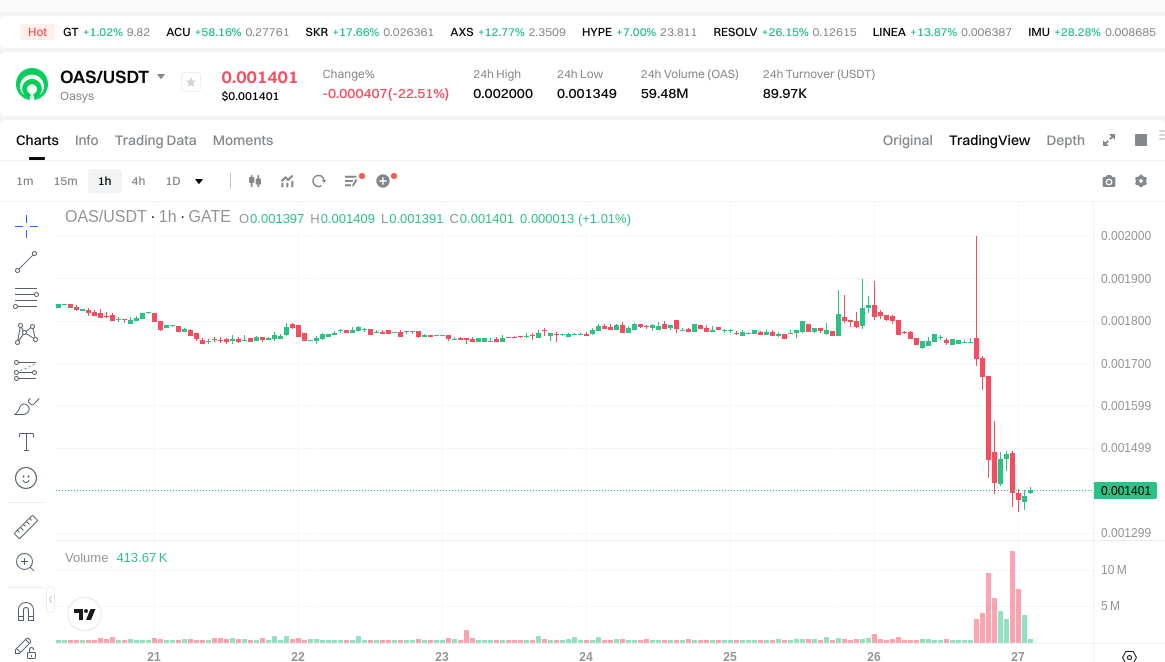
I. Oasys (OAS) Price History Review and Current Investment Value
- 2024: OAS reached a notable price level of $0.141992 on February 13, 2024 → Price subsequently entered a downward trend, reflecting broader market adjustments
- 2025-2026: Market cycle transition → Price declined from $0.141992 to $0.00138385, representing a substantial correction phase
- January 2026: Price stabilized around $0.001406 → 24-hour volatility showed -22.66% decline, indicating continued market pressure
Current OAS Investment Market Status (January 2026)
- OAS current price: $0.001406
- Market sentiment: Data indicates risk-off positioning, with significant price volatility across recent trading sessions
- 24-hour trading volume: $89,865.89
- Market capitalization: $8,887,837.49, representing 0.00045% market share among tracked digital assets
Click to view real-time OAS market price
II. Core Factors Influencing Whether OAS is a Good Investment
Supply Mechanism and Scarcity (OAS Investment Scarcity)
- Maximum Supply: 10,000,000,000 OAS tokens with current circulating supply of approximately 6,321,363,792 tokens (63.21% of total supply)
- Current token distribution indicates a substantial portion remains outside circulation, which may influence future supply dynamics
- The relationship between circulating supply and maximum supply suggests potential future token releases could affect scarcity considerations
- Investment consideration: The token economics structure, with approximately 37% of tokens not yet in circulation, represents a factor that market participants may evaluate when assessing long-term value propositions
Institutional Investment and Mainstream Adoption (Institutional Investment in OAS)
- Oasys was launched with support from gaming companies focused on blockchain gaming applications
- Current exchange listing status: Available on 9 exchanges, though recent developments include delisting from certain platforms due to liquidity considerations
- The Digital Asset eXchange Alliance (DAXA) issued regulatory observations regarding OAS, which represents a development that market participants may consider
- Institutional adoption metrics remain limited in available data, with trading volume of $89,865.89 recorded over a 24-hour period
Technology and Ecosystem Development (Technology & Ecosystem for OAS Investment)
- EVM-compatible protocol utilizing multi-layer architecture: Hub-Layer (first layer with scalability focus) and Verse-Layer (second layer employing Ethereum layer-2 scaling solutions)
- Gaming-focused blockchain infrastructure designed to support blockchain gaming applications
- Native token OAS serves as the primary utility token within the Oasys ecosystem
- Technical architecture aims to address scalability requirements specific to gaming applications, though market response to these technical features has varied
- Ecosystem positioning focuses on gaming sector integration, representing a specialized application area within the broader blockchain landscape
III. OAS Future Investment Forecast and Price Outlook (Is Oasys(OAS) worth investing in 2026-2031)
Short-term Investment Forecast (2026, short-term OAS investment outlook)
Based on available market projections, OAS presents varied short-term scenarios for 2026:
- Conservative forecast: $0.001232 - $0.001401
- Neutral forecast: $0.001401 - $0.001625
- Optimistic forecast: $0.001625 - $0.001872
The short-term outlook reflects multiple analyst perspectives, with TradingBeast projecting potential growth to $0.001872 by year-end, while more cautious estimates from PricePrediction.net suggest prices may remain near $0.001435.
Mid-term Investment Outlook (2027-2028, mid-term Oasys(OAS) investment forecast)
- Market stage expectation: Consolidation phase with moderate volatility, influenced by gaming blockchain adoption trends and ecosystem development progress
- Investment return forecast:
- 2027: $0.001195 - $0.001629 (representing potential 7% year-over-year growth in average price)
- 2028: $0.000844 - $0.001965 (showing increased price range reflecting market uncertainty)
- Key catalysts: Technical infrastructure improvements, partnership announcements with gaming companies, and broader EVM-compatible protocol adoption
Analyst consensus for 2027 shows divergence, with WalletInvestor projecting upward movement to approximately $0.002117, while alternative models suggest more conservative targets around $0.001609. The 2028 forecasts indicate potential price appreciation, though projections range from $0.002012 (TradingBeast) to $0.002379 (WalletInvestor).
Long-term Investment Outlook (Is OAS a good long-term investment?)
- Baseline scenario: $0.001250 - $0.002083 (assuming steady ecosystem development and moderate market conditions)
- Optimistic scenario: $0.002083 - $0.002687 (contingent upon successful gaming blockchain adoption and favorable regulatory environment)
- Risk scenario: $0.001250 - $0.001526 (under adverse market conditions or slower-than-expected ecosystem growth)
View OAS long-term investment and price prediction: Price Prediction
2026-01-27 - 2031 Long-term Outlook
- Base scenario: $0.001526 - $0.002385 (corresponding to steady progress and mainstream application advancement)
- Optimistic scenario: $0.002385 - $0.003459 (corresponding to large-scale adoption and favorable market environment)
- Transformational scenario: Above $0.003459 (if ecosystem achieves breakthrough developments and mainstream popularization)
- 2031-12-31 projected high: $0.003459 (based on optimistic development assumptions)
Disclaimer: These projections represent analytical estimates based on historical data and current market trends. Cryptocurrency markets exhibit substantial volatility, and actual prices may differ significantly from forecasts. Multiple factors influence OAS valuation, including technological developments, regulatory changes, market sentiment, and broader cryptocurrency market conditions. This analysis does not constitute investment advice. Investors should conduct independent research and consider their risk tolerance before making investment decisions.
| Year |
Predicted High Price |
Predicted Average Price |
Predicted Low Price |
Price Change |
| 2026 |
0.00162516 |
0.001401 |
0.00123288 |
0 |
| 2027 |
0.0015584724 |
0.00151308 |
0.0011953332 |
7 |
| 2028 |
0.001965793536 |
0.0015357762 |
0.00084467691 |
9 |
| 2029 |
0.00241608311784 |
0.001750784868 |
0.00159321422988 |
24 |
| 2030 |
0.002687629850866 |
0.00208343399292 |
0.001250060395752 |
48 |
| 2031 |
0.003459021286745 |
0.002385531921893 |
0.001526740430011 |
69 |
IV. OAS Investment Strategy and Risk Management (How to invest in Oasys)
Investment Methodology (OAS investment strategy)
Long-term Holding (HODL OAS)
For conservative investors seeking steady exposure to blockchain gaming infrastructure, a long-term holding strategy may be considered. This approach involves accumulating OAS tokens during periods of lower valuation and maintaining positions through market cycles. Investors following this method typically focus on the fundamental development of the Oasys ecosystem, including partnerships with gaming companies and adoption metrics of the Hub-Layer and Verse-Layer architecture.
Active Trading
Active traders may utilize technical analysis and swing trading strategies when engaging with OAS. Given the token's recent price volatility (24-hour change of -22.66% and 7-day change of -24.46% as of January 27, 2026), short-term trading opportunities may emerge. This approach requires monitoring price levels, volume patterns, and key support/resistance zones. The 24-hour high of $0.002 and low of $0.001349 demonstrate the potential trading ranges available to active participants.
Risk Management (Risk management for OAS investment)
Asset Allocation Ratios
- Conservative Investors: May consider limiting OAS exposure to 1-3% of total crypto portfolio, with the remainder in more established digital assets
- Aggressive Investors: Could allocate 5-10% to OAS while maintaining diversification across multiple blockchain gaming projects
- Professional Investors: May deploy 10-15% in specialized gaming blockchain infrastructure with appropriate hedging strategies
Risk Hedging Solutions
Investors might consider implementing multi-asset portfolio strategies that include:
- Diversification across different blockchain sectors (DeFi, Layer-1, Layer-2, gaming)
- Correlation analysis with major cryptocurrencies to understand portfolio behavior
- Position sizing based on market capitalization and liquidity metrics (OAS currently has a market cap of approximately $8.89 million)
Secure Storage
- Hot Wallets: Suitable for active trading portions, enabling quick access to exchanges
- Cold Wallets: Recommended for long-term holdings to minimize exposure to online threats
- Hardware Wallets: Devices such as Ledger or Trezor provide enhanced security for substantial OAS holdings
V. OAS Investment Risks and Challenges (Risks of investing in Oasys)
Market Risks
High Volatility
OAS has demonstrated significant price fluctuations, with a 1-year decline of -95.11% from previous levels. The token's 24-hour trading volume of approximately $89,865.89 relative to its market capitalization suggests potential liquidity constraints that may amplify price movements during periods of selling or buying pressure.
Price Dynamics
With a circulating supply of approximately 6.32 billion tokens (63.21% of the 10 billion total supply), the substantial portion of tokens yet to enter circulation represents a potential source of selling pressure. The market cap to fully diluted valuation ratio of 63.21% indicates that future token unlocks should be monitored by investors.
Regulatory Risks
Policy Uncertainty
Blockchain gaming projects face evolving regulatory frameworks across different jurisdictions. Changes in cryptocurrency regulations, gaming laws, or blockchain technology policies in major markets could impact the adoption and utility of the Oasys platform. Investors should monitor regulatory developments in regions where Oasys operates or where major gaming company partners are based.
Compliance Considerations
As gaming regulations and blockchain laws continue to develop globally, the Oasys ecosystem may need to adapt its architecture or operational model, potentially affecting token utility and value proposition.
Technical Risks
Network Security
As an EVM-compatible protocol with a multi-layer architecture (Hub-Layer and Verse-Layer), Oasys faces technical challenges inherent to complex blockchain systems. Potential vulnerabilities in smart contracts, cross-layer communication, or Layer-2 scaling solutions could pose risks to the network's security and reliability.
Upgrade Execution
The implementation of protocol upgrades, improvements to the Hub-Layer scalability, or modifications to the Verse-Layer infrastructure carries execution risks. Failed upgrades or technical issues during deployment could temporarily impact network functionality and user confidence.
Ecosystem Dependencies
Oasys relies on partnerships with gaming companies and the adoption of its specialized Layer-2 solutions. Technical challenges in integrating gaming applications or limitations in the platform's performance could affect its competitive position within the blockchain gaming sector.
VI. Conclusion: Is Oasys a Good Investment?
Investment Value Summary
OAS presents exposure to the blockchain gaming infrastructure sector through its specialized multi-layer architecture designed specifically for gaming applications. The token's positioning within a niche but growing market segment offers potential long-term opportunities tied to the adoption of blockchain technology in gaming. However, the significant price decline over the past year (-95.11%) and recent short-term volatility highlight the considerable risks associated with this investment.
Investor Recommendations
✅ Beginners: Consider a dollar-cost averaging approach with small, regular purchases rather than lump-sum investments. Prioritize secure storage using hardware wallets or reputable cold storage solutions. Limit exposure to a small percentage of overall portfolio given the high-risk nature of the asset.
✅ Experienced Investors: May explore swing trading opportunities during periods of heightened volatility while maintaining a core position for longer-term exposure. Consider portfolio diversification across multiple blockchain gaming projects to mitigate single-project risk.
✅ Institutional Investors: Could evaluate OAS as part of a strategic blockchain gaming sector allocation, with appropriate risk management frameworks including position limits, liquidity requirements, and correlation analysis with broader digital asset holdings.
⚠️ Disclaimer: Cryptocurrency investments involve substantial risk and price volatility. This content is provided for informational purposes only and does not constitute investment advice, financial advice, trading advice, or recommendations. Market conditions can change rapidly, and past performance does not indicate future results. Investors should conduct thorough due diligence and consider consulting with qualified financial advisors before making investment decisions.
VII. FAQ
Q1: What is Oasys (OAS) and why is it positioned in the gaming blockchain sector?
Oasys is an EVM-compatible public blockchain specifically designed for gaming applications, featuring a unique multi-layer architecture consisting of a Hub-Layer (for scalability) and Verse-Layer (utilizing Ethereum Layer-2 scaling solutions). The platform was launched in 2022 with support from gaming companies seeking to integrate blockchain technology into gaming experiences. Its specialized infrastructure aims to address the scalability and performance requirements unique to gaming applications, distinguishing it from general-purpose blockchain platforms.
Q2: What is the current price performance and market position of OAS as of January 2026?
As of January 27, 2026, OAS trades at approximately $0.001406 with a market capitalization of $8.89 million and a circulating supply of about 6.32 billion tokens (63.21% of the 10 billion maximum supply). The token has experienced substantial decline with a 1-year drop of -95.11% and recent 24-hour volatility showing -22.66% movement. Trading volume stands at $89,865.89 over 24 hours, and the asset represents approximately 0.00045% market share among tracked digital assets.
Q3: What are the key price projections for OAS from 2026 to 2031?
Price forecasts vary across different timeframes: For 2026, projections range from $0.001232 (conservative) to $0.001872 (optimistic). Mid-term outlook for 2027-2028 shows estimates between $0.001195 and $0.001965, with analyst projections diverging based on ecosystem development assumptions. Long-term forecasts extending to 2031 suggest potential prices reaching $0.003459 under optimistic scenarios involving successful gaming blockchain adoption, though conservative estimates remain between $0.001526 and $0.002385 depending on market conditions and technological progress.
Q4: What are the primary investment risks associated with OAS?
OAS carries multiple risk dimensions: Market risks include extreme volatility (demonstrated by -95.11% annual decline) and limited liquidity with relatively low trading volumes that may amplify price swings. Regulatory uncertainty affects blockchain gaming projects as laws evolve across jurisdictions. Technical risks encompass network security challenges inherent to multi-layer architecture, potential smart contract vulnerabilities, and execution risks during protocol upgrades. Additionally, approximately 37% of tokens remain outside circulation, representing potential future selling pressure that investors should monitor.
Q5: What investment strategies are suitable for different types of OAS investors?
Conservative investors may consider limiting OAS exposure to 1-3% of their crypto portfolio using a long-term holding (HODL) strategy focused on fundamental ecosystem development. Active traders might exploit short-term volatility through swing trading, monitoring technical indicators and the significant price ranges (recent 24-hour range: $0.001349-$0.002). Aggressive investors could allocate 5-10% to OAS while maintaining diversification across blockchain gaming projects. Regardless of strategy, implementing secure storage solutions (hardware wallets for long-term holdings, hot wallets for active trading) and proper risk management through asset allocation and portfolio diversification remains essential.
Q6: How does OAS's token economics affect its investment potential?
OAS has a maximum supply of 10 billion tokens with approximately 6.32 billion currently in circulation (63.21%). The substantial portion of tokens not yet released (approximately 3.68 billion or 37%) represents a critical factor for investment consideration, as future token unlocks could create selling pressure and affect scarcity dynamics. The relationship between circulating supply and maximum supply influences long-term value propositions, and investors should monitor token release schedules and distribution mechanisms when evaluating OAS's investment characteristics.
Q7: What role do institutional partnerships play in OAS's value proposition?
Oasys launched with support from gaming companies focused on blockchain gaming applications, positioning it within a specialized sector. However, current institutional adoption metrics remain limited based on available data, with the token listed on 9 exchanges and recent developments including delistings from certain platforms due to liquidity considerations. The Digital Asset eXchange Alliance (DAXA) has issued regulatory observations regarding OAS, representing developments that market participants evaluate. The extent of institutional investment and mainstream adoption remains a key factor that could influence OAS's future trajectory, though current indicators suggest this remains an emerging area for the project.
Q8: Is OAS suitable for long-term investment based on its technological foundation?
OAS's long-term investment potential depends significantly on the success of its specialized gaming blockchain infrastructure and EVM-compatible multi-layer architecture. The technical design aims to address gaming-specific scalability requirements through its Hub-Layer and Verse-Layer system. However, the platform faces execution risks including technical challenges in gaming application integration, competition from other blockchain gaming solutions, and dependency on partnerships with gaming companies for adoption. While the specialized focus presents differentiation, investors should evaluate whether the technological advantages translate into sustainable ecosystem growth and whether the current market capitalization of $8.89 million reflects appropriate valuation relative to development progress and adoption metrics.
* The information is not intended to be and does not constitute financial advice or any other recommendation of any sort offered or endorsed by Gate.